
Documents

Featured Collections

Oral History
Photograph Collections
Biographies
Documents

Celebrating Black Heritage: Books and Documents

The book title references the phrase “How long? Not long!” associated with Dr. Martin Luther King Jr.’s 1965 speech at the conclusion of the Selma to Montgomery march, signaling a connection to civil rights rhetoric and social justice activism. The subtitle situates the work specifically within Bakersfield, California, indicating a localized account of anti-poverty efforts. The cover imagery includes a stylized geographic form with labeled sections, likely referencing neighborhoods or districts within Bakersfield, along with silhouettes of houses, infrastructure, and figures. These elements suggest themes of urban development, inequality, housing, and grassroots organizing. Given the title and imagery, the book likely addresses poverty, community advocacy, faith-based or civil rights organizing, and structural barriers affecting residents in Kern County. As a historical artifact, the cover reflects local engagement with national civil rights discourse and community-based reform movements.


These newspaper clippings reflect public discussions about racism and equality in Kern County around 1990. The headline “Black leaders echo judge’s call for equality” suggests that a judicial statement addressing racial inequities prompted community response and solidarity among African American leaders. The accompanying article titled “RACISM: ‘Never stops hurting’” appears to focus on personal testimony or community perspectives about the enduring effects of racism. During the late twentieth century, communities across California confronted issues related to policing, housing discrimination, employment disparities, and educational inequality. Public dialogue in local newspapers often served as a forum for civic debate and community organizing. The presence of headshots in the second clipping indicates a human-interest or opinion format, centering lived experiences. Such articles contribute to the historical record of local civil rights advocacy and the ongoing struggle against racial discrimination in regional contexts.

Campbell, Greg. “Black Leaders Echo Judge’s Call for Equality,” Bakersfield Californian, March 29, 1990, B1-B2


April 28, 1952—The Rev. Henry H. Collins, a minister of the CME church, became the first black man elected to a city council in the state of California. He was elected to the Bakersfield City Council. April 28, 1952—Carter Walker Wesley, founder of the National Negro Publishers Assn. (NNPA), was born in Houston, Tex. Wesley became publisher and editor of the weekly Houston Informer and a chain of affiliated newspapers in Austin, Dallas and Beaumont, Tex., New Orleans, La., Mobile, Ala., and San Diego, Calif. A civil rights lawyer, some of his major cases resulted in U.S. Supreme Court decisions. C. W. Wesley Dr. C. W. Wesley is the first Black man elected to a city council in the state of California. He was elected to the Richmond City Council. A professor of history at the University of North Carolina at Chapel Hill, Dr. Wesley served as executive secretary of the NAACP. He authored numerous books and articles and was active in civic and political affairs. Detailed Description / Context: This Jet Magazine clipping documents milestones in African American political leadership and publishing history. The highlighted entry for Dr. C. W. Wesley identifies him as the first Black man elected to a city council in California, specifically the Richmond City Council. Wesley was a historian and educator associated with the University of North Carolina and served as executive secretary of the NAACP, reflecting the interconnected nature of academic scholarship and civil rights activism. The clipping also references Rev. Henry H. Collins as the first Black man elected to the Bakersfield City Council, situating Kern County within the broader narrative of expanding African American political participation during the mid-twentieth century. Jet Magazine, founded in 1951 by John H. Johnson, was a nationally circulated publication that documented African American political achievements, civil rights developments, and community milestones. Articles such as this contributed to public recognition of Black elected officials at a time when representation in municipal government remained limited. The piece situates local and state-level political breakthroughs within a national framework of African American civic advancement during the postwar era.

“Yesterday in American History,” Jet Magazine, April 16, 1970, p11


Detailed Description / Context: This magazine page from The Crisis, the official publication of the NAACP founded in 1910 and long edited by W. E. B. Du Bois in its early decades, highlights the election of Rev. H. H. Collins to the Bakersfield City Council. The caption identifies him as the first African American elected to a city council in California, marking a significant moment in the expansion of Black political representation in the state. Rev. Collins’ dual role as a pastor and elected official reflects the historical importance of Black churches as centers of civic leadership, political mobilization, and community organization. During the 1950s, African American political gains at the municipal level were part of broader civil rights efforts aimed at dismantling segregation, expanding voting access, and challenging discriminatory housing, employment, and public accommodation practices. By featuring Collins in The Crisis, the NAACP documented and circulated news of African American political milestones to a national readership, reinforcing the importance of local achievements within the larger struggle for civil rights and equal representation.

Collins, Mary L. “Bakersfield Makes History,” Crisis Magazine, June-July 1953, page 344
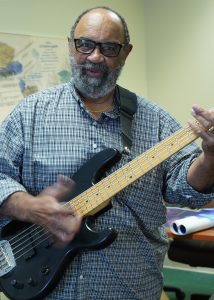


The image shows an African American man standing and holding a black electric bass guitar, with his left hand positioned along the fretboard and his right hand near the strings. He wears glasses and a long-sleeve patterned shirt. The background includes a wall map and office or classroom materials, suggesting an educational or informal institutional setting rather than a stage performance. The relaxed expression and posture suggest the photograph captures a candid or informal moment, possibly during a music lesson, rehearsal, or community event. Electric bass guitars are commonly associated with jazz, blues, gospel, funk, and other genres with deep roots in African American musical traditions. Photographs such as this often document cultural participation, artistic expression, and community engagement in educational or local institutional spaces.


Billy Haynes, interview and primary sources