
Before 1938 – Braceros – Buying on Contract – Covenant Database
California Nativism – Citizenship – Covenants – East Bakersfield – Education – Eminent Domain
Japanese Internment – Moving into a Neighborhood – Neighborhoods – Public Housing
Resources – Rumford Fair Housing Act – Suburban Expansion – Zoning
“The Golden West” and “The GrizzlyBear”:
“Strictly a California Magazine”
California’s Nativism and Anti-Immigration
1870
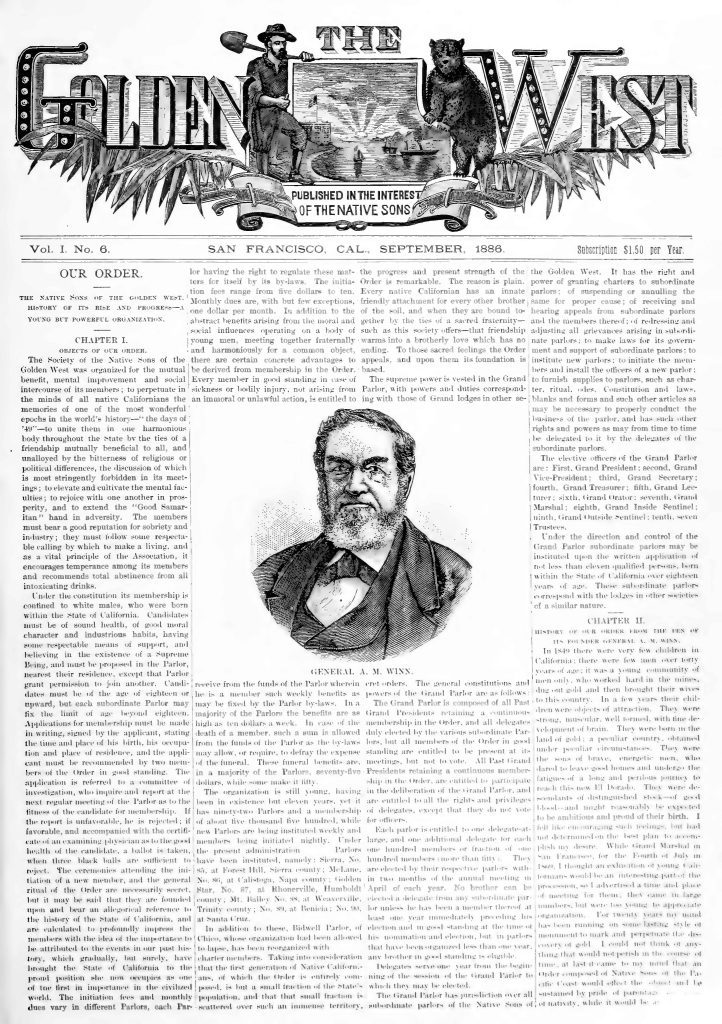
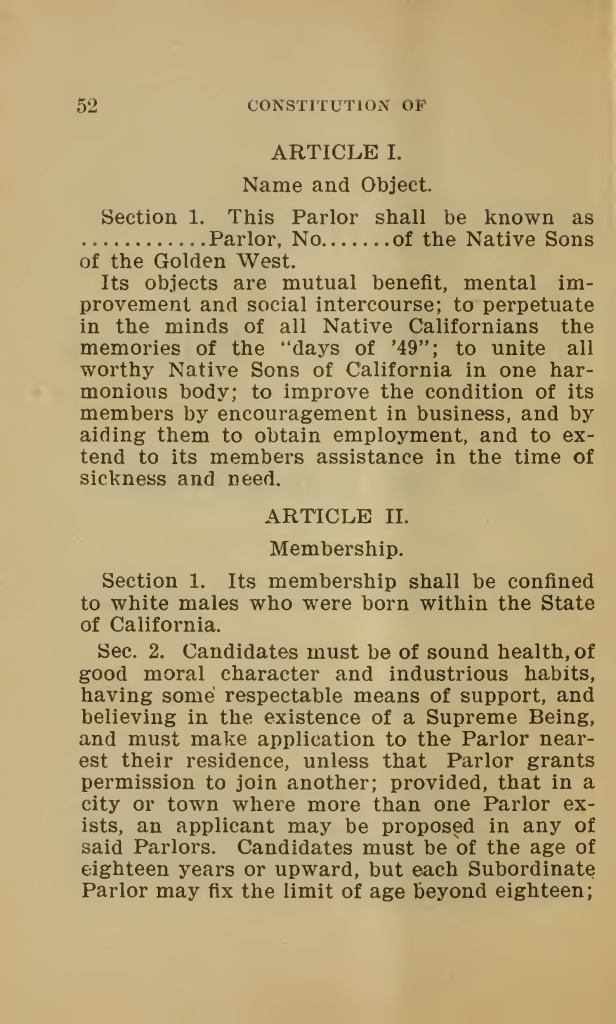
In the waning years after the American Civil War, the Sons of the Golden West was founded in 1873. On October 8, 1884, the Baker Parlor, No 42, established a local chapter located in Bakersfield, Kern County; the charter members included 27 members; in 1886, they had 28 members. The president was EF Jameson, and the secretary was EW Goodrich, and they met on Tuesdays at the International Order of Odd Fellows (IOOF ) Hall. In September 1886, the first iterations of the “Golden West: Published in the Interest of the Native Sons,” an 11th year reflection stated, “to perpetuate in the minds of all native Californians the memories of the one of the most wonderful epochs in the world’s history,” referring to Manifest Destiny, and colonialism in the West, “Under the constitution its membership is confined to white males, who were born within the State of California.” By October 1886, Thomas Baker is listed as a member of the organization.
The post-Civil War era would come to define racial prejudice; the question of color would define social race relations. The Nadir, Jim Crow, Heredity, Anglo-Saxon superiority, and eugenics would influence the decades to come.

1880
The 1880s marked the start toward modern era of federal immigration restrictions. “1882 Congress passed a law excluding convicts, lunatics, idiots, and paupers.” States and counties had their own systems of exclusion. In 1876, the Supreme Court ruled state laws unconstitutional. “The underlying principle of this 1882 legislation was that the government could select individual immigrants…”
Nativist publications had a large role in societal perceptions of immigration policy. Poems like “The Last Crusade,” with quotes sounding the alarm on, “Ye native sons! Know you indeed what heritage is yours? What mighty triumphs wait to crown this empire yet to be.” The call often referenced and called to the racial or European lineage or heritage of ownership that must be preserved. “This state your fathers founded, and its future rests with you.” Soil, labor, history, resolutions, brotherhood, fatherland, idealized portrayals of land and industry, poetry, membership, rules, morality, religion, ceremonial reflections, and race become early themes in the writings. In November 1886, C.A. Canfield’s poetry recanted, “Where the savages were rightfully owned,” with language to claim ownership of the nativist rhetoric.
![THEGOLDEN WEST PUBLISHED IN THE INTEREST OF THE NATIVE SONS Vol. I. No. 8. SAN FRANCISCO, CAL., NOVEMBER, 1886. Subscription, $1.50 Per Year. CALIFORNIA. [WRITTEN FOR THE GOLDEN WEST.] Oh mighty land of the Golden West, Where the sun sinks at eventide, Reflecting around it a golden light Brighter by far that the moon at night— Where the moaning breakers of the Pacific Ocean Kiss thy golden shores in gentle devotion— What wonderful change time has brought Since they bountiful wealth our fathers sought. In vale and forest where the grizzlies Wreathed savage defiance, The unarmed and the captive, where the deer fed Undisturbed, As numerous as sheep in one mighty herd, Where the coyote and the wild-cat lurked, And where the bison once ranged Are deserted by these and inhabited by man, Who has torn down thy forest and destroyed all The charm. No more in the distance the blue smoke is seen Arising on high above the tall trees so green, Betokening the spot where the Indian camp-fire Blazed. No evidence their minds were crazed. But in grove and meadow, of the tribes that dwelt there, It tells their tale in the air. All cities now stand where their villages stood, And cattle now graze where the bear sought its Food. These are the changes that time has brought O’er this land of gold where our fathers fought, Where the sturdy miner with his pick in his hand Dug for the wealth of this glorious land. Watched by highwayman, fearless and bold, Who robbed him of all his hard earned gold, And left him to wander o’er the solitudes alone, Far away from his friends and his home. Then gather, ye sons, from far and from near, And join in praise of each brave pioneer That slumbers at rest in this land of the west Where the sun sinks in splendor and the future Is brightest. When the pines and the red-woods sigh in the Breeze And rowers like sentinels above the oak trees— Long may their deeds be written in song and in Prose, And o’er their green graves twine the wild rose. Santa Cruz, November 6, 1886. C. A. CASFIELD. THE WAR IN TIPTOPTON. There is blood in the air at Tiptopton. Twenty-three practical jokers wear a savage and determined look; a twenty-fourth has resigned his position in a bank and fled into exile in the mountains to escape twenty-three challenges to mortal combat; and a twenty-fifth, whenever he sees one of the twenty-three, wreathes his face in smiles which end in a broad grin. This hostile state of affairs was caused by turning the tables on the practical jokers. Tiptopton is the birthplace of a young bachelor club, the pride of the town, the admiration of the ladies. One article of the constitution of the club expressly states that if any member shall at any time or place so far forget himself as to take a wife, he must gracefully yield to all jokers placed upon him by the other members of the club until such time as he becomes a father. Recently one of the members, Brown by name, “during a fit of temporary insanity,” as the town explained it, was married to the belle of the town. When he returned from his honeymoon trip, Jones the twenty-fourth man, proposed that the club give a committee of the whole holiday pay a visit of condolence to the unhappy wretch, and the proposition was unanimously adopted. It was also proposed and agreed that a speech-maker be appointed to express the regret of the club at its loss; also that the visit should be a surprise, and that they all go in full evening costume in black, which, of course, would have to be paid for by Brown. When the meeting adjourned the members of the club devoted themselves to discussing the various ways in which they would enjoy themselves. One proposed bringing chickens into the house and chasing them around; another said a greased pig would be a good thing to enliven the company. Some one else suggested limburger cheese as a good appetizer. Still another proposed that they all catch fleas, bed-bugs and mosquitoes, starve them for a couple of days, and then let them loose in the bed-chamber. Then snakes and frogs to put in the bed and closets were suggested. Each one thought of some joke to play, and each considered his the best. Jones alone was silent; but he laughed inwardly as he thought of the joke he would play. A few nights after this six hacks drove up in front of the club-rooms, and the twenty-four members, each with a bundle of some sort in his hand, got in and were driven off. In about twenty minutes the carriage stopped in front of a neat-looking cottage, and the young men alighted. Leaving his bundle in the hack, Jones, the only one who knew Brown’s residence, ran lightly up the stone of the house and rang the bell. A middle-aged man in his shirt-sleeves presented himself in answer to the ring. Jones said something to him which was unheard by the others, then turning around, said in a loud voice, “Come in, boys, this is the place.” While the “boys” filed in, circling and laughing, Jones presumably returned to the carriage for his package. The old man, not knowing the meaning of the visit, but probably thinking his fellow-townsmen intended to confer some high political office upon him, hustled around and brought chairs into the parlor for his guests, at the same time trying to compose a fitting speech. When the gentlemen were all seated, he stood in the doorway waiting for some one to begin the conversation, while his wife with arms akimbo, strove to peer over his shoulder. But no one spoke. The shakes wriggled, the frogs tried to get out of their prison, the pig squealed in response to numerous twistings of its tail, and the cheese gave forth its characteristic odor. But still no one spoke. The snakes wriggled some more, the pig squealed again, and still no one spoke. Finally, when the silence had become so thick that you could hardly see through it, one of the boys called for Jones. But there was no answer. Another one said that Jones had returned to the carriage for his bundle and had not come in yet. After a moment’s pause, during which every one failed in trying to appear at ease, the one who had been designated to make the speech asked for Mr. Brown. “Mr. Brown?” said the old man inquisitively. “I don’t know anybody by that name.” A blank look of amazement broke over twenty-three faces. “Doesn’t Mr. Brown live here?” asked several in chorus, a horrible suspicion forcing itself upon them. “Well, no,” said the old man, in a look of disappointment spread across his features, “I live here, but my name is Smith.” As the truth dawned the visitors began to feel like a plunged knife. “Jones, where’s Jones?” inquired one of the next school. “Where’s Jones?” But Mr. Jones appeared. Then they saw the joke. The speech-maker said he was sorry to inform the unfortunate Smith and family that the inhabitants of the club-room had been deeply afflicted at the loss of Brown, and had come to offer their sympathy; and the gentlemen in black coats and evening suits made their bows and got out. Then some one called out, “Jones, oh Jones!” and the cry was taken up by the whole party. But at that time Jones was probably speeding away in Brown’s buggy, a cigar over his shoulder. But no one spoke. The calling in vain for some time, the would-be jokers sullenly got into the hacks and were driven back to the club-rooms. As they were disrobing down to the lower end of their pockets for the required coin, Brown appeared and laughingly hoped that they had enjoyed their visit. This only served to increase their anger, and had he not sought safety in flight, it would have gone hard with him. It seems that the whole affair was published in the daily papers under the heading of “Jones, oh Jones!” And each member of the club, as he read the article, swore to be avenged with interest at two per cent a month, compounded weekly. And this is why the twenty-three jokers wear such a savage look, why Jones has gone into exile, and why Brown laughs. M. A. DORN, GRAND TRUSTEE. The Pioneers’ Successors. The “Native Sons of the Golden West” will hold their annual celebration in San Jose this year. This evening the San Francisco parlor and the order will take the train for the Garden City after a procession through our, or rather through their, principal streets. As a wise and safe test, “The destinies of a Republic are in the hands of its young men under twenty-five years of age,” and the destinies of California are fast passing out of the hands of the pioneers and into the hands of the native sons. There was something pathetic in the notion made at the Pioneer Committee meeting the other evening, that a committee be appointed to devise a new badge, as the Native Sons had appropriated the old days’ symbol. But this is fortunately the way the world goes. The old blood has to give way to the new. San Francisco has made head of such a change, and wants to be placed as an example in passing into the hands of its native sons, it seems which belongs to the Order are a fair sample of the youth. The public will have an opportunity to judge of the material of which the Native Sons of the Golden West is composed, as the parlor marches through the streets this evening. We have seen them before, and we know that there will be as large and as enthusiastic a crowd. Useful Information. A brilliant black varnish for iron stoves and fireplaces is made by stirring ivory black into ordinary shellac varnish. It should be applied when the article is perfectly clean. Hot alum in the hot water destroys snow. Put it in hot water and let it melt and throw it in trenches. An adjustable table screen to regulate drafts for rooms in houses that are warm. [End of visible page.] Detailed Description / Context: This issue of The Golden West was published in November 1886 in San Francisco during a period of rapid urban growth, railroad expansion, and consolidation of Anglo-American political and cultural dominance in California. The Native Sons of the Golden West, founded in 1875, was a fraternal organization restricted to white men born in California, and it played a significant role in shaping civic identity, commemorative practices, and exclusionary politics. The poem “California” reflects late nineteenth-century settler colonial ideology, depicting Indigenous displacement as a completed and naturalized process while celebrating pioneer conquest and development. Such representations coincided with broader patterns of Native dispossession, anti-Chinese agitation (including the Chinese Exclusion Act of 1882), and efforts to institutionalize racialized belonging within civic organizations. “The Pioneers’ Successors” situates generational transfer of power from Gold Rush pioneers to their California-born sons, reinforcing nativist identity formation and claims to political authority. Publications like this helped consolidate a mythic pioneer narrative that informed urban planning, memorialization, and the politics of land, property, and citizenship in late nineteenth-century California. Thematic Keywords: Native Sons of the Golden West California boosterism Pioneer commemoration Settler colonialism Nineteenth-century fraternal organizations San Francisco civic identity Generational political succession Print culture Racial exclusion in California Gilded Age California](https://hrc.csub.edu/wp-content/uploads/2026/02/Pages-from-gb1886goldenwest18861890nati-2-717x1024.jpg)
In the next years the Sons and Daughters of the Golden West reported, “The Native Sons of the Golden West has become a powerful organization and will continuously grow stronger. It has already made itself felt both politically and socially,” and publish efforts to build up fraternity, “Talk about it. Write about it,” with consistent reflections as California, a part of the United States’ empire. The Native Sons celebrated the admission of California to the Union, “Admission Day” yearly. The publication served as an affirmation to conquest, belonging amongst Euro-Americans, and ownership of the state and resources. In September 1887, the Native Sons published, “Since 1880, to the present time, the history of our Golden State has formed an era of unexamined progress and prosperity, which space will not permit of our considering detail. San Francisco has recovered its old vigor of spirit, tempered with a commendable degree of prudence gleaned from the experiences of the past; the fertile lands of the interior are being rapidly occupied and improved by a reputable class of white immigrants. Chinese immigrants have been restricted.”
In 1888, the journal was transferred to “Golden West Publishing Co.,” a professional-style publishing house, which would cement the voice and interest of historicizing a white California. That same year, February, the Sons’ imagined grandiose social positions in their membership, “A Native Son will be governor of California someday; nor will it be ‘an extraordinary occasion,’ bringing about his elevation to that dignity. Another generation will find all affairs, all business, practically in the hands of the Native Sons of the Golden West; and with that deposit of trust, all the responsibilities of public and private life.” The Sons had imagined a world run by the politics and social imagination of California-born white, male, and heteronormative. Their library collected their materials and helped celebrate the Sons’ and Daughters’ in the ways they wrote about California, cementing an early narrative of a White Male California during the first years of statehood.
In 1889, they had successfully lobbied Governor Waterman to introduce legislation to establish a commemorative day, “The Natives Day,” to confer, “upon our society and populace a legal day than which in the minds of Californians is exceeded by none but the nation’s national day.” The Native Sons focused on historic colonial landmarks, like Sutter’s Fort. “The duty of saving this one of the few noteworthy relics of Pioneer times, is incumbent upon the fraternity from its very character, and the members should not shrink from their obligations.” Public symbols were retained as a marker of conquest and white supremacy. Advertisements often included “white labor only,” articles praised “white” accomplishments, and “first white child born.” Old immigrants were portrayed as hardy pioneers who had helped develop the United States and had become an integral part of the nation, while the new immigrants were viewed as latecomers who had migrated to cash in on American prosperity and had failed to assimilate with the older population.
1900
The literacy test bill was proposed in Congress in 1896 and passed both houses by overwhelming margins. President Cleveland vetoed the bill, however, terming it a “radical departure” from previous policy. The veto was overridden in the House of Representatives, but the support of southern senators sustained it in the upper house. The agitation subsided for a few years with the return of prosperity and the shift in public attention to war and imperialism. The principle of individual selection was reaffirmed in the law of 1903, which added to the excluded list epileptics, beggars, anarchists, and all who believed in the “forceful overthrow of the government.”
In 1898, the Native Daughters of the Golden West, “advised subordinate Parlors to constitute themselves local history and landmark clubs for the purpose of collecting California legends, historical facts, pictures, mementoes, preserving landmarks and other historical data of interests to Californians.” They 1902, historic preservation report included “histories,” that started with “discovered by whites,” and “the first white men to enter.” The Chinese Exclusion Act was made permanent in 1904.
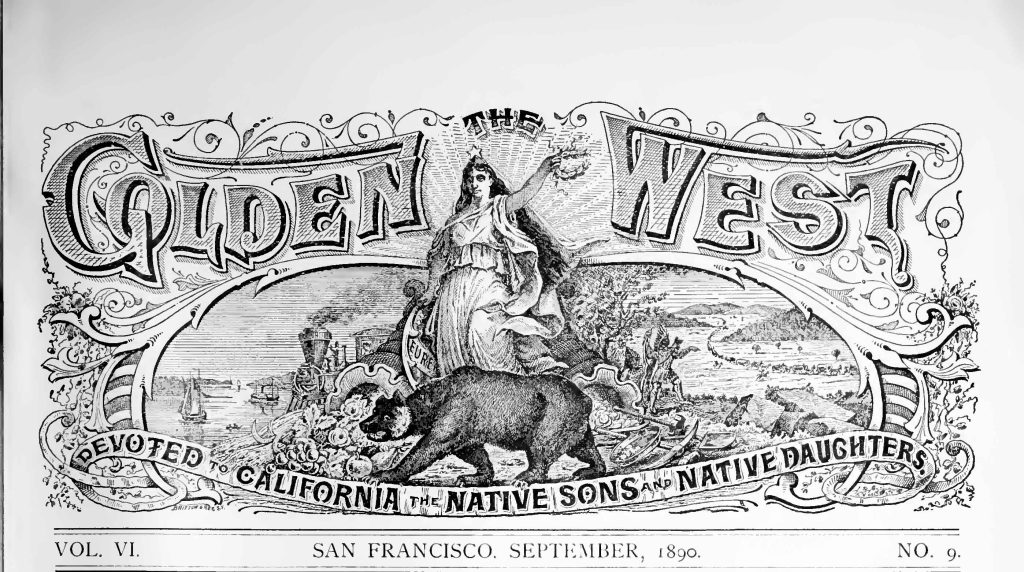
By 1908, the “Golden West: Published in the Interest of the Native Sons” had transformed into “GrizzlyBear: Strictly a California Magazine,” where race was still central to California and preservation of society, “We Native Sons and Daughters of the Golden West are partnered after no other Order. We are original. Therefore, in this too we can be original. We can show the world that away out here on the shores of the Pacific, we can grasp the idea of the Original Mother of the white race from our own pioneer mother.”
1910
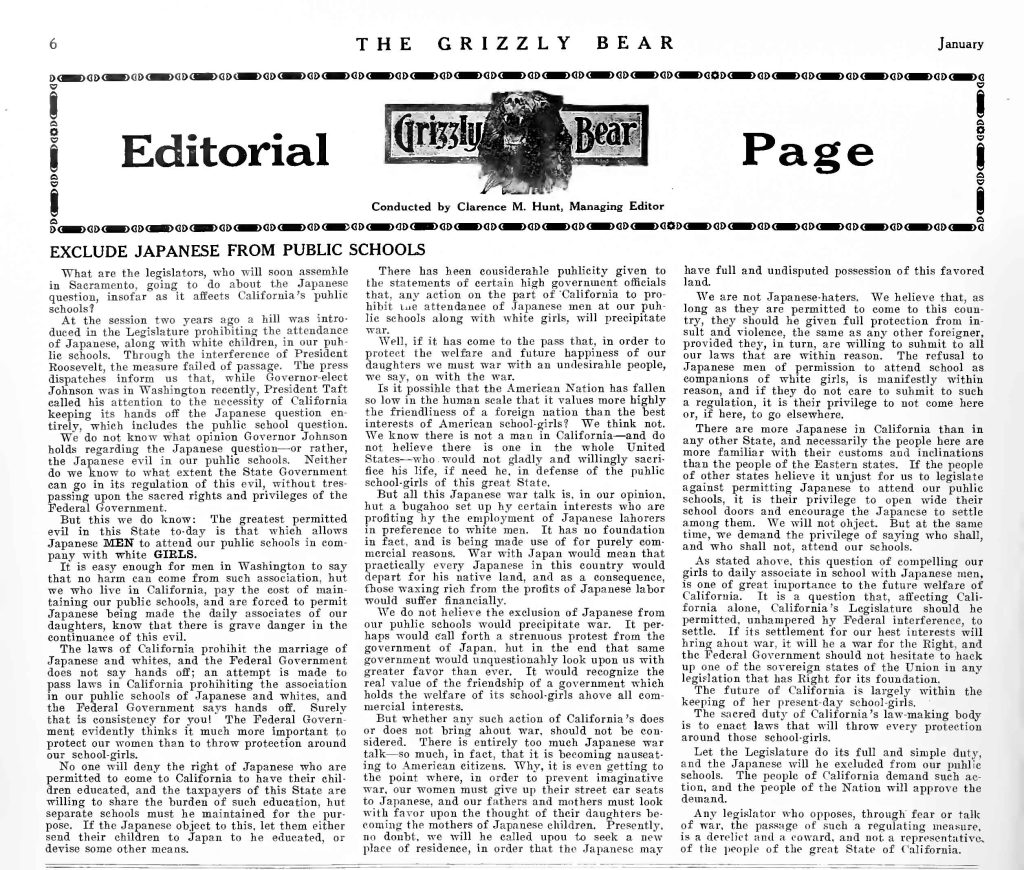
As early as January 1911, the GrizzlyBear encouraged “EXCLUDE JAPANESE FROM PUBLIC SCHOOLS.” The coverage of the failed national legislation to exclude Japanese set the tone that “There are more Japanese in California than in any other state… If the people of other states believe it unjust for us to legislate against permitting Japanese to attend our public schools, it is their privilege… but at the same time, we demand the privilege of saying who shall, and who shall not, attend our schools.” The GoldenBear was for racial segregation. In February 1911, the GrizzlyBear penned an open letter regarding public education, stating, “I knew someone there was standing up for the WHITE RACE.” The article wrote about the survival of the white race, keeping the bonds strong within the white race. In the next pages, articles, “SCHOOL SEGREGATION AND ALIEN LAND BILLS SHOULD PASS,” ran with statements like, “Make Japanese understand that we will not tolerate their being placed upon an equality with the white race,” and “The great State of California cannot afford to longer put off the passage of such laws as will correct these evils. This should be, from the very nature of things, a white man’s paradise.” In May 1912, the GrizzlyBear published “they must keep the rules,” advocating that members keep in line and meet the expectations of the Golden Sons and Daughters. “Are we cowards these days, I wonder, or are we simply dumb from lack of initiative? Don’t we know any better, or is it true that we, the white race, are we slowly taking on the lower standards, of the negro and the Japanese?”
California, Alien Land Law 1913- prohibited undocumented individuals from owning land. Four principles of immigration policy were the primary arguments: economic (best land), social (racial), nationalistic (racial), and foreign relations (International policy).
![Title:ALIEN LAND LAW. Initiative act. Date: Not visible. Creator / Publisher: Not listed. Document Type: Proposed law / ballot initiative text Location: State of California Brief Description: This document contains the text of a proposed California “Alien Land Law” presented as an initiative act for submission to voters at a general election. The measure outlines rights and restrictions concerning acquisition, possession, and transfer of real property by aliens, including those ineligible to citizenship, and prescribes reporting requirements and penalties. The text reflects early twentieth-century California efforts to regulate land ownership by immigrants through statutory and treaty-based limitations. Full Extracted Text: ALIEN LAND LAW. Initiative act. Permits acquisition and transfer of real property by aliens eligible to citizenship, to same extent as citizens except as otherwise provided by law; permits other aliens, and companies, associations and corporations in which they hold majority interest, to acquire and transfer real property only as prescribed by treaty, but prohibiting appointment thereof as guardians of estates of minors consisting wholly or partially of real property or shares in such corporations; provides for escheats in certain cases; requires reports of property holdings to facilitate enforcement of act; prescribes penalties and repeals conflicting acts. YES NO Sufficient qualified electors of the State of California present to the secretary of state this petition and request that a proposed measure, as hereinafter set forth, be submitted to the people of the State of California for their approval or rejection, at the next ensuing general election. The proposed measure is as follows: PROPOSED LAW. (Proposed changes from provisions of present laws are printed in black-faced type.) An act relating to the rights, powers and disabilities of aliens and of certain companies, associations and corporations with respect to property in this state, providing for escheats in certain cases, prescribing the procedure therein, requiring reports of certain property holdings to facilitate the enforcement of this act, prescribing penalties for violation of the provisions hereof, and repealing all acts or parts of acts inconsistent or in conflict herewith. The people of the State of California do enact as follows: Section 1. All aliens eligible to citizenship under the laws of the United States may acquire, possess, enjoy, transmit and inherit real property, or any interest therein, in this state, in the same manner and to the same extent as citizens of the United States, except as otherwise provided by the laws of this state. Sec. 2. All aliens other than those mentioned in section one of this act may acquire, possess, enjoy and transfer real property, or any interest therein, in this state, in the manner and to the extent and for the purposes prescribed by any treaty now existing between the government of the United States and the nation or country of which such alien is a citizen or subject, and not otherwise. Sec. 3. Any company, association or corporation organized under the laws of this or any other state or nation, of which a majority of the members are aliens other than those specified in section one of this act, or in which a majority of the issued capital stock is owned by such aliens, may acquire, possess, enjoy, and convey real property, or any interest therein, in this state, in the manner and to the extent and for the purposes prescribed by any treaty now existing between the government of the United States and the nation or country of which such alien is a citizen or subject, and not otherwise. Hereafter all aliens other than those specified in section one hereof may become members of or acquire shares of stock in any company, association or corporation that is or may be authorized to acquire, possess, enjoy or convey agricultural land, in the manner and to the extent and for the purposes prescribed by any treaty now existing between the government of the United States and the nation or country of which such alien is a citizen or subject, and not otherwise. Sec. 4. Hereafter no alien mentioned in section two hereof and no company, association or corporation mentioned in section three hereof, may be appointed guardian of that portion of the estate of a minor which consists of property which such alien or such company, association or corporation is inhibited from acquiring, possessing, enjoying or transferring by reason of the provisions of this act. The public administrator of the proper county, or any other competent person or corporation, may be appointed guardian of the estate of a minor citizen whose parents are ineligible to appointment under the provisions of this section. On such notice to the guardian as the court may require, the superior court may remove the guardian of such an estate whenever it appears to the satisfaction of the court: (a) That the guardian has failed to file the report required by the provisions of section five hereof; or (b) That the property of the ward has not been or is not being administered with due regard to the primary interests of the ward; or (c) That facts exist which would make the guardian ineligible to appointment in the first instance; or (d) That facts establishing any other legal ground for removal exist. Sec. 5. (a) The term “trustee” as used in this section means any person, company, association or corporation that as guardian, trustee, attorney-in-fact or agent, or in any other capacity has the title, custody or control of property, or some interest therein, belonging to an alien mentioned in section two hereof, or to the minor child of such an alien, if the property is of such a character that such alien is inhibited from acquiring, possessing, enjoying or transferring it. (b) Annually on or before the thirty-first day of January every such trustee must file in the office of the secretary of state of California and in the office of the county clerk of each county in which any of the property is situated, a verified written report showing: (1) The property, real or personal, held by him for or on behalf of such an alien or minor; (2) A statement showing the date when each item of such property came into his possession or control; (3) An itemized account of all expenditures, investments, rents, issues and profits in respect to the administration and control of such property with particular reference to holdings of corporate stock and leases, cropping contracts and other agreements in respect to land and the handling or sale of products therefrom. (c) Any person, company, association or corporation that violates any provision of this section is guilty of a misdemeanor and shall be punished by a fine not exceeding one thousand dollars or by imprisonment in the county jail not exceeding one year, or by both such fine and imprisonment. (d) The provisions of this section are cumulative and are not intended to change the jurisdiction or the rules of practice of courts of justice. Sec. 6. Whenever it appears to the court in any probate proceeding that by reason of the provisions of this act any heir or devisee cannot take real property in this state or membership or shares of stock in a company, association or corporation which, but for said provisions, said heir or devisee would take as such, the court, instead of ordering a distribution of such property to such heir or devisee, [End] Detailed Description / Context: This proposed initiative reflects California’s early twentieth-century Alien Land Law framework, which targeted “aliens ineligible to citizenship,” a category that effectively applied to Asian immigrants under federal naturalization law. At the time, U.S. citizenship eligibility was limited primarily to “free white persons” and persons of African nativity or descent, rendering most Japanese immigrants legally ineligible for naturalization. By tying land ownership rights to citizenship eligibility and to treaty provisions, the act restricted the ability of Japanese and other Asian immigrants to acquire agricultural land, control property through corporate structures, or serve as guardians of estates involving real property. The inclusion of reporting requirements, escheat provisions, and criminal penalties demonstrates the administrative mechanisms designed to enforce racialized property restrictions. These measures emerged amid broader anti-Asian agitation in California, labor competition debates, and diplomatic tensions with Japan. The Alien Land Laws of 1913 and 1920 were central to California’s system of racialized property regulation, influencing patterns of land tenure, agricultural development, and community formation among immigrant populations. The initiative format also illustrates the use of direct democracy mechanisms to enact exclusionary land policies.](https://hrc.csub.edu/wp-content/uploads/2026/02/ALIEN-LAND-LAW_Page_2-663x1024.jpg)
https://repository.uclawsf.edu/ca_ballot_props/130
1920
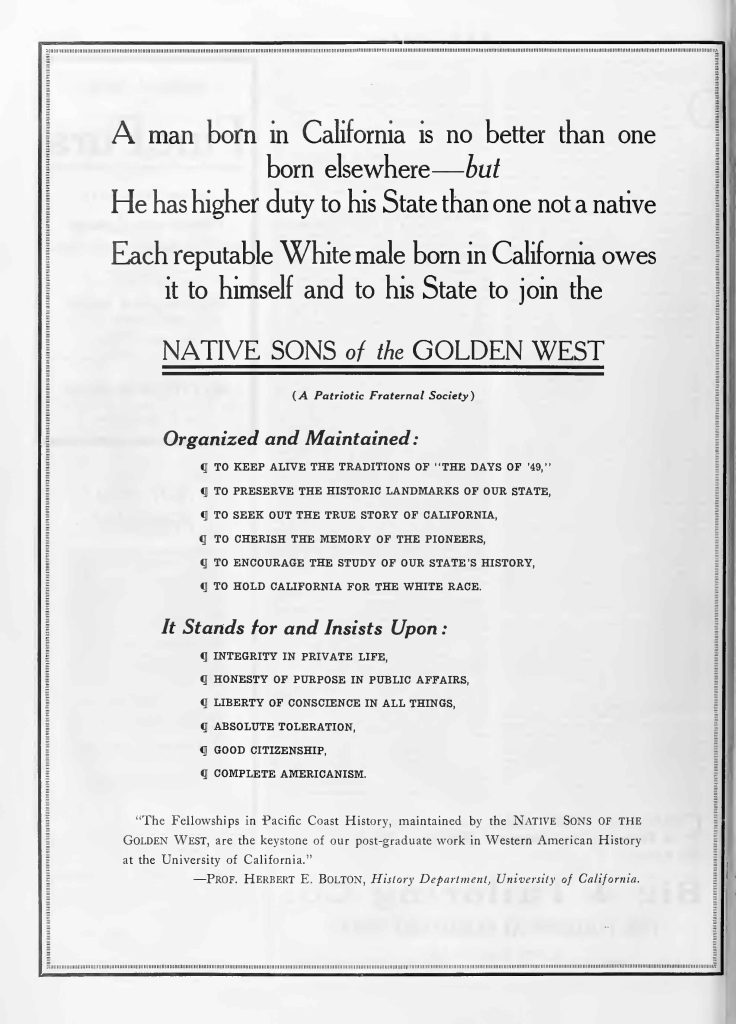
By the 1910s, the State of California was modernizing and industrializing, no longer a state of the “Old West.” By the 1920s, the GrizzlyBear ran a full-page advocating for “White males born in California,” and “to hold California for the White Race.” This was around the same time that California was seeing the rise of the Ku Klux Klan. The advertisement also included a quote and name of Herbert E. Bolton, professor of history, University of California, and past president of the American Historical Association. Along with sentimental support of white supremacy, “The fellowships in the Pacific Coast History, maintained by the Native Sons of the Golden West, are the keystone of the post-graduate work in Western American History of at the University of California.” Language focused on crisis and hysteria, mongrolization, racial suicide, and miscegenation. Even the mildest academics reinforced stereotypes and white supremacy.
On May 29, 1921, President Harding signed the first bill in American history explicitly restricting European Immigration. This Law established the quota system, by which immigration was confined to 3 percent of foreign born of each European nationality residing in the United States in 1910. The laws were based on the belief that millions of war-torn Europeans were about to descend on the United States described as a veritable flood which would completely subvert the traditional American way of life. The quota system was enacted into law in 1924. The Quota system was a product of the rise of populism, theories about ethnics, race, human society, eugenics, and the wave of a new nationalism.
The post 1920s United States became “Racial Nationalism.” 70% of quota immigrants came from Nordic and Mediterranean people. Racial purity becomes a focus to preserve nationalism and democracy advertisements often referred to government, race, and state. The House Committee on Immigration voiced this belief as the fundamental justification for restriction.
![Grizzly BearNovember 1920 Stamp Out This Yellow Menace! [Cartoon text:] NIPPON PACIFIC OCEAN EASTERN COAST YOU NOT LIKE, I CAN MOVE BANK HOTEL FISHING FARMING POTATOES NEWSPAPER With a “X” After “YES,” Proposition One, November Ballot THE YEAR $1.00 THE COPY 10c CALIFORNIA INFORMATION FROM EVERY SECTION EXCLUSIVELY ESTABLISHED MAY 1907 Detailed Description / Context: This 1920 cover reflects organized political advocacy surrounding California’s Alien Land Law of 1920, an expansion of the 1913 statute restricting land ownership by “aliens ineligible to citizenship,” a category that primarily affected Japanese immigrants under federal naturalization law. Proposition One on the November 1920 ballot strengthened prohibitions on land leasing and ownership arrangements designed to circumvent earlier restrictions. The imagery portrays Japan (“Nippon”) as an invasive economic force represented by a many-armed figure controlling sectors such as banking, agriculture, fishing, hotels, and newspapers. The slogan “Stamp Out This Yellow Menace!” invokes the racialized “Yellow Peril” trope common in early twentieth-century anti-Asian propaganda. The allegorical female figure labeled “California,” accompanied by a child, suggests the defense of the state and its future against perceived foreign encroachment. Grizzly Bear magazine was associated with nativist and exclusionist activism in California and frequently supported legislation targeting Japanese immigrants. The cover demonstrates how visual satire, racial caricature, and ballot advocacy were mobilized in support of exclusionary land policy.](https://hrc.csub.edu/wp-content/uploads/2026/02/Pages-from-gb1920-776x1024.jpg)
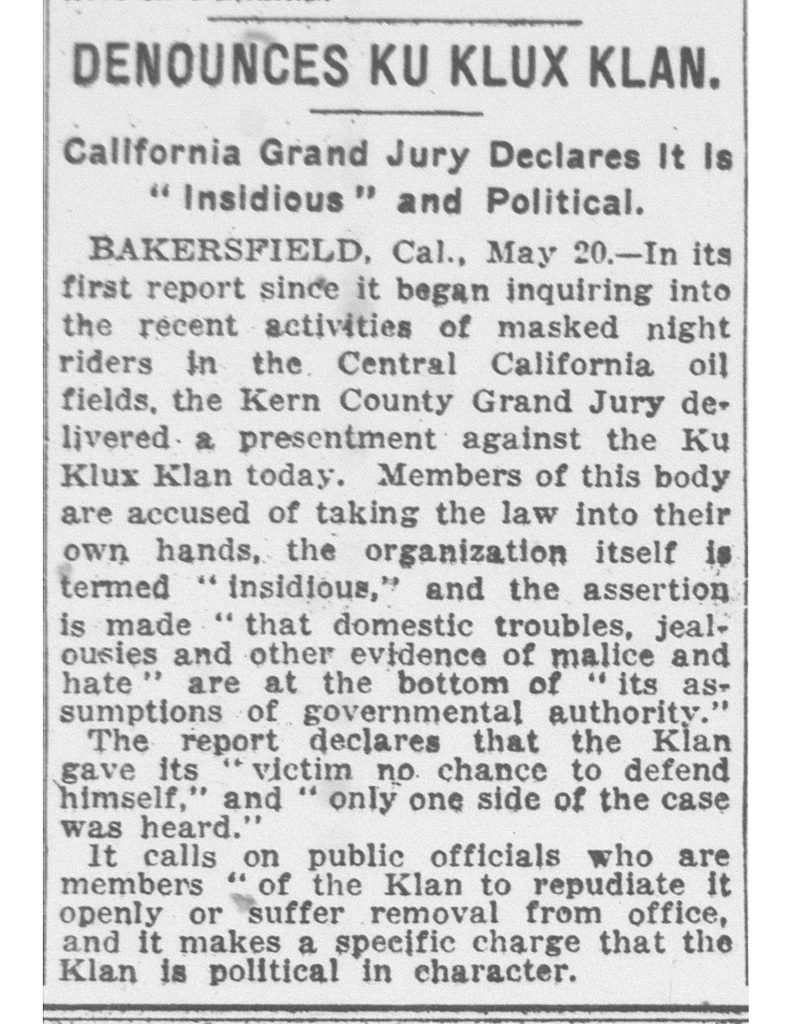
The quota system did not initially include restrictions from Mexico, Canada, and Western Hemisphere countries, something that was debated in the 1924 National Origins act, but was voted down. Legislators rallied to “close the back door,” but farmers, cattlemen, sugar manufacturers, and railroads used the labor to cheapen labor wages.
The State Department sent notice to the Mexican Consulate to restrict immigration visas based on Literacy and contract labor 1929, in 1917 they operated by denying visas to people “likely to become a public charge.” The language was left intentionally vague and left to the discretion of the official.
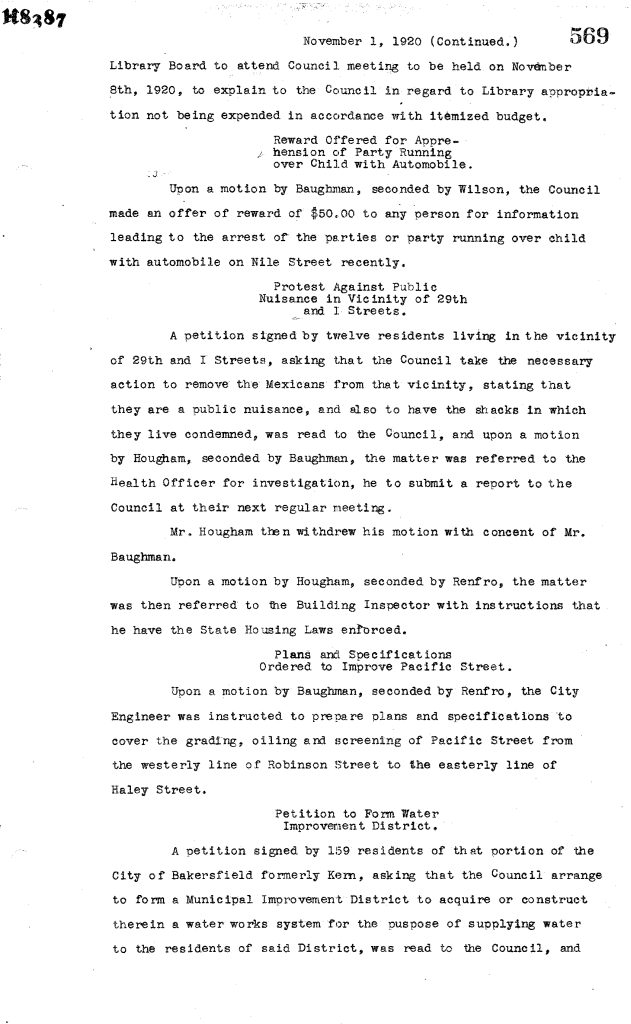
1930
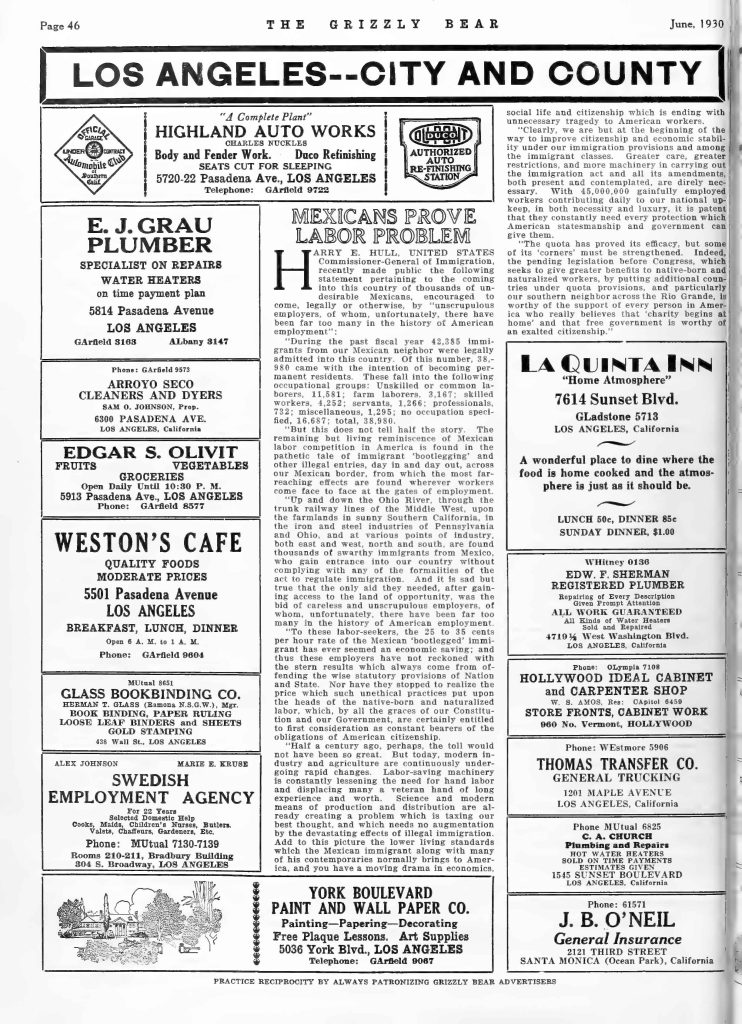
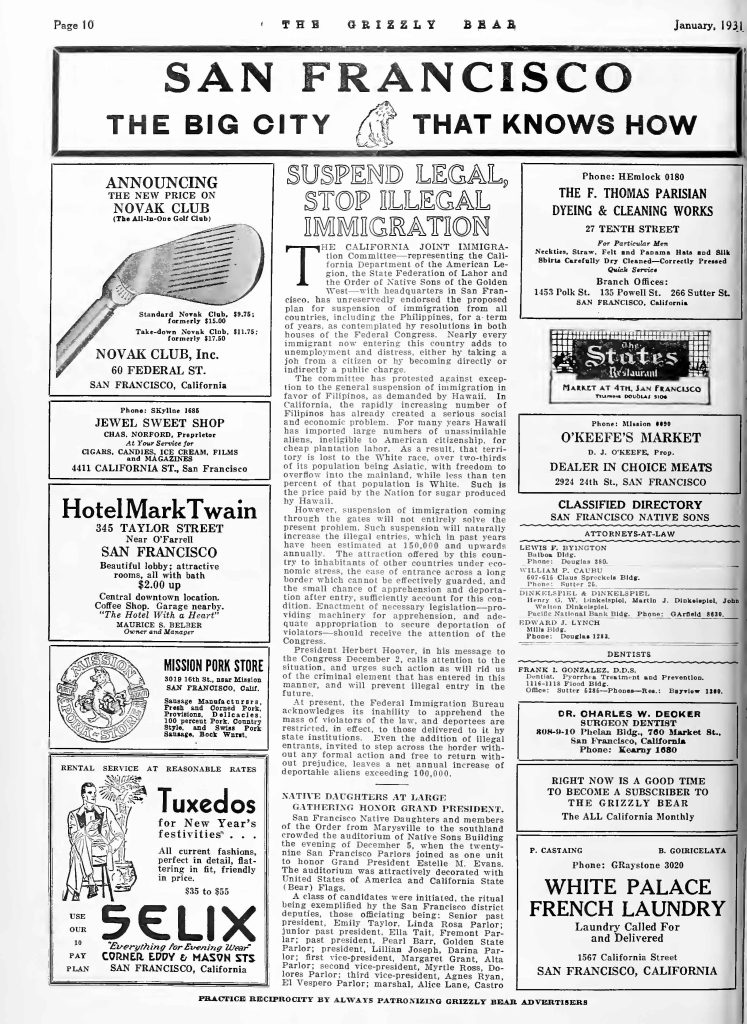
By 1929, the tides of written materials were shifting towards anti-Mexican. The “Grizzly Growls,” a news section emphasizing the position of the GrizzlyBear wrote, “At the request of the California Joint Committee, Attorney-General US Webb of California has just given an opinion to the effect that the Indian or Red Races in Mexico, consisting the bulk of the population in that country are ineligible for American Citizenship. He declares that, under comparatively recent decisions of the United States Supreme Court, the statues do not permit naturalization of any person not of the White Race, or of African Nativity or descent; Mexican Indians, being of the Red race, are clearly ineligible, he holds.” In 1929, articles became more pointed against Mexican Americans, “Mexican Births in California Increase at Menacing Rate.” Previous articles only mentioned Mexico or Mexicans in reference to the Spanish American War, where California and Texas were taken from Mexico, as a settlement history. Articles in 1930 blamed unemployment on “undesirables,” “Mexican Immigration,” “Mexican Prove Labor Problem.”
![Page 4THE GRIZZLY BEAR November, 1929 GRIZZLY GROWLS (CLARENCE M. HUNT.) SPEAKING AT DEARBORN, MICHIGAN, October 21, at the celebration of the fiftieth anniversary of Thomas Alva Edison’s invention of the incandescent lamp, President Herbert Hoover concluded his address with: “Scientific research means more than practical results in increased living comfort. The future of our nation is not merely a question of the development of our industries, of reducing the cost of living, of multiplying our harvests, or of larger leisure. We must constantly strengthen the fiber of national life by the inculcation of that veracity of thought which springs from the search for truth. From its pursuit we shall discover the unfolding of beauty, we shall stimulate the aspiration for knowledge, we shall ever widen human understanding. “Mr. Edison has given a long life to such service. Every American owes a debt to him. It is not alone a debt for great benefactions he has brought to mankind, but also a debt for the honor he has brought to our country. Mr. Edison by his own genius and effort rose from modest beginnings to membership among the leaders of men. His life gives renewed confidence that our institutions hold open the door of opportunity to all those who would enter. “Our civilization is much like a garden. It is to be appraised by the quality of its blooms. In degree as we fertilize its soil with liberty, as we maintain diligence in cultivation and guardianship against destructive forces, do we then produce those blossoms, the fragrance of whose lives stimulate renewed endeavor, give to us the courage to renewed effort and confidence of the future.” The San Bernardino Chamber of Commerce has gone on record as favoring application of the quota to Mexico. Estimating that there are 9,000 Mexis in San Bernardino City and 20,000 in the county, a recent report said: The 1920 United States census gives the Mexican population for San Bernardino County as 7,165. The committee conservatively estimates that this population has increased at least 300 per cent. The American population has not increased to exceed 50 per cent for the county in the same period. A tabulated report from the county hospital shows that for the fiscal year 1928-1929 20 per cent of the total number of cases assigned to the hospital were Mexicans. A report from the welfare department of San Bernardino County for the same fiscal year indicates that 40 percent of the charitable cases handled were Mexicans. A report from the district attorney’s office for the same fiscal year indicates that of the felony cases tried in the Superior Court 35 percent were Mexicans. The situation in San Bernardino is equally deplorable in the other California counties, where these undesirables congregate. At the request of the California Joint Immigration Committee, Attorney-General U.S. Webb of California has given an opinion to the effect that the Indian or Red races in Mexico, constituting the bulk of the population in that country, are ineligible for American citizenship. He declares that, under comparatively recent decisions of the United States Supreme Court, the statutes do not permit naturalization of any person not of the White race, or of African nativity or descent; Mexican Indians, being of the Red race, are clearly ineligible, he holds. That being the case, those Californians who are opposed to inundating California with ineligible-to-citizenship aliens, should demand of the Federal Government that this statute excluding such aliens be applied to Mexico. And it would be an excellent idea, also, in the interest of California’s welfare, to round up all such Mexican who are now here and return them whence they came. Senator Sheppard of Texas has introduced in the United States Congress a bill to amend the National Prohibition Act by making the purchase of intoxicating liquor for beverage purpose unlawful. The proposal would make section 3 of the act read as follows, the word “purchase,” in brackets, being the amendment: “No person shall on or after the date when the Eighteenth Amendment to the Constitution of the United States goes into effect manufacture, [purchase], sell, barter, transport, import, deliver, furnish or possess any intoxicating liquor except as authorized in this act, and all the pro- (Continued on Page 38) ALASKA–COUNTRY OF CONTRASTS A LAND OF MANY CONTRASTS—One passenger railroad; dogsled transportation in many other sections; and fifty-nine airports—such is Alaska, as seen by a visitor who went there with a definite purpose. He had formed many impressions of the country; impressions such as most of us are likely to form about places which we have studied, principally in our school geographies, and in casual reading later. He found on arrival in Alaska that his impressions needed drastic revisions. The man who made the visit, and recorded his vivid impressions later, is J. Arthur Jeffers, manager of the Pacific branch of the American Red Cross, with headquarters in San Francisco, which is headquarters also for the vast Territory of Alaska, where the Red Cross is a valued organization, playing an important part in the life here of Americans and natives alike. “The first thing which impressed me,” Jeffers reported, “was the size of the country. It is one-fifth the area of the United States, or 586,400 square miles, and, counting the Aleutians, it extends eight degrees of longitude into the Eastern Hemisphere, or through 58 degrees of longitude. In a north and south direction its span is approximately 20 degrees north latitude. In traveling from New York toward the end of the Aleutian Islands, one is not halfway there when he has reached San Francisco. The western terminal of the Aleutians is in the same longitude as New Zealand.” He was especially impressed by the wide use of airplanes observed in Alaska, commenting on the fact that there are now fifty-nine airports, and that the miners and trappers regard travel in aircraft as a luxury for which they are willing to pay a dollar per mile. When it is considered that the distance from Fairbanks to Nome is 760 miles and the cost one way is $750, this method of traveling can indeed be classed as a luxury. “I was greatly surprised at the climate,” Jeffers also wrote, “which for the first sixteen days of my trip was either rainy or foggy and cloudy, so that I never saw the sun from the time the boat left the dock at Seattle until I saw it theoretically set in Fairbanks, the night of July 26. The air was chilly, and one could have worn a reasonably heavy overcoat all the time. Yet, when I arrived in Fairbanks, the sun was shining and the thermometer stood at 90 degrees.” Jeffers said he found the people of Alaska loyal to the interests of the American Flag and to the American Red Cross. “The outstanding social work, outside of some mission schools, is done by the American Red Cross,” his report continued. “In sixteen centers we are represented and our chapters, while limited in funds and, [Text continues in column:] to some extent, in personnel because of small population, are exceedingly generous in service, in the contribution of funds and in memberships. As an illustration, in the twelfth roll call last year the City of Ketchikan increased its membership from 178 to 675; Juneau scored a membership of 1,688; Seward, with a population of about 2,000, enrolled 789 members; Cordova, with about 1,200, returned a membership of 322. All the Red Cross chapters at the points named exceeded their quotas. “The American Legion is well organized in all towns of any size, and is especially co-operative with the Red Cross. It was my privilege to address practically every legion group in the towns visited, and I found them anxious to support any work the Red Cross might undertake. I was assured in every community by the legion representatives that in event of disaster or other emergency, the Red Cross could count on the Legion for support.” Jeffers commented on the care with which the White population attends the needs in disaster relief of the native Indian populations, and on the activities of the people in behalf of disaster-stricken regions in Alaska. These services were extended, as in the Continental United States, through the Red Cross. Contrasted with this vast pioneer country is the Pacific Coast or Continental United States, with its populous cities, great industries, and varied interests forever one. Here, too, the Red Cross has a firm place in the hearts of the people. One of the most important branches of the American Red Cross, comprising in itself a world movement of tremendous international significance, is under the leadership of a former California educator, Dr. Harry Bruce Wilson, formerly superintendent of schools of Berkeley, Alameda County, and noted in educational circles on the coast. He is the recently appointed director of the Junior Red Cross, outnumbering in membership even the parent organization and, under his leadership, participating on a major scale in the regular activities of the American Red Cross as well as in international work of its own. The progressive organization of the Red Cross in the Pacific Coast territory varies only with the city in which each local Red Cross Chapter is situated. The Pacific area registered a 10 per cent increase in Red Cross membership at the last roll call, compared with the previous enrollment. The forthcoming membership enrollment for the whole country will be inaugurated November 11 and continue to November 28. NATIVE SONS PROPOSE BUILDING GIGANTIC PIONEER STATUE. San Francisco—As a monument to California Pioneers, Native Sons of the Golden West plan a statue for this city higher and of more monumental proportions than the Liberty Statue, according to Lewis F. Byington, Past Grand President N. S. G. W. Members of a committee working with that idea in view include the following Native Sons: Senator James D. Phelan, Mayor James Rolph, A. P. Giannini, William F. Humphrey, Past Grand President Joseph R. Knowland, Joseph B. Keenan, Past Grand President James A. Wil- [Text continues:] son and Grand Secretary John T. Regan. Later on the committee will be considerably enlarged and a campaign for funds inaugurated. The public park at the summit of Telegraph Hill has been chosen as the site. Present plans include a museum at the base of the statue for the housing of historical data and relics of the early days. The names of Pioneers will appear upon tablets at the base of the monument which, standing on the edge of the Western world, is expected to draw to the gateway of the Pacific the world attention accorded the Statue of Liberty. GIANT DAM, ERECTED AT COST OF MILLIONS, DEDICATED. Oakland (Alameda County)—The Pardee dam, a giant concrete structure on the boundary of Amador and Calaveras Counties, was dedicated October 19. The dam, constructed by the East (San Francisco) Bay Utility District at a cost of $7,000,000, impounds waters of the Mokelumne River for use by 450,000 residents of nine cities comprising the district. Rastus took Mandy to the circus and was explaining all about the animals. “Lawzee, Rastus, what’s at?” asked she, when they came to a zebra. “Don’t you know, gal? You sho’ has neglected yo’ animology. Dat’s nuthin’ but a spot’ model jackass.”—Exchange. The Grizzly Bear Magazine The ALL California Monthly OWNED, CONTROLLED, PUBLISHED BY GRIZZLY BEAR PUBLISHING CO. (Incorporated) COMPOSED OF NATIVE SONS. CLARENCE M. HUNT, General Manager and Editor. OFFICIAL ORGAN AND THE ONLY OFFICIAL PUBLICATION OF THE NATIVE SONS AND THE NATIVE DAUGHTERS GOLDEN WEST. ISSUED FIRST EACH MONTH. FORMS CLOSE 20TH MONTH. ADVERTISING RATES ON APPLICATION. SAN FRANCISCO OFFICE: N.S.G.W. BLDG., 414 MASON ST., RM. 302 (Office Grand Secretary N.S.G.W.) Telephone: Kearny 1223 SAN FRANCISCO, CALIFORNIA PUBLICATION OFFICE: 309-15 WILCOX BLDG., 2D AND SPRING, Telephone: VAndike 6234 LOS ANGELES, CALIFORNIA (Entered as second-class matter May 29, 1918, at the Postoffice at Los Angeles, California, under the act of August 24, 1912.) Published Regularly Since May 1907](https://hrc.csub.edu/wp-content/uploads/2026/02/Pages-from-gb1929-736x1024.jpg)
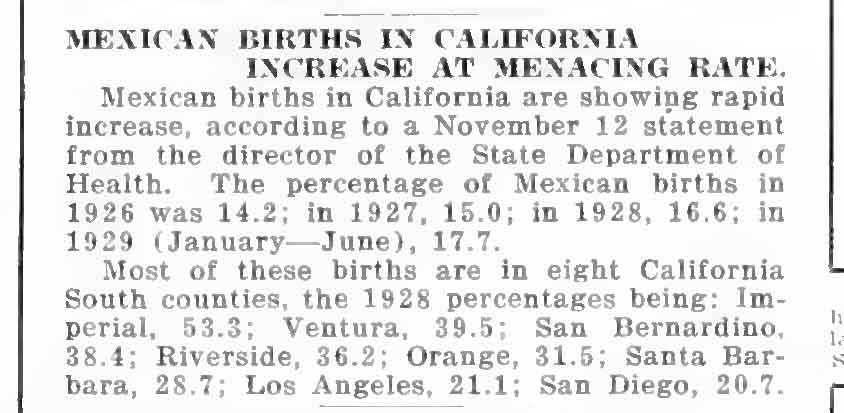
Anti-indigenous attitudes were present in the decade before. In 1925, the House Immigration Committee published a report on Robert Foerster, a Princeton Economist, in which he pointed out that 90 percent of the Latin American population was of Indian blood and concluded they were racially inferior to white stock. The same committee had “biologist” Eugenicist, so-called experts, Harry Laughlin. Racial homogeneity became racial prejudice as public policy.
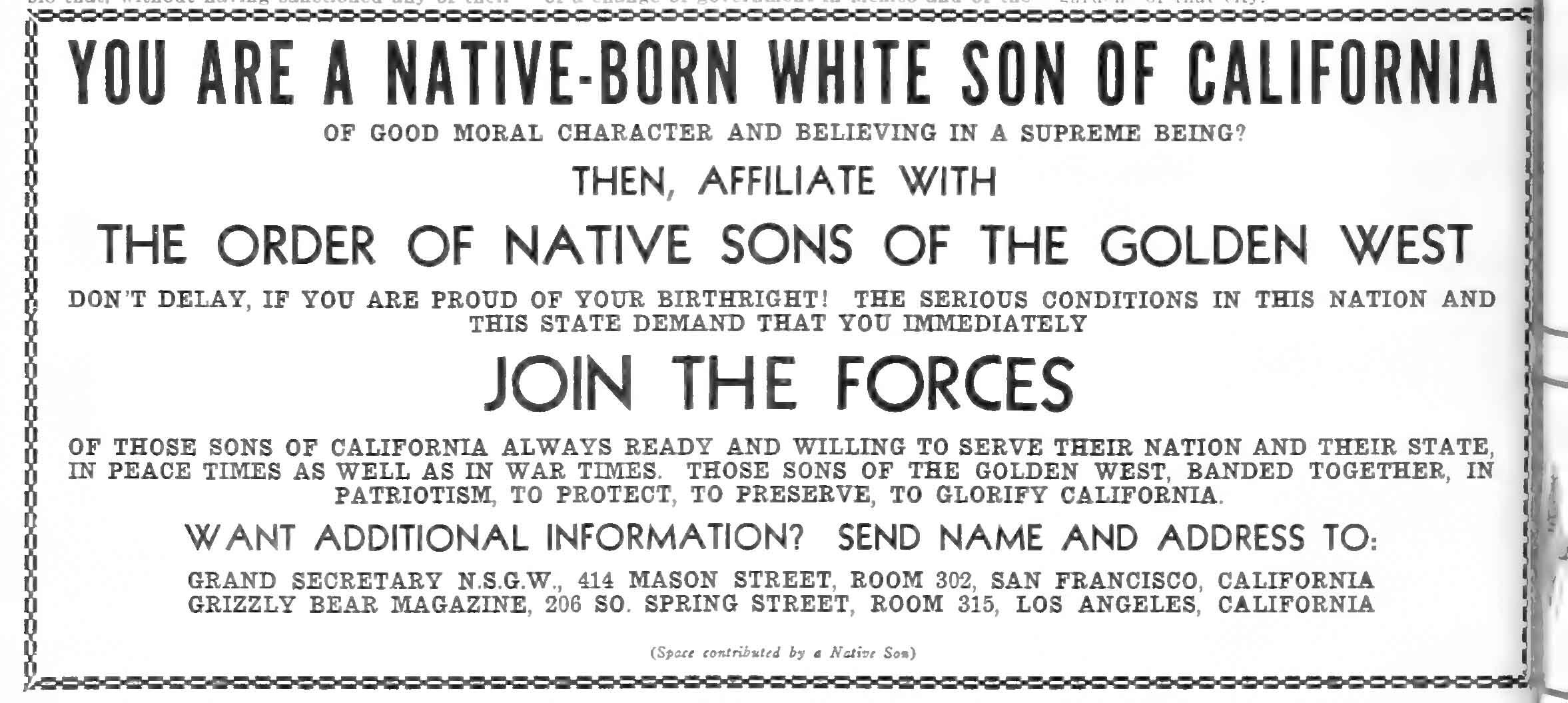
The Sons and Daughters have used the publication as a form of objecting to racial diversity in California. In November 1931, the anti-Mexican publications were still going, a slur was also created: “The Mexis who come to this country, being not of the White race, are ineligible for American Citizenship.” Nativism took on the charge of publishing another full page advertisement, “Are You, Natives of the Paradise of Earth, California,” and “Composed, Exclusively, of Native-Born American Citizens of the White Race of Men and Women, Born within the Confines of California…” and by 1935 the advertisement stated, “You are a native-born white sone of California… JOIN THE FORCES.” After the mid 1940s, the publication stopped referring to race, and in 1942 still advocated for the internment of Japanese Californians.
Filipinos were not included in the original national origins policy. The “territory” did not grant Filipinos citizenship but were seen as wards of the state. There was already racial animosity against Filipinos, in 1928, an outbreak of spinal meningitis was connected to Filipinos in California. President Hoover issued an executive order June 2, 1929, banning Filipinos, and by 1930 there was a national conversation on exclusions. in 1934, congress passed a law to fund the repatriation to the Philippines, including racial restriction. Immigration restriction was also been used as a tactic during economic depressions, also increasing imitation- labor perspectives.
Nativist- patriotic groups very involved in stating and setting up the social atmosphere against immigration.
1940
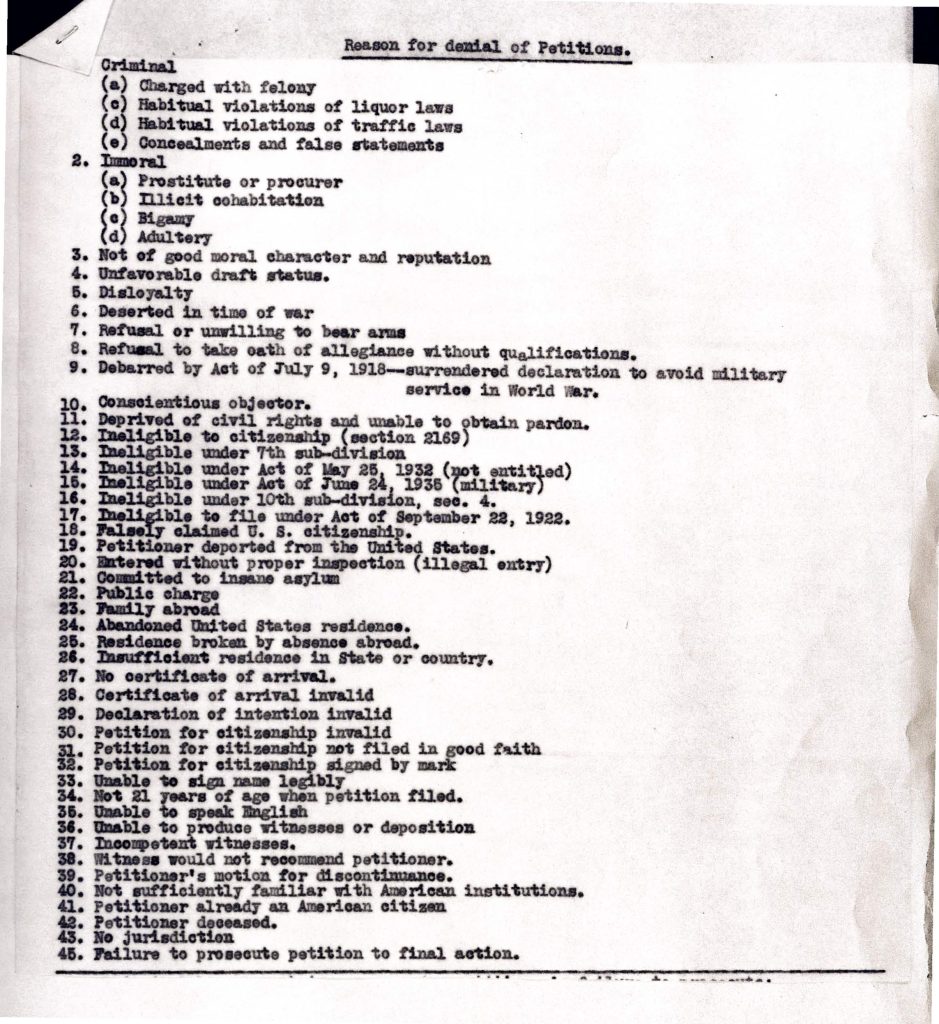
In 1940, Congress passed the Smith Act, indicating a shift of national policy to include the investigation of “subversive elements.” Franklin Delano Roosevelt recommended moving Immigration Services away from the Department of Labor to the Department of Justice. It was not until June 1941 that the Department of Justice worked on a new system to screen for “security risks.” A Central Visa Board was formed at the State Department, Immigration Services, FBI, Naval, and Military Intelligence. If they found the person favorable, they were allowed a visa. From 1930 to 1940, immigration was moved from a congressional authority to a presidential one. Congress did this was done by the gradual implementation and establishment of Regulated government offices for immigration, led by the executive branch. Later, moved by FDR. The move consolidated immigration, not as a domestic issue, but as an international one. Before that, immigration was more of a state restriction, and or local power.
Filipinos were to be excluded on granting their independence on July 4, 1946. The introduction of Racial exclusion was in 1947 by Walter Judd of Minnesota. Judd wrote a bill to exclude from the Asia Pacific Triangle- Race-based Geography to 100 people from all included regions. The first “racial” category was “Asian,” and it passed house on March 1, 1949. Racist concepts of Racial Harmony suggested balance based on ideas of racial hierarchy in the 1950s.