Before 1938 – Braceros – Buying on Contract – Covenant Database
California Nativism – Citizenship – Covenants – East Bakersfield – Education – Eminent Domain
English Only – Japanese Internment – Moving into a Neighborhood – Neighborhoods – Public Housing
Resources – Rumford Fair Housing Act – Suburban Expansion – Zoning
Proposition 63- English as the Official State Language
To Speak of apartheid, then, in postwar California, is to inquire into a system of meaning making and policy formation that constructed compelling ideas about the inevitability of racial hierarchy and segregation. The formal structures of racial exclusion rapidly developed ideas about rights and opportunity that were publicly valorized.
– HoSang, D. (2010). Racial propositions : ballot initiatives and the making of postwar California (1st ed.). University of California Press. https://doi.org/10.1525/9780520947719
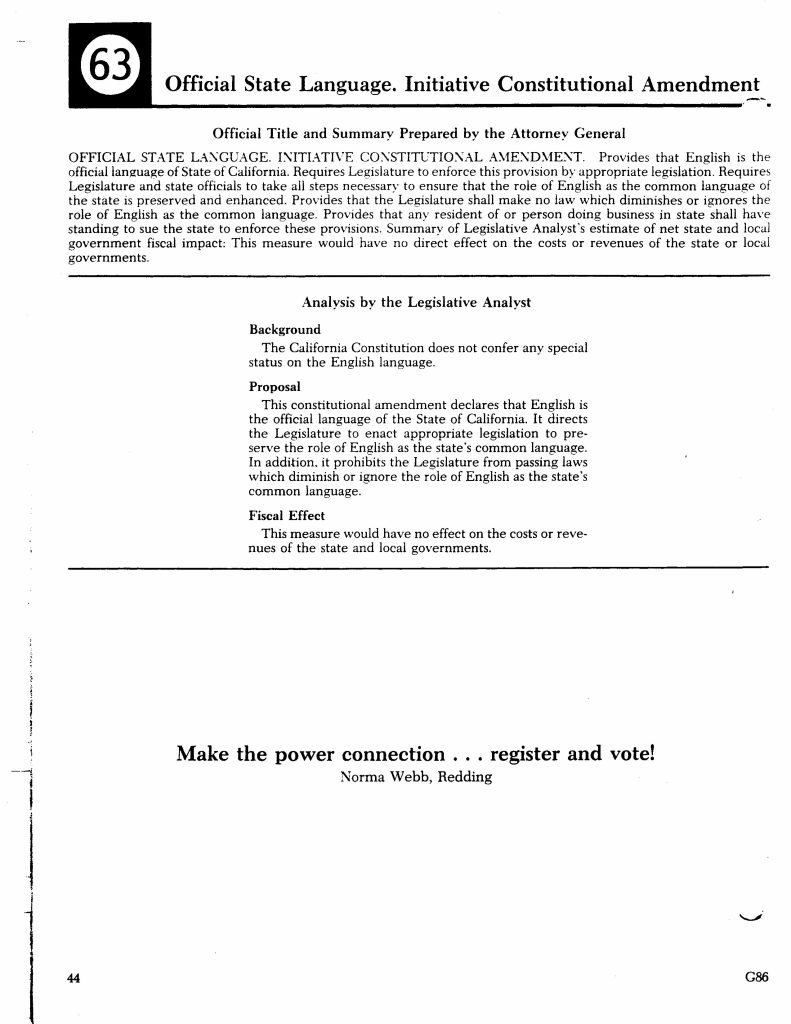
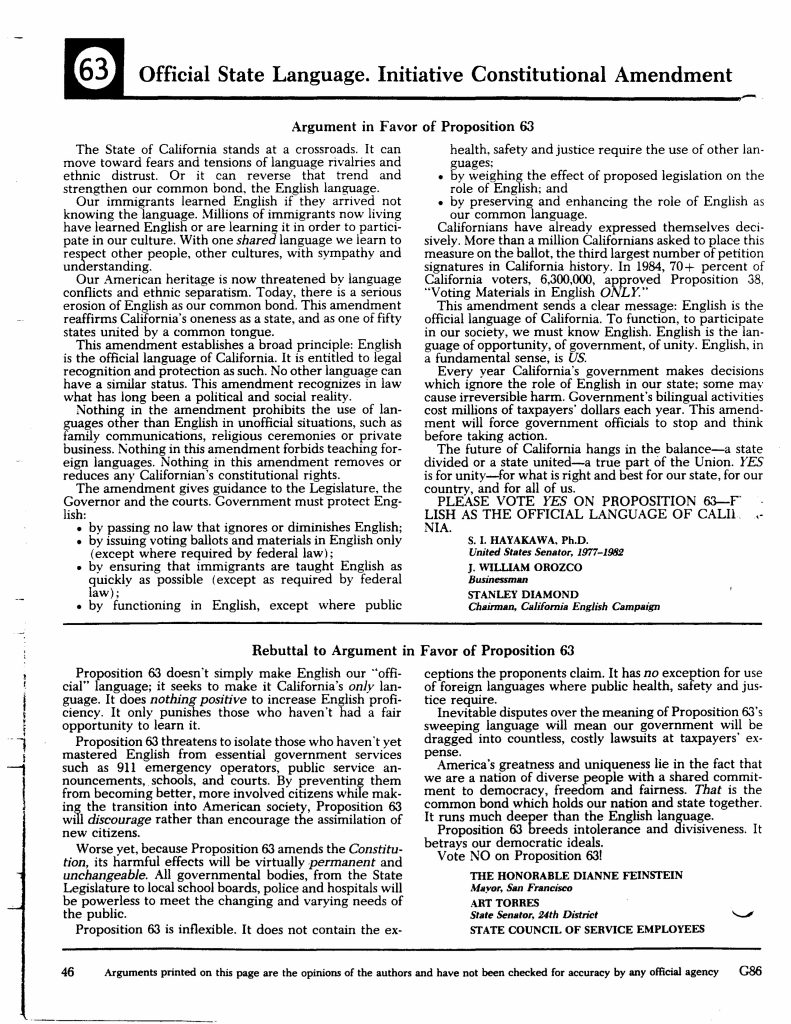
Dr. Samuel Hayakawa, a former California State University President, and later Senator, introduced racialized political gaze with Proposition 63. English as the California State Official Language. The “English as the Official Language” oriented politics, citizenship, and race as priority in policy. Racialized political gaze became renovated and renewed at time of considerable social, economic, and political changes in the 1980s. Dubbed as the “English Only” proposition, even when written by a person of color, only reinforced racial stereotypes and excluded US non-English speaking citizens, residents, and many others. The policy suggested that society was anti-Spanish speaking, anti-Hispanic and Latina/e/o/x. The 1980s represented a large growth of Latina/e/o/x demographic in California. The legislation was billed as “good for minorities.”
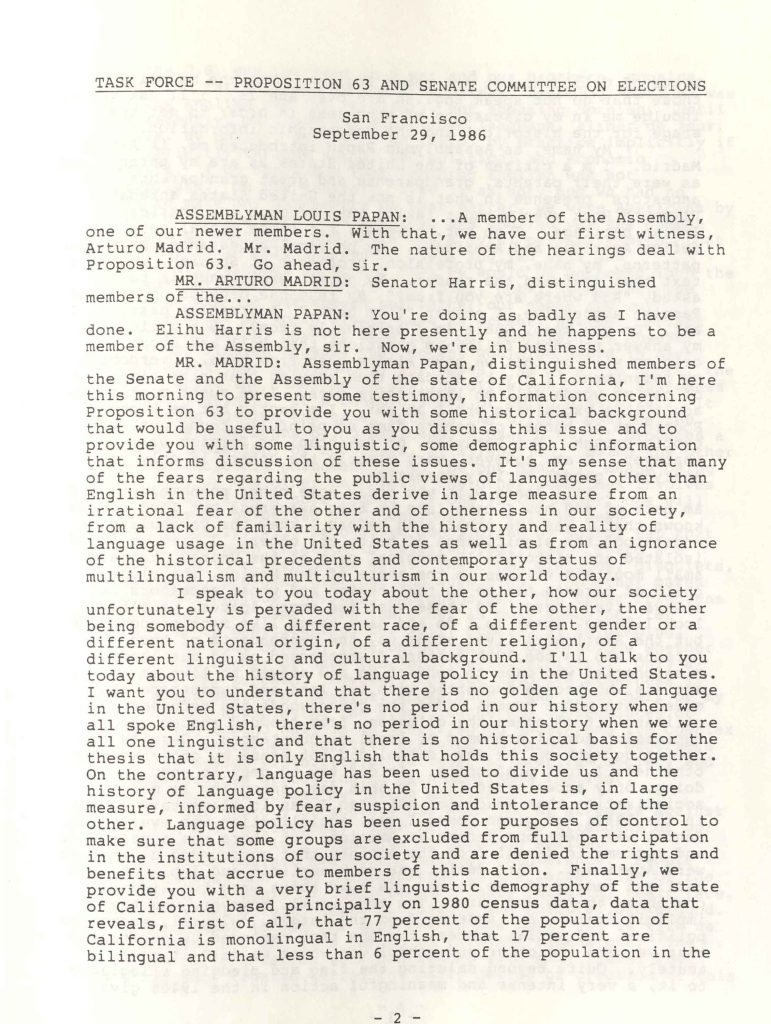
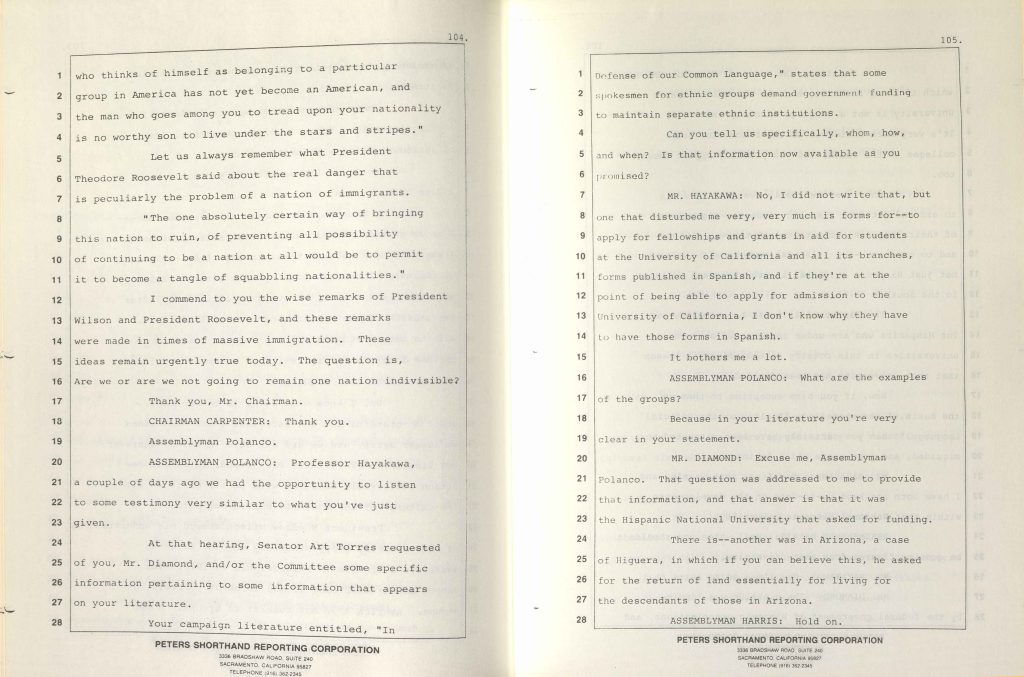
San Francisco September 29, 1986- Statement on the hearing of Proposition 63
Joint Interim Hearing on Proposition 63: English as the Official State Language, September 29, 1986, San Francisco. 1986. The Committee.
Arturo Madrid- “I want you to understand that there is no golden age of language in the United States, there’s no period in our history when we were all one linguistic and that there is no historical basis for the thesis that it is only English that holds this society together.”
This linguistic legislation was political subjectivity rooted in Caucasian racial identity. The “gaze” on politics was reinforced by the unequal expectation of immigrants as a “Super Citizen.” America had already asks extraordinary measures for representation of immigrants and that their over expressions of American Citizenship would be redemptive and idealized economically, civil, and familial subjectivity. The policy would question who contributes to the economy, while obeying conservative and nationalistic expectations. This conformity of Apartheid policy upheld a social system or culture where white men hold primary power, dominating roles in political leadership, moral authority, social privilege, and control of property and social norms. The Proposition upheld that no immigrant was an investor or owner in America, unless they spoke English. Expectations included individual exceptionalism, and choice worthiness, often out of reach for many people.
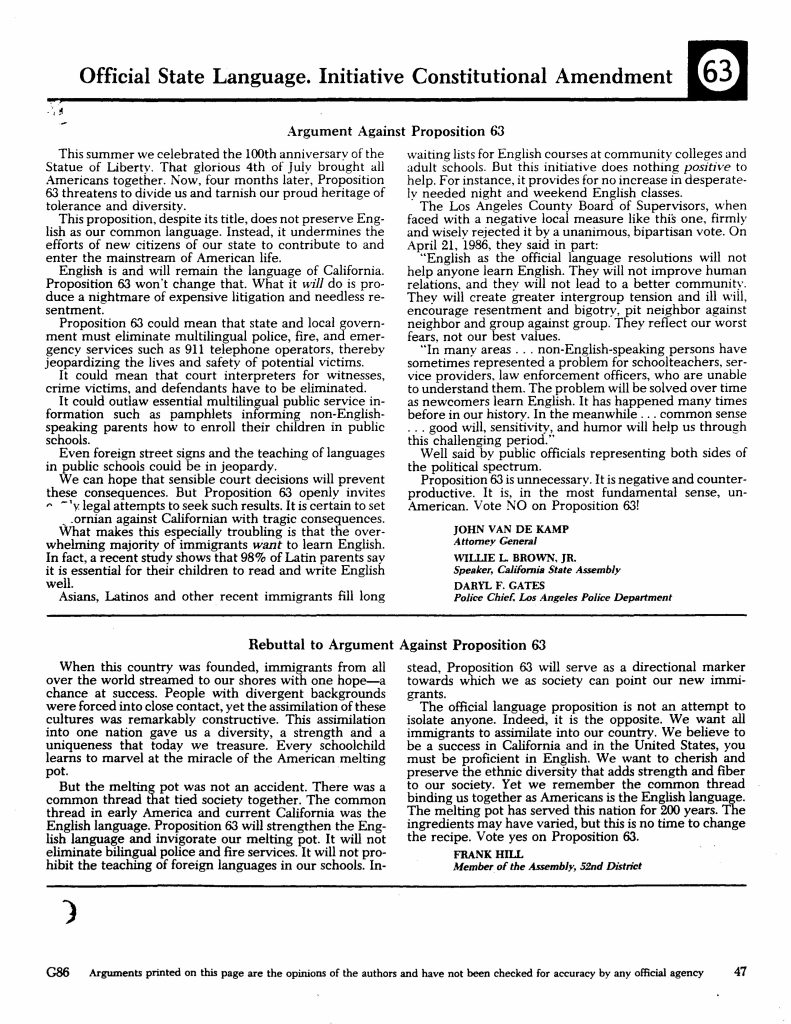
Previously in California the Dymally Alatorre Act 1973, established bilingual services to in state programs, in an effort to reduced second class access to public services.
Samuel Hayakawa, born in Canada, who came on a student visa to the United States. Dr. Hayakawa was Professor of English and later a California State University, San Francisco President, before becoming a Senator. Dr. Hayakawa, of Japanese Heritage, believed that English was the key to social participation, and key to the opportunities and self-realization that American life had to offer.
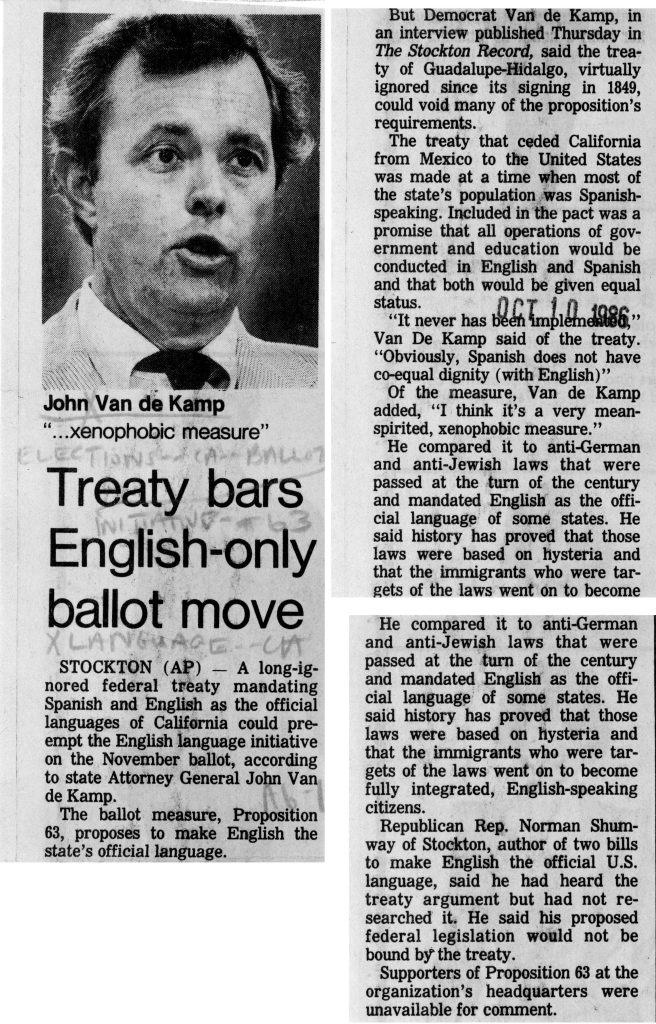
Dr. Hayakawa saw himself as a vehicle to Americanization, as a professor and educator of English. Through the American conversion and with the baptism of English and cultural alignment towards White America, Dr. Hayakawa stated the language was a unifying force. There no time in the United States were English was only spoken and had been a voice that unified everyone, or that English holds society together.
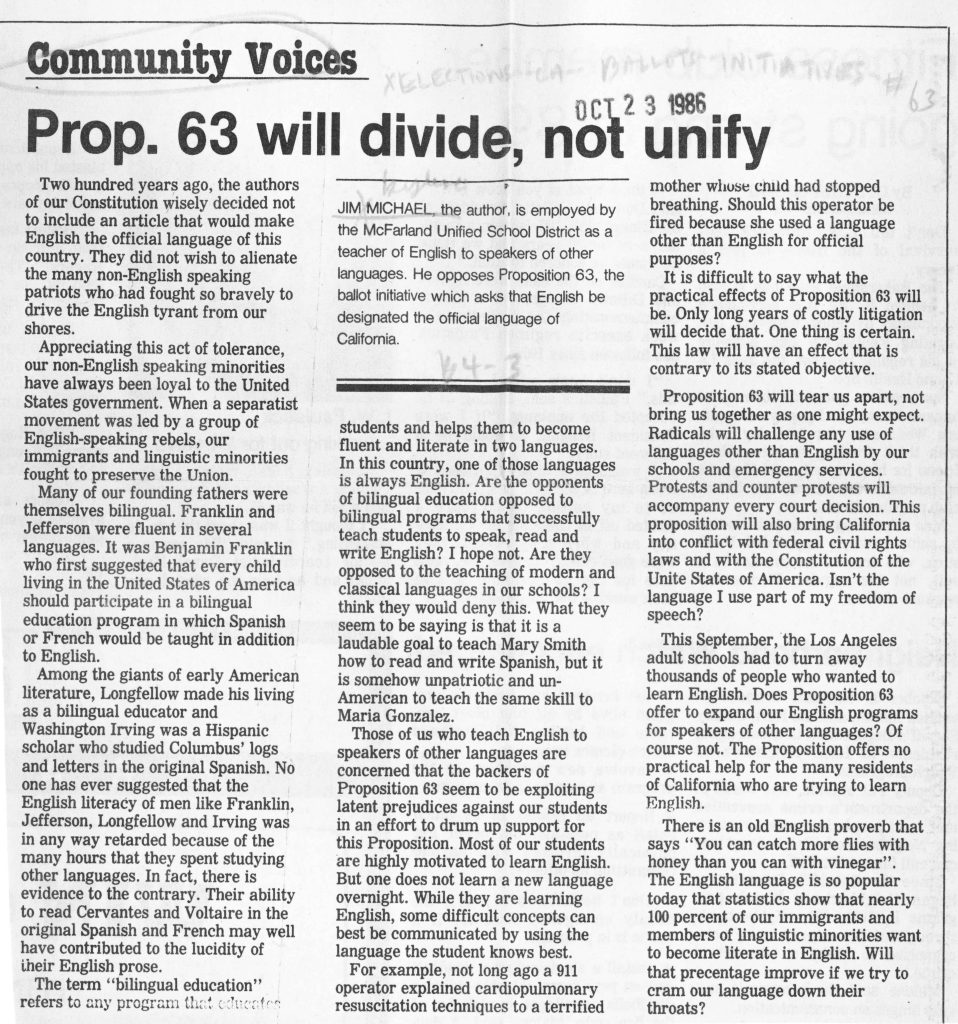
The empty promise, later taken up by the state, the policy did nothing for equal education, nor funded education more, nor added provisions against racial and ethnic discrimination. Proposition 63 actually supported discrimination as a method to incentivize the learning of English. Dr. Hayakawa misunderstood that his struggles and his life were steppingstones that changed him into an American. As other activists understood, that these actions or tribulations were unnecessary if they were equal, and that would effectively end bilingual education.
The proposition sent a message to immigrant communities that English fluency was a prerequisite for social mobility, while also characterizing immigrant groups as lacking ambition or unmotivated. They were constructed as second class because of their limited understanding of English. It should be pointed out that formal education takes time, money, and systems of support, like family care, generational wealth, job protection, and guidance on accessing the formal education system. These structures already heavily favor the knowledge of English: like the Admissions process, application of financial aid, and navigating resources. Many groups saw this legislation as anti-civil rights, including labor unions. In 1986, most of the non-English speakers were over the age of 25. Official languages did not encourage or create better teaching. Claiming or asserting American or English speaking racial identity did not automatically guarantee security or economic mobility. The proposition, while passed, did not improve lives.
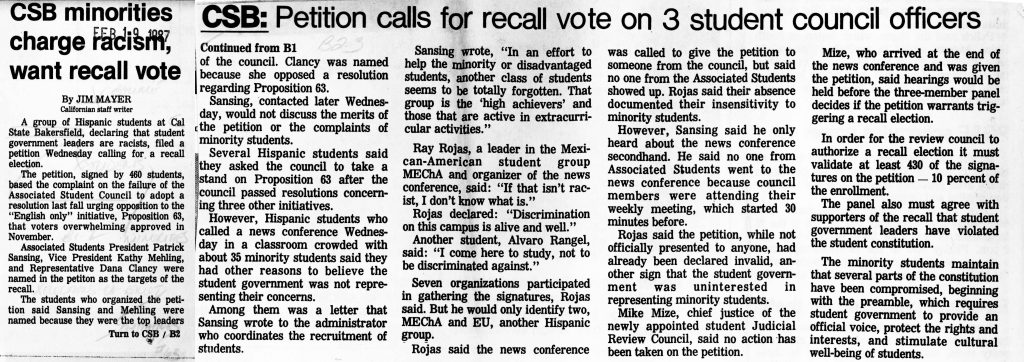
1986 was also the same year that the Immigration Reform and Control Act “Amnesty” was passed in the United States. The policy, while allowing some to naturalized, created Federalized Employer sanctions, and criminal penalties for employers who employed undocumented workers.
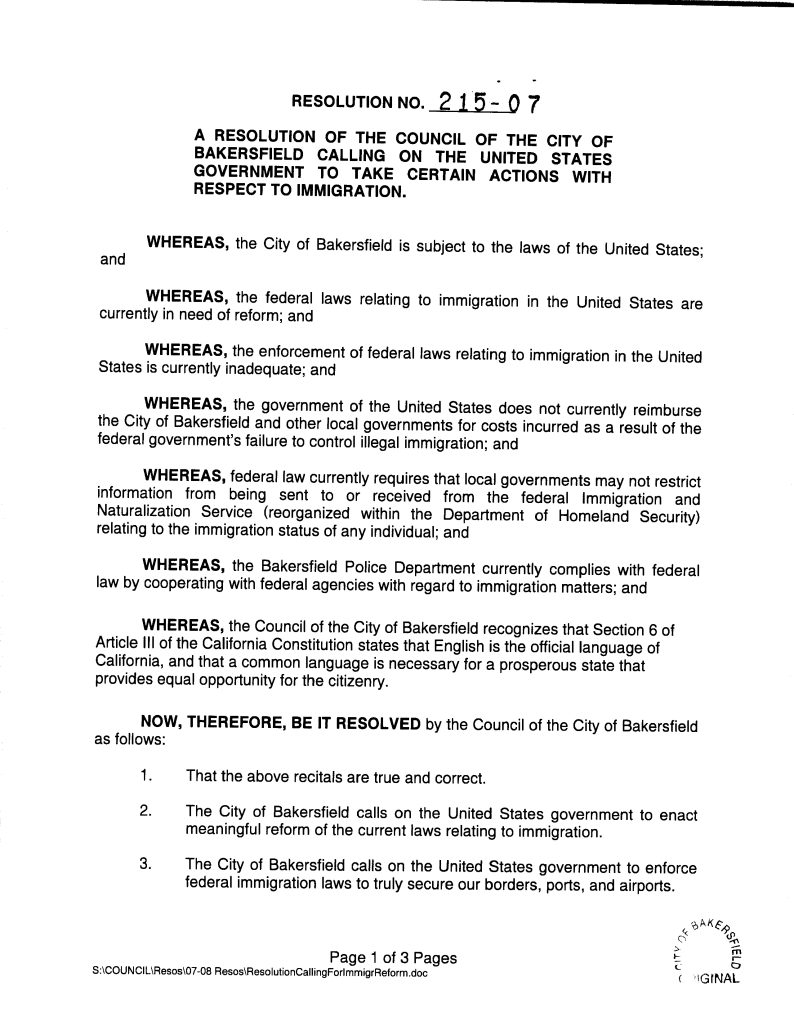
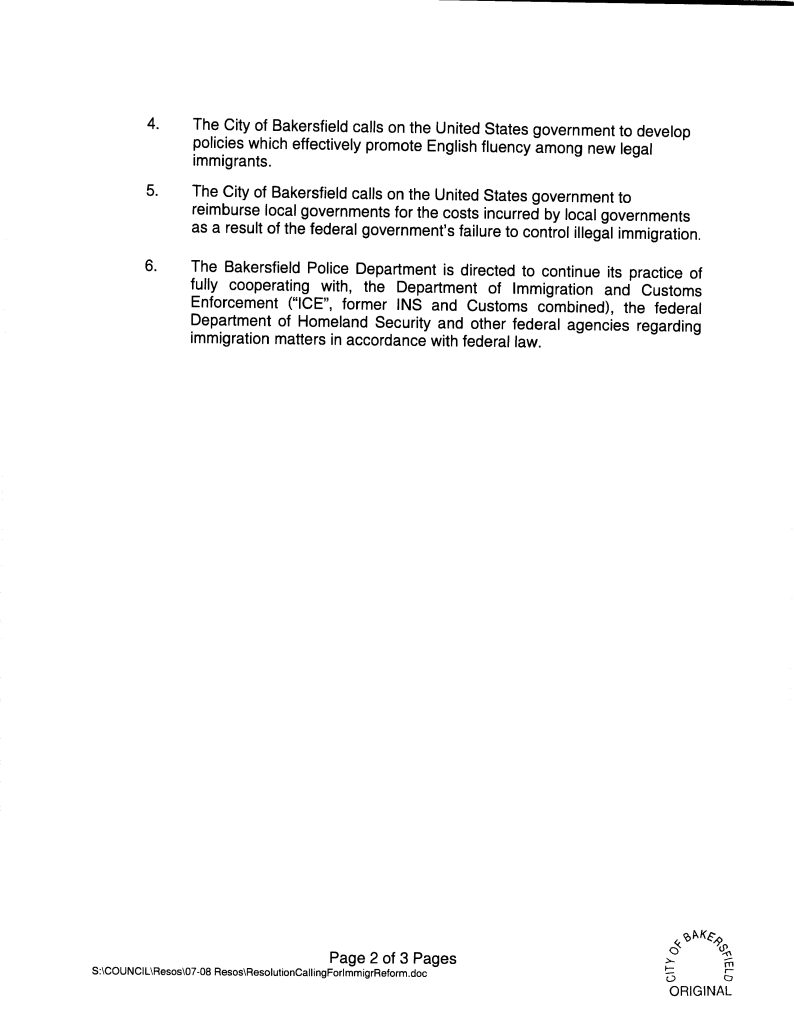
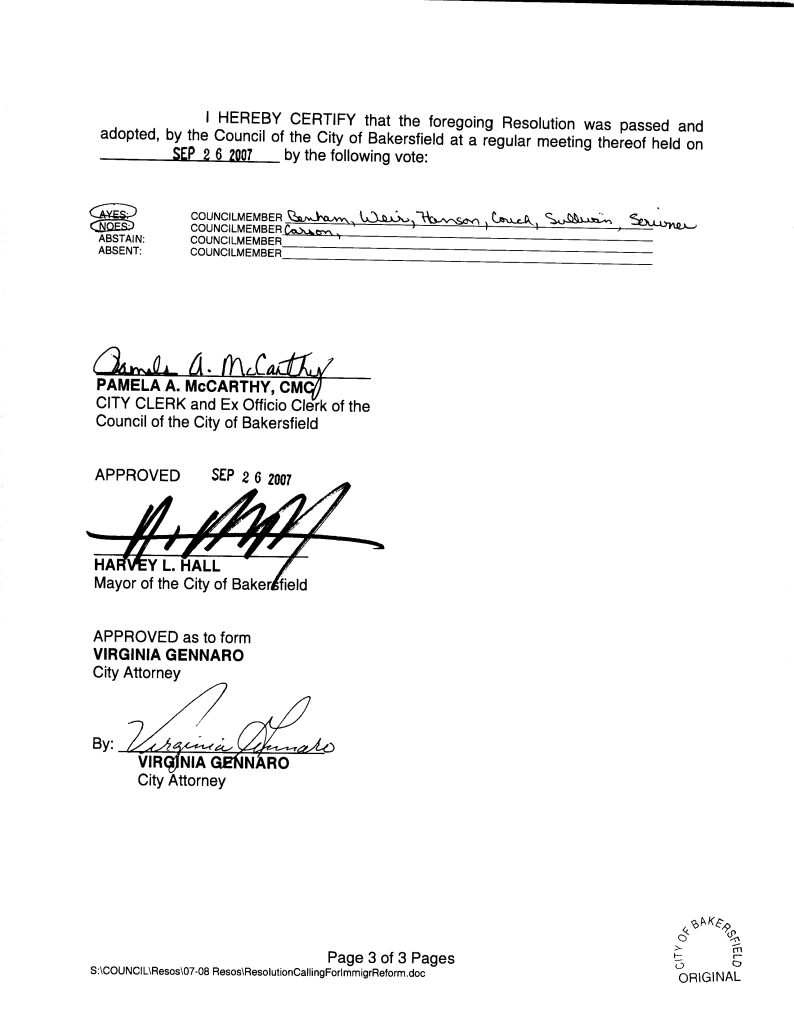
In 2007, the Bakersfield City Council passed the Resolution to take certain action with respects to immigration. The City resolved that United States needed reform to reimburse city for their deportation efforts and that current laws were inadequate to enforce immigration. The City of Bakersfield was then cooperating with Homeland Security on immigration. The city also resolved that English was the official language of California, calling on Proposition 63’s ghost 40 year later, “Whereas, the Council of the City of Bakersfield recognizes that Section 6 of Article III of the California Constitution states that English is the official language of California and that a common language is necessary for a prosperous state that provides equal opportunity for the citizenry.”
Singed Yes: Council Members Benham, Weir, Hanson, Couch, Sullivan, Scrivener
Singed No: Carson
Approved by Mayor Hall, and by the city attorney Virginia Gennaro