
Gender

Historians like Collin Gordon and Gene Slater have chronicled that these racial segregation practices and found that they were not necessarily unique but systemic when adopted by federal programs during the New Deal.
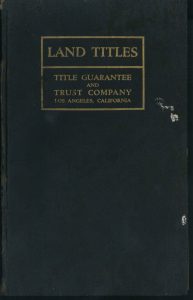
Title companies like the Title Guarantee and Trust Company played a central role in real estate transactions by maintaining records of property ownership and ensuring clear title for buyers and lenders. These records were essential for documenting legal claims, liens, and restrictions attached to land parcels.In California during the early 20th century, such title records often included racially restrictive covenants, easements, and other conditions that shaped patterns of land use and residential segregation. Title books served as both legal instruments and historical archives of property ownership, reflecting broader economic, legal, and social systems governing land. The physical format of the volume—bound and labeled for institutional use—indicates its function as an official repository of property information, likely used by legal professionals, lenders, and real estate agents.
LAND TITLES TITLE GUARANTEE AND TRUST COMPANY LOS ANGELES, CALIFORNIA 1929

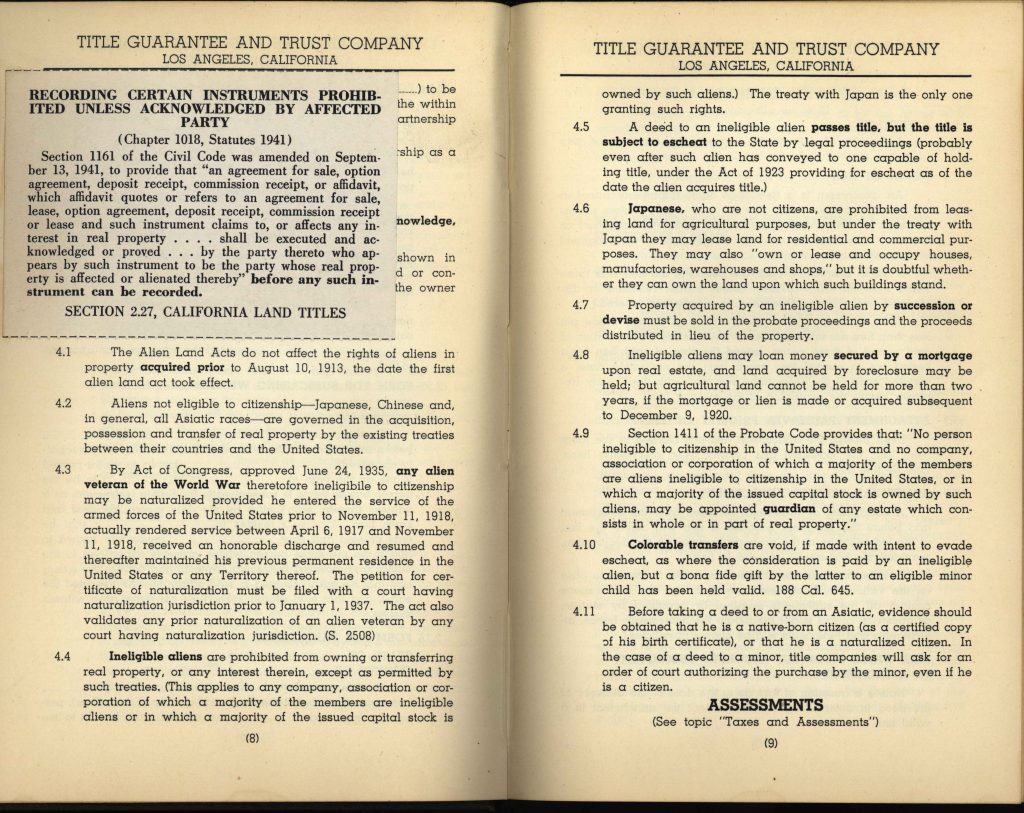
Land title books from the Bakersfield Abstract Company in 1929 and 1936, both encourage race restrictions and inform sellers on citizenship clauses, like the Alien Lands Act (1913), and the Chinese Exclusion Acts. Section 34 of the Land Titles: Titles and Guarantee and Trust Company, stated that, “Japanese, Chinese, Hindus, Malays, and possibly all Asiatics,” were not able to acquire, posses, transfer real property, because of citizenship and land exclusion laws. Furthermore, Section 35-42 goes into specific details about passing titles, who is capable of, and even expressing doubt of racial ownership, because of Alien Land Laws.
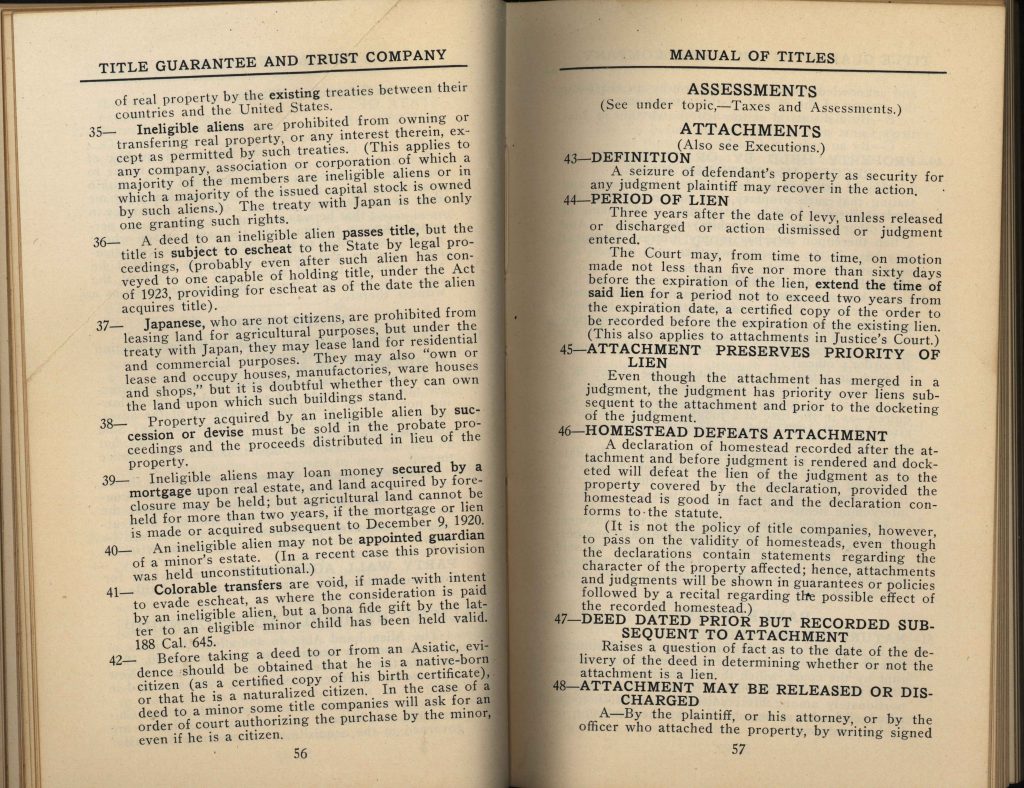
35— Ineligible aliens are prohibited from owning or transferring real property, or any interest therein, except as permitted by such treaties. (This applies to any company, association or corporation of which a majority of the members are ineligible aliens or in which a majority of the issued capital stock is owned by such aliens.) The treaty with Japan is the only one granting such rights.36— A deed to an ineligible alien passes title, but the title is subject to escheat to the State by legal proceedings, (probably even after such alien has conveyed to one capable of holding title, under the Act of 1923, providing for escheat as of the date the alien acquires title). 37— Japanese, who are not citizens, are prohibited from leasing land for agricultural purposes, but under the treaty with Japan, they may lease land for residential and commercial purposes. They may also “own or lease and occupy houses, manufactories, warehouses and shops,” but it is doubtful whether they can own the land upon which such buildings stand. 38— Property acquired by an ineligible alien by succession or devise must be sold in the probate proceedings and the proceeds distributed in lieu of the property. 39— Ineligible aliens may loan money secured by a mortgage upon real estate, and land acquired by foreclosure may be held; but agricultural land cannot be held for more than two years, if the mortgage or lien is made or acquired subsequent to December 19, 1920. 40— An ineligible alien may not be appointed guardian of a minor’s estate. (In a recent case this provision was held unconstitutional.) 41— Colorable transfers are void, if made with intent to evade escheat, as where the consideration is paid by an ineligible alien, but a bona fide gift by the latter to an eligible minor child has been held valid. 188 Cal. 645. 42— Before taking a deed to or from an Asiatic, evidence should be obtained that he is a native-born citizen (as a certified copy of his birth certificate), or that he is a naturalized citizen. In the case of a deed to a minor some title companies will ask for an order of court authorizing the purchase by the minor, even if he is a citizen.
LAND TITLES TITLE GUARANTEE AND TRUST COMPANY LOS ANGELES, CALIFORNIA 1929
TITLE GUARANTEE AND TRUST COMPANYLOS ANGELES, CALIFORNIA RECORDING CERTAIN INSTRUMENTS PROHIBITED UNLESS ACKNOWLEDGED BY AFFECTED PARTY (Chapter 1018, Statutes 1941) Section 1161 of the Civil Code was amended on September 13, 1941, to provide that “an agreement for sale, option agreement, deposit receipt, commission receipt, or affidavit, which affidavit quotes or refers to an agreement for sale, lease, option agreement, deposit receipt, commission receipt or lease and such instrument claims to, or affects any interest in real property . . . shall be executed and acknowledged or proved . . . by the party thereto who appears by such instrument to be the party whose real property is affected or alienated thereby” before any such instrument can be recorded. SECTION 2.27, CALIFORNIA LAND TITLES 4.1 The Alien Land Acts do not affect the rights of aliens in property acquired prior to August 10, 1913, the date the first alien land act took effect. 4.2 Aliens not eligible to citizenship—Japanese, Chinese and, in general, all Asiatic races—are governed in the acquisition, possession and transfer of real property by the existing treaties between their countries and the United States. 4.3 By Act of Congress, approved June 24, 1935, any alien veteran of the World War theretofore ineligible to citizenship may be naturalized provided he entered the service of the armed forces of the United States prior to November 11, 1918, actually rendered service between April 6, 1917 and November 11, 1918, received an honorable discharge and resumed and thereafter maintained his previous permanent residence in the United States or any Territory thereof. The petition for certificate of naturalization must be filed with a court having naturalization jurisdiction prior to January 1, 1937. The act also validates any prior naturalization of an alien veteran by any court having naturalization jurisdiction. (S. 2508) 4.4 Ineligible aliens are prohibited from owning or transferring real property, or any interest therein, except as permitted by such treaties. (This applies to any company, association or corporation of which a majority of the members are ineligible aliens or in which a majority of the issued capital stock is owned by such aliens.) (continued) to be owned by such aliens.) The treaty with Japan is the only one granting such rights. 4.5 A deed to an ineligible alien passes title, but the title is subject to escheat to the State by legal proceedings (probably even after such alien has conveyed to one capable of holding title, under the Act of 1923 providing for escheat as of the date the alien acquires title). 4.6 Japanese, who are not citizens, are prohibited from leasing land for agricultural purposes, but under the treaty with Japan they may lease land for residential and commercial purposes. They may also “own or lease and occupy houses, manufactories, warehouses and shops,” but it is doubtful whether they can own the land upon which such buildings stand. 4.7 Property acquired by an ineligible alien by succession or devise must be sold in the probate proceedings and the proceeds distributed in lieu of the property. 4.8 Ineligible aliens may loan money secured by a mortgage upon real estate, and land acquired by foreclosure may be held; but agricultural land cannot be held for more than two years, if the mortgage or lien is made or acquired subsequent to December 9, 1920. 4.9 Section 1411 of the Probate Code provides that: “No person ineligible to citizenship in the United States and no company, association or corporation of which a majority of the members are aliens ineligible to citizenship in the United States, or in which a majority of the issued capital stock is owned by such aliens, may be appointed guardian of any estate which consists in whole or in part of real property.” 4.10 Colorable transfers are void, if made with intent to evade escheat, as where the consideration is paid by an ineligible alien, but a bona fide gift by the latter to an eligible minor child has been held valid. 188 Cal. 645. 4.11 Before taking a deed to or from an Asiatic, evidence should be obtained that he is a native-born citizen (as a certified copy of his birth certificate), or that he is a naturalized citizen. In the case of a deed to a minor, title companies will ask for an order of court authorizing the purchase by the minor, even if he is a citizen. ASSESSMENTS (See topic “Taxes and Assessments”) Detailed Description / Context: This title manual provides a detailed account of California property law as it relates to “ineligible aliens,” reflecting the legal framework established by the Alien Land Acts of 1913 and 1920. These laws targeted immigrants—particularly those of Asian descent—who were barred from naturalization under federal law, restricting their ability to own or lease agricultural land. The document explicitly categorizes Japanese, Chinese, and other “Asiatic races” as ineligible for citizenship and outlines the legal consequences for property ownership, including escheat (state seizure), limitations on leasing, and restrictions on inheritance. It also references treaty provisions, particularly with Japan, which provided limited rights for residential and commercial leasing. These legal doctrines played a central role in institutionalizing racial discrimination in land ownership and economic participation in California. Title companies, such as the Title Guarantee and Trust Company, were instrumental in interpreting and enforcing these laws in real estate transactions. The document is significant for understanding how private legal institutions codified and operationalized discriminatory state policies, shaping patterns of land ownership and exclusion that persisted for decades.
LAND TITLES TITLE GUARANTEE AND TRUST COMPANY LOS ANGELES, CALIFORNIA 1936

Statements that Asian residents could not use their children to hold property, unless property was given to them as a gift, and ends with, “before taking property from an Asiatic, evidence should be obtained that he is a native-born citizen or that this is a naturalized citizen.” The books were “to E. G. O’Boyle, Compliments of Bakersfield Abstract Company,” which cleared titles for real estate agents in Bakersfield.
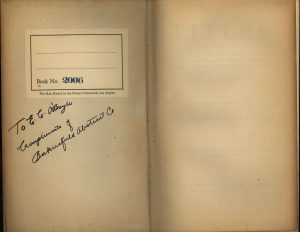
This page is part of a land title record volume used by title companies to document property ownership, transfers, liens, and restrictions. The Bakersfield Abstract Company, referenced in the inscription, likely used this volume in its business of compiling and certifying property histories for legal and financial transactions.Title books such as this were essential tools in early 20th-century real estate systems, particularly in California, where rapid development required reliable documentation of land ownership. These volumes often contained detailed records that could include deeds, easements, and restrictive covenants, including racially restrictive clauses common during this period. The handwritten inscription suggests the book may have been gifted or transferred to an individual associated with property or legal work, reflecting professional networks within the real estate and title industry. The printed note indicates production by a Los Angeles printing firm, emphasizing the standardized production of such record-keeping materials.
LAND TITLES TITLE GUARANTEE AND TRUST COMPANY LOS ANGELES, CALIFORNIA 1929


In similar restrictions to citizenship, even American born women lost their citizenship if they married an undocumented person before 1922. This misogynistic policy created denaturalized or “non-citizen nationals.” Women, who lost their citizenship, were able to receive citizenship through the naturalization process.
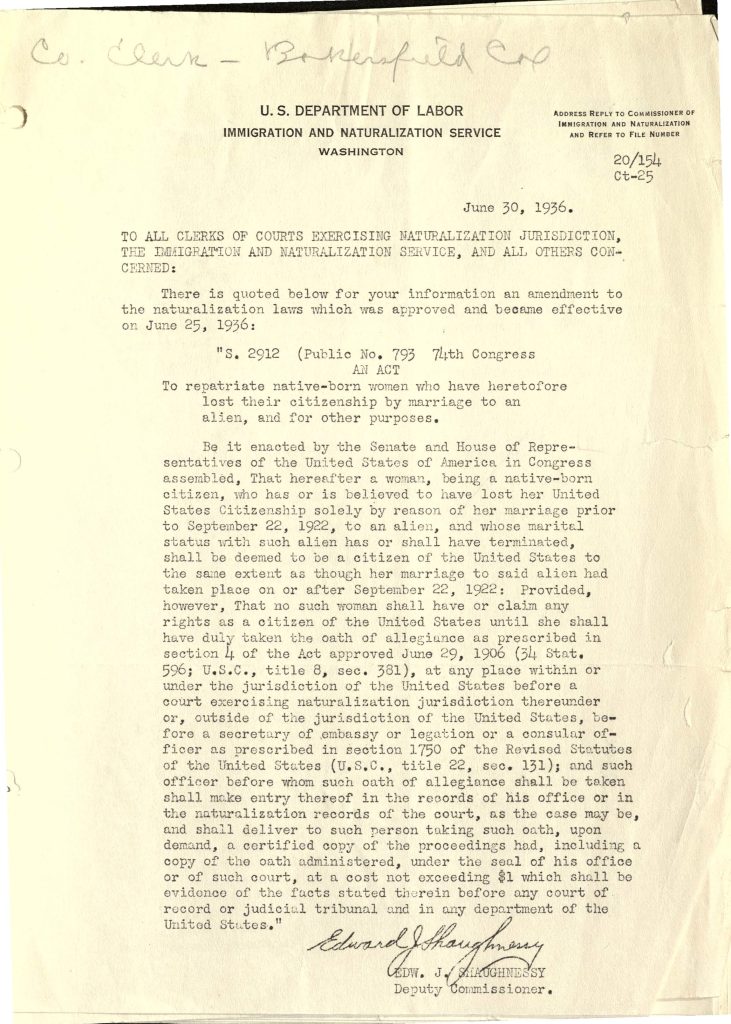
U.S. DEPARTMENT OF LABORIMMIGRATION AND NATURALIZATION SERVICE WASHINGTON Address reply to Commissioner of Immigration and Naturalization and refer to file number 20/154 Ct-25 June 30, 1936. TO ALL CLERKS OF COURTS EXERCISING NATURALIZATION JURISDICTION, THE IMMIGRATION AND NATURALIZATION SERVICE, AND ALL OTHERS CONCERNED: There is quoted below for your information an amendment to the naturalization laws which was approved and became effective on June 25, 1936: "S. 2912 (Public No. 793 74th Congress AN ACT To repatriate native-born women who have heretofore lost their citizenship by marriage to an alien, and for other purposes. Be it enacted by the Senate and House of Representatives of the United States of America in Congress assembled, That hereafter a woman, being a native-born citizen, who has or is believed to have lost her United States Citizenship solely by reason of her marriage prior to September 22, 1922, to an alien, and whose marital status with such alien has or shall have terminated, shall be deemed to be a citizen of the United States to the same extent as though her marriage to said alien had taken place on or after September 22, 1922: Provided, however, That no such woman shall have or claim any rights as a citizen of the United States until she shall have duly taken the oath of allegiance as prescribed in section 4 of the Act approved June 29, 1906 (34 Stat. 596; U.S.C., title 8, sec. 381), at any place within or under the jurisdiction of the United States before a court exercising naturalization jurisdiction thereunder or, outside of the jurisdiction of the United States, before a secretary of embassy or legation or a consular officer as prescribed in section 1750 of the Revised Statutes of the United States (U.S.C., title 22, sec. 131); and such officer before whom such oath of allegiance shall be taken shall make entry thereof in the records of his office or in the naturalization records of the court, as the case may be, and shall deliver to such person taking such oath, upon demand, a certified copy of the proceedings had, including a copy of the oath administered, under the seal of his office or of such court, at a cost not exceeding $1 which shall be evidence of the facts stated therein before any court of record or judicial tribunal and in any department of the United States." Edward J. Shaughnessy EDW. J. SHAUGHNESSY Deputy Commissioner. Detailed Description / Context: This 1936 circular reflects a significant shift in U.S. citizenship law affecting women. Prior to reforms in the early 20th century, American women could lose their citizenship automatically upon marrying a foreign national, particularly under the Expatriation Act of 1907. Although the Cable Act of 1922 began to reverse some of these policies, it did not fully restore citizenship to women who had already lost it. The 1936 amendment addressed this gap by allowing certain native-born women to regain citizenship if their marriage to an alien had ended. However, the requirement to take an oath of allegiance indicates that restoration was not automatic but required formal legal action. The document highlights the intersection of gender, citizenship, and immigration law in the United States, illustrating how legal reforms gradually expanded women’s rights while still imposing procedural barriers. It is part of a broader history of evolving citizenship policy and the dismantling of discriminatory legal frameworks based on marital status.
U.S. DEPARTMENT OF LABOR IMMIGRATION AND NATURALIZATION SERVICE WASHINGTON Address reply to Commissioner of Immigration and Naturalization and refer to file number 20/154 Ct-25, Kern County Court Records

Public Law 793, June 25, 1936, eventually repatriated American born women back as citizens, with an oath of loyalty. Misogyny and gender inequality are also deeply embedded into redlining. Women as they were still subject to land exclusion laws, racial covenants, and if the property was acquired before 1917, it was presumed that a wife was not included in co-ownership of the property, unless otherwise written on the contract.
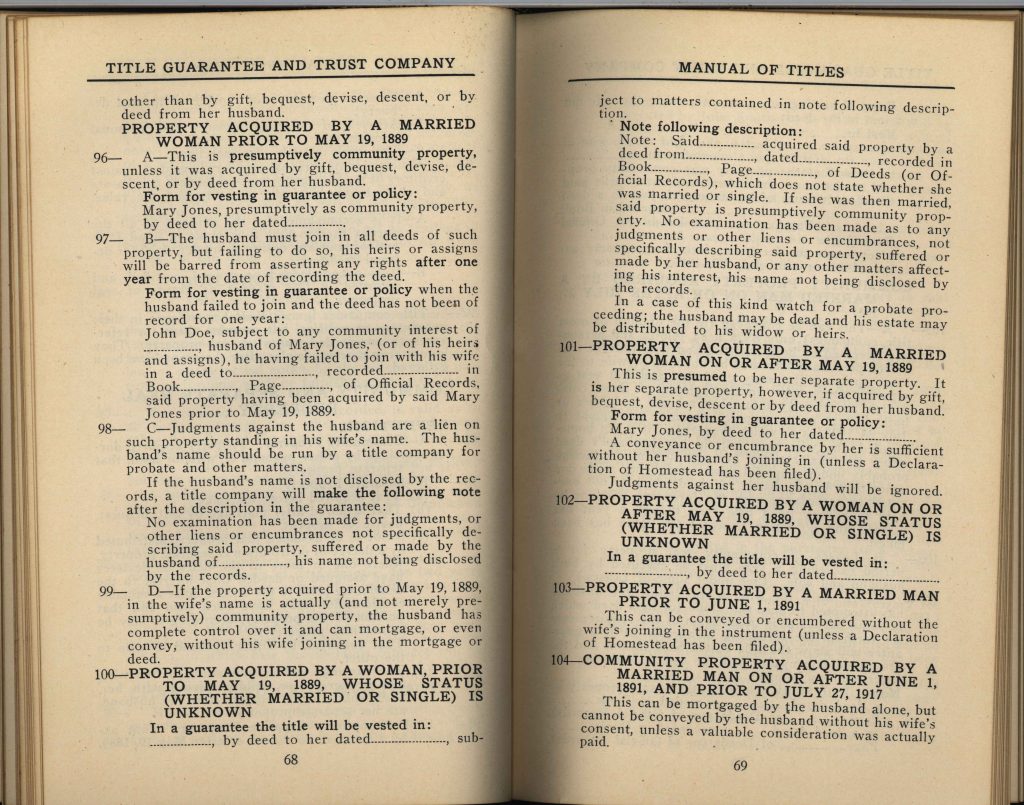
TITLE GUARANTEE AND TRUST COMPANYPROPERTY ACQUIRED BY A MARRIED WOMAN PRIOR TO MAY 19, 1889 96— A—This is presumptively community property, unless it was acquired by gift, bequest, devise, descent, or by deed from her husband. Form for vesting in guarantee or policy: Mary Jones, presumptively as community property, by deed to her dated ________ 97— B—The husband must join in all deeds of such property, but failing to do so, his heirs or assigns will be barred from asserting any rights after one year from the date of recording the deed. Form for vesting in guarantee or policy when the husband failed to join and the deed has not been of record for one year: John Doe, subject to any community interest of ________, husband of Mary Jones, (or of his heirs and assigns), he having failed to join with his wife in a deed to ________, recorded ________ Book ________ Page ________ of Official Records, said property having been acquired by said Mary Jones prior to May 19, 1889. 98— C—Judgments against the husband are a lien on such property standing in his wife’s name. The husband’s name should be run by a title company for probate and other matters. If the husband’s name is not disclosed by the records, a title company will make the following note after the description in the guarantee: No examination has been made for judgments, or other liens or encumbrances not specifically describing said property, suffered or made by the husband of ________, his name not being disclosed by the records. 99— D—If the property acquired prior to May 19, 1889, in the wife’s name is actually (and not merely presumptively) community property, the husband has complete control over it and can mortgage, or even convey, without his wife joining in the mortgage or deed. 100— PROPERTY ACQUIRED BY A WOMAN PRIOR TO MAY 19, 1889, WHOSE STATUS (WHETHER MARRIED OR SINGLE) IS UNKNOWN In a guarantee the title will be vested in: ________, by deed to her dated ________, sub- TITLE GUARANTEE AND TRUST COMPANY LOS ANGELES, CALIFORNIA MANUAL OF TITLES Note following description: Note: Said ________ acquired said property by a deed from ________, dated ________, recorded in Book ________ Page ________ of Deeds (or Official Records), which does not state whether she was married or single. If she was then married, said property is presumptively community property. No examination has been made as to any judgments or other liens or encumbrances, not made by her husband, or any other matters affecting his interest, his name not being disclosed by the records. In a case of this kind watch for a probate proceeding; the husband may be dead and his estate may be distributed to his widow or heirs. 101— PROPERTY ACQUIRED BY A MARRIED WOMAN ON OR AFTER MAY 19, 1889 This is presumed to be her separate property. It is her separate property, however, if acquired by gift, bequest, devise, descent or by deed from her husband. Form for vesting in guarantee or policy: Mary Jones, by deed to her dated ________ A conveyance or encumbrance by her is sufficient without her husband’s joining in (unless a Declaration of Homestead has been filed). Judgments against her husband will be ignored. 102— PROPERTY ACQUIRED BY A WOMAN ON OR AFTER MAY 19, 1889, WHOSE STATUS (WHETHER MARRIED OR SINGLE) IS UNKNOWN In a guarantee the title will be vested in: ________, by deed to her dated ________ 103— PROPERTY ACQUIRED BY A MARRIED MAN PRIOR TO JUNE 1, 1891 This can be conveyed or encumbered without the wife’s joining in the instrument (unless a Declaration of Homestead has been filed). 104— COMMUNITY PROPERTY ACQUIRED BY A MARRIED MAN ON OR AFTER JUNE 1, 1891, AND PRIOR TO JULY 27, 1917 This can be mortgaged by the husband alone, but cannot be conveyed by the husband without his wife’s consent, unless a valuable consideration was actually paid. Detailed Description / Context: These pages from a title manual provide insight into gendered property law in California, particularly regarding married women’s property rights. The distinction between property acquired before and after May 19, 1889 reflects changes in state law that expanded married women’s control over property. Prior to reforms, married women’s property was often treated as community property subject to the husband’s control, even if held in the wife’s name. After legal changes, women gained greater recognition of separate property rights, allowing them to own, manage, and transfer property independently under certain conditions. The detailed instructions for title companies illustrate how these legal distinctions were operationalized in real estate transactions. They also reveal the persistence of patriarchal legal assumptions, such as the need to account for the husband’s potential claims or liabilities. This document is significant for understanding the evolution of women’s property rights, the legal structure of marriage and ownership, and the role of title companies in applying and enforcing these rules in early 20th-century California.
LAND TITLES TITLE GUARANTEE AND TRUST COMPANY LOS ANGELES, CALIFORNIA 1929

It is important to note that these limitation had an economic and community effect on legal ownership, and were detrimental to financial abilities anyone who was not a white male (redlining).
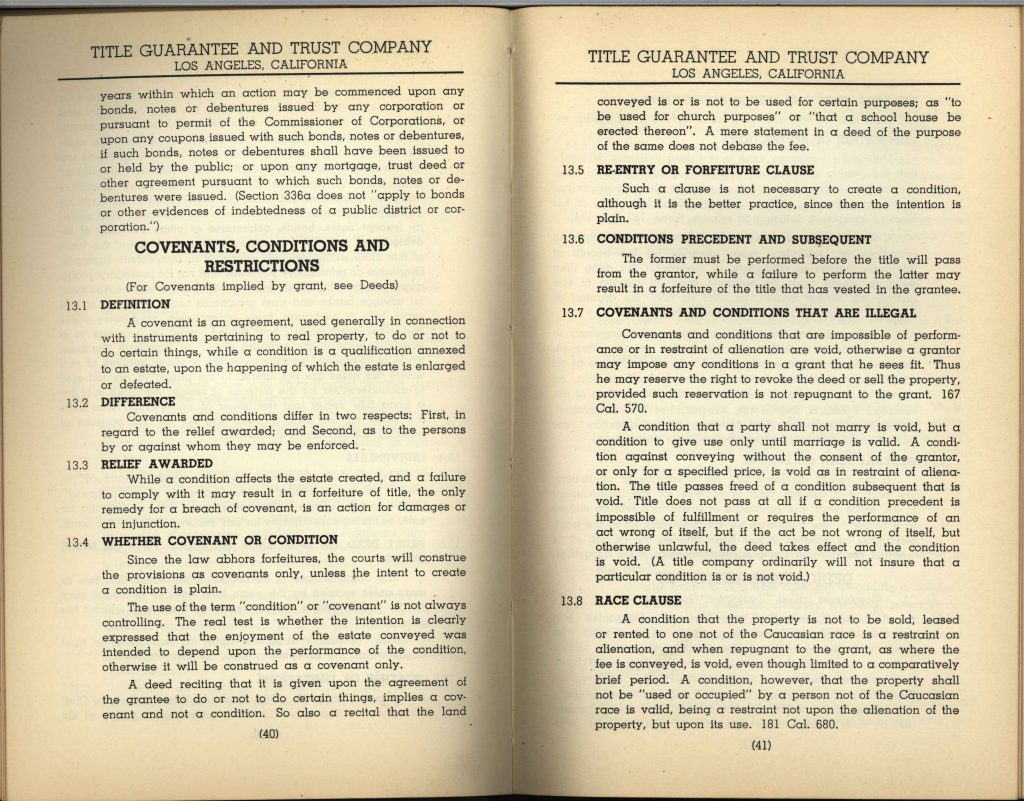
13.1 DEFINITIONA covenant is an agreement, used generally in connection with instruments pertaining to real property, to do or not to do certain things, while a condition is a qualification annexed to an estate, upon the happening of which the estate is enlarged or defeated. 13.2 DIFFERENCE Covenants and conditions differ in two respects: First, in regard to the relief awarded; and Second, as to the persons by or against whom they may be enforced. 13.3 RELIEF AWARDED While a condition affects the estate created, and a failure to comply with it may result in a forfeiture of title, the only remedy for a breach of covenant is an action for damages or an injunction. 13.4 WHETHER COVENANT OR CONDITION Since the law abhors forfeitures, the courts will construe the provisions as covenants only, unless the intent to create a condition is plain. The use of the term "condition" or "covenant" is not always controlling. The real test is whether the intention is clearly expressed that the enjoyment of the estate conveyed was intended to depend upon the performance of the condition, otherwise it will be construed as a covenant only. A deed reciting that it is given upon the agreement of the grantee to do or not to do certain things, implies a covenant and not a condition. So also a recital that the land conveyed is or is not to be used for certain purposes, as "to be used for church purposes" or "that a school house be erected thereon". A mere statement in a deed of the purpose of the same does not debase the fee. TITLE GUARANTEE AND TRUST COMPANY LOS ANGELES, CALIFORNIA 13.5 RE-ENTRY OR FORFEITURE CLAUSE Such a clause is not necessary to create a condition, although it is the better practice, since then the intention is plain. 13.6 CONDITIONS PRECEDENT AND SUBSEQUENT The former must be performed before the title will pass from the grantor, while a failure to perform the latter may result in a forfeiture of the title that has vested in the grantee. 13.7 COVENANTS AND CONDITIONS THAT ARE ILLEGAL Covenants and conditions that are impossible of performance or in restraint of alienation are void, otherwise a grantor may impose any conditions in a grant that he sees fit. Thus he may reserve the right to revoke the deed or sell the property, provided such reservation is not repugnant to the grant. 167 Cal. 570. A condition that a party shall not marry is void, but a condition to give use only until marriage is valid. A condition against conveying without the consent of the grantor, or only for a specified price, is void as in restraint of alienation. The title passes free of a condition subsequent that is void. Title does not pass at all if a condition precedent is impossible of fulfillment or requires the performance of an act wrong of itself, but if the act be not wrong of itself, but otherwise unlawful, the deed takes effect and the condition is void. (A title company ordinarily will not insure that a particular condition is or is not void.) 13.8 RACE CLAUSE A condition that the property is not to be sold, leased or rented to one not of the Caucasian race is a restraint on alienation, and when repugnant to the grant, as where the fee is conveyed, is void, even though limited to a comparatively brief period. A condition, however, that the property shall not be "used or occupied" by a person not of the Caucasian race is valid, being a restraint not upon the alienation of the property, but upon its use. 181 Cal. 680. Detailed Description / Context: These pages from a title manual illustrate how legal professionals and title companies interpreted property law in California, including the distinction between covenants and conditions and their enforceability. The section on race clauses is particularly significant, as it reflects the legal reasoning used to justify racially restrictive covenants in property use during the early 20th century. The text distinguishes between restrictions on sale (alienation), which could be void, and restrictions on use or occupancy, which were considered legally enforceable at the time. This distinction underpinned the widespread use of racially restrictive covenants that excluded non-white individuals from occupying certain properties, even when outright ownership restrictions were challenged. Such legal interpretations contributed to the institutionalization of housing segregation in California and across the United States. Although later invalidated by court decisions such as Shelley v. Kraemer (1948), these doctrines remained embedded in property records and legal practice for decades.
LAND TITLES TITLE GUARANTEE AND TRUST COMPANY LOS ANGELES, CALIFORNIA 1936