The Mexican railways constructed by Porfirio Diaz, Mexican President. The rail paved the may to transport Mexican laborers to the United States during the 1940s to the 1960s, and modern pathways of La Bestia. Their crossing of the Rio Grande, Texas, created the racist word and stereotype of Mexican Americans as Wetbacks, Mojado (racist to say).
Lange, Dorothea, photographer. Mexicans, field laborers, on strike in cotton picking season, apply to Farm Security Administration FSA for relief. Bakersfield, California. California United States Kern County Bakersfield, 1938. Nov. Photograph. https://www.loc.gov/item/2017771023/.
The first stage of the “Bracero” program lasted between 1942 and 1951. Workers were described as loyal, and had a reputation for hard work. The second stage followed by Public Law 78, July 1951. It became a major economic element in California, and other border states, and some of the American South. In 1957, 100,000 Braceros were in California. The Bracero program and Public Law 78 was not carried further than 1963, on the eave of the Civil Rights Acts, and height of the long Civil Rights Movements, and later the Chicano, Brown Pride, movement of the 1970s.
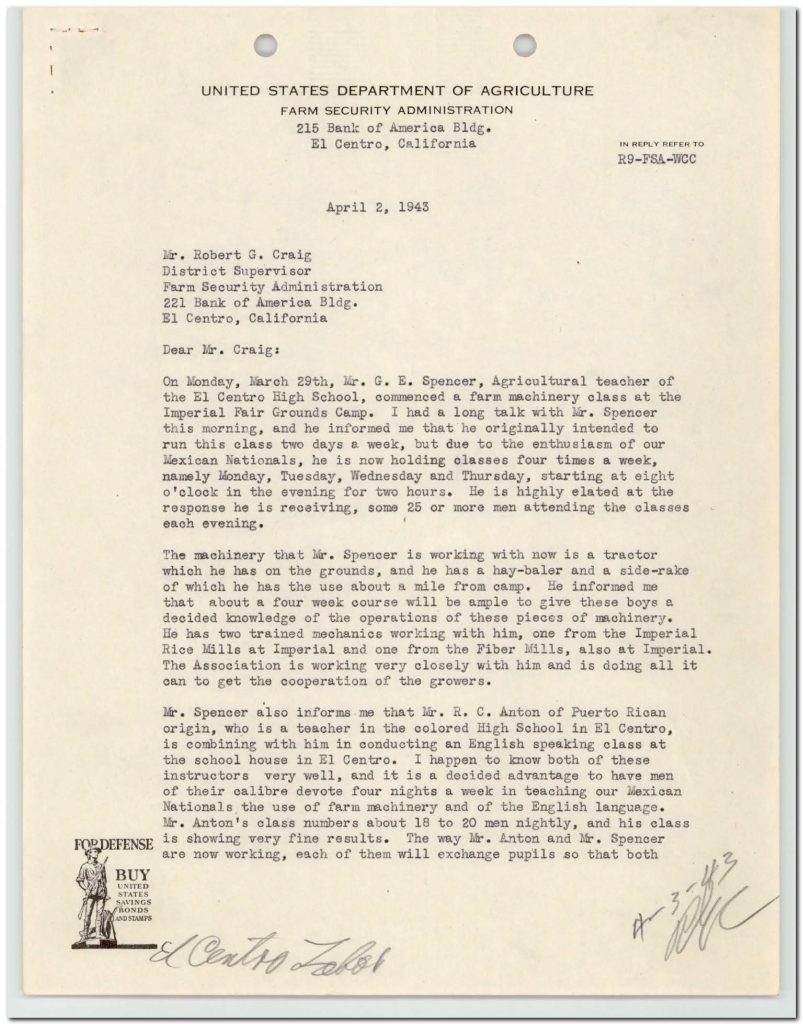
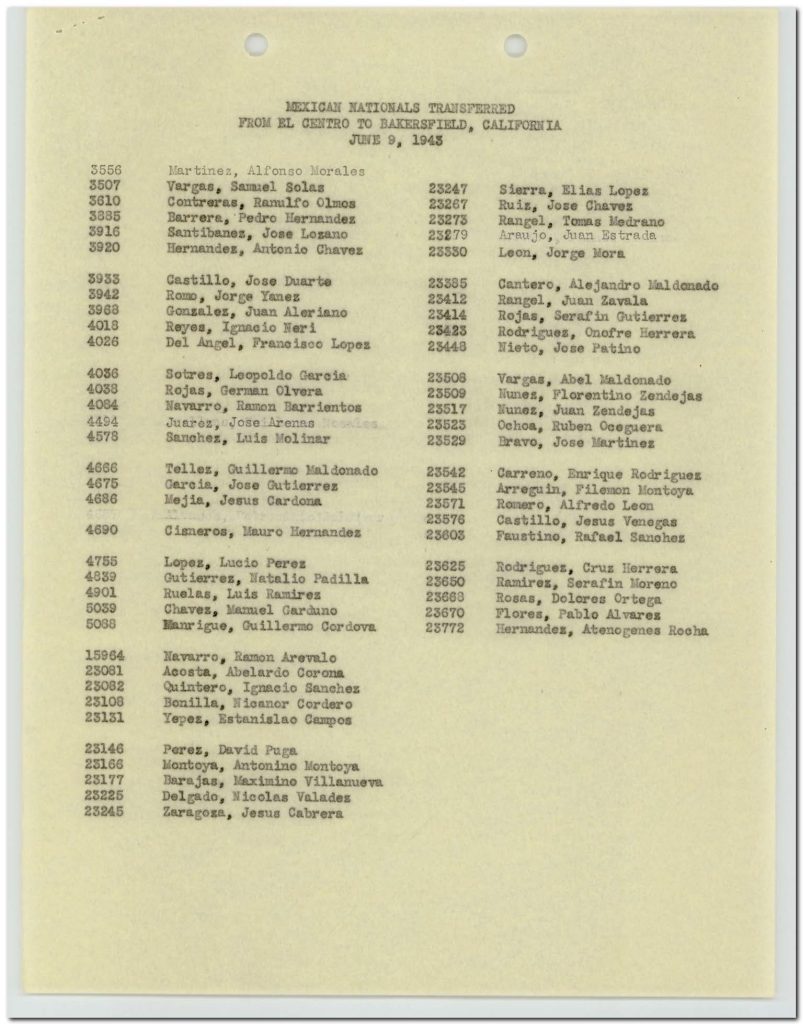
60 Braceros Transferred to Bakersfield, General – El Centro Labor Office, Record Group 224Records of the Office of Labor (War Food Administration) National Archives, https://catalog.archives.gov/id/222091491Between 1900 and 1940 over 1,000,000 Mexicans crossed into Texas, Arizona, and California. Wages remained low for immigrants, and were at the mercy of the land owners for housing and wage. Undocumented workers included agricultural laborers, skilled trade workers, and educated individuals, who later obtained critical skills during their labor in America. Many also found labor in restaurants, hotels, laundries, garages, building construction, domestic service, mills, bricklayers, factories, and railways. City migrants settled in colonies, and agriculture workers were on farm company housing.
Training of Skilled Workers and Mechanics, 500 – Rehabilitation El Centro Labor Office, Record Group 224 Records of the Office of Labor (War Food Administration), National Archives, https://catalog.archives.gov/id/222091526
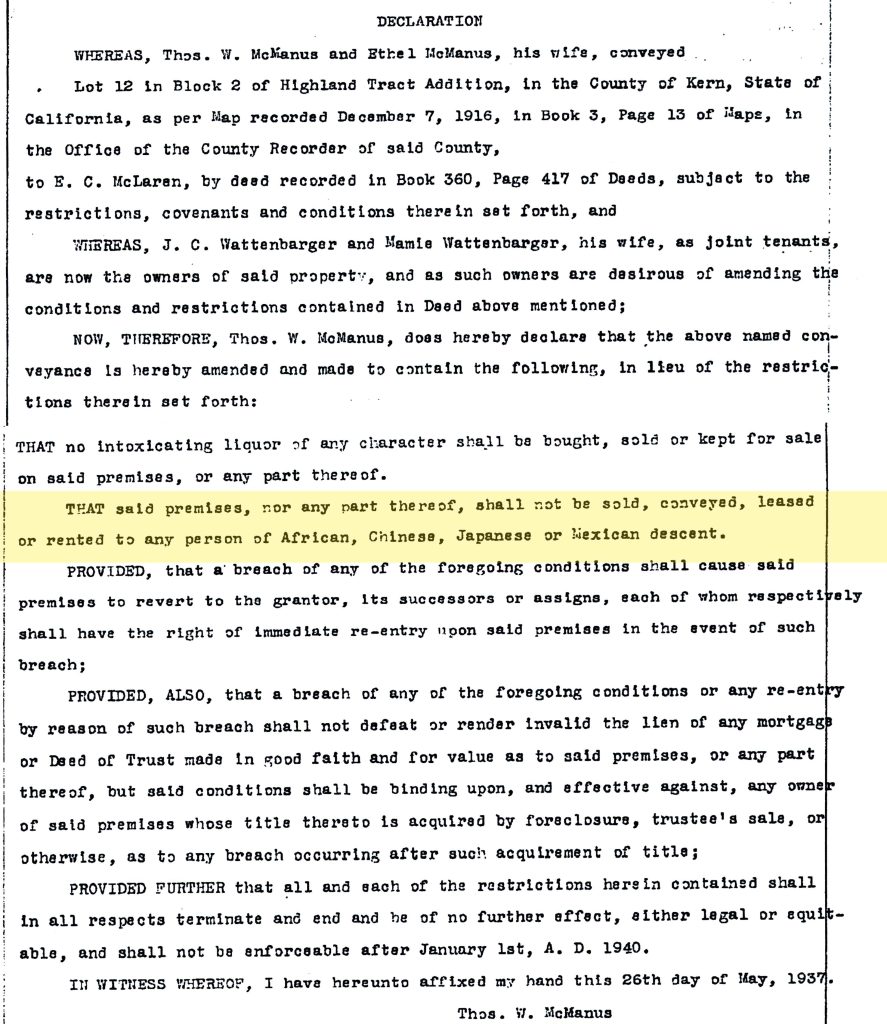
California Colonia’s (neighborhoods) were subject to racial segregation and urban systems of redlining and inequality. Violence against workers, and worker strikes led directly to the first Bracero diaspora of visa labor, and eventually Public Law 78. This was an institutional effort to quell civil rights conversations, limit citizenship, and foster a greater segregation and economic outcomes of race and labor.
Anti-Mexican Housing Restrictions, Highland Tract, June 26, 1937. Housing Discrimination and Redlining Archives, 2024-004. California State University, Bakersfield, Walter W. Stiern Library-Historical Research Center. https://archives.csub.edu/repositories/3/archival_objects/10223 Accessed March 17, 2026.
The Bracero agreement was supposed to be: travel cost covered, exempt of military service, no discrimination, and living expenses covered. On the books, Braceros were free to buy any merchandise they wanted, housing and sanitary facilities adequate, deductions of 10% for take home wages when service was completed, guaranteed contract work for ¾ of contracted time, wages to be prevailing and equal to American labor, and not less than 30 cents an hour. The Mexican labor agreement was established through yearly pubic laws: 1943 (PL 45), ,1944 (PL 229), and 1945 (PL 529). After 1946, the Department of State had notified Mexico the ending of the program, but was extended to 1949 because of employers wanting to continue the program. In 1948, prevailing wages became a point of disagreement between Mexico and the US employers that led to PL 78 of 1951, with a more centralized Department of Labor oversight and agreements. Laborers were hired by contractor associations, never directly by the farm. This method is still used as a subcontractor and in the past agriculture association companies. The subcontracted model allowed for more economic abuses and distance from labor to contract.
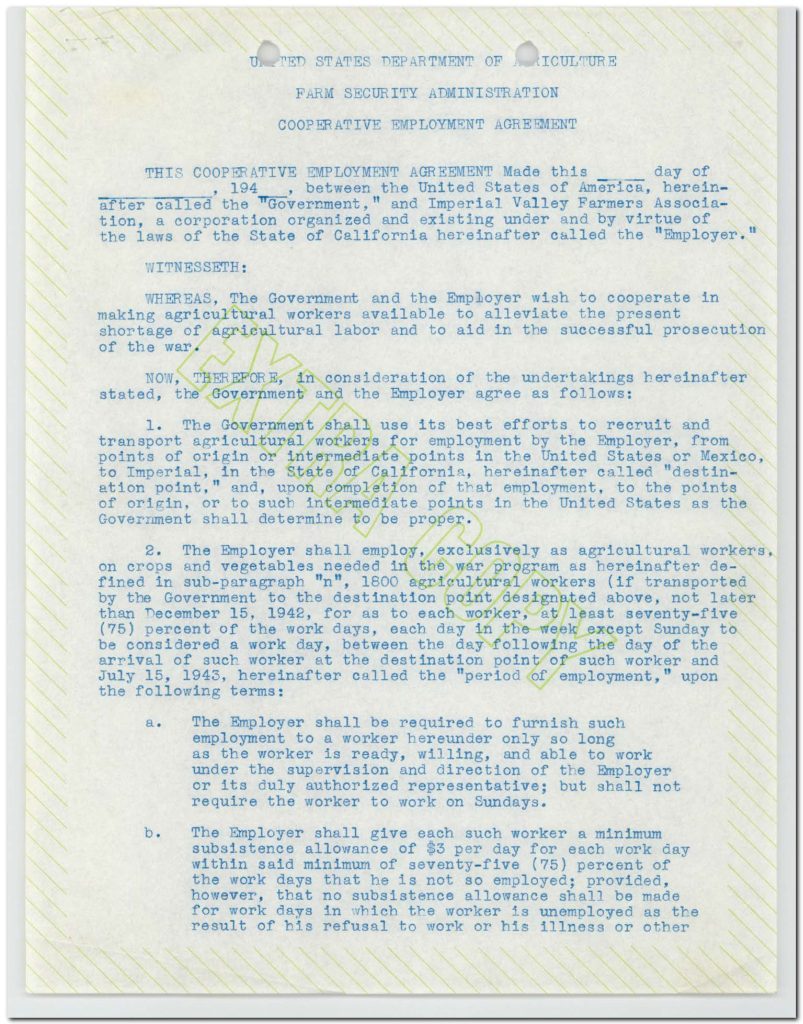
Cooperation Agreement Contract, General – El Centro Labor Office, Record Group 224Records of the Office of Labor (War Food Administration), National Archives https://catalog.archives.gov/id/222091491
DiGiorgio Fruit Company was the first to employ bracero labor in Bakersfield, and Kern County. In 1948, Border Patrol raided DiGiorgio Farms in Arvin arresting 315 in 1949, and was often the site of “surveys” or raids on the ranch. Growers often spoke about their absent knowledge of undocumented labor. In 1954, Operation “Wetback,” a racist deportation strategy campaign that started in June 1954, by the Department of Labor focusing on California and Texas. This about 10 years after the Zoot Suit civil rights demonstrations in California. Deportations were up to 2,000 a day and drastically reduced Bracero Labor. Public Law 78 forbade employers from hiring undocumented workers and reserved labor to the least desirable and most physically demanding jobs for Braceros (Visa Workers). Upon completion of satisfactory labor, they were given a mica, worker identification card, which they could later present to gain more employment access through this “recommendation.” The mica was later used, by later generations, to refer to any residency status, green card, or visa. Some Bracero’s left the program and later gained permanent residency and naturalization in the United States.
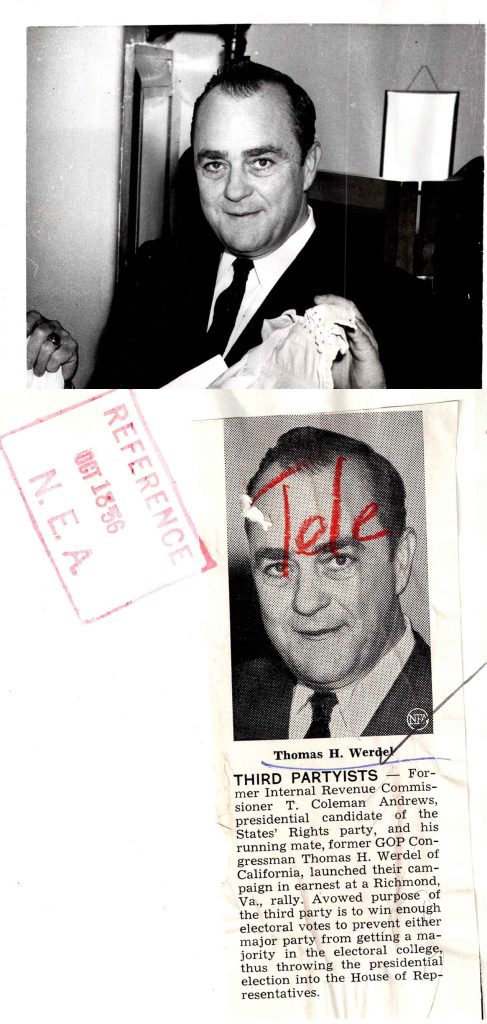
Thomas H. Werdel, a law partner of the family of the DiGiorgio, long with Bruce Sandborn Jr, the VP of the DiGiorgio Fruit Company headed the conversation of the Public Law 78 and changes. Thomas H. Werdel was a Republican politician and later ran as the Vice President pick for the States Rights Party in 1956.
“Thomas H. Werdel Third Partyists” NEA, October 1 1956, 1-8: Thomas H. Werdel holding Girdle Photo/Clipping , 30350014273653, Box: 1 Donato Cruz. Donato Cruz Collection , 2023. California State University, Bakersfield, Walter W. Stiern Library-Historical Research Center. https://archives.csub.edu/repositories/3/archival_objects/15233 Accessed March 17, 2026.
Prevailing wage was supposed to keep American labor unaffected or not in competition with Visa workers. It was argued that braceros did not compete with domestic labor or lowered their wages. Prevailing wages were always a cap on wages, and never rose between those who accepted the employment. The wage was both a ceiling and floor, often used to keep domestic and visa wages capped.
While braceros were always described as suppletory, their data showed that they dominated labor sectors. Braceros made up to 75% of the labor force in 1956 and held primary numbers of the labor force demographic until 1960. The prevailing wage decimated domestic labor, and created a pre-negotiated economic expectation, with the intent of boxing in the worker as temporary, low paid, and not included in American naturalization, citizenship rights, and expectations of equality and organizing.
Names of Bracero Workers Transferred to Bakersfield,. 500 – Rehabilitation El Centro Labor Office, Record Group 224 Records of the Office of Labor (War Food Administration), National Archives, https://catalog.archives.gov/id/222091526
Domestic workers formed unions to counter the use of bracero labor. The National Farm Labor Union was brought into the Central Valley in 1947 in Kern County and other major production centers. A strike was called on DiGiorgio company on October 1947. The Bracero was often used to break union strikes and was very effective. In Arvin, there were 130 braceros and 200 undocumented workers. The undocumented workers started the strike, the Braceros stood in solidarity the first day, but the Kern County Sherieff Loustalot, called the U.S. Department of Agriculture to “speak” or threaten the braceros into working again. The braceros were used to break the strike for six weeks until the Federal Government gave in to the union. Shortly after, the Border Patrol was called to take in the undocumented union workers. Domestic, unionized and not unionized workers saw the braceros as a reserve and force of economic action against their labor movement.
Read the works of Ernesto Galarza for more information:
The braceros were recognized in having the power to Unionize (Article 21 of their contract), but they never created a syndicate of countervailing power. Bracero contracts did not set up meeting with representatives, and the Department of Labor systemically refused to meet with union officials to discuss bracero gradiences. Workers were constantly moved and had communication and settlement challenges. Protest, rather than represented strikes were organized, their temporary status was always leveraged against them. Leaders were often found within deportable means and removed.
Public Law 78 found its challenges due to government and oversight of neutrality, even if the Bracero program was not truly equal it did represented employee interests. The agribusiness had no interest in government neutrality. Owners and managers feared that the regulate of control of wages hours, working conditions, and collective bargaining, much like the Bracero agreement would find its way into American labor conditions. Braceros were seen as a challenge by domestic workers, but too progressive in labor rights for owners. At the start of the program, farm owners and labor contractors saw the labor force under their control: systemic low wages, control of complaint process, repatriation, employment at will, housing, medical services, and limited accountability.
The bracero had a short contract, was renewable on the terms of the employer. They protested little, did not ask for lots of pay, was not familiar with customs or historic patterns of labor performance or labor conditions, and avoided stigmas as an agitator for those reasons. Braceros often worked many positions without knowing their financial value, from trimmer to loader, anything for the same wage. At times, braceros worked themselves to death.
Bracero Deaths and Burials – Mexican National Program, Record Group 224 Records of the Office of Labor (War Food Administration), National Archives https://catalog.archives.gov/id/222091539In 1950, the House of Representatives held a hearing on Arvin California. It was headed by Thomas H. Werdel, a House of Representative, which his district included Bakersfield. The strike was in Arvin, located on the DiGiorgio farms. Hearings and subcommittees had been gathering since late 1949. In the hearing room, was big farm owners, and various unions. The controversy was housing and living conditions at the DiGiorgio farm, and the film, “Poverty in the Valley of Plenty,” Produced by Hollywood Film Council, on behalf of the A.F. of L. Union.
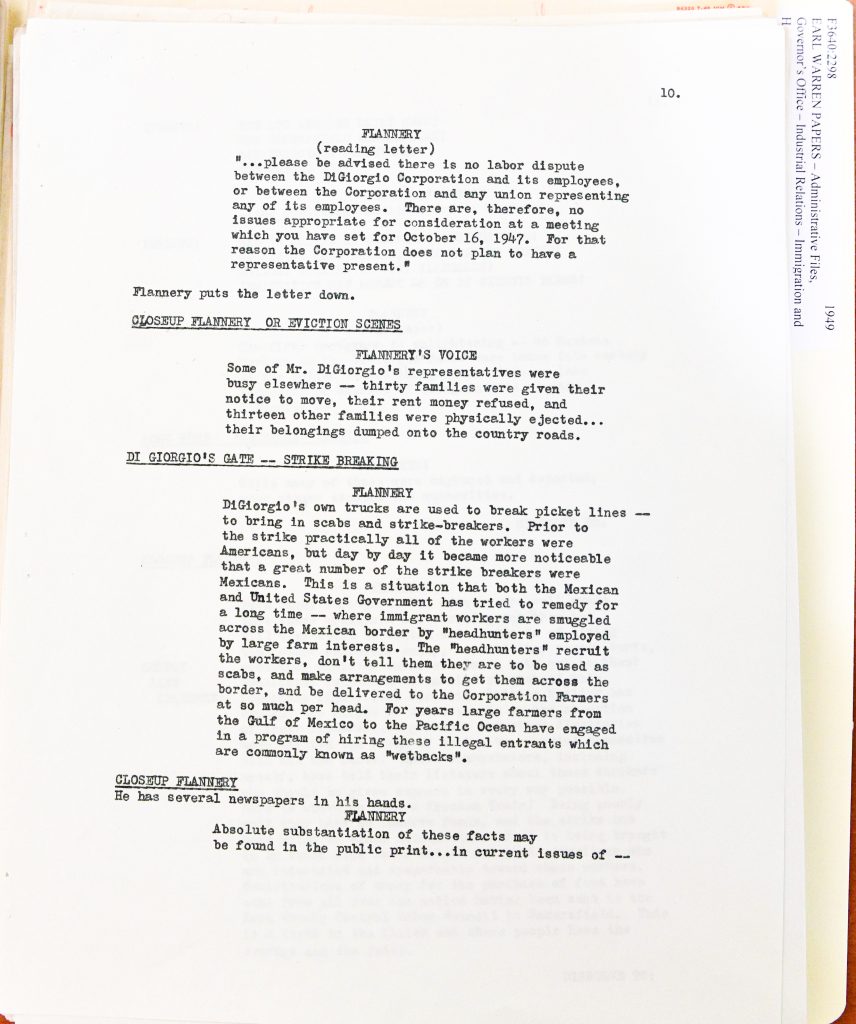
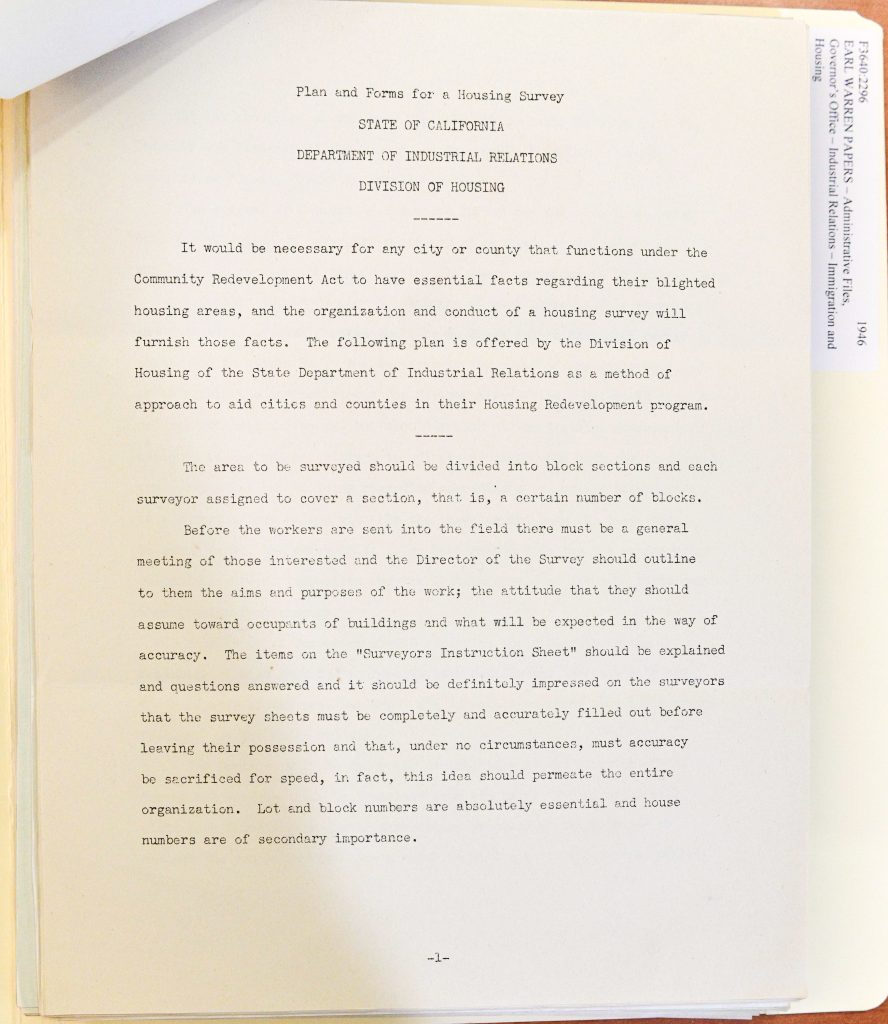
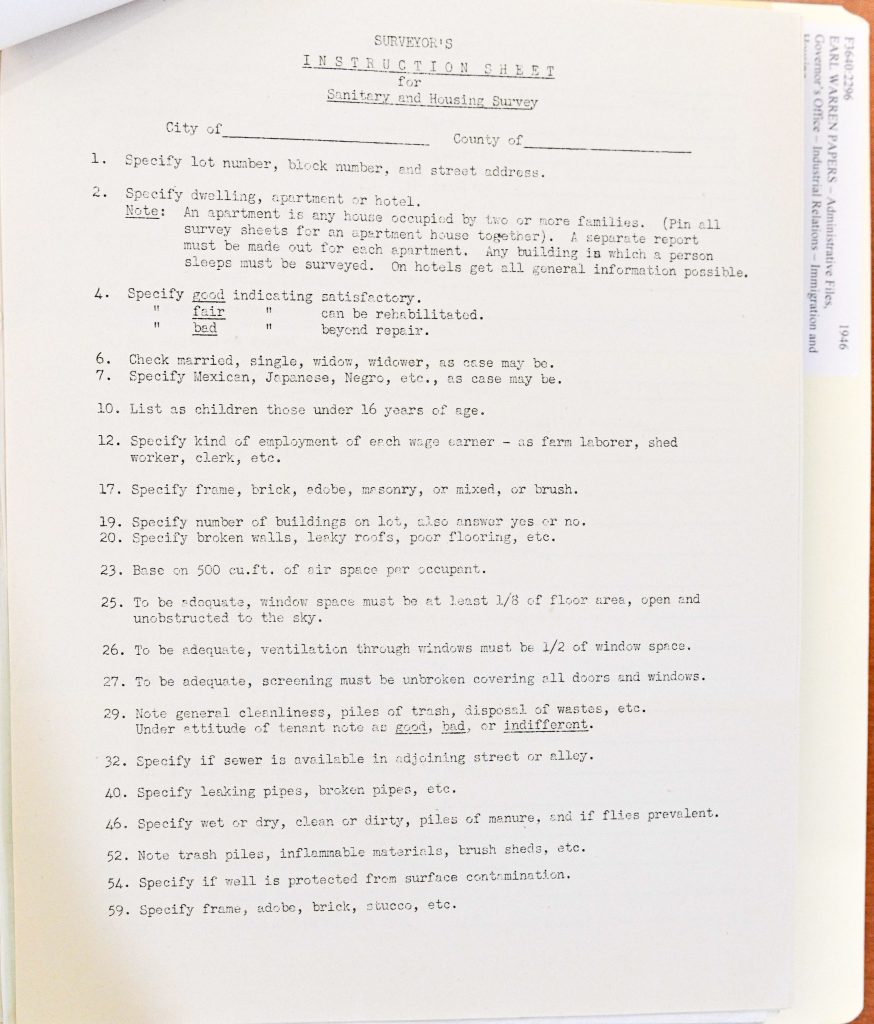
“Anti-Mexican references in ‘Poverty in the Valley of Plenty,'” Earl Warren Papers, Governor’s Office Administrative Files, Housing, Division of [Series], http://gencat.sos.ca.gov/minerva/permalink-d.html?key=6443
There was also a strike from workers regarding the conditions of labor. The DiGiorgio company sued the National Farm Labor Union and the producers for the film, following a 2-million-dollar settlement and the end of the strike. The film was also banned from showing. The film showed the poverty conditions of workers, and how they used braceros and undocumented workers as strike breakers. The film was also anti-Mexican and had xenophobic language. The lawsuit and banning was a careful orchestration of politics, lawsuits, and biased reporting against farmworkers.
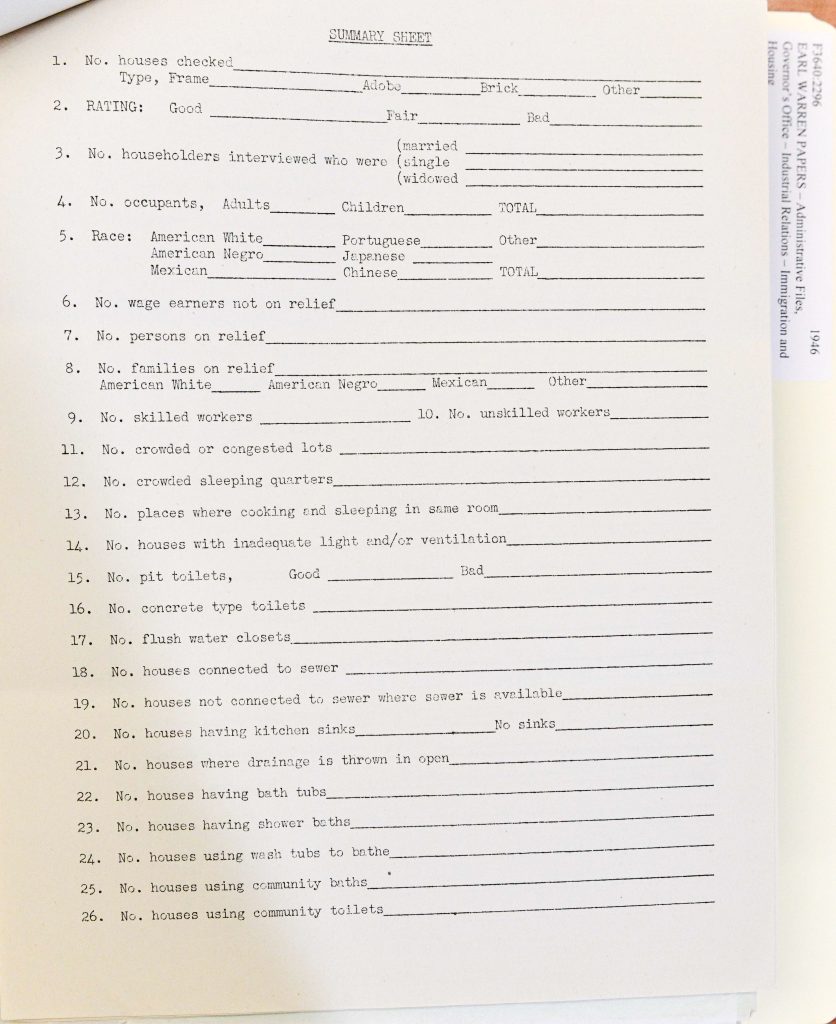
5. Race: American White, Portuguese, American Negro, Japanese, Mexican, Chinese, Other
No. 5 Race of those Surveyed, Earl Warren Papers, Governor’s Office Administrative Files, Housing, Division of [Series], http://gencat.sos.ca.gov/minerva/permalink-d.html?key=6443
In the 1940s, DiGiorgio was the second largest producer of wine in the United States. In 1942, Joseph DiGiorgio and his corporation were indited by federal grand jury for wrongful and attempting to fix and monopolize methods of distribution.
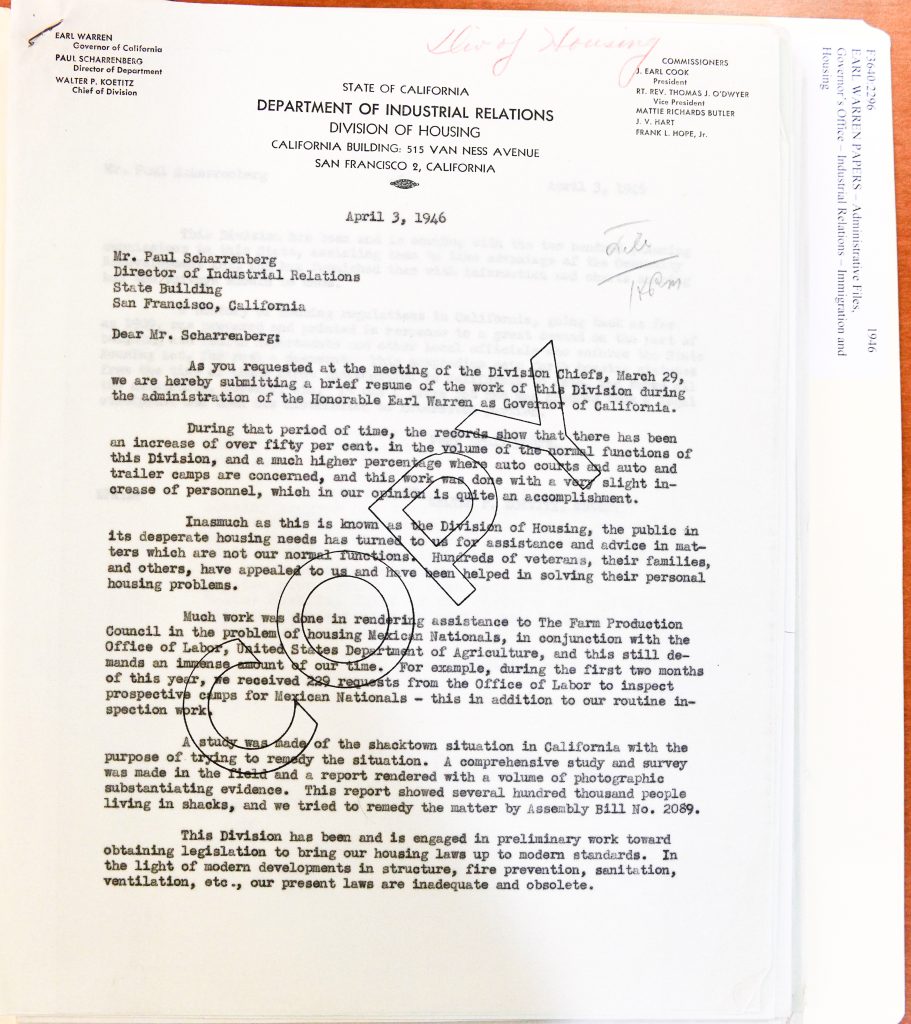
In 1946, Walter P. Koetitz, Chief of the Department of Industrial Relations, Division of Housing, wrote to the Director Paul Scharrenberg, that the State of California had received 299 requests from the Office of Labor to inspect labor camps for Mexican nationals. A study was made, regarding dilapidated farm housing conditions, with volumes of photographic evidence. Legislators had passed Assembly Bill 2089, and a voluntary redevelopment act to furnish and bring the housing up to modern living standards. Housing had already been monitored by the State of California.
229 Bracero Farm Living Quarters, Earl Warren Papers, Governor’s Office Administrative Files, Housing, Division of [Series], http://gencat.sos.ca.gov/minerva/permalink-d.html?key=6443DiGiorgio kept working camps segregated, and did not hire African Americans. As workers started to unionize past race, the company brought price negotiated braceros. When first strike began in 1947, the camp had 130 bracero workers, and Border patrol took undocumented workers who were organizing. Local 218 was organized in September 1947, and had 858 contracted to work with wage increases, seniority rights, grievance procedures, and collective bargaining, DiGiorgio did not reply. As the workers were told of DiGiorgio’s silence at the Weedpatch Grange Hall on September 30, 1947, they voted to strike the next day. The union asked for the removal of Braceros, who had laid down their tools that day too. The braceros went back to work, since they had a “collective” bargaining agreement and the convincing of Sheriff Loustalot. On November 17, the Braceros were removed. Border patrol was alerted again and again to raid the farms by the farmers and the unions.
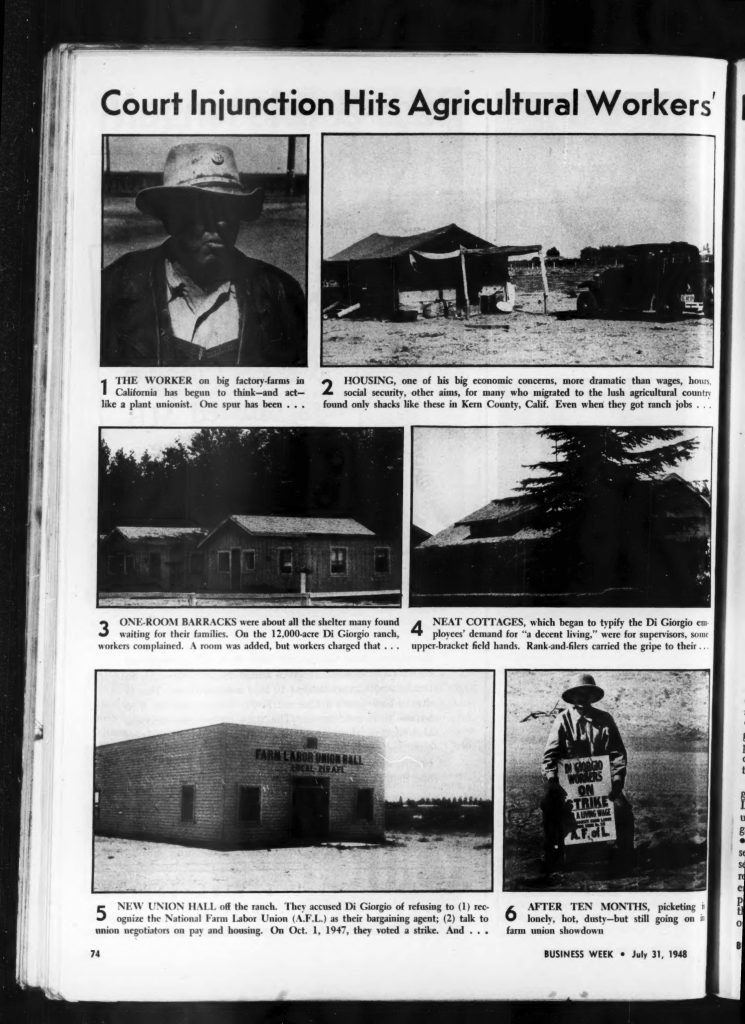
Ernesto Galarza to Earl Warren, Earl Warren Papers, Governor’s Office Administrative Files, Housing, Division of [Series], http://gencat.sos.ca.gov/minerva/permalink-d.html?key=6443Ernest Galarza wrote to Governor Earl Warren regarding Local 218, Arvin, which was strike bound at the DiGiorgio farm. Galarza wrote that the housing conditions were neglected, even after asking for improvements. He explained that Business Week had ran a propaganda story, showing that housing was good. The letter states that Galarza sent photographs of the very poor housing conditions, and that the article willfully misrepresented housing conditions.
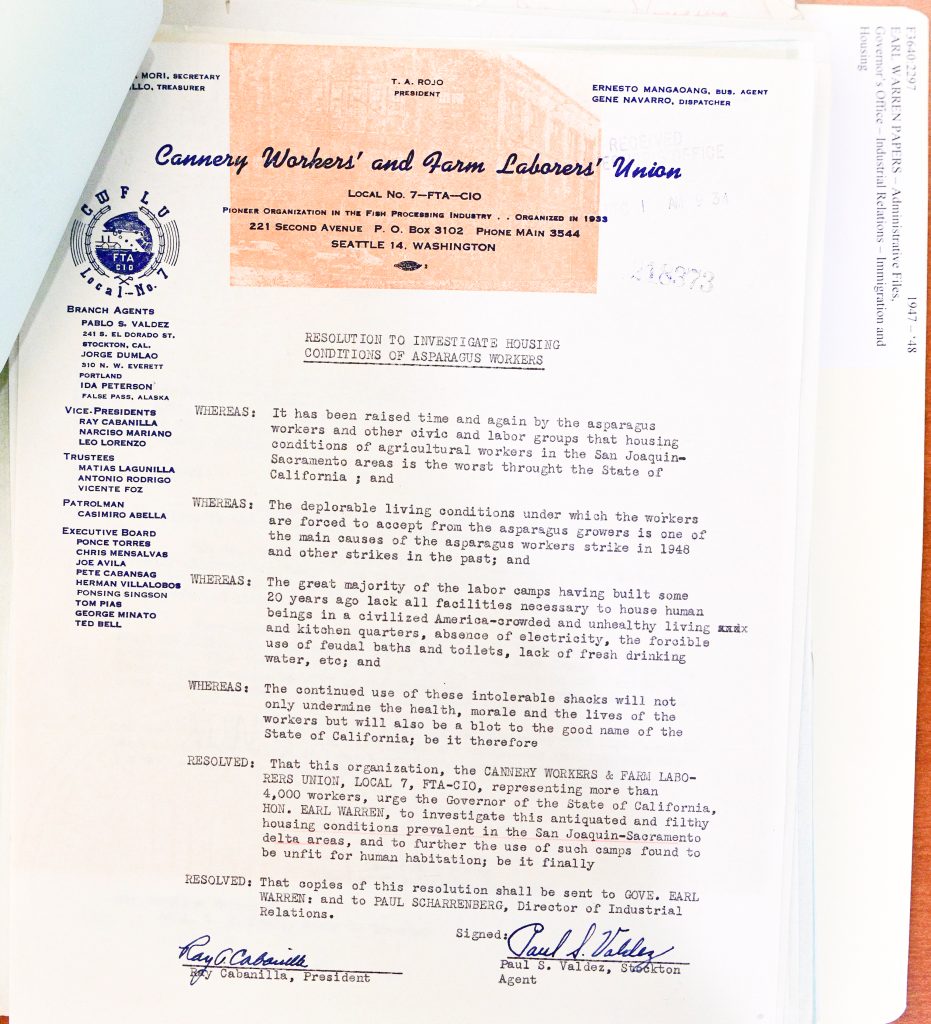
That same year, unions in the Central Valley had published and approved resolution on Agriculture Housing Conditions in San Joaquin Valley in 1948. The resolution sated that there had been deplorable housing conditions and was one of the main causes for the strike. They found the conditions intolerable with the unhealthy living conditions in the kitchen, crowded living quarters, and feudal baths, toilets, and no fresh drinking water.
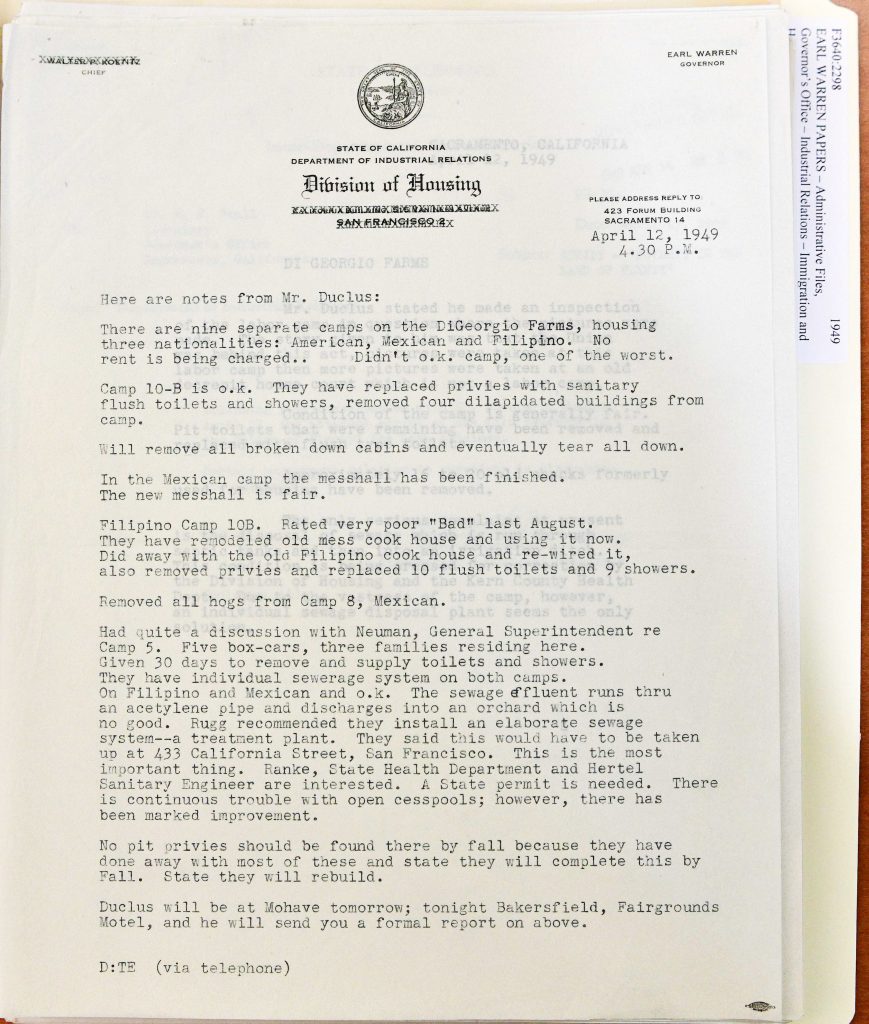
Resolution to Investigate Housing, Earl Warren Papers, Governor’s Office Administrative Files, Housing, Division of [Series], http://gencat.sos.ca.gov/minerva/permalink-d.html?key=6443Koertitz wrote to Ernest Galarza in 1948, who had raised concern regarding farm housing in Kern County, DiGiorgio Farms. Koertitz wrote that there were Americans (White), Mexican and Filipino farmers. That housing was provided for 1.25 a day for board, for single men, that there was sanitary facilities, after installing flush toilets. The American Camps were reported in good conditions. The Mexican homes were substandard, had pit toilets, and that cleanliness and sanitation was neglected. They also had hog pens near the camps. In august 1948, DiGiorgio was ordered to repair or replace sanitary facilities, garbage disposal, and pit toilets to be removed.
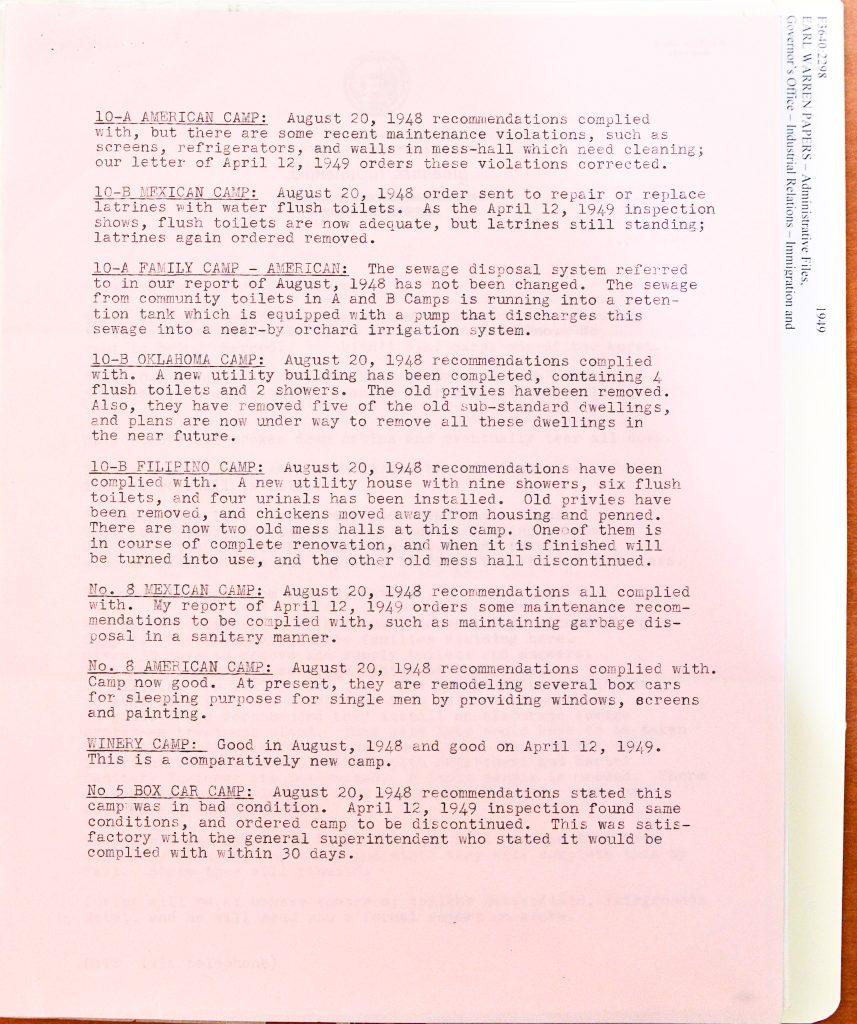
Response to Inquiry for Investigation, Earl Warren Papers, Governor’s Office Administrative Files, Housing, Division of [Series], http://gencat.sos.ca.gov/minerva/permalink-d.html?key=6443By June 1949, a two years later, housing conditions had been improved with the strike and resolutions. DiGiorgio farms had fixed the sewage system and passed state inspection. The Mexican camp now had three septic tanks, and modern leach lines. “Poverty in the Valley of Plenty,” had effectively started an effort to revitalize farmworker housing, which would help DiGiogrio win his lawsuit against the film’s producers. DiGiorgio spend between $5,000 to $8,000 to raise housing and sanitation standards, and had 17 men contracted. They installed new utility buildings, camp showers, and were gradually dispensing substandard dwellings. In 1950 there was 215 farm labor housing inspected by the State of California. The 1940s and 1950s saw the creation of modern housing codes and zoning in California. This time would also influence the start of the redevelopment of cities and destruction of homes to supplement suburbanization and post-war modern architecture.
Camp Improvements at DiGiorgio, Earl Warren Papers, Governor’s Office Administrative Files, Housing, Division of [Series], http://gencat.sos.ca.gov/minerva/permalink-d.html?key=6443Braceros were often used at sites with the greatest labor complaints and unionizing. Unions would cite braceros and undocumented workers as their greatest threat, based on how employers used them to diminish organizing power. When the undocumented workers were no longer needed, they were deported and when the bracero was the last left, they too were no longer contracted again. The farmer held all the cards against each other documented and undocumented workers, what Ernesto Galarza calls, spider in the house, workers in the field. Most of the research and history remains unsympathetic to undocumented workers and braceros for their effects on unions. This should be critical of organized labor, that they themselves draw their own lines at citizenship and visa labor.
Camp Improvements, Earl Warren Papers, Governor’s Office Administrative Files, Housing, Division of [Series], http://gencat.sos.ca.gov/minerva/permalink-d.html?key=6443Operation Wetback (racist terminology) was initiated in 1954. The undocumented person was blamed for the social problems and civil rights upheavals. 1954 was right in the middle of the Bracero height of employment, Braceros made up to 75% of the labor force in 1956 and held primary demographics until 1960. 1940 to 1950 was also when many cities were undergoing housing civil rights, desegregation of education, and employment civil rights. Bakersfield had asked for fair housing and minority neighborhoods were incorporated into city boundaries, and Bakersfield elected its first Black city council member, and had undergone a labor rights strike movement at DiGiorgio Farms. Los Angels had also elected its first Mexican American City Council Member. The same year, 1954, saw Brown vs. Board of Education. The decade was also marked by Citizens Councils, housing race restrictions, unequal education, and the start of political names like Richard Nixon, Thomas H. Werdel, and William Knowland. Ten years prior, the late 1940s, saw the use of political offices to defend farm agribusiness against civil rights complaints for adequate housing.
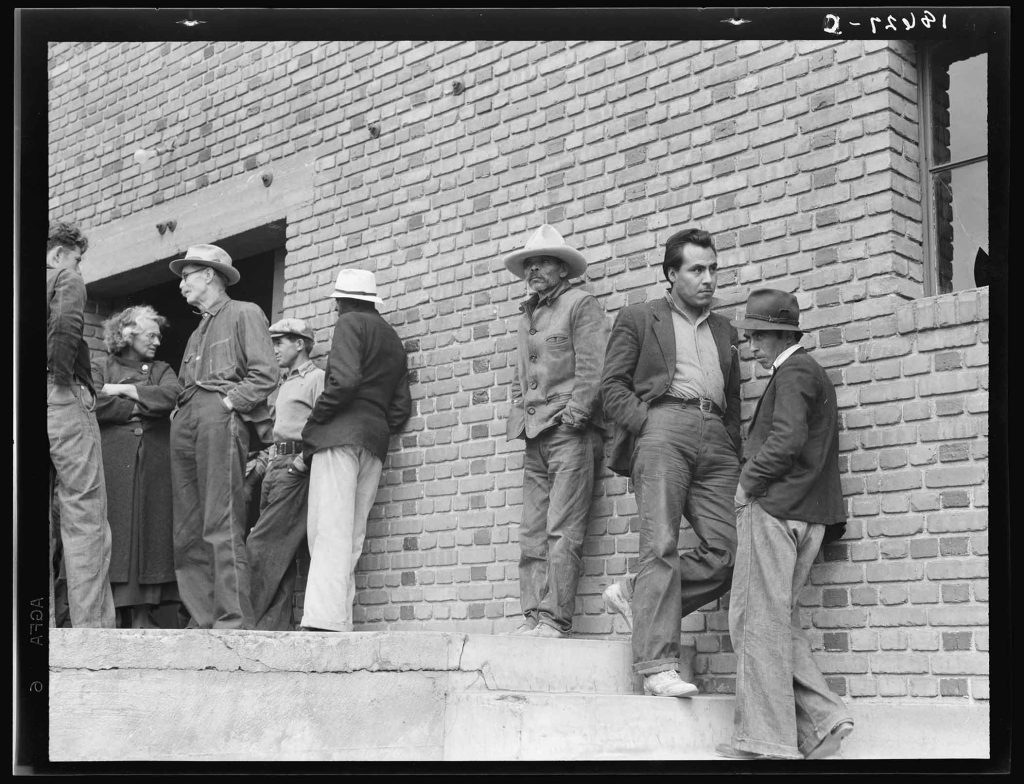
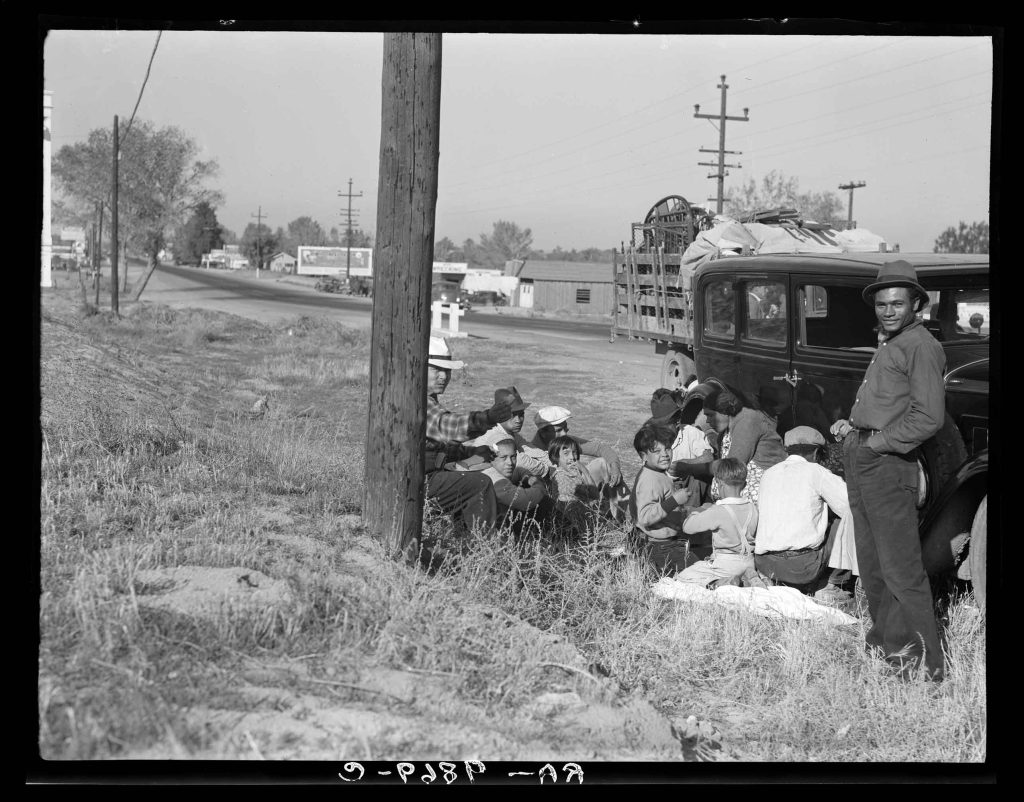
Lange, Dorothea, photographer. Mexicans bound for the Imperial Valley to harvest peas. Near Bakersfield, California. California United States Kern County Bakersfield, 1936. Nov. Photograph. https://www.loc.gov/item/2017763219/.
Braceros and undocumented workers offer earned more in the United States, but as they there located in the United State for their labor, it is often overlooked by historians that their own cost of living rose during their migration north, not all could be sent as a renitence, but what could be sent did offset the inflation in Mexico.
American unions were consolidated and gather their collective power in the 1930s, as dust bowlers moved to organize after transiting as small farmers to laborers of agribusiness, and gather racial sympathy. When Mexico declared war against the Axis Powers, that next month, July 23 1942, they signed an agreement to send Mexican workers to the United States. The Farm Security Administration was assigned as the administrative agency during the war. That next year was followed by the Zoot Suit Civil Rights movement and action in Los Angeles. Mexican Americans were beat, attacked, and jailed in 1943. Research often prioritizes Bracero numbers from the northern states in Mexico, but Braceros from Oaxaca (126,453) and Puebla (63,381) also came to the United States. Employers understood that Braceros were only good if they didn’t become American, “understood their labor rights.”
500 – Rehabilitation El Centro Labor Office, Record Group 224 Records of the Office of Labor (War Food Administration), National Archives, https://catalog.archives.gov/id/222091526The same year that Public Law 78 was amended to stop employers from contracting undocumented workers and reauthorized to bring Braceros, Operation W was initiated. Prior to 1954, Border Patrol was divided into 13 sectors. Joseph Swing became the Commissioner of Immigration. In June of 1950 William F. Kelley, Assistant Commissioner of Immigration admitted that the Border Patrol cooperated with local growers on raids after harvest seasons. During the 1950s, there was a rise of anti-undocumented groups, including civil rights organizations like the NAACP and farm labor unions. Peoples of Chicana/o/x ancestry also drew the line at citizenship, even those who became naturalized later after immigrating to the United States. Undocumented individuals were pathologized into a “wetbackism,” racist depictions and associations of increased disease rates, crime rates, narcotics, welfare cost, and exploitation. Undocumented workers were exploited by growers, professional smugglers, and their own, who spoke Spanish. In 1954, United States Attorney General Herbert Brownell (Republican Party) spent the early part of the year in California investigating claims against undocumented communities as he planned a massive action against the communities. June 9th, 1954 was the start of the mass deportation in California. Brownell was an anti-Mexican extremist and had been quoted to scare Mexican migrants by shooting a couple of them, and had theoretically planned “Operation Cloudburst,” to send California’s Sixth Army to the Border to stop the “Illegal Invasion.” Burnell helped get Joseph Swing, with a reputation as a professional “Mexican Hater.”
“Humanizing the Administration of the Immigration Law,” Address by Herbert Brownell, Jr., prepared for delivery before a Conference Sponsored by the American Council of Voluntary Agencies, Committee on Migration and Refugee Problems, the American Immigration Conference, National Council on Naturalization and Citizenship, Town Hall Club New York City, January 26, 1955 https://catalog.archives.gov/id/1790292801954 would represent the collective efforts of Border Patrol. On June 10, 1954, all boarder chiefs met in California. They created a mobile task force of 12 men patrol teams, jeeps, radios, buses planes, positive propaganda and squads to resemble special forces. June 17 Operation W would begin formally. Much of the xenophobia was based on undocumented labor, Public Law 78, and civil rights gains during the 1940s and 1950s. Deported estimates for June 17 to July 15 were about 50,000 people. Films like “Poverty in the Valley of Plenty,” and other publications often positioned citizens as not receiving benefits entitle to citizens, or that Braceros and undocumented workers got better treatment. While the bracero was taken advantage of, and had limited agency in their working conditions, their overall labor contract resembled collective bargaining. United State labor groups: White American, Mexican American, and Black American, wanted some of the Bracero negotiated provisions, that were often denied by farmers who used Braceros and undocumented labor to break their efforts. The problem was the farm owner and the United States Representatives, and Government, who had their hand in creating and sustaining the labor animosities and inequalities. Deportation of undocumented, and repatriation of Braceros did not solve labor disputes.
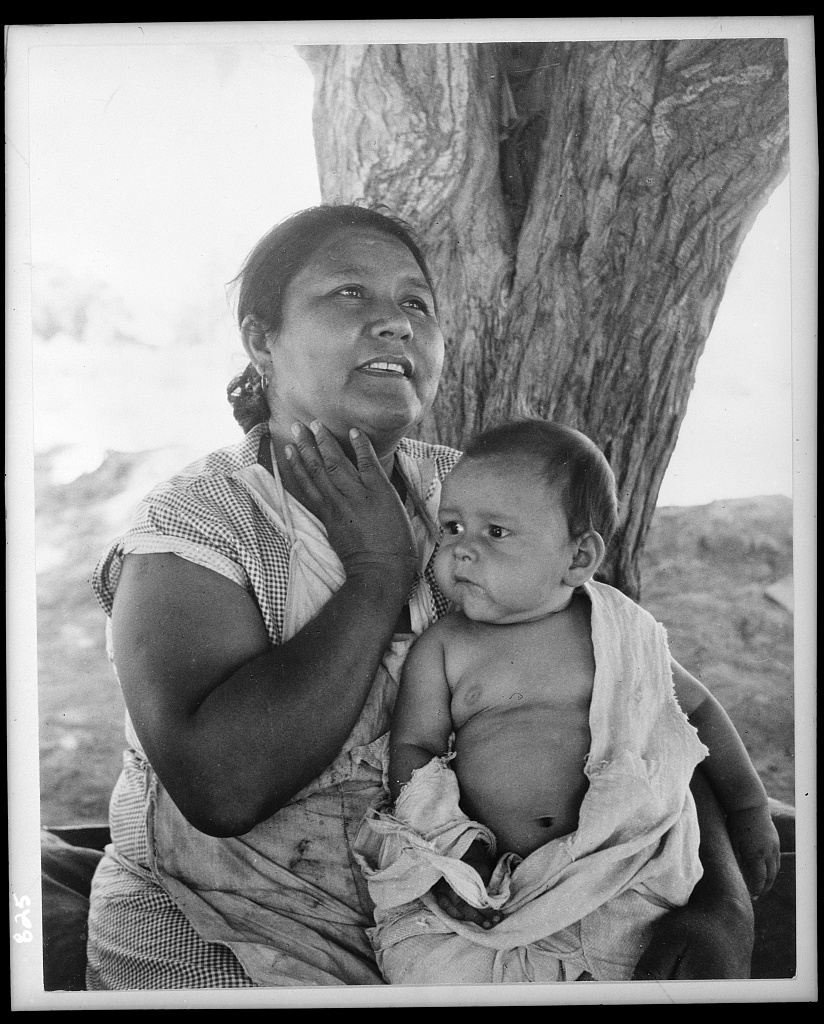
Lange, Dorothea, photographer. Mexican mother in California. “Sometimes I tell my children that I would like to go to Mexico, but they tell me ‘We don’t want to go, we belong here.'” Note on Mexican labor situation in repatriation. California United States, 1935. June. Photograph. https://www.loc.gov/item/2017759126/.
The next year, President Eisenhower State of the Union Address in 1955, proclaimed that immigration detention had ended. But the year before 1954, the United States and Border Patrol had just deported and detained many Mexican Americans, proclaiming up to 1 million deported.
“Two years ago I advised the Congress of injustices under existing immigration laws. Through humane administration, the Department of Justice is doing what it legally can to alleviate hardships. Clearance of aliens before arrival has been initiated, and except for criminal offenders, the imprisonment of aliens awaiting admission or deportation has been stopped. Certain provisions of law, however, have the effect of compelling action in respect to aliens which are inequitable in some instances and discriminatory in others. These provisions should be corrected in this session of the Congress” President Eisenhower State of the Union Address, “Annual Message to the Congress on the State of the Union.” Eisenhower Presidential Library, January 6, 1955 https://www.eisenhowerlibrary.gov/sites/default/files/file/1955_state_of_the_union.pdf
At the end of 1954, undocumented apprehensions taper after 1954, 1955, 1956 dropped to an average of 30-40 thousand each year until 1964. Those same year Bracero’s increased from 1954 (309,033), up to 400,000 contracted laborers for 1955 to 1959, and tapering to 300,000 for 1960 and 1961, and less than 200,000 from 1962 to 1964 (the height of the Civil Rights Movement, and passage of the first Civil Rights Acts.)

![5 – Mr. Cohen Mr. Vierhus' separation became effective on June 5th. However, Mrs. DeHoff informs me that he will send in a man from Phoenix area to help out for a few days so that we will be able to function and keep in contact with all of the growers' and workers' problems. TRANSFERS: On Wednesday night, June 9th, at 12 o'clock, we transferred to the Bakersfield area, as per our prior arrangements with you, 60 men who we believe will make very fine workers and will go through with their contracts without interruption. I got all of these men together prior to their leaving and informed them that they were expected to extend their contracts immediately on arrival to October 31st, and that they were to be assigned to general ranch work. I am trying to have each one of these men being transferred understand that they are not specifically crop men and that it may be possible that they will have to work on quite a different agricultural crop than that which they have been working on here. I believe it is necessary to make this explanation to those men due to the fact that most of them have been earning very good money here in carrots, and it is quite possible they will not be able to earn as much up-state as they have here. They accepted these explanations in good form and informed me that they would do whatever work was assigned to them. Sincerely yours, [signature] William C. Costello Acting County Supervisor cc: Mr. DeHoff Mr. Tribolet Detailed Description / Context: This letter documents the organized transfer of agricultural laborers to the Bakersfield area, likely within a structured labor program such as the mid-20th-century Bracero Program or a similar agricultural labor arrangement. The reference to contract extensions, coordinated transfers, and centralized oversight suggests a system in which workers were managed collectively and assigned to different agricultural tasks based on regional labor demands. The mention of workers previously earning wages in carrot production and being reassigned to potentially different crops highlights the flexibility—and precarity—of agricultural labor during this period. Such documents reflect broader patterns of labor migration, employer control, and economic conditions in California’s agricultural sector. The involvement of a county supervisor and coordination with multiple individuals indicates formal administrative oversight of labor distribution. These practices were common in California agriculture, where seasonal labor demands required organized movement of workers across regions.](https://hrc.csub.edu/wp-content/uploads/2026/03/Cooperative-Agreement_Page_057-803x1024.jpg)
![WAR FOOD ADMINISTRATION OFFICE OF LABOR 2180 Milvia St. Berkeley 4, California April 16, 1945 To: Area Representatives and Supervisors in Charge From: William A. Anglim, Chief of Operations Subject: Deaths of Mexican Nationals The record of the number of deaths among Mexican Nationals since the beginning of the Mexican Labor Program in the fall of 1942 bears evidence of the need for safety education among the workers. You will be interested in the following table listing the number of deaths in all Divisions by cause, computed as of March 14, 1945, with a total of 200 deaths. 1942 1943 1944 1945 Totals Percent Struck by vehicle on road 0 14 18 3 35 17.50 Accident while riding on vehicle 0 17 20 0 37 18.50 Accident at work 1 11 6 0 18 9.00 Other accidents 0 4 14 0 18 9.00 Killed in fight 1 5 7 2 15 7.50 Suicide 0 0 2 0 2 1.00 Natural Causes 1 22 50 2 75 37.50 TOTALS 3 73 117 7 200 100.00 Of particular interest is the figure of 54% caused by all accidents, representing 108 workers, many of whom could have been saved by a better understanding and adoption of simple principles of accident prevention. We refer you to the April issue of El Mexicano in which a notice on safety around vehicles is included. We plan to issue posters also for use in camps in pointing out certain safety items in the hope that through education the workers will become more conscious of means for preventing accidents to themselves and to other people. Of the total number of deaths 31% were caused by the Mexican National having been struck by some vehicle while on the road. This particularly reflects a lack of awareness of hazards from walking at night on the highway without necessary caution. Reports have included even such instances as a worker being struck by a car while sleeping in the middle of a highway at night and one who walked into a moving train. Intoxication was involved in many of these deaths, but not as a primary cause so it was not tabulated as such. The usual picture however is that two or three Mexican Nationals are returning to their camp at night, in varying degrees of intoxication, walking in the [cut off] Detailed Description / Context: This 1945 memorandum documents mortality among Mexican nationals participating in the wartime Mexican Labor Program, commonly associated with the Bracero Program. Administered under federal agencies such as the War Food Administration, the program brought Mexican workers to the United States to address agricultural labor shortages during World War II. The document highlights workplace and transportation hazards faced by migrant laborers, with a majority of deaths attributed to accidents, particularly those involving vehicles. The emphasis on safety education reflects federal concerns about labor conditions, but also reveals the risks inherent in the program, including inadequate infrastructure, long working hours, and living conditions that contributed to vulnerability. The memo also reflects paternalistic administrative attitudes, focusing on worker behavior (such as walking at night or intoxication) rather than broader structural conditions. Nonetheless, it provides important statistical evidence of mortality patterns and working conditions within wartime agricultural labor systems.](https://hrc.csub.edu/wp-content/uploads/2026/03/1942-1945-deaths-803x1024.jpg)
![STATE OF CALIFORNIA NATIONAL FARM LABOR UNION AFFILIATED AMERICAN FEDERATION OF LABOR 512 Victor Building 726 9th Street, N.W. WASHINGTON 1, D. C. Phone: REpublic 6613 ERNESTO GALARZA, Director Research and Education 1025 Santa Ynez Way Sacramento, Calif. August 12, 1948 My dear Governor Warren: During the past two weeks members of Local 218, Arvin, California, of the National Farm Labor Union (AFL) have gathered some information on present housing conditions on the strikebound DiGiorgio ranch. This information has come to my attention. Some of it I have confirmed from personal visits to the picket line, which is about as close as the corporation will allow persons other than its employees to the housing which it provides. It is our impression that the DiGiorgio Fruit Corporation is not now and has not in recent months complied with the housing standards specifically laid down in the State Labor Code. Confirmation of this impression seems to lie in the fact that the corporation refused at one time to allow an impartial observer to enter the premises to study housing facilities. The corporation, through certain of its friends, has widely circulated a pamphlet entitled "A Community Aroused" in which photographs are reproduced purporting to show the splendid homes that DiGiorgio provides his field hands. In the last issue of Business Week (July 31) you will find photographic evidence that the corporation palpably and deliberately misrepresented housing conditions to the public and the state authorities. On behalf of the National Farm Labor Union, I should like to ask that an immediate investigation be made of housing and living conditions on the DiGiorgio ranch near Arvin, to determine whether this corporation has been and is now abiding by the specific provisions of the State Labor Code which refer to housing for rural workers. With appreciation of your interest in this matter, and thanking you in behalf of our organization, I remain, Sincerely yours, [signature] Ernesto Galarza The Honorable Earl Warren Governor's Office State Capitol, Sacramento, Calif. Detailed Description / Context: This 1948 letter from labor leader Ernesto Galarza reflects ongoing conflicts between agricultural employers and organized labor in California’s post–World War II period. The National Farm Labor Union, affiliated with the American Federation of Labor, was actively organizing farmworkers and advocating for improved wages and living conditions. The letter focuses on the DiGiorgio Fruit Corporation, a major agricultural employer, and alleges noncompliance with state housing regulations for farmworkers. It references a strike situation in Arvin, California, and highlights the difficulty of accessing worker housing for independent inspection. The mention of public relations materials and media coverage indicates competing narratives about labor conditions. The document illustrates broader struggles over labor rights, housing standards, and employer accountability in mid-20th-century agriculture. It also highlights the role of state government in regulating labor conditions and responding to union complaints, as well as the importance of figures like Ernesto Galarza in documenting and challenging inequities faced by farmworkers.](https://hrc.csub.edu/wp-content/uploads/2026/03/DSC_8805-902x1024.jpg)
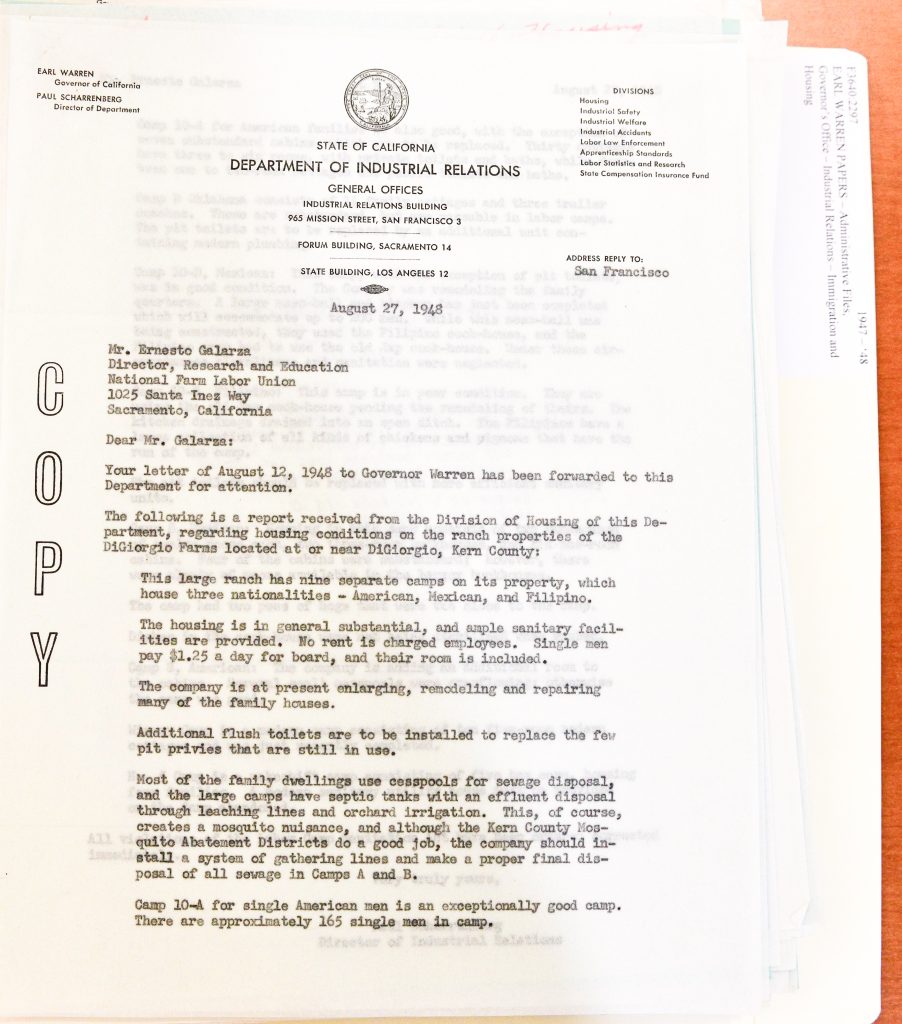
![FORM 111 DIVISION OF HOUSING DEPARTMENT OF INDUSTRIAL RELATIONS [INTER-OFFICE COMMUNICATION] San Francisco, April 14, 1949 ATTENTION: Mr. Paul Scharrenberg Director of Industrial Relations SUBJECT: DiGiorgio Farms Camps A check of the DiGiorgio Farms Camps in the Weed Patch area of Kern County was made on April 12, 1949, and it develops from this survey that there has been appreciable improvement at all these camps since the inspection of August 20, 1949. There are nine camps in all. A detailed note of the improvements is included in the attached report. The Company seems to be cooperative in their efforts to improve housing and conditions of sanitation, and our inspector was informed that the Company is spending between $5,000 and $8,000 per month in raising the housing and sanitation standards. He was further informed that some 17 men are now employed in this work. The Company is installing new utility buildings in some of their camps and providing flush water closets and showers. They are gradually dispensing with sub-standard dwellings, and are providing new mess-halls to replace the older ones. They have one small old box-car family camp that is still in operation, and we have recommended that it be discontinued. The DiGiorgio superintendent stated that this would be done within 30 days. There is a matter of sewage disposal condition at two of the main camps where the sewage from community utilities is being discharged into a retention tank and subsequently pumped, together with irrigation water, onto the orchards on the surface of the ground. This matter was called to the attention of the company last August, but nothing has been done to correct the situation, and we are again ordering its correction and will follow through to see that the sewage is disposed of in a satisfactory and sanitary manner. Charlie H. Salyers Charlie H. Salyers Chief of Division Detailed Description / Context: This 1949 memorandum represents a follow-up inspection of housing conditions at DiGiorgio Farms in Kern County, California, following earlier complaints and investigations initiated by labor unions such as the National Farm Labor Union. It reflects ongoing state monitoring of agricultural labor camps during a period of heightened scrutiny of farmworker living conditions. The document indicates that improvements were made, including installation of sanitation facilities and replacement of substandard housing, suggesting some responsiveness by the company to regulatory pressure. However, it also highlights persistent infrastructural problems, particularly in sewage disposal, underscoring the uneven nature of reform efforts. The reference to the Weed Patch area connects the site to a historically significant region associated with migrant labor camps dating back to the Dust Bowl era. The memo illustrates how state agencies attempted to enforce housing standards amid broader labor disputes, economic pressures, and evolving regulatory frameworks in postwar California agriculture.](https://hrc.csub.edu/wp-content/uploads/2026/03/DSC_8839-881x1024.jpg)
![Full Extracted Text:215 Bank of America Bldg. El Centro, California R9-FSA-WCC April 21, 1943 Mr. Myer Cohen Asst. Regional Director, M Farm Security Administration 30 Van Ness Avenue San Francisco, California Subject: AYALA, David C. #3645 Dear Mr. Cohen: According to our records here, Mexican National David C. Ayala, who arrived here on November 18, 1942, is an American citizen, and although I can find nothing relating to him in the files, I do recall that Mr. Speares turned him over to the Immigration Authorities when he refused to work shortly after his arrival. This was due to the fact that the man produced a baptismal certificate showing that he was born in California and that he claimed we had no control over him. The Immigration authorities, together with the F.B.I., had him in charge for a while and then turned him loose. According to his yellow card, he was born 9-7-1919, and although he married in Mexico, he would be subject to draft regulations, as his age would now be 23 years. I have not seen or heard anything of this man for some considerable time, and I assume that he is either in the Army or working some place in California outside of the control of our office. This information is given to you at this late date so that you can arrange your files accordingly. Very truly yours, [signature] William C. Costello, Acting Asst. Employment Supervisor cc: Mr. DeHoff Mr. Craig Detailed Description / Context: This 1943 letter highlights administrative complexities within wartime agricultural labor programs, particularly in distinguishing between Mexican nationals recruited for farm labor and U.S.-born individuals of Mexican descent. The case of David C. Ayala illustrates how documentation such as baptismal certificates could establish citizenship and challenge the authority of labor program administrators. The involvement of immigration authorities and the FBI indicates the intersection of labor management with federal enforcement and wartime regulatory systems, including military draft requirements. The reference to a “yellow card” suggests identification systems used within labor programs to track workers. The document reflects broader issues of identity, citizenship, and labor control during World War II, especially within programs like the Bracero Program and related agricultural labor initiatives. It underscores how racialized assumptions and bureaucratic processes shaped the treatment of workers of Mexican origin, regardless of citizenship status.](https://hrc.csub.edu/wp-content/uploads/2026/03/American-Born-Bracero-803x1024.jpg)
![There are two kinds of Mexican aliens working in our country. One is called a "Bracero." His entry is legal. He carries no formal passport but a white card which makes him eligible for temporary employment in our country. He is engaged under a formal contract, the terms of which are approved by the Mexican and the United States Governments. This contract guarantees the prevailing wage, stable employment, housing, food at reasonable cost and occupational insurance. In farm areas where the Department of Labor finds that there is not sufficient domestic help available for planting, harvesting and other needs, these "braceros" are a welcome and appreciated addition to our work force. When their work is completed, they are required to return to Mexico. The other kind of Mexican alien found in our country comes illegally. He is called a "Wetback" because many of them swim or wade the Rio Grande in the Texas area to get into this country unnoticed. Others come hidden in trains, trucks and cars. Since they are here illegally, they will work for starvation wages and live in sub-standard housing often without sanitation facilities. These conditions breed crime and disease. Many become a burden on the welfare resources of cities and communities. They cause other serious social and economic problems for the United States. You will appreciate the enormity of this problem when you learn that in each of the years ending June 30, 1953 and June 30, 1954, there were more than 1,000,000 apprehensions of Mexican aliens illegally in the United States. After making my survey trip to the Mexican border, I determined that this situation had to be cleaned up. Accordingly, in May 1954, we started a drive against illegal Mexican labor, hoping to wipe out the disease, criminal [cut off] Detailed Description / Context: This document reflects U.S. government discourse on Mexican labor migration during the mid-20th century, particularly in the context of the Bracero Program (1942–1964) and immigration enforcement efforts such as Operation Wetback (1954). The text distinguishes between legally contracted agricultural workers and undocumented migrants, presenting the former as regulated and beneficial while portraying the latter in negative and often stigmatizing terms. The language used in the document—including terminology now recognized as derogatory—illustrates prevailing attitudes within government policy discussions of the period. It also highlights how immigration policy was closely tied to labor needs in agriculture, with legal programs designed to supply workers while enforcement campaigns sought to control unauthorized migration. The reference to large numbers of apprehensions and a coordinated enforcement “drive” situates the document within broader federal efforts to regulate the border and labor markets. The document is significant for understanding how economic demand, labor policy, and immigration enforcement intersected in shaping U.S.–Mexico migration patterns and public discourse during the 1950s.](https://hrc.csub.edu/wp-content/uploads/2026/03/Pages-from-Brownell-01-26-1955-794x1024.jpg)
![Full Extracted Text:9 - activity, juvenile delinquency and social instability that attends any wetback invasion. To gain control over the situation, we used all available manpower of the Service from all sections of the country to reinforce the Border Patrol. "Operation wetback" began on June 10, 1954, in California, and on July 15, 1954 in South Texas. Public notice was given before the operation began that a concentrated drive was to be made on the wetbacks. Employers were urged to arrange to obtain legal Mexican labor. The Service officers engaged on this operation worked without time off and around the clock. They swept the border areas clean. Before their net many of the illegal Mexican laborers voluntarily fled back to Mexico without awaiting enforcement of their departure. Thousands more were rounded up, collected in staging areas, and returned to Mexico. This large scale operation involving about 250,000 "wetbacks" was carried out humanely without disorder or incident. Members of family groups were allowed to remain together. Persons having property or equities in the United States were allowed reasonable opportunity to dispose of them. When periods of waiting were required for transportation, adequate food and shelter were provided. As a whole, ranchers and farmers willingly cooperated in the program, and agreed to conform with the law. Material assistance was given too by counties, cities and towns where the program was underway. The Mexican Government also cooperated fully in the operation. These vigorous and well organized efforts have brought the lawless situation under control. The Border Patrol has been augmented. Its patrols are covering more ground than ever before. The success of "operation [cut off] Detailed Description / Context: This document reflects official U.S. government reporting on Operation Wetback, a 1954 immigration enforcement campaign aimed at removing undocumented Mexican workers from the United States. The operation involved coordinated efforts by the Immigration and Naturalization Service (INS), Border Patrol, and local authorities, and resulted in hundreds of thousands of deportations. The language used in the document reflects the perspective and terminology of the period, including framing undocumented migration as a source of social instability and emphasizing the efficiency and scale of enforcement actions. The text presents the operation as orderly and cooperative, highlighting coordination with employers, local governments, and the Mexican government. Historically, Operation Wetback has been widely studied as a major episode in U.S. immigration enforcement, with scholars noting both its scale and its human impact, including forced removals and disruption of communities. The document illustrates how federal authorities justified and described enforcement efforts within the broader context of labor demand, border control, and mid-20th-century migration policy.](https://hrc.csub.edu/wp-content/uploads/2026/03/Pages-from-Brownell-01-26-1955-3-795x1024.jpg)