English Only

Proposition 63- English as the Official State Language


To Speak of apartheid, then, in postwar California, is to inquire into a system of meaning making and policy formation that constructed compelling ideas about the inevitability of racial hierarchy and segregation. The formal structures of racial exclusion rapidly developed ideas about rights and opportunity that were publicly valorized.

HoSang, D. (2010). Racial propositions : ballot initiatives and the making of postwar California (1st ed.). University of California Press. https://doi.org/10.1525/9780520947719
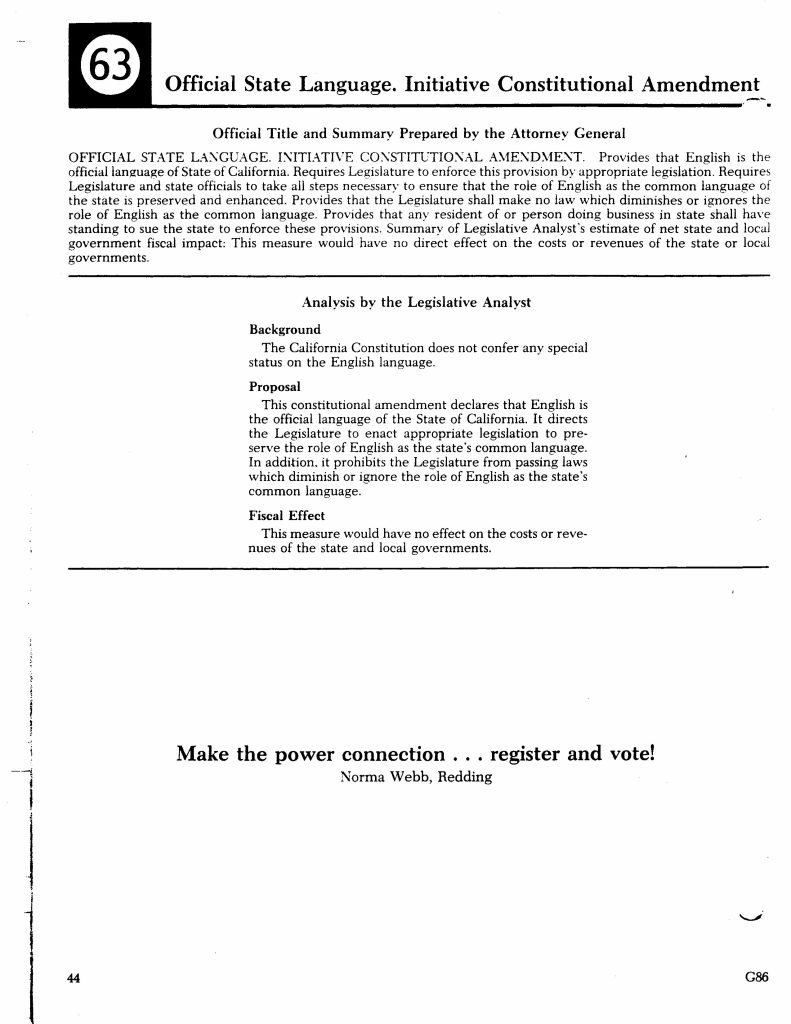
 

Proposition 63 appeared on the November 1986 California ballot as a constitutional amendment establishing English as the state's official language. The initiative was part of a broader national movement during the 1980s advocating for “Official English” laws in response to increasing linguistic diversity and immigration. The measure amended the California Constitution and directed the Legislature to support and preserve English as the common language of government.Politically, the initiative reflected debates over bilingual education, multilingual ballots, and access to public services for non-English-speaking residents. Although the Legislative Analyst projected no direct fiscal impact, the amendment carried potential legal implications, including granting residents standing to sue the state to enforce the language provisions. The initiative intersected with federal civil rights law, including Voting Rights Act requirements for bilingual election materials, and contributed to ongoing discussions about language policy, civic participation, and immigrant integration in California.
Official State Language. Initiative Constitutional Amendment California Proposition 63 (1986). https://repository.uclawsf.edu/ca_ballot_props/968


Dr. Samuel Hayakawa, a former California State University Presidents, and later Senator, racialized the gaze of politics with Proposition 63, English as the California State Official Language. The English as the Official Language oriented political whiteness as priority in policy. Political whiteness became renovated and renewed at time of considerable social, economic, and political changes in the 1980s. Dubbed as the “English Only” proposition, even when written by a person of color, only reinforced racial stereotypes and excluded US non-English speaking citizens, residents, and many others. The policy suggested that society was anti-Spanish speaking, anti-Hispanic, Latina/e/o/x, as the 1980s represented a large growth of Latina/e/o/x demographic. The legislation was billed as “good for minorities.” 
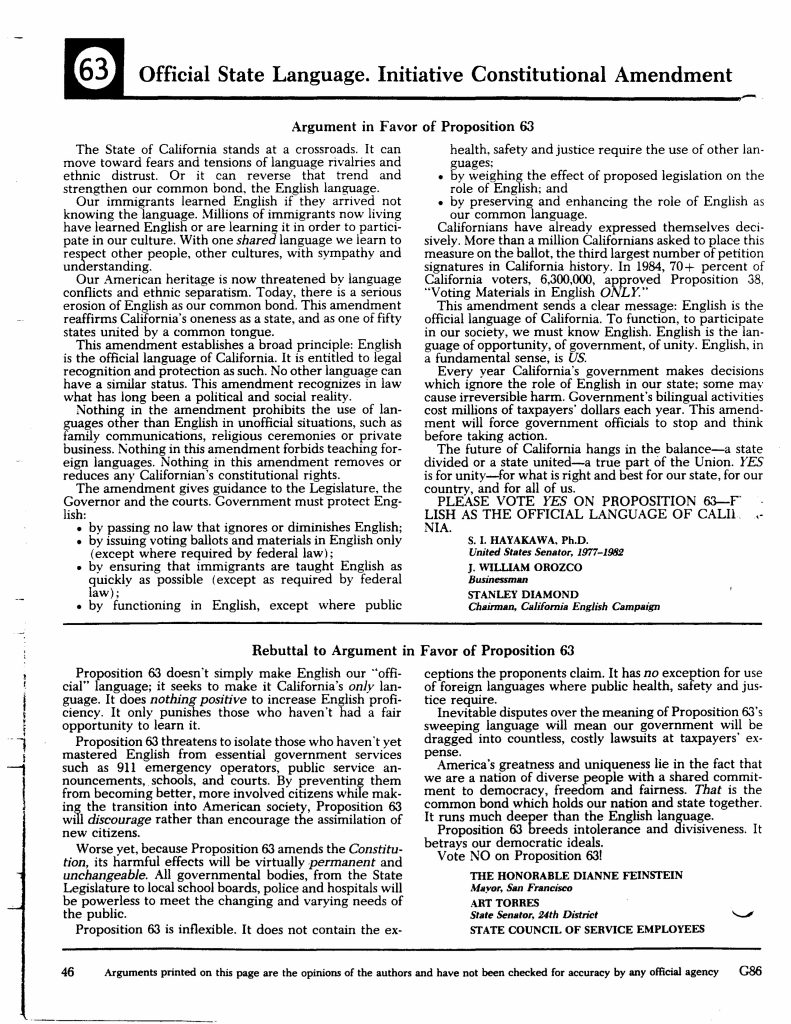
63Official State Language. Initiative Constitutional Amendment Argument in Favor of Proposition 63 The State of California stands at a crossroads. It can move toward fears and tensions of language rivalries and ethnic distrust. Or it can reverse that trend and strengthen our common bond, the English language. Our immigrants learned English if they arrived not knowing the language. Millions of immigrants now living have learned English or are learning it in order to participate in our culture. With one shared language we learn to respect other people, other cultures, with sympathy and understanding. Our American heritage is now threatened by language conflicts and ethnic separatism. Today, there is a serious erosion of English as our common bond. This amendment reaffirms California’s oneness as a state, and as one of fifty states united by a common tongue. This amendment establishes a broad principle: English is the official language of California. It is entitled to legal recognition and protection as such. No other language can have a similar status. This amendment recognizes in law what has long been a political and social reality. Nothing in the amendment prohibits the use of languages other than English in unofficial situations, such as family communications, religious ceremonies or private business. Nothing in this amendment forbids teaching foreign languages. Nothing in this amendment removes or reduces any Californian’s constitutional rights. The amendment gives guidance to the Legislature, the Governor and the courts. Government must protect English: • by passing no law that ignores or diminishes English; • by issuing voting ballots and materials in English only (except where required by federal law); • by ensuring that immigrants are taught English as quickly as possible (except as required by federal law); • by functioning in English, except where public health, safety and justice require the use of other languages; • by weighing the effect of proposed legislation on the role of English; and • by preserving and enhancing the role of English as our common language. Californians have already expressed themselves decisively. More than a million Californians asked to place this measure on the ballot, the third largest number of petition signatures in California history. In 1984, 70+ percent of California voters, 6,300,000, approved Proposition 38, “Voting Materials in English Only.” This amendment sends a clear message: English is the official language of California. To function, to participate in our society, we must know English. English is the language of opportunity, of government, of unity. English, in a fundamental sense, is US. Every year California’s government makes decisions which ignore the role of English in our state; some may cause irreversible harm. Government’s bilingual activities cost millions of taxpayers’ dollars each year. This amendment will force government officials to stop and think before taking action. The future of California hangs in the balance—a state divided or a state united—a true part of the Union. YES for unity—for what is right and best for our state, for our country, and for all of us. PLEASE VOTE YES ON PROPOSITION 63—ENGLISH AS THE OFFICIAL LANGUAGE OF CALIFORNIA. S. I. HAYAKAWA, Ph.D. United States Senator, 1977–1982 J. WILLIAM OROZCO Businessman STANLEY DIAMOND Chairman, California English Campaign Rebuttal to Argument in Favor of Proposition 63 Proposition 63 doesn’t simply make English our “official” language; it seeks to make it California’s only language. It does nothing positive to increase English proficiency. It only punishes those who haven’t had a fair opportunity to learn it. Proposition 63 threatens to isolate those who haven’t yet mastered English from essential government services such as 911 emergency operators, public service announcements, schools, and courts. By preventing them from becoming better, more involved citizens while making the transition into American society, Proposition 63 will discourage rather than encourage the assimilation of new citizens. Worse yet, because Proposition 63 amends the Constitution, its harmful effects will be virtually permanent and unchangeable. All governmental bodies, from the State Legislature to local school boards, police and hospitals will be powerless to meet the changing and varying needs of the public. Proposition 63 is inflexible. It does not contain the exceptions the proponents claim. It has no exception for use of foreign languages where public health, safety and justice require. Inevitable disputes over the meaning of Proposition 63’s sweeping language will mean our government will be dragged into countless, costly lawsuits at taxpayers’ expense. America’s greatness and uniqueness lie in the fact that we are a nation of diverse people with a shared commitment to democracy, freedom and fairness. That is the common bond which holds our nation and state together. It runs much deeper than the English language. Proposition 63 breeds intolerance and divisiveness. It betrays our democratic ideals. Vote NO on Proposition 63! THE HONORABLE DIANNE FEINSTEIN Mayor, San Francisco ART TORRES State Senator, 24th District STATE COUNCIL OF SERVICE EMPLOYEES 46 Arguments printed on this page are the opinions of the authors and have not been checked for accuracy by any official agency G86 Detailed Description / Context: This ballot pamphlet page reflects the public arguments surrounding Proposition 63 in 1986, when California voters considered amending the state constitution to declare English the official language. The initiative emerged during a period of heightened political debate over immigration, bilingual education, and multilingual government services, particularly in a state experiencing significant demographic change. Supporters framed the amendment as a unifying measure reinforcing English as a common civic language and limiting government bilingual activities. Opponents argued that the constitutional amendment risked restricting access to public services, increasing litigation, and marginalizing non-English-speaking residents. The measure intersected with federal civil rights requirements, including Voting Rights Act provisions mandating bilingual election materials in certain jurisdictions. As a constitutional amendment, Proposition 63 had durable legal implications, potentially constraining legislative flexibility in language policy. The arguments illustrate broader national discussions in the 1980s over “Official English” initiatives, assimilation, multiculturalism, and the relationship between language, citizenship, and public administration.
Official State Language. Initiative Constitutional Amendment California Proposition 63 (1986). https://repository.uclawsf.edu/ca_ballot_props/968


San Francisco September 29, 1986- Statement on the hearing of Proposition 63 
DocsCal L534 H42 CALIFORNIA LEGISLATURE ASSEMBLY TASK FORCE ON PROPOSITION 63 ASSEMBLYMAN ELIHU HARRIS, CHAIRMAN SENATE COMMITTEE ON ELECTIONS SENATOR PAUL B. CARPENTER, CHAIRMAN JOINT INTERIM HEARING ON PROPOSITION 63 ENGLISH AS THE OFFICIAL STATE LANGUAGE CALIFORNIA STATE ASSEMBLY SEAL OF THE SENATE OF THE STATE OF CALIFORNIA SEPTEMBER 29, 1986 SAN FRANCISCO CALIFORNIA DOCUMENTS Depository JUL 25 1988 LIBRARY C.S.C. Bakersfield 099J Detailed Description / Context: Proposition 63 was placed on the November 1986 California ballot as a constitutional amendment declaring English the official language of the state. The measure emerged within broader national debates over immigration, bilingual education, multilingual ballots, and government language services during the 1980s. California, experiencing substantial demographic change, became a central site of these policy discussions. The joint interim hearing represented legislative inquiry into the legal, political, and administrative implications of formalizing English as the state’s official language. Issues implicated by the measure included compliance with the federal Voting Rights Act, access to public services for non-English-speaking residents, and the symbolic and practical effects of constitutional language designation. Although framed by supporters as reinforcing civic unity, critics raised concerns about potential impacts on civil rights, public administration, and equal access to government programs. The hearing documentation reflects the intersection of language policy, immigration politics, and constitutional law in late twentieth-century California.
Assembly Task Form on Proosition 63 and Senate Committee on Elections, “Joint Interim Hearing on Proposition 63: English as the Official State Language” (1986). California Joint Committees. 27. https://digitalcommons.law.ggu.edu/caldocs_joint_committees/27

Arturo Madrid- “I want you to understand that there is no golden age of language in the United States, there’s no period in our history when we were all one linguistic and that there is no historical basis for the thesis that it is only English that holds this society together.” 
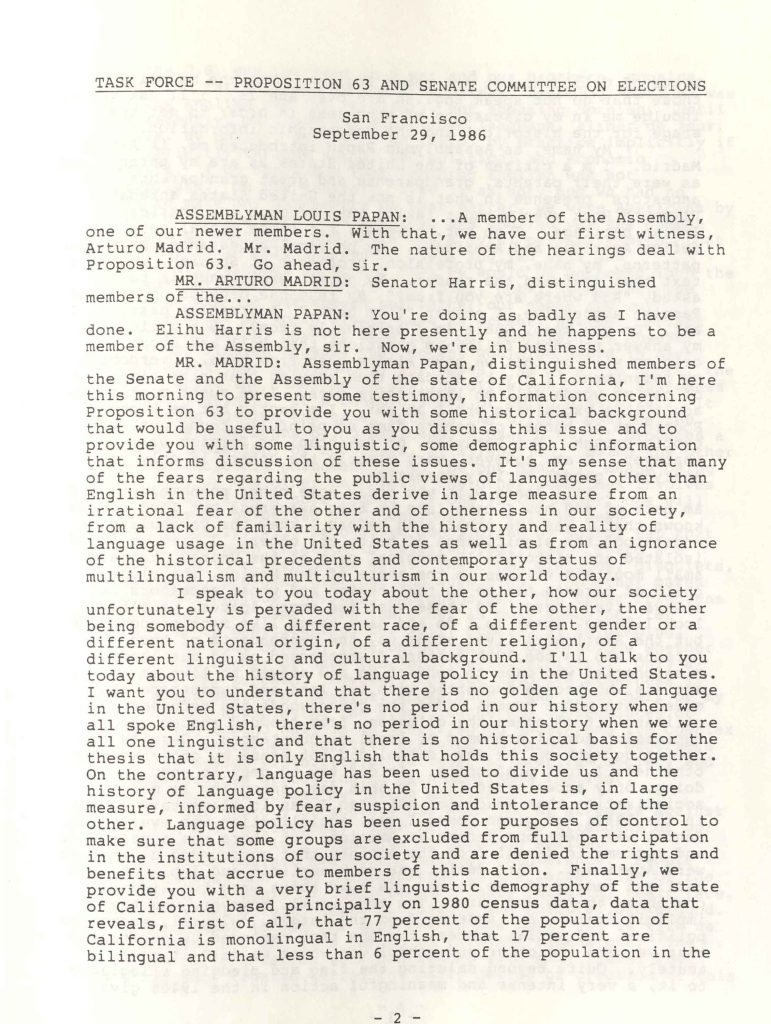
TASK FORCE -- PROPOSITION 63 AND SENATE COMMITTEE ON ELECTIONSSan Francisco September 29, 1986 ASSEMBLYMAN LOUIS PAPAN: ...A member of the Assembly, one of our newer members. With that, we have our first witness, Arturo Madrid. Mr. Madrid. The nature of the hearings deal with Proposition 63. Go ahead, sir. MR. ARTURO MADRID: Senator Harris, distinguished members of the... ASSEMBLYMAN PAPAN: You're doing as badly as I have done. Elihu Harris is not here presently and he happens to be a member of the Assembly, sir. Now, we're in business. MR. MADRID: Assemblyman Papan, distinguished members of the Senate and the Assembly of the state of California, I'm here this morning to present some testimony, information concerning Proposition 63 to provide you with some historical background that would be useful to you as you discuss this issue and to provide you with some linguistic, some demographic information that informs discussion of these issues. It's my sense that many of the fears regarding the public views of languages other than English in the United States derive in large measure from an irrational fear of the other and of otherness in our society, from a lack of familiarity with the history and reality of language usage in the United States as well as from an ignorance of the historical precedents and contemporary status of multilingualism and multiculturalism in our world today. I speak to you today about the other, how our society unfortunately is pervaded with the fear of the other, the other being somebody of a different race, of a different gender or a different national origin, of a different religion, of a different linguistic and cultural background. I'll talk to you today about the history of language policy in the United States. I want you to understand that there is no golden age of language in the United States, there's no period in our history when we all spoke English, there's no period in our history when we were all one linguistic and that there is no historical basis for the thesis that it is only English that holds this society together. On the contrary, language has been used to divide us and the history of language policy in the United States is, in large measure, informed by fear, suspicion and intolerance of the other. Language policy has been used for purposes of control to make sure that some groups are excluded from full participation in the institutions of our society and are denied the rights and benefits that accrue to members of this nation. Finally, we provide you with a very brief linguistic demography of the state of California based principally on 1980 census data, data that reveals, first of all, that 77 percent of the population of California is monolingual in English, that 17 percent are bilingual and that less than 6 percent of the population in the 2 - Detailed Description / Context: This transcript excerpt documents testimony presented during a joint legislative hearing on Proposition 63, the 1986 California ballot initiative proposing to amend the state constitution to designate English as the official language. The hearing was conducted by the Assembly Task Force on Proposition 63 and the Senate Committee on Elections in San Francisco. The testimony by Arturo Madrid situates the initiative within the broader history of U.S. language policy, multilingualism, and demographic change. The speaker references 1980 Census data and argues that language policy has historically intersected with issues of race, national origin, religion, and access to civic participation. The discussion reflects the political climate of the 1980s, when debates over immigration, bilingual education, and cultural pluralism were prominent in California and nationally. Legally and administratively, Proposition 63 raised questions about constitutional language designation, potential litigation, and the relationship between state policy and federal civil rights requirements. The transcript illustrates how legislators and witnesses engaged with demographic data, historical precedent, and concerns about inclusion and exclusion in shaping public policy.
Assembly Task Form on Proosition 63 and Senate Committee on Elections, “Joint Interim Hearing on Proposition 63: English as the Official State Language” (1986). California Joint Committees. 27.
https://digitalcommons.law.ggu.edu/caldocs_joint_committees/27


This linguistic legislation was political whiteness and political subjectivity rooted in white racial identity. The “White gaze” on politics was constituted by whites and reinforced the unequal expectation of immigrants as a “Super Citizen.” America already asks extraordinary measures for representation of immigrants and that their over expressions of American Citizenship would be redemptive and idealized economically, civil, and familial subjectivity. The policy would question who contributes to the economy, while obeying conservative and nationalistic expectations. This conformity or Apartheid policy upholds a social system or culture where white men hold primary power, dominating roles in political leadership, moral authority, social privilege, and control of property and social norms. The Proposition upheld that no immigrant was an investor or owner in America, unless they spoke English. Expectations included individual exceptionalism, and choice worthiness, often out of reach for many people.  
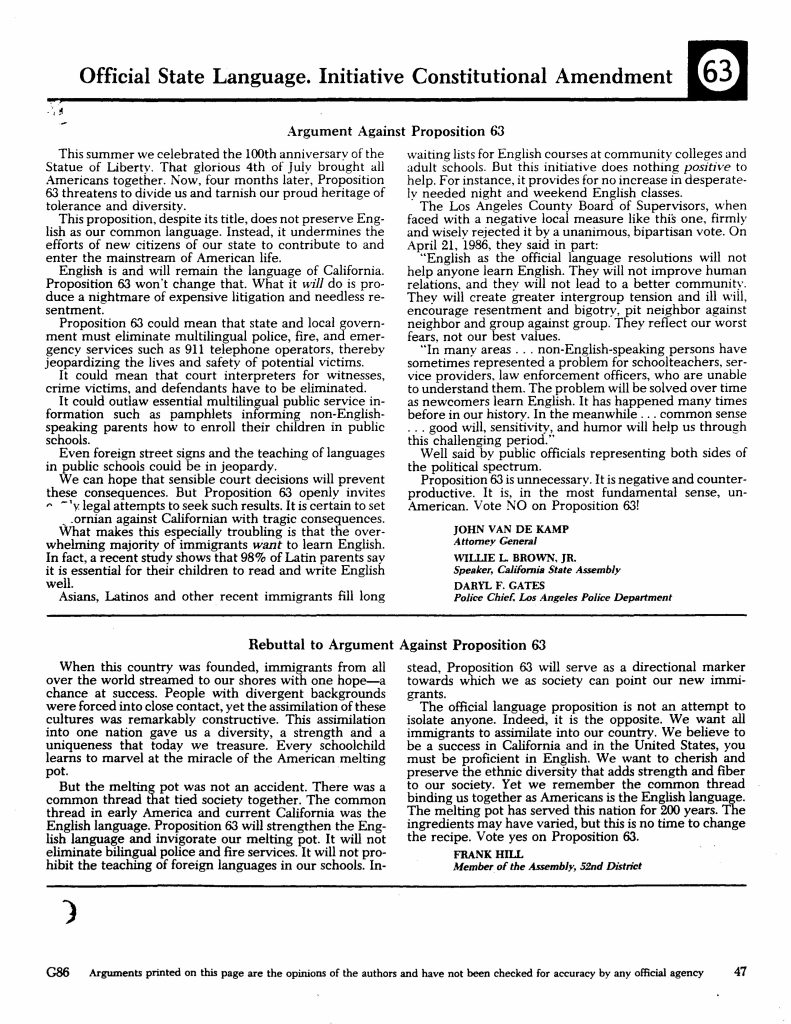
 

Official State Language. Initiative Constitutional Amendment63 Argument Against Proposition 63 This summer we celebrated the 100th anniversary of the Statue of Liberty. That glorious 4th of July brought all Americans together. Now, four months later, Proposition 63 threatens to divide us and tarnish our proud heritage of tolerance and diversity. This proposition, despite its title, does not preserve English as our common language. Instead, it undermines the efforts of new citizens of our state to contribute to and enter the mainstream of American life. English is and will remain the language of California. Proposition 63 won’t change that. What it will do is produce a nightmare of expensive litigation and needless resentment. Proposition 63 could mean that state and local government must eliminate multilingual police, fire, and emergency services such as 911 telephone operators, thereby jeopardizing the lives and safety of potential victims. It could mean that court interpreters for witnesses, crime victims, and defendants have to be eliminated. It could outlaw essential multilingual public service information such as pamphlets informing non-English-speaking parents how to enroll their children in public schools. Even foreign street signs and the teaching of languages in public schools could be in jeopardy. We can hope that sensible court decisions will prevent these consequences. But Proposition 63 openly invites costly legal attempts to seek such results. It is certain to set a collision against Californians with tragic consequences. What makes this especially troubling is that the overwhelming majority of immigrants want to learn English. In fact, a recent study shows that 98% of Latin parents say it is essential for their children to read and write English well. Asians, Latinos and other recent immigrants fill long waiting lists for English courses at community colleges and adult schools. But this initiative does nothing positive to help. For instance, it provides for no increase in desperately needed night and weekend English classes. The Los Angeles County Board of Supervisors, when faced with a negative local measure like this one, firmly and wisely rejected it by a unanimous, bipartisan vote. On April 21, 1986, they said in part: “English as the official language resolutions will not help anyone learn English. They will not improve human relations, and they will not lead to a better community. They will create greater intergroup tension and will encourage resentment and bigotry, pit neighbor against neighbor and group against group. They reflect our worst fears, not our best values. “In many areas . . . non-English-speaking persons have sometimes represented a problem for schoolteachers, service providers, law enforcement officers, who are unable to understand them. The problem will be solved over time as newcomers learn English. It has happened many times before in our history. In the meanwhile . . . common sense . . . good will, sensitivity, and humor will help us through this challenging period.” Well said by public officials representing both sides of the political spectrum. Proposition 63 is unnecessary. It is negative and counterproductive. It is, in the most fundamental sense, un-American. Vote NO on Proposition 63! JOHN VAN DE KAMP Attorney General WILLIE L. BROWN, JR. Speaker, California State Assembly DARYL F. GATES Police Chief, Los Angeles Police Department Rebuttal to Argument Against Proposition 63 When this country was founded, immigrants from all over the world streamed to our shores with one hope—a chance at success. People with divergent backgrounds were forced into close contact, yet the assimilation of these cultures was remarkably constructive. This assimilation into one nation gave us a diversity, a strength and a uniqueness that today we treasure. Every schoolchild learns to marvel at the miracle of the American melting pot. But the melting pot was not an accident. There was a common thread that tied society together. The common thread in early America and current California was the English language. Proposition 63 will strengthen the English language and invigorate our melting pot. It will not eliminate bilingual police and fire services. It will not prohibit the teaching of foreign languages in our schools. Instead, Proposition 63 will serve as a directional marker towards which we as society can point our new immigrants. The official language proposition is not an attempt to isolate anyone. Indeed, it is the opposite. We want all immigrants to assimilate into our country. We believe that to be a success in California and in the United States, you must be proficient in English. We want to cherish and preserve the ethnic diversity that adds strength and fiber to our society. Yet we remember the common thread binding us together as Americans is the English language. The melting pot has served this nation for 200 years. The ingredients may have varied, but this is no time to change the recipe. Vote yes on Proposition 63. FRANK HILL Member of the Assembly, 52nd District G86 Arguments printed on this page are the opinions of the authors and have not been checked for accuracy by any official agency 47 Detailed Description / Context: This ballot pamphlet page captures the structured debate over Proposition 63 in 1986, when California voters considered amending the state constitution to declare English the official language. Opponents argued that the measure could restrict multilingual public services, increase litigation, and undermine access to emergency services, courts, and public education for non-English-speaking residents. They emphasized assimilation through education rather than constitutional mandate and cited concerns about social division and discrimination. Supporters, in rebuttal, framed the amendment as reinforcing assimilation and national unity, asserting that it would not eliminate essential bilingual services or foreign language instruction. The debate reflects broader 1980s national discussions about immigration, bilingual education, and the “Official English” movement. The measure raised potential constitutional and administrative implications for state and local governance, particularly regarding compliance with federal civil rights law, including Voting Rights Act requirements for language assistance in elections.
Official State Language. Initiative Constitutional Amendment California Proposition 63 (1986). https://repository.uclawsf.edu/ca_ballot_props/968


Previously in California the Dymally Alatorre Act 1973, established bilingual services to in state programs, in an effort to reduced second class access to public services.  

Samuel Hayakawa, born in Canada, who came on a student visa to the United States. Dr. Hayakawa was Professor of English and later a California State University, San Francisco President, before becoming a Senator. Dr. Hayakawa, of Japanese Heritage, believed that English was the key to social participation, and key to the opportunities and self-realization that American life had to offer.  
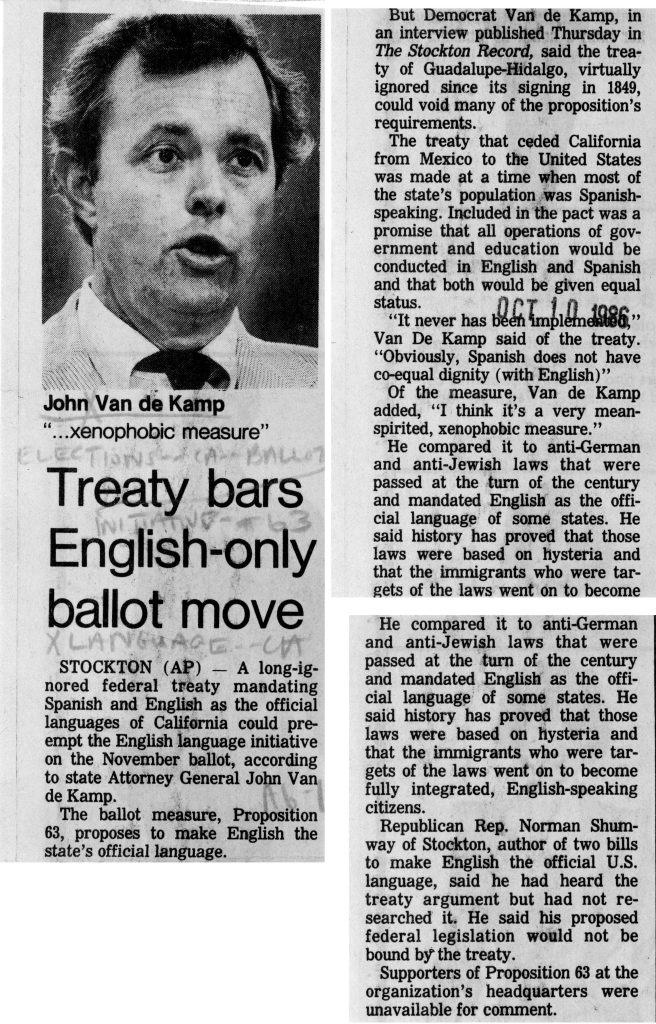
Full Extracted Text:John Van de Kamp “…xenophobic measure” Treaty bars English-only ballot move STOCKTON (AP) — A long-ignored federal treaty mandating Spanish and English as the official languages of California could pre-empt the English language initiative on the November ballot, according to state Attorney General John Van de Kamp. The ballot measure, Proposition 63, proposes to make English the state’s official language. But Democrat Van de Kamp, in an interview published Thursday in The Stockton Record, said the treaty of Guadalupe-Hidalgo, virtually ignored since its signing in 1849, could void many of the proposition’s requirements. The treaty that ceded California from Mexico to the United States was made at a time when most of the state’s population was Spanish-speaking. Included in the pact was a promise that all operations of government and education would be conducted in English and Spanish and that both would be given equal status. “It never has been implemented,” Van De Kamp said of the treaty. “Obviously, Spanish does not have co-equal dignity (with English)” Of the measure, Van de Kamp added, “I think it’s a very mean-spirited, xenophobic measure.” He compared it to anti-German and anti-Jewish laws that were passed at the turn of the century and mandated English as the official language of some states. He said history has proved that those laws were based on hysteria and that the immigrants who were targets of the laws went on to become fully integrated, English-speaking citizens. Republican Rep. Norman Shumway of Stockton, author of two bills to make English the official U.S. language, said he had heard the treaty argument but had not researched it. He said his proposed federal legislation would not be bound by the treaty. Supporters of Proposition 63 at the organization’s headquarters were unavailable for comment. Detailed Description / Context: This article was published in October 1986 during the campaign over Proposition 63, the California ballot initiative that amended the state constitution to declare English the official language. Attorney General John Van de Kamp suggested that the Treaty of Guadalupe Hidalgo (1848), which concluded the Mexican-American War and transferred California to the United States, might provide legal grounds to challenge the initiative based on historical commitments concerning language rights. The reference to the treaty situates the debate within a longer history of California’s transition from Mexican to U.S. governance and the legal status of Spanish-speaking residents. While the treaty guaranteed certain civil and property rights to former Mexican citizens, the extent to which it required bilingual government operations has been historically contested. Van de Kamp’s remarks frame Proposition 63 within broader issues of civil rights, immigration, and historical precedent. The article reflects the polarized political climate surrounding language policy in the 1980s, including debates over bilingual education, voting materials, and the symbolic role of English in public life. It also demonstrates how federal treaties and constitutional interpretation were invoked in contemporary electoral politics.
John Van De Kamp, “Treaty bars English-only ballot move” Bakersfield Californian, October 10, 1986

Dr. Hayakawa saw himself as a vehicle to Americanization, as a professor and educator of English. Through the American conversion and with the baptism of English and cultural alignment towards White America, Dr. Hayakawa stated the language was a unifying force. There had been or is there no time in the United States were English was only spoken and had been a voice that unified everyone, or that English holds society together.
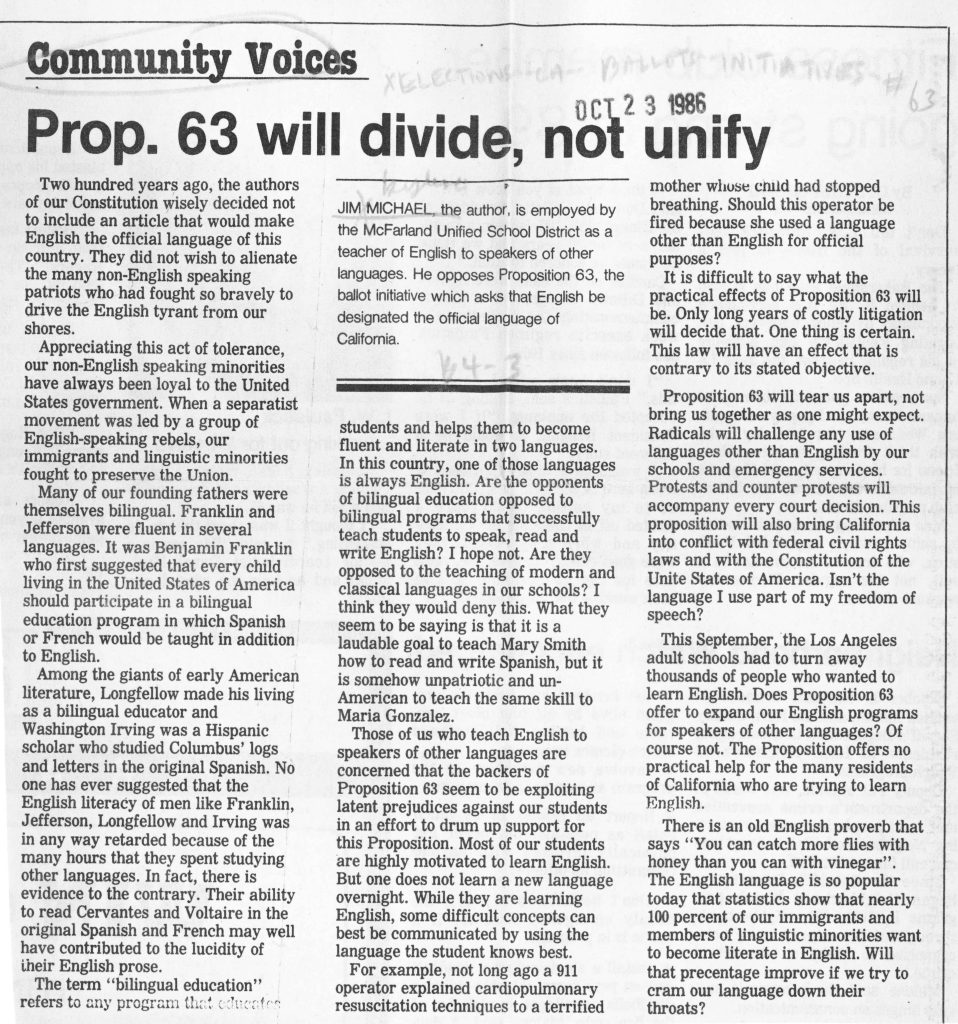
 

Community VoicesProp. 63 will divide, not unify Two hundred years ago, the authors of our Constitution wisely decided not to include an article that would make English the official language of this country. They did not wish to alienate the many non-English speaking patriots who had fought so bravely to drive the English tyrant from our shores. Appreciating this act of tolerance, our non-English speaking minorities have always been loyal to the United States government. When a separatist movement was led by a group of English-speaking rebels, our immigrants and linguistic minorities fought to preserve the Union. Many of our founding fathers were themselves bilingual. Franklin and Jefferson were fluent in several languages. It was Benjamin Franklin who first suggested that every child living in the United States of America should participate in a bilingual education program in which Spanish or French would be taught in addition to English. Among the giants of early American literature, Longfellow made his living as a bilingual educator and Washington Irving was a Hispanic scholar who studied Columbus’ logs and letters in the original Spanish. No one has ever suggested that the English literacy of men like Franklin, Jefferson, Longfellow and Irving was in any way retarded because of the many hours that they spent studying other languages. In fact, there is evidence to the contrary. Their ability to read Cervantes and Voltaire in the original Spanish and French may well have contributed to the lucidity of their English prose. The term “bilingual education” refers to any program that connects students and helps them to become fluent and literate in two languages. In this country, one of those languages is always English. Are the opponents of bilingual education opposed to bilingual programs that successfully teach students to speak, read and write English? I hope not. Are they opposed to the teaching of modern and classical languages in our schools? I think they would deny this. What they seem to be saying is that it is a laudable goal to teach Mary Smith how to read and write Spanish, but it is somehow unpatriotic and un-American to teach the same skill to Maria Gonzalez. Those of us who teach English to speakers of other languages are concerned that the backers of Proposition 63 seem to be exploiting latent prejudices against our students in an effort to drum up support for this Proposition. Most of our students are highly motivated to learn English. But one does not learn a new language overnight. While they are learning English, some difficult concepts can best be communicated by using the language the student knows best. For example, not long ago a 911 operator explained cardiopulmonary resuscitation techniques to a terrified mother whose child had stopped breathing. Should this operator be fired because she used a language other than English for official purposes? It is difficult to say what the practical effects of Proposition 63 will be. Only long years of costly litigation will decide that. One thing is certain. This law will have an effect that is contrary to its stated objective. Proposition 63 will tear us apart, not bring us together as one might expect. Radicals will challenge any use of languages other than English by our schools and emergency services. Protests and counter protests will accompany every court decision. This proposition will also bring California into conflict with federal civil rights laws and with the Constitution of the United States of America. Isn’t the language I use part of my freedom of speech? This September, the Los Angeles adult schools had to turn away thousands of people who wanted to learn English. Does Proposition 63 offer to expand our English programs for speakers of other languages? Of course not. The Proposition offers no practical help for the many residents of California who are trying to learn English. There is an old English proverb that says “You can catch more flies with honey than you can with vinegar.” The English language is so popular today that statistics show that nearly 100 percent of our immigrants and members of linguistic minorities want to become literate in English. Will that percentage improve if we try to cram our language down their throats? JIM MICHAEL, the author, is employed by the McFarland Unified School District as a teacher of English to speakers of other languages. He opposes Proposition 63, the ballot initiative which asks that English be designated the official language of California. Detailed Description / Context: This opinion column was published on October 23, 1986, during the campaign leading up to the November 1986 vote on Proposition 63 in California. The measure sought to amend the California Constitution to declare English the official language of the state. The column reflects opposition grounded in concerns about bilingual education, immigrant integration, and constitutional freedoms. The author frames the debate within American founding principles and historical examples of multilingualism among prominent early American figures. The piece argues that language policy should encourage English acquisition without restricting multilingual public services or educational programs. It raises concerns about potential litigation, conflict with federal civil rights laws, and implications for freedom of speech. The column illustrates how Proposition 63 prompted broader public discourse about assimilation, pluralism, public education, and the legal status of language in civic life. It reflects the tension in 1980s California between official English initiatives and the state’s growing linguistic diversity.
Jim Michael, “Prop. 63 will divide, not unify,” Bakersfield Californian, 1986-10-23

The empty promise, later taken up by the state, the policy did nothing for equal education, nor funded education more, nor added provisions against racial and ethnic discrimination. Proposition 63 actually supported discrimination as a method to incentivize the learning of English. Dr. Hayakawa misunderstood that his struggles and understood his life as challenges steppingstones that changed him into an American. As other activists understood, that these actions or tribulations were unnecessary if they were equal, and that would effectively end bilingual education.  
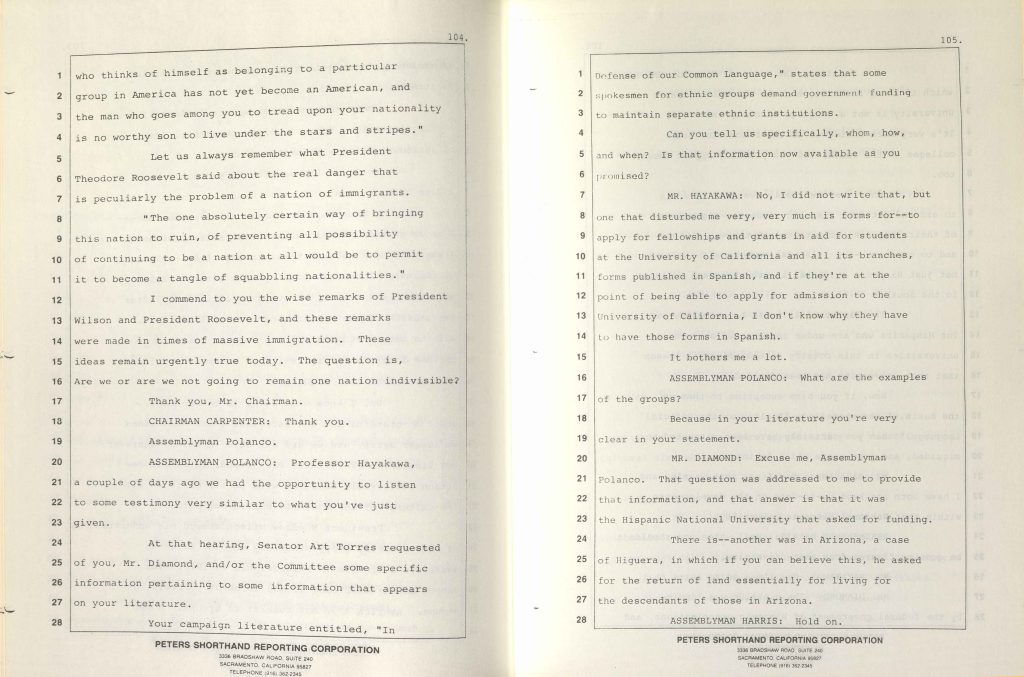
1 who thinks of himself as belonging to a particular2 group in America has not yet become an American, and 3 the man who goes among you to tread upon your nationality 4 is no worthy son to live under the stars and stripes." 5 Let us always remember what President 6 Theodore Roosevelt said about the real danger that 7 is peculiarly the problem of a nation of immigrants. 8 "The one absolutely certain way of bringing 9 this nation to ruin, of preventing all possibility 10 of continuing to be a nation at all would be to permit 11 it to become a tangle of squabbling nationalities." 12 I commend to you the wise remarks of President 13 Wilson and President Roosevelt, and these remarks 14 were made in times of massive immigration. These 15 ideas remain urgently true today. The question is, 16 Are we or are we not going to remain one nation indivisible? 17 Thank you, Mr. Chairman. 18 CHAIRMAN CARPENTER: Thank you. 19 Assemblyman Polanco. 20 ASSEMBLYMAN POLANCO: Professor Hayakawa, 21 a couple of days ago we had the opportunity to listen 22 to some testimony very similar to what you've just 23 given. 24 At that hearing, Senator Art Torres requested 25 of you, Mr. Diamond, and/or the Committee some specific 26 information pertaining to some information that appears 27 on your literature. 28 Your campaign literature entitled, "In PETERS SHORTHAND REPORTING CORPORATION 3336 BRADSHAW ROAD, SUITE 240 SACRAMENTO, CALIFORNIA 95827 TELEPHONE (916) 362-2345 1 Defense of our Common Language," states that some 2 spokesmen for ethnic groups demand government funding 3 to maintain separate ethnic institutions. 4 Can you tell us specifically, whom, how, 5 and when? Is that information now available as you 6 promised? 7 MR. HAYAKAWA: No, I did not write that, but 8 one that disturbed me very, very much is forms for--to 9 apply for fellowships and grants in aid for students 10 at the University of California and all its branches, 11 forms published in Spanish, and if they're at the 12 point of being able to apply for admission to the 13 University of California, I don't know why they have 14 to have those forms in Spanish. 15 It bothers me a lot. 16 ASSEMBLYMAN POLANCO: What are the examples 17 of the groups? 18 Because in your literature you're very 19 clear in your statement. 20 MR. DIAMOND: Excuse me, Assemblyman 21 Polanco. That question was addressed to me to provide 22 that information, and that answer is that it was 23 the Hispanic National University that asked for funding. 24 There is--another was in Arizona, a case 25 of Higuera, in which if you can believe this, he asked 26 for the return of land essentially for living for 27 the descendants of those in Arizona. 28 ASSEMBLYMAN HARRIS: Hold on. PETERS SHORTHAND REPORTING CORPORATION 3336 BRADSHAW ROAD, SUITE 240 SACRAMENTO, CALIFORNIA 95827 TELEPHONE (916) 362-2345 Detailed Description / Context: These transcript pages document exchanges during a joint legislative hearing concerning Proposition 63, the 1986 initiative to amend the California Constitution to declare English the official state language. The remarks reference earlier presidential statements about national unity and immigration, invoking historical rhetoric from Theodore Roosevelt and Woodrow Wilson during prior periods of mass immigration. The subsequent questioning focuses on claims made in campaign literature supporting the initiative, particularly allegations that ethnic organizations sought public funding for separate institutions. Legislators request clarification and evidentiary support for such assertions. The testimony references Spanish-language university forms and specific institutions, reflecting broader debates over bilingual services, multiculturalism, and assimilation in public institutions. The exchange illustrates how language policy debates in the 1980s intersected with concerns about immigration, higher education access, ethnic advocacy organizations, and constitutional governance. The hearing reflects both symbolic and practical tensions surrounding multilingual accommodation, public funding, and the boundaries of state authority in regulating language use.
“I don’t know what they have to have those forms in Spanish. It bothers me a lot.” Dr. Samuel Hayakawa, Senate Committee on Elections and Assembly Task Force on Proposition 63, “Joint Interim Hearing on Proposition 63: English as the Official State Language – Oct. 1, 1986” (1986). California Joint Committees. 28.
https://digitalcommons.law.ggu.edu/caldocs_joint_committees/28

The proposition sent a message to immigrant communities that English fluency was a prerequisite for social mobility, while also characterizing immigrant groups as lacking ambition or unmotivated. They were constructed as second class because of their limited understanding of English. It should be pointed out that formal education takes time, money, and systems of support, like family care, generational wealth, job protection, and guidance on accessing the formal education system. These structures already heavily favor the knowledge of English: like the Admissions process, application of financial aid, and navigating resources. Many groups saw this legislation as anti-civil rights, including labor unions. In 1986, most of the non-English speakers were over the age of 25.  Official languages don’t encourage or create better teaching. Claiming or asserting white identity does not automatically guarantee security or economic mobility. The proposition, while passed, did not improve lives.  
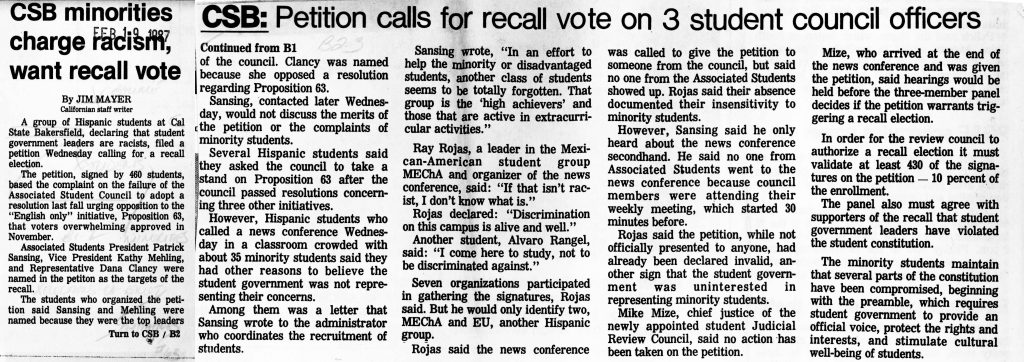
CSB minorities charge racism, want recall voteBy JIM MAYER Californian staff writer A group of Hispanic students at Cal State Bakersfield, declaring that student government leaders are racists, filed a petition Wednesday calling for a recall election. The petition, signed by 460 students, based the complaint on the failure of the Associated Student Council to adopt a resolution last fall urging opposition to the “English only” initiative, Proposition 63, that voters overwhelmingly approved in November. Associated Students President Patrick Sansing, Vice President Kathy Mehling, and Representative Dana Clancy were named in the petition as the targets of the recall. The students who organized the petition said Sansing and Mehling were named because they were the top leaders of the council. Clancy was named because she opposed a resolution regarding Proposition 63. Continued from B1 Sansing, contacted later Wednesday, would not discuss the merits of the petition or the complaints of minority students. Several Hispanic students said they asked the council to take a stand on Proposition 63 after the council passed resolutions concerning three other initiatives. However, Hispanic students who called a news conference Wednesday in a classroom crowded with about 35 minority students said they had other reasons to believe the student government was not representing their concerns. Among them was a letter that Sansing wrote to the administrator who coordinates the recruitment of students. Sansing wrote, “In an effort to help the minority or disadvantaged students, another class of students seems to be totally forgotten. That group is the ‘high achievers’ and those that are active in extracurricular activities.” Ray Rojas, a leader in the Mexican-American student group MEChA and organizer of the news conference, said: “If that isn’t racist, I don’t know what is.” Rojas declared: “Discrimination on this campus is alive and well.” Another student, Alvaro Rangel, said: “I come here to study, not to be discriminated against.” Seven organizations participated in gathering the signatures, Rojas said. But he would only identify two, MEChA and EU, another Hispanic group. Rojas said the news conference was called to give the petition to someone from the council, but said no one from the Associated Students showed up. Rojas said their absence documented their insensitivity to minority students. However, Sansing said he only heard about the news conference secondhand. He said no one from the Associated Students went to the news conference because council members were attending their weekly meeting, which started 30 minutes before. Rojas said the petition, while not officially presented to anyone, had already been declared invalid, another sign that the student government was uninterested in representing minority students. Mike Mize, chief justice of the newly appointed student Judicial Review Council, said no action has been taken on the petition. Mize, who arrived at the end of the news conference and was given the petition, said hearings would be held before the three-member panel decides if the petition warrants triggering a recall election. In order for the review council to authorize a recall election it must validate at least 430 of the signatures on the petition — 10 percent of the enrollment. The panel also must agree with supporters of the recall that student government leaders have violated the student constitution. The minority students maintain that several parts of the constitution have been compromised, beginning with the preamble, which requires student government to provide an official voice, protect the rights and interests, and stimulate cultural well-being of students. Detailed Description / Context: This article documents campus political conflict at California State Bakersfield in February 1987 following the November 1986 passage of Proposition 63, which amended the California Constitution to declare English the official state language. Hispanic students alleged that student government leaders failed to represent minority concerns, particularly by declining to pass a resolution opposing the English-only initiative. The dispute reflects how Proposition 63 extended beyond state politics into university governance and student activism. Minority student organizations, including MEChA (Movimiento Estudiantil Chicano de Aztlán), mobilized around concerns about discrimination, representation, and the symbolic impact of official language policy. The recall petition invoked procedural mechanisms within the student constitution, highlighting tensions over institutional accountability and minority representation. The article illustrates the broader social climate in California during the late 1980s, when debates over language, immigration, and civil rights were prominent in public institutions, including higher education campuses.
Jim Mayer, “CSB minorities charge racism want recall vote,” Bakersfield Californian, 1987-02-19

1986 was also the same year that the Immigration Reform and Control Act “Amnesty” was passed in the United States. The policy, while allowing some to naturalized, created Federalized Employer sanctions, and criminal penalties for employers who employed undocumented workers.

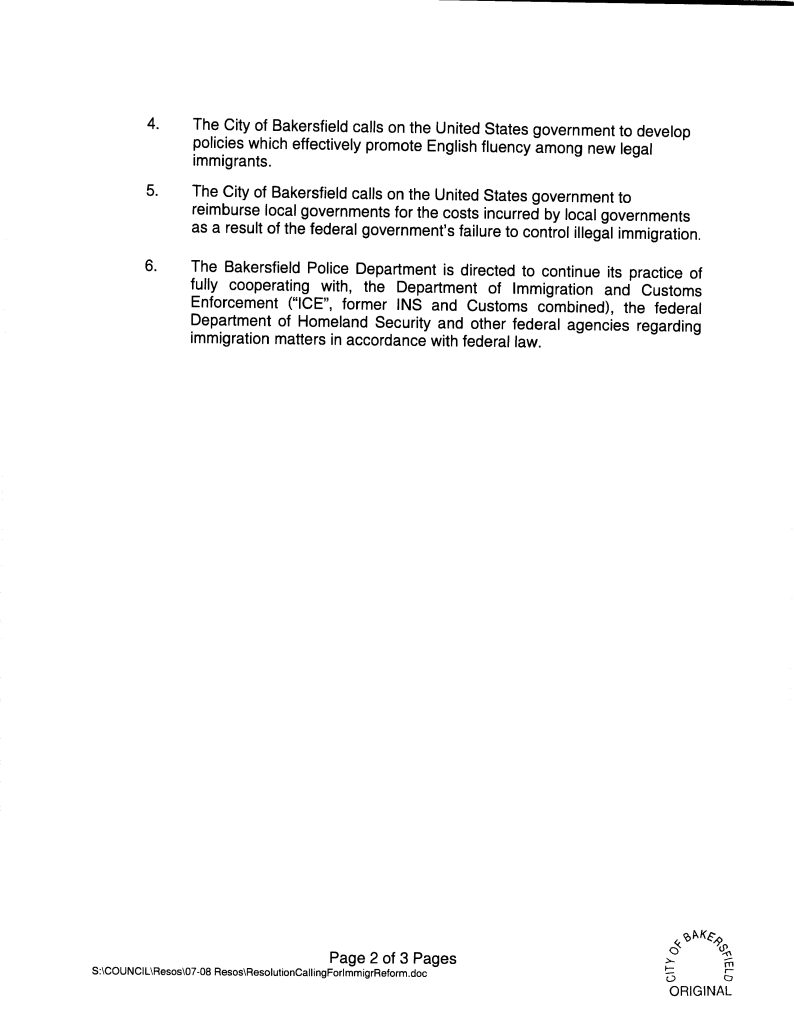
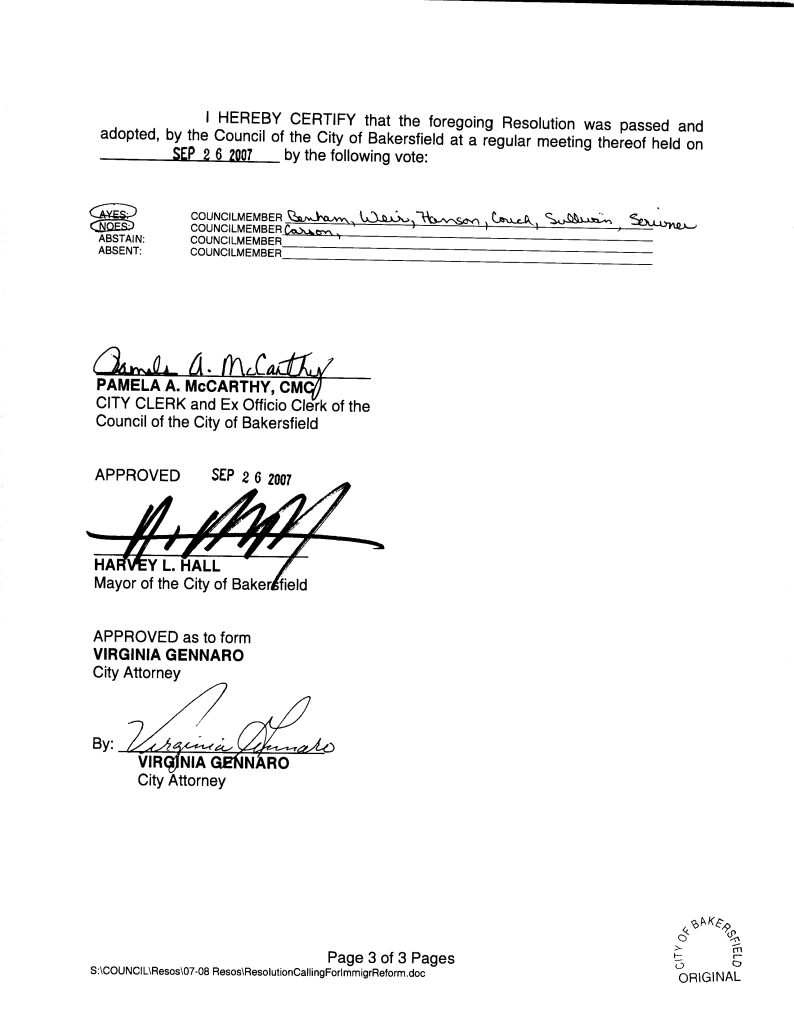
In 2007, the Bakersfield City Council passed the Resolution to take certain action with respects to immigration. The City resolved that United States needed reform to reimburse city for their deportation efforts and that current laws were inadequate to enforce immigration. The City of Bakersfield was then cooperating with Homeland Security on immigration. The city also resolved that English was the official language of California, calling on Proposition 63’s ghost 40 year later, “Whereas, the Council of the City of Bakersfield recognizes that Section 6 of Article III of the California Constitution states that English is the official language of California and that a common language is necessary for a prosperous state that provides equal opportunity for the citizenry.”

Singed Yes: Council Members Benham, Weir, Hanson, Couch, Sullivan, Scrivener 

Singed No: Irma Carson 

Approved by Mayor Harvey Hall, and by the city attorney Virginia Gennaro  
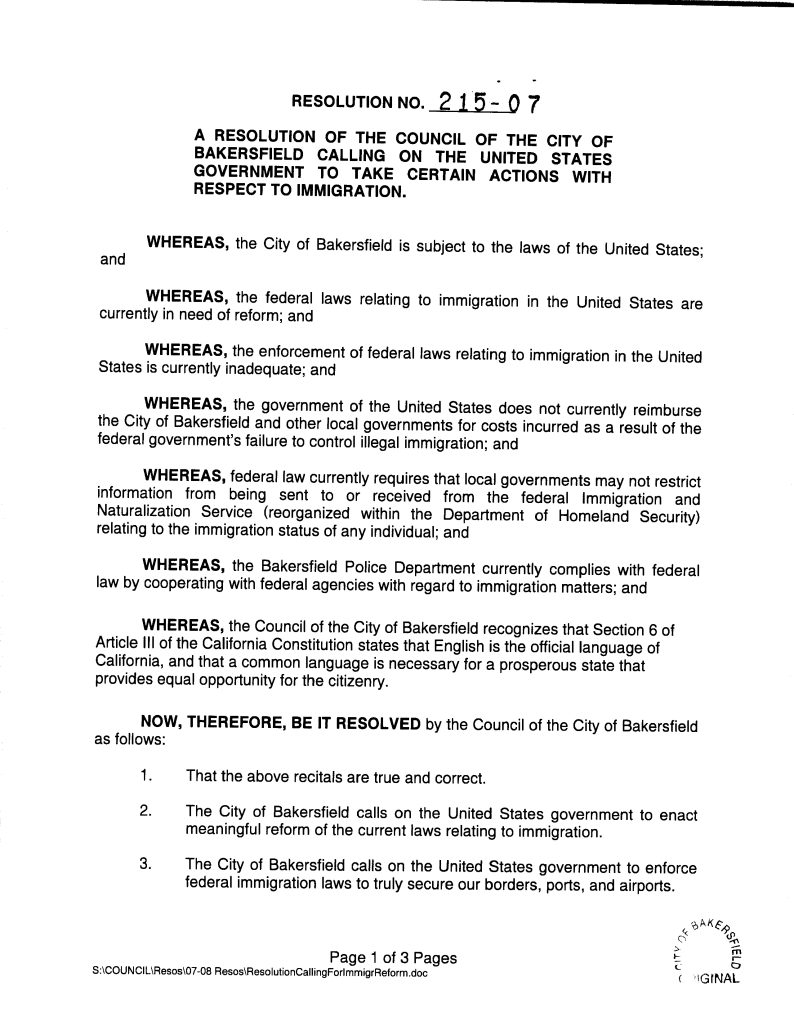
 

Title: RESOLUTION NO. 215-07 A RESOLUTION OF THE COUNCIL OF THE CITY OF BAKERSFIELD CALLING ON THE UNITED STATES GOVERNMENT TO TAKE CERTAIN ACTIONS WITH RESPECT TO IMMIGRATION.Date: SEP 26 2007 Creator / Publisher: Council of the City of Bakersfield Document Type: Municipal resolution Location: Bakersfield, California Brief Description: This document is Resolution No. 215-07 adopted by the City Council of Bakersfield on September 26, 2007. The resolution calls upon the United States government to reform and enforce federal immigration laws, promote English fluency among new legal immigrants, reimburse local governments for costs related to illegal immigration, and continue cooperation between the Bakersfield Police Department and federal immigration authorities. The resolution reflects municipal engagement in federal immigration policy and references California’s constitutional designation of English as the official state language. Full Extracted Text: RESOLUTION NO. 215-07 A RESOLUTION OF THE COUNCIL OF THE CITY OF BAKERSFIELD CALLING ON THE UNITED STATES GOVERNMENT TO TAKE CERTAIN ACTIONS WITH RESPECT TO IMMIGRATION. WHEREAS, the City of Bakersfield is subject to the laws of the United States; and WHEREAS, the federal laws relating to immigration in the United States are currently in need of reform; and WHEREAS, the enforcement of federal laws relating to immigration in the United States is currently inadequate; and WHEREAS, the government of the United States does not currently reimburse the City of Bakersfield and other local governments for costs incurred as a result of the federal government’s failure to control illegal immigration; and WHEREAS, federal law currently requires that local governments may not restrict information from being sent to or received from the federal Immigration and Naturalization Service (reorganized within the Department of Homeland Security) relating to the immigration status of any individual; and WHEREAS, the Bakersfield Police Department currently complies with federal law by cooperating with federal agencies with regard to immigration matters; and WHEREAS, the Council of the City of Bakersfield recognizes that Section 6 of Article III of the California Constitution states that English is the official language of California, and that a common language is necessary for a prosperous state that provides equal opportunity for the citizenry. NOW, THEREFORE, BE IT RESOLVED by the Council of the City of Bakersfield as follows:
City of Bakersfield. Resolution No. 215-07: A Resolution of the Council of the City of Bakersfield Calling on the United States Government to Take Certain Actions with Respect to Immigration. Adopted September 26, 2007. Bakersfield, CA.
That the above recitals are true and correct.The City of Bakersfield calls on the United States government to enact meaningful reform of the current laws relating to immigration. The City of Bakersfield calls on the United States government to enforce federal immigration laws to truly secure our borders, ports, and airports. Page 1 of 3 Pages S:\COUNCIL\Resos\07-08 Resos\ResolutionCallingForImmigrReform.doc The City of Bakersfield calls on the United States government to develop policies which effectively promote English fluency among new legal immigrants. The City of Bakersfield calls on the United States government to reimburse local governments for the costs incurred by local governments as a result of the federal government’s failure to control illegal immigration. The Bakersfield Police Department is directed to continue its practice of fully cooperating with, the Department of Immigration and Customs Enforcement (“ICE”, former INS and Customs combined), the federal Department of Homeland Security and other federal agencies regarding immigration matters in accordance with federal law.
City of Bakersfield. Resolution No. 215-07: A Resolution of the Council of the City of Bakersfield Calling on the United States Government to Take Certain Actions with Respect to Immigration. Adopted September 26, 2007. Bakersfield, CA.
Page 2 of 3 PagesS:\COUNCIL\Resos\07-08 Resos\ResolutionCallingForImmigrReform.doc I HEREBY CERTIFY that the foregoing Resolution was passed and adopted, by the Council of the City of Bakersfield at a regular meeting thereof held on SEP 26 2007 by the following vote: AYES: COUNCILMEMBER Bonham, Weir, Hanson, Couch, Sullivan, Scrivner NOES: COUNCILMEMBER Carson ABSTAIN: COUNCILMEMBER ABSENT: COUNCILMEMBER PAMELA A. McCARTHY, CMC CITY CLERK and Ex Officio Clerk of the Council of the City of Bakersfield APPROVED SEP 26 2007 HARVEY L. HALL Mayor of the City of Bakersfield APPROVED as to form VIRGINIA GENNARO City Attorney By: VIRGINIA GENNARO City Attorney Page 3 of 3 Pages S:\COUNCIL\Resos\07-08 Resos\ResolutionCallingForImmigrReform.doc Detailed Description / Context: Resolution No. 215-07 was adopted by the Bakersfield City Council in September 2007 amid national debates over federal immigration reform, border enforcement, and the fiscal impacts of immigration on local governments. During this period, Congress was actively considering comprehensive immigration reform proposals, while local jurisdictions across the United States were adopting resolutions addressing enforcement cooperation and reimbursement for immigration-related costs. The resolution explicitly references Section 6 of Article III of the California Constitution, added by Proposition 63 in 1986, which designates English as the official state language. By invoking this constitutional provision, the City links language policy to immigration governance and economic opportunity. The resolution calls for enhanced federal enforcement, reimbursement for municipal expenditures related to illegal immigration, and continued cooperation between local law enforcement and federal agencies such as ICE and the Department of Homeland Security. Legally, the document reflects tensions between federal authority over immigration and local administrative burdens, as well as debates over information-sharing requirements between local governments and federal immigration authorities. It situates municipal policy within broader national discussions about border security, fiscal responsibility, English-language acquisition, and federal–local coordination in immigration enforcement.
City of Bakersfield. Resolution No. 215-07: A Resolution of the Council of the City of Bakersfield Calling on the United States Government to Take Certain Actions with Respect to Immigration. Adopted September 26, 2007. Bakersfield, CA.