Chinatown

Before 1938      –      Buying on Contract     –     Covenants     –     East Bakersfield

Eminent Domain      –      Moving into a Neighborhood    –        Neighborhoods      –      Public Housing

Resources       –      Rumford Fair Housing Act             Suburban Expansion       –      Zoning

The Two Chinatowns of Bakersfield

Any survey of a Bakersfield map quickly reveals the long-established presence of Chinese immigrants and their descendants in the city’s street names, ranging from Ming Avenue in the South to China Grade Loop in the North.
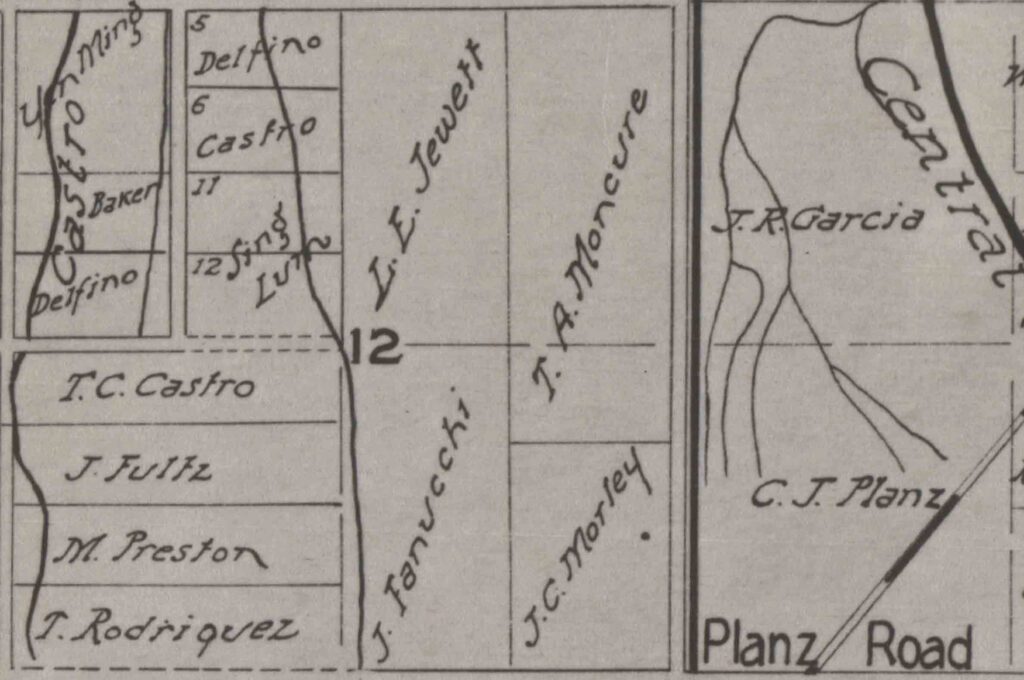
This black-and-white cropped map detail depicts subdivided parcels arranged in rectangular lots. Each parcel contains handwritten names identifying property owners or occupants. Visible names include:“Delfino” “Castro” “J. Fultz” “M. Preston” “T. Rodriguez” “T. E. Jewett” “J. F. Moncure” “J. C. Morley” “J. R. Garcia” “G. J. Planzi” (partially visible) The number “12” appears prominently near the center, possibly indicating a tract, block, or parcel number. Streets and boundaries are drawn in bold lines, and “Planz Road” is clearly labeled at the lower right edge of the image. On the right side of the image, a curving boundary line suggests a natural feature or irregular parcel edge. The map style indicates a property ownership or assessment map, likely used for planning, taxation, or community analysis purposes.
Yen Ming listed as a property owner, “1929 Map” Kern Court Records- Intersections of modern-day Ming and Wible.


Yet one of the most easily overlooked keys to this rich history lies within a single block: tucked between L and M Streets downtown and located immediately behind the KGET television station on 22nd Street, is a small street colloquially known as China Alley. Along with the adjacent Ying On Fraternal Hall, this alley now stands as the only remnant of Bakersfield’s once-bustling twin Chinatowns.
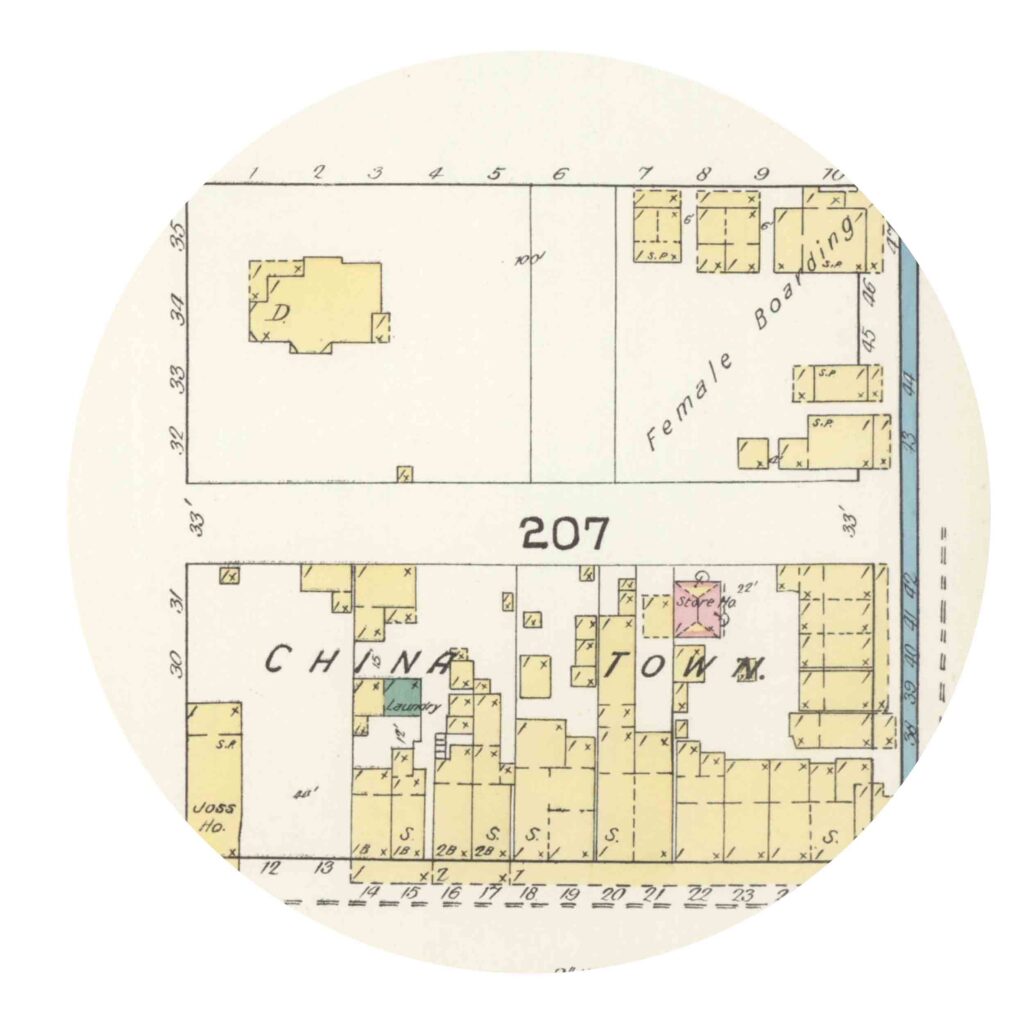
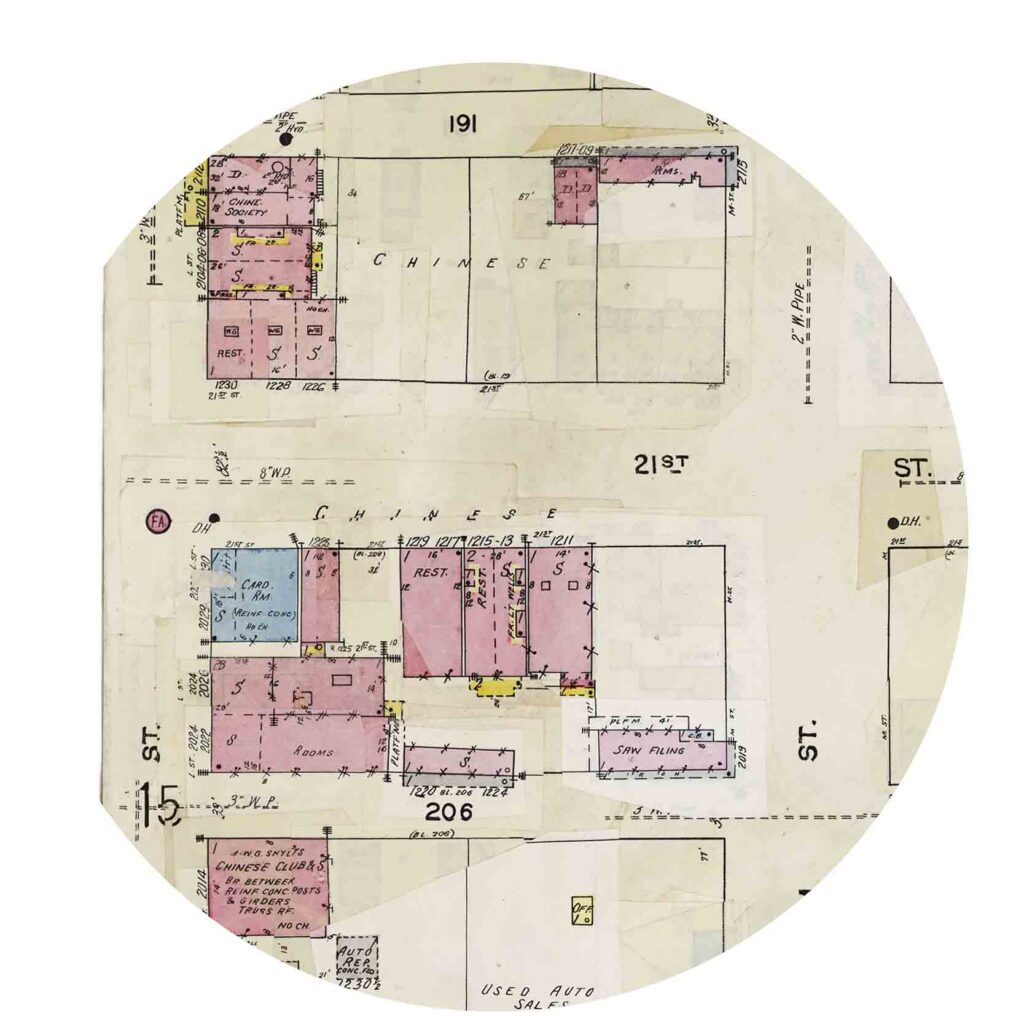
This image is a circular-cropped excerpt from a color Sanborn fire insurance map depicting Block 207 in Bakersfield, California. The block is prominently labeled “CHINA TOWN” across its center. Individual lots are numbered along the perimeter, with visible lot numbers including 1–10 along the top edge and 12–23 along the bottom edge.Buildings are shown in yellow, indicating wood-frame construction typical of Sanborn conventions. Structural details such as small outbuildings, porches, and internal divisions are marked with dashed lines and symbols. Several buildings are labeled with specific uses, including: “Female Boarding” (upper right portion of the block) “Joss Ho” (likely “Joss House,” referring to a Chinese temple; lower left area) “Laundry” (centrally located, highlighted in green) “Store” (marked in pink near the upper right quadrant) The number “207” appears prominently in the center of the image, identifying the block number. Along the right edge is a blue vertical band, likely representing a canal, drainage feature, or waterway. The map reflects a segregated ethnic district identified explicitly as “Chinatown,” with multiple boarding houses and small commercial structures clustered within the block. The building density and varied uses suggest a mixed residential and commercial enclave typical of early 20th-century Chinese American communities.
Chinatown, Sanborn Fire Insurance Map, 1892 LOC https://www.loc.gov/resource/g4364bm.g4364bm_g004041892/?sp=4&st=image
Chinatown, Sanborn Fire Insurance Map, 1950 LOC https://www.loc.gov/resource/g4364bm.g4364bm_g00404195101/?sp=17&st=image&r=-0.018,0.324,0.654,0.394,0

Local historian Diane Ogden notes how the current location of KGET was once the site of a religious temple and lodging house in the late 19th century, with a gambling hall located three blocks further south.1 This portion of downtown eventually became known as “Old Chinatown,” in contrast with the “New Chinatown” that was established several blocks further east. This Chinatown similarly had its own temple: originally a wooden building facing south along the river near 17th Street, it was replaced in the 1890s by “a new red brick building at the southwest corner of 18th and R Streets” – directly adjacent to the present-day downtown Antiques Mall and a block south of where the Bakersfield Museum of Art is now located.
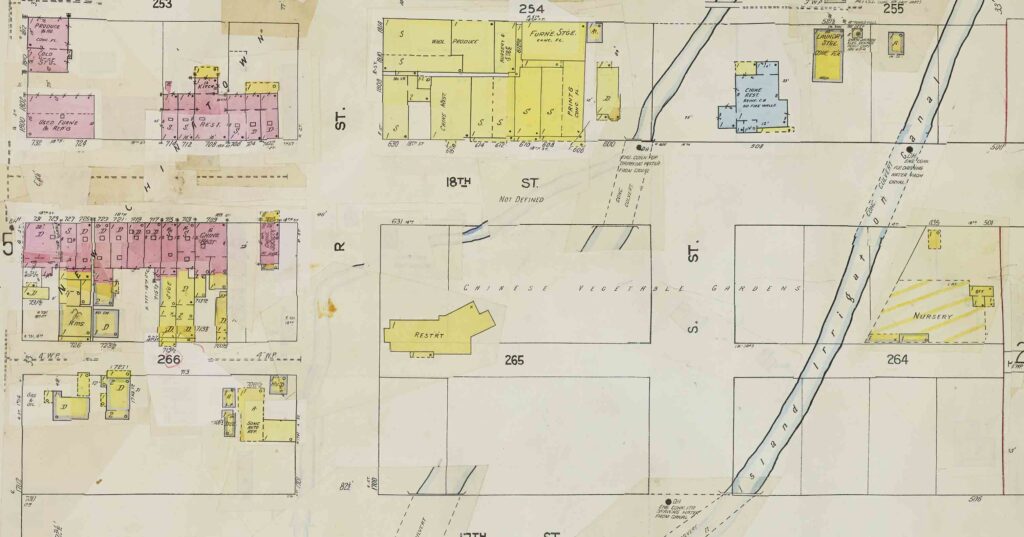
This image is a detailed, color-coded Sanborn Fire Insurance map page depicting part of Bakersfield, California. The map includes blocks numbered 253, 254, 255, 264, 265, and 266, with 18th Street running horizontally across the center of the image.At the center of the map, Block 265 is labeled “Chinese Vegetable Gardens.” A structure marked “Rest.” (restaurant) appears within this block, shaded in yellow to indicate frame construction. Surrounding the gardens are large open parcels and subdivided lots. To the left (Block 266), multiple small buildings are clustered together. These are shaded in pink and yellow, indicating brick and frame construction, respectively. Labels such as “Rooms,” “Store,” and “Chinese Store” appear among the clustered structures, suggesting a small commercial district associated with the Chinese community. On the right side of the map, a waterway or canal runs vertically through the page, labeled “Kern Island Canal.” Adjacent to it in Block 264 is a property labeled “Nursery.” The map uses standard Sanborn symbology: Pink shading indicates brick buildings. Yellow shading indicates frame (wood) construction. Blue shading typically marks special construction materials (such as adobe or stone). Lot dimensions and building footprints are precisely measured. Street labels include 18th St., and vertical streets are marked with directional indicators (e.g., “S.”). Lot boundaries and property dimensions are clearly drawn. This map documents the built environment and land use patterns of a section of Bakersfield in the early 20th century. It provides evidence of a distinct Chinese commercial and agricultural presence near 18th Street, alongside nurseries, small stores, restaurants, and residential or lodging structures.
Chinatown, Sanborn Fire Insurance Map, 1950 LOC https://www.loc.gov/resource/g4364bm.g4364bm_g00404195101/?sp=27&st=image&r=-0.093,0.451,0.542,0.327,0

The Chinese immigrants who settled in Bakersfield and other adjoining cities in Kern County in the mid-19th century arrived as part of a large workforce. While the first of these immigrants made their livings mining gold and quartz in the Kern River from 1859–1860, the next decade saw a further growth in the Chinese population due to laborers working on key infrastructure projects such as the Kern Island Canal in Bakersfield and the construction of the Southern Pacific Railroad. The railroad’s construction spanned all of Kern County from Delano to the Tehachapi Mountains, with this southern end proving the most dangerous as many immigrants lost their lives to explosives and cave-ins as they tunneled their way through.

In the 1870s, the United States began passing laws regarding the exclusion of Chinese laborers, these laws were called the Chinese Exclusion Act; the basis for these Acts were the Naturalization laws. Beginning in 1875, the Chinese could only come here for work, and when they came to the ports the consul-general could decide whether or not to allow the worker(s) their permits. In 1882, the Chinese were seen as a danger to Americans and it was decided that the Chinese would be suspended from admittance into the US for a period of ten years. However, this law does not apply to the laborers who came to the US on November 17th, 1880 or laborers who come within ninety days of the passage of the law. Those Chinese laborers who stay in the US and decide to go out of the country for a bit must provide their name, occupation, last place of residency, as well as distinctive physical marks to a consul-general to be written down on a list. If a Chinese person was not a laborer and wanted to stay, the Chinese government would have to provide the correct paperwork to the US government, and any Chinese person found to be illegally in the country would be deported on order from the US president. On May 6th, 1882 No Chinese laborers, unskilled or skilled, would be allowed into the United States; this law also applied to Chinese miners. When the Exclusion Act expired in 1892, Congress extended it for 10 years in the form of the Geary Act. This extension, made permanent in 1902, added restrictions by requiring each Chinese resident to register and obtain a certificate of residence. Without a certificate, she or he faced deportation. The Geary Act regulated Chinese immigration until the 1920s. 

Unfortunately, Chinese immigrants’ willingness to work labor-intensive jobs such as these at low pay rates, paired with their growing population, led to tensions with Bakersfield’s white-majority community. An increased distaste was evident across class lines, as laborers feared that these immigrants would replace them and landowners feared that the same immigrants would lower property values. Growing discriminatory attitudes culminated in a town hall meeting on February 27, 1886, in which a resolution was signed by sixty-eight attendees, with another 200 names added within the following two weeks. This resolution reads in part: “Whereas, It is a fact that the Chinese are now and will forever remain a distinct and dangerous element, prohibiting forever the hope that the Americans can take them as neighbors or friends… Resolved, that it is the duty of all citizens having the general welfare of the Caucasian race at heart, and who, either from necessity or choice, are using Chinese labor, to replace it with Caucasian labor as soon as possible… The Undersigned hereby declare that we are in favor of the adoption of all lawful means for the exclusion of the Chinese from the Pacific Coast, and we hereby pledge that we will use every effort to secure white men to take the places now held by Chinamen, and that when they are thus secured we will not employ Chinamen, directly or indirectly, nor purchase the products of Chinese labor.”


In March of 1886, This image shows a cropped portion of a typed index or ledger page listing numbered entries from the year 1886. The visible entries are numbered 286 through 291, with associated names, actions, dates, and page references.The entries read as follows: 286 – W. B. Carr — Sheriff to serve citation — Page 4, 100 — Jan. 6 287 – Jacob Niederauer — Superintendent of Union Cemetery — Page 4, 102 — Jan. 8 288 – Suit of J. F. Rowe vs. Kern County — Special counsel employed — Page 4, 102 — Jan. 8 289 – Placing of gate on South line of Tejon grant — Hearing to be held February 1, 1886 — Page 4, 103 — Jan. 9 290 – Suit of W. R. Bower vs. Kern County — Special counsel employed — Page 4, 105 — Jan. 9 291 – Delegates to Anti-Chinese Convention — Confirmed — Page 4, 121 — Mar. 1 The format appears to be a formal county record index, likely from a Board of Supervisors or similar governmental body. Each entry includes a subject or individual, a brief description of the action taken, a volume and page reference, and a date. Of particular historical significance is entry 291, which records that delegates to an Anti-Chinese Convention were confirmed on March 1, 1886. This entry reflects organized anti-Chinese political activity during a period of widespread anti-Chinese sentiment in California and the western United States in the late nineteenth century. The document is presented in a simple tabular format, with clean typed text and narrow margins, consistent with official record books from the period.
Kern County delegates sent to Anti-Chinese Convention, March 1 1886


This image shows a cropped portion of a typed index or ledger page listing official county actions. The visible entries are numbered 563 and 564, and both reference anti-Chinese political organizing.The entries read as follows: 563 – Anti-Chinese Convention — Delegates appointed — Volume 9, Page 620 — Nov. 4 564 – Chinese Exclusion Convention — Delegates appointed — Volume 9, Page 637 — Nov. 11, 1902 The format matches a formal county record index, likely documenting actions taken by a Board of Supervisors or other county governing body. Each entry includes the subject, action taken (“Delegates appointed”), volume and page references, and the date of action. These entries document official participation in conventions organized around anti-Chinese exclusion policies. The reference to a “Chinese Exclusion Convention” directly reflects organized political support for exclusionary immigration laws and anti-Chinese measures during the late nineteenth and early twentieth centuries. The dates (November 1902) place these actions in the context of the renewal and enforcement of federal Chinese exclusion laws. The document is presented in a structured tabular format with narrow columns and typed text, consistent with official record books of the period.
Kern County delegates sent to Anti-Chinese Convention, November 4, 11,  1901


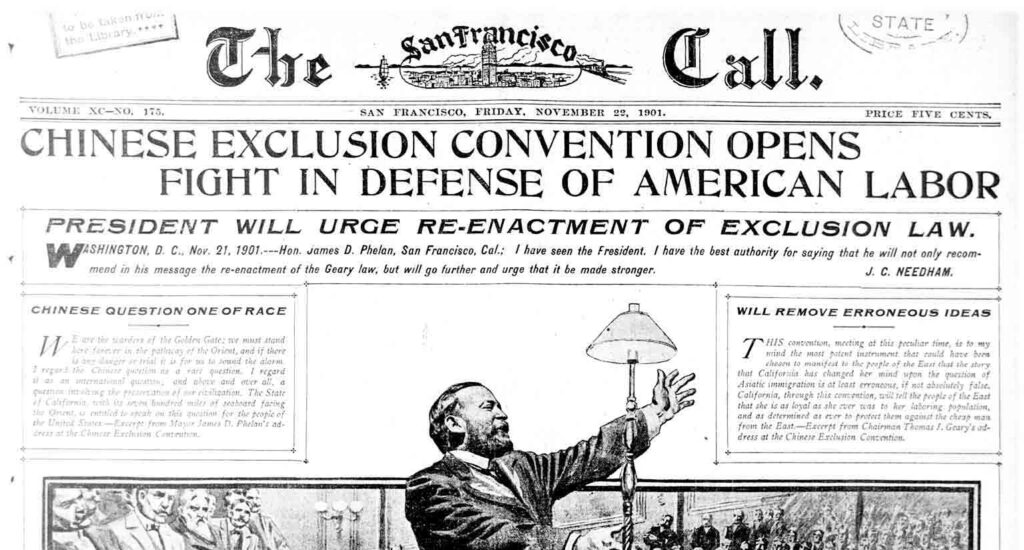
The prominent headline reads:“CHINESE EXCLUSION CONVENTION OPENS FIGHT IN DEFENSE OF AMERICAN LABOR” A secondary headline states: “PRESIDENT WILL URGE RE-ENACTMENT OF EXCLUSION LAW” A dateline from Washington, D.C., November 21, 1901, quotes Hon. James D. Phelan of San Francisco as asserting that the President would not only recommend renewal of the Geary Law but advocate strengthening it. Subheadings include: “CHINESE QUESTION ONE OF RACE” “WILL REMOVE ERRONEOUS IDEAS” The layout features bold typographic treatment typical of early twentieth-century metropolitan newspapers, with large block headlines, column divisions, and an engraved illustration beneath the text (partially visible in the image). The article reflects organized political efforts to renew and intensify federal Chinese exclusion policies at the turn of the twentieth century. The Geary Act (1892) had extended and strengthened the earlier Chinese Exclusion Act of 1882. By 1901, political leaders and labor advocates in California were actively campaigning for its re-enactment and expansion. The framing of exclusion as a defense of “American labor” and as a “race” issue illustrates the racialized rhetoric common in public discourse of the period. This front-page coverage documents the prominence and normalization of anti-Chinese political organizing in California at the beginning of the twentieth century.
“Chinese Exclusion Convention Opens Fight in Defense of American Labor,” The San Francisco Call, November 22, 1901

As early as three years before this resolution, landowners such as the Carr and Haggin Land Company already began seeking ways to decrease their dependence on Chinese laborers, including the recruitment of African-American farmworkers from the South who were experienced in planting and picking cotton. By the time of the Dust Bowl, debates about the impacts of Chinese immigration had largely fallen by the wayside, as the Central Valley’s workforce instead became overwhelmed by an influx of migrants from the Midwest and Black migrants from the South. Despite these demographic changes, Bakersfield’s population of Chinese descent stayed resilient; having once been shunned and exploited, this population grew in social status in the following decades. By the time she wrote her essay in 1974, nearly ninety years past the discriminatory and highly racist city resolution, Ogden observed that many white residents in Bakersfield had shifted to a highly positive view of the Chinese-American community. Most notably, this opinion was shared by Bakersfield’s upper class, who were now “willing to live next door to them in some of the biggest houses and the most ‘elite’ section of town.”

Ogden, Diane. History of Chinese in Bakersfield / Diane Ogden. Bakersfield, CA: California State College, 1974.

With increased postwar immigration, Congress adopted new means for regulation: quotas and requirements pertaining to national origin. By this time, anti-Chinese agitation had quieted. In 1943 Congress repealed all the exclusion acts under the Mugnuson Act during World War II, leaving a yearly limit of 105 Chinese and giving foreign-born Chinese the right to seek naturalization. The United States intended to increase war moral, China was a wartime ally. The so-called national origin system, with various modifications, lasted until Congress passed the Immigration Act of 1965 after 80 years of exclusion.  

How did the Chinese Exclusion Act affect Bakersfield’s Chinese residents?

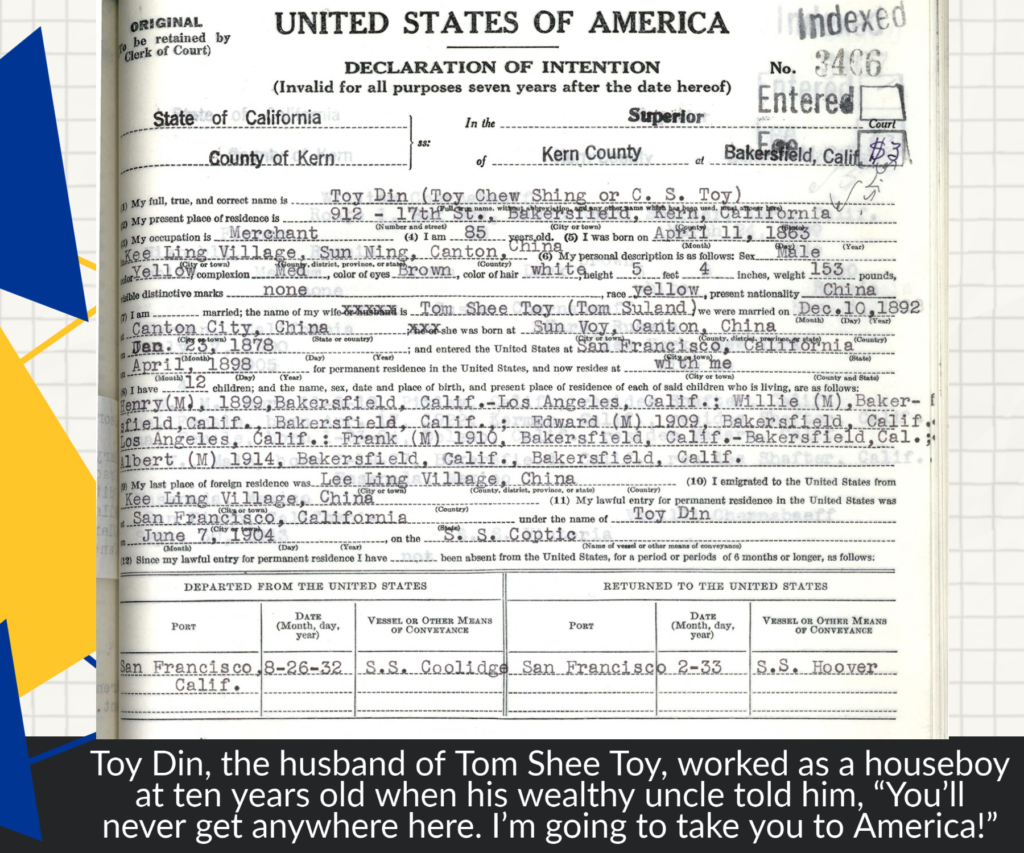
Toy Din, worked as a houseboy in Hong Kong at ten years old when his wealthy uncle told him, “You’ll never get anywhere here. I’m going to take you to America!” They immigrated through San Francisco in 1875. He worked at $50 per year for nine years before returning to China to marry Tom Shee Toy and returned to the U.S. in 1898 through San Francisco. The couple had twelve children, six sons, and six daughters. According to Tom Shee Toy‘s “Declaration of Intention,” she filed for citizenship, on January 15, 1948. In 1943, Congress repealed all the Chinese exclusion acts under the Mugnuson Act, leaving a yearly limit of 105 Chinese and giving foreign-born Chinese the right to seek naturalization. The United States intended to increase war morale because China was a wartime ally. The so-called national origin system, with various modifications, lasted until Congress passed the Immigration Act of 1965 after 80 years of exclusion.  Din Toy operated the first store in “New Chinatown” which carried both Chinese and American groceries on the southeast corner of 18th and Q Street in Bakersfield. He later built the first large Chinese restaurant across the street, which was operated by their son George Toy. Din Toy (85) and Tom Shee Toy (69) naturalized in 1947. They naturalized 3 year after the repeal of the Chinese exclusion act.
The prominent headline reads: “CHINESE EXCLUSION CONVENTION OPENS FIGHT IN DEFENSE OF AMERICAN LABOR” A secondary headline states: “PRESIDENT WILL URGE RE-ENACTMENT OF EXCLUSION LAW” A dateline from Washington, D.C., November 21, 1901, quotes Hon. James D. Phelan of San Francisco as asserting that the President would not only recommend renewal of the Geary Law but advocate strengthening it. Subheadings include: “CHINESE QUESTION ONE OF RACE” “WILL REMOVE ERRONEOUS IDEAS” The layout features bold typographic treatment typical of early twentieth-century metropolitan newspapers, with large block headlines, column divisions, and an engraved illustration beneath the text (partially visible in the image). The article reflects organized political efforts to renew and intensify federal Chinese exclusion policies at the turn of the twentieth century. The Geary Act (1892) had extended and strengthened the earlier Chinese Exclusion Act of 1882. By 1901, political leaders and labor advocates in California were actively campaigning for its re-enactment and expansion. The framing of exclusion as a defense of “American labor” and as a “race” issue illustrates the racialized rhetoric common in public discourse of the period. This front-page coverage documents the prominence and normalization of anti-Chinese political organizing in California at the beginning of the twentieth century.


Title: United States Declaration of Intention – Toy Din (Toy Cher Shing / C.S. Toy), Kern County, CaliforniaBrief Description: Federal “Declaration of Intention” naturalization document filed in Kern County, California, for Toy Din (also known as Toy Cher Shing or C.S. Toy), a Chinese-born merchant residing in Bakersfield. Extended Description: This image shows a United States naturalization form titled “United States of America – Declaration of Intention” (noted as invalid seven years after the date thereof). The document is filed in the Superior Court of Kern County, Bakersfield, California, and bears filing and indexing marks, including document number 3406. The declarant’s full name is listed as Toy Din (Toy Cher Shing or C.S. Toy). He states that he resided at 912 17th Street, Bakersfield, Kern County, California, and that his occupation was merchant. He reports being born on April 11, 1883, in Kee Ling Village, Sun Ning, Canton, China. The form includes a physical description section identifying him as: Sex: Male Complexion: Yellow Eyes: Brown Hair: White Height: 5 feet 4 inches Weight: 153 pounds Race: Yellow Present nationality: China He states that he is married to Tom Shee Toy (Tom Shee Sullard) and records marriage details in Canton City, China. The form also lists his wife’s immigration details, including entry through San Francisco, California. The document records multiple children, including names, birth years, and places of birth. Several children are identified as born in Bakersfield, California, indicating the family’s long-term residence in Kern County. The declaration includes immigration history, noting: Lawful entry for permanent residence at San Francisco, California in June 1904 under the name Toy Din. A departure from San Francisco on August 26, 1932, aboard the S.S. Coolidge. A return to San Francisco in February 1933 aboard the S.S. Hoover. This document reflects the complex legal and bureaucratic processes Chinese immigrants faced in the United States during the era shaped by the Chinese Exclusion Act and related immigration restrictions. The standardized racial classifications and detailed personal reporting illustrate how federal authorities documented identity, nationality, and family structure for immigrants of Chinese descent in early twentieth-century California.
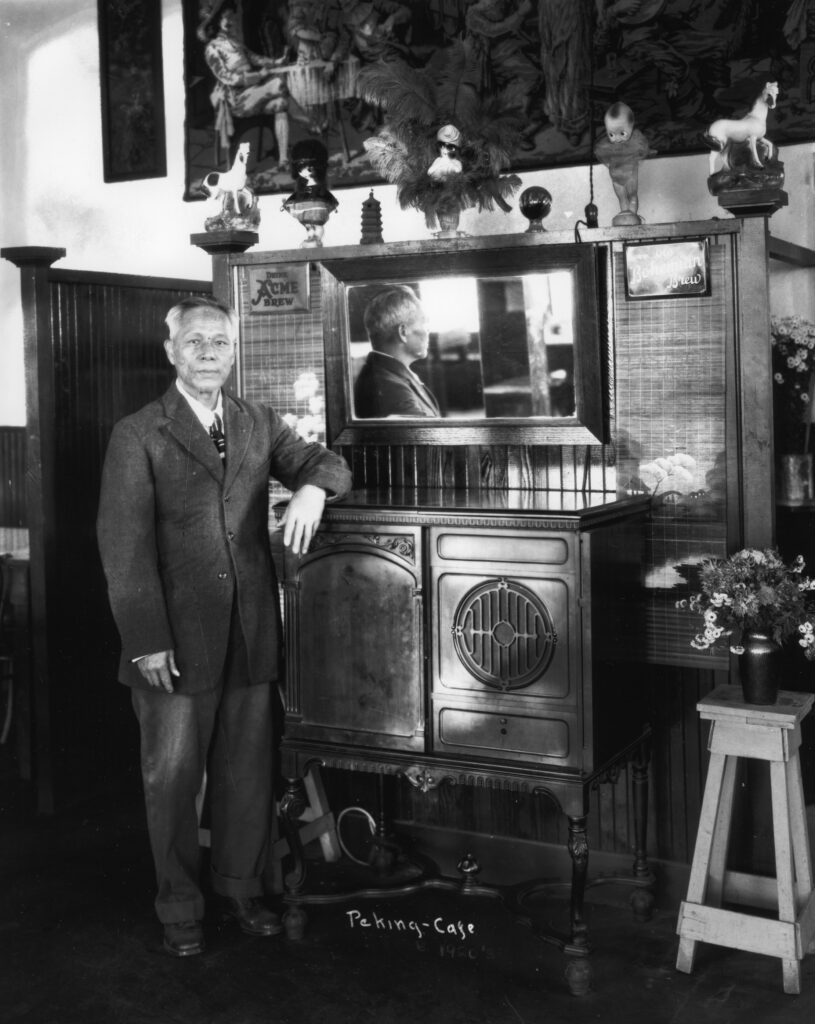
Din Toy inside the Peking Cafe at 731 18th Street late 1920s.

Chinese Americans often experienced additional surveillance and investigations for their ancestry.
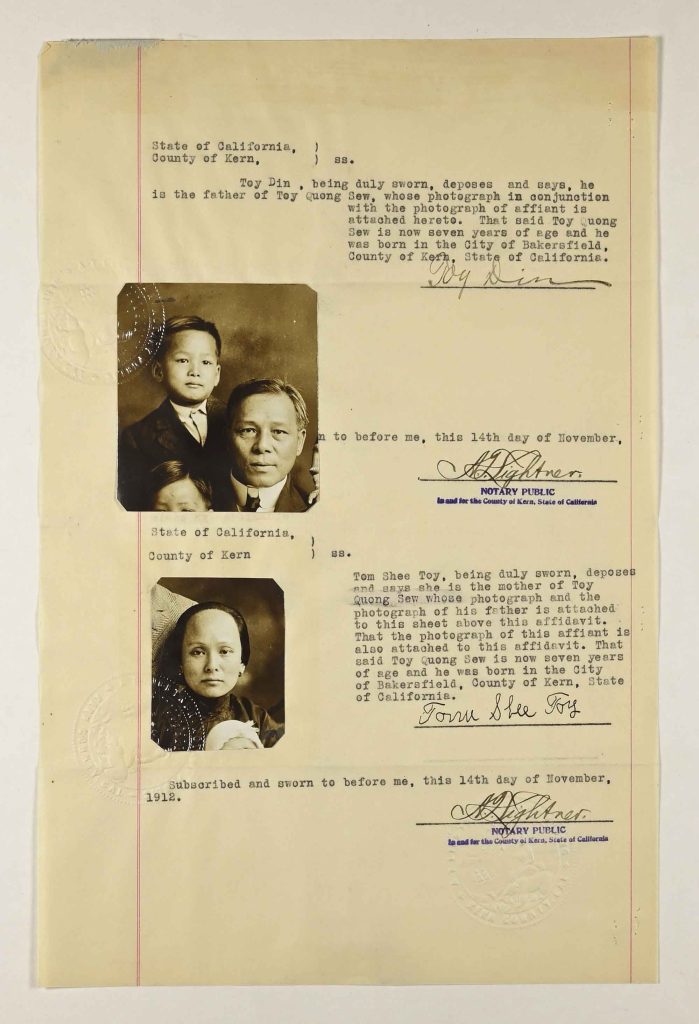
This document is a typed, notarized affidavit from the State of California, County of Kern, dated November 14, 1912. It contains sworn statements by Toy Din and Tom Shee Toy affirming the parentage and birthplace of their son, Toy Quong Sew.The upper portion of the document reads: “State of California, County of Kern, ss. Toy Din, being duly sworn, deposes and says, he is the father of Toy Quong Sew, whose photograph in conjunction with the photograph of affiant is attached hereto. That said Toy Quong Sew is now seven years of age and he was born in the City of Bakersfield, County of Kern, State of California.” The statement is signed “Toy Din” and notarized, with a visible notary public stamp and signature reading “A. Lightner, Notary Public, in and for the County of Kern, State of California.” The notarial text states the affidavit was subscribed and sworn to on the 14th day of November. Affixed below this statement is a sepia-toned portrait photograph showing an adult man (presumably Toy Din) and a young boy (Toy Quong Sew). The boy appears formally dressed in a suit jacket; the man wears a dark coat and tie. A faint embossed seal overlaps part of the photograph. The lower portion of the page contains a second sworn statement: “State of California, County of Kern, ss. Tom Shee Toy, being duly sworn, deposes and says she is the mother of Toy Quong Sew whose photograph and the photograph of his father is attached to this sheet above this affidavit. That the photograph of this affiant is also attached to this affidavit. That said Toy Quong Sew is now seven years of age and he was born in the City of Bakersfield, County of Kern, State of California.” This statement is signed “Tom Shee Toy” and similarly notarized by A. Lightner on November 14, 1912. A second sepia portrait photograph is attached near this statement, depicting a woman (Tom Shee Toy) holding a young child. An embossed seal is partially visible near this photograph as well. The document combines typed legal text, handwritten signatures, attached photographs, embossed official seals, and notary stamps. It appears to have been created to formally document and verify the birth and parentage of Toy Quong Sew in Bakersfield, California. Physical Details Typed legal affidavit on cream paper with red vertical margin lines. Two attached sepia portrait photographs with embossed seals. Handwritten signatures and blue notary stamps. Page shows minor edge wear consistent with archival document handling.
Record Group 85
Records of the Immigration and Naturalization Service, Chinese Exclusion Act Case Files
ca. 1893 – ca. 1945, https://catalog.archives.gov/id/574411254?objectPage=4
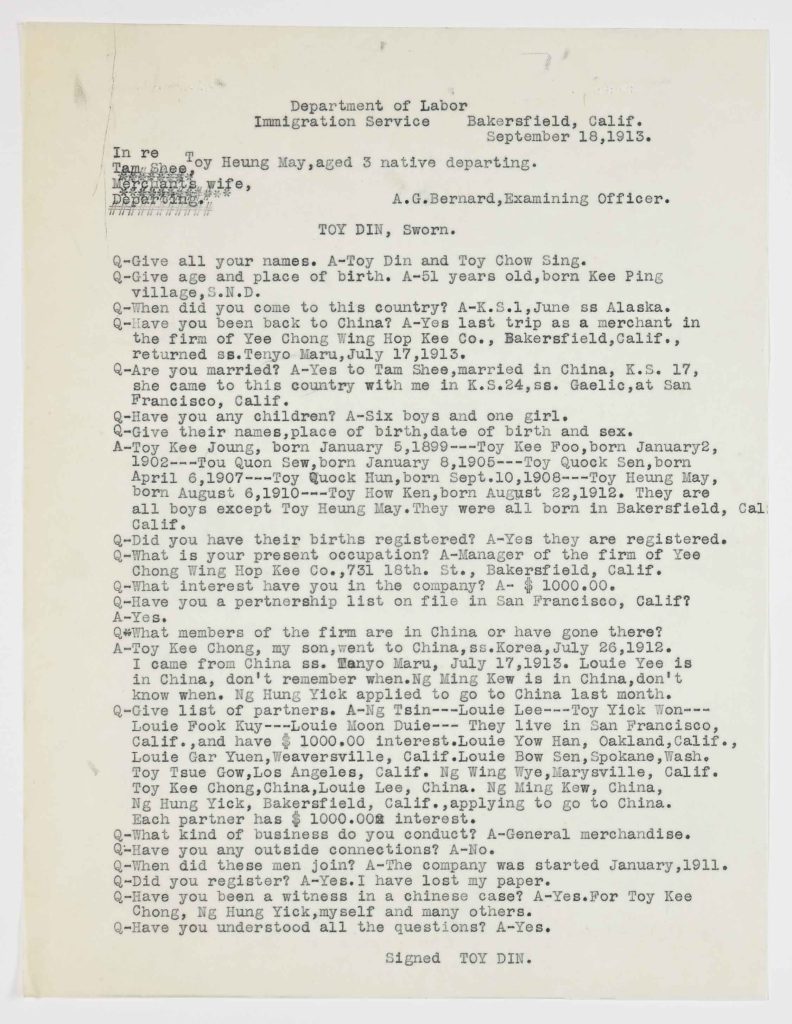
Department of Labor<br />Immigration Service<br /> Bakersfield, Calif.<br /> September 18, 1913.<br /> In re Toy Heung May, aged 3 native departing.<br /> Tam Shee,<br /> Merchant’s wife,<br /> Departing.<br /> A.G. Bernard, Examining Officer.<br /> TOY DIN, Sworn.<br /> Q – Give all your names.<br /> A – Toy Din and Toy Chow Sing.<br /> Q – Give age and place of birth.<br /> A – 51 years old, born Kee Ping Village, S.N.D.<br /> Q – When did you come to this country?<br /> A – K.S. 1, June ss Alaska.<br /> Q – Have you been back to China?<br /> A – Yes last trip as a merchant in the firm of Yee Chong Wing Hop Kee Co., Bakersfield, Calif., returned ss. Tenyo Maru, July 17, 1913.<br /> Q – Are you married?<br /> A – Yes to Tam Shee, married in China, K.S. 17, she came to this country with me in K.S. 24, ss. Gaelic, at San Francisco, Calif.<br /> Q – Have you any children?<br /> A – Six boys and one girl.<br /> Q – Give their names, place of birth, date of birth and sex.<br /> A – Toy Kee Joung, born January 5, 1899 — Toy Kee Foo, born January 2, 1902 — Toy Quon Sew, born January 8, 1905 — Toy Quock Sen, born April 6, 1907 — Toy Quock Hun, born Sept. 10, 1908 — Toy Heung May, born August 6, 1910 — Toy How Ken, born August 22, 1912. They are all boys except Toy Heung May. They were all born in Bakersfield, Calif.<br /> Q – Did you have their births registered?<br /> A – Yes they are registered.<br /> Q – What is your present occupation?<br /> A – Manager of the firm of Yee Chong Wing Hop Kee Co., 731 18th. St., Bakersfield, Calif.<br /> Q – What interest have you in the company?<br /> A – $1000.00.<br /> Q – Have you a partnership list on file in San Francisco, Calif?<br /> A – Yes.<br /> Q – What members of the firm are in China or have gone there?<br /> A – Toy Kee Chong, my son, went to China, ss. Korea, July 26, 1912. I came from China ss. Tenyo Maru, July 17, 1913. Louie Yee is in China, don’t remember when. Ng Ming Kew is in China, don’t know when. Ng Hung Yick applied to go to China last month.<br /> Q – Give list of partners.<br /> A – Ng Tsin — Louie Lee — Toy Yick Won — Louie Fook Kuy — Louie Moon Duie — They live in San Francisco, Calif., and have $1000.00 interest. Louie Yow Han, Oakland, Calif. Louie Gar Yuen, Weaverville, Calif. Louie Bow Sen, Spokane, Wash. Toy Tsue Gow, Los Angeles, Calif. Ng Wing Wye, Marysville, Calif. Toy Kee Chong, China. Louie Lee, China. Ng Ming Kew, China. Ng Hung Yick, Bakersfield, Calif., applying to go to China. Each partner has $1000.00 interest.<br /> Q – What kind of business do you conduct?<br /> A – General merchandise.<br /> Q – Have you any outside connections?<br /> A – No.<br /> Q – When did these men join?<br /> A – The company was started January, 1911.<br /> Q – Did you register?<br /> A – Yes. I have lost my paper.<br /> Q – Have you been a witness in a Chinese case?<br /> A – Yes. For Toy Kee Chong, Ng Hung Yick, myself and many others.<br /> Q – Have you understood all the questions?<br /> A – Yes.<br /> Signed<br /> TOY DIN.<br /> Physical Details<br /> Typed single-page government examination form on cream paper; question-and-answer format. Signed by Toy Din. Header identifies Department of Labor, Immigration Service, Bakersfield, California. Minor edge wear consistent with archival handling.
Record Group 85 Records of the Immigration and Naturalization Service, Chinese Exclusion Act Case Files ca. 1893 – ca. 1945 https://catalog.archives.gov/id/574412413?objectPage=18
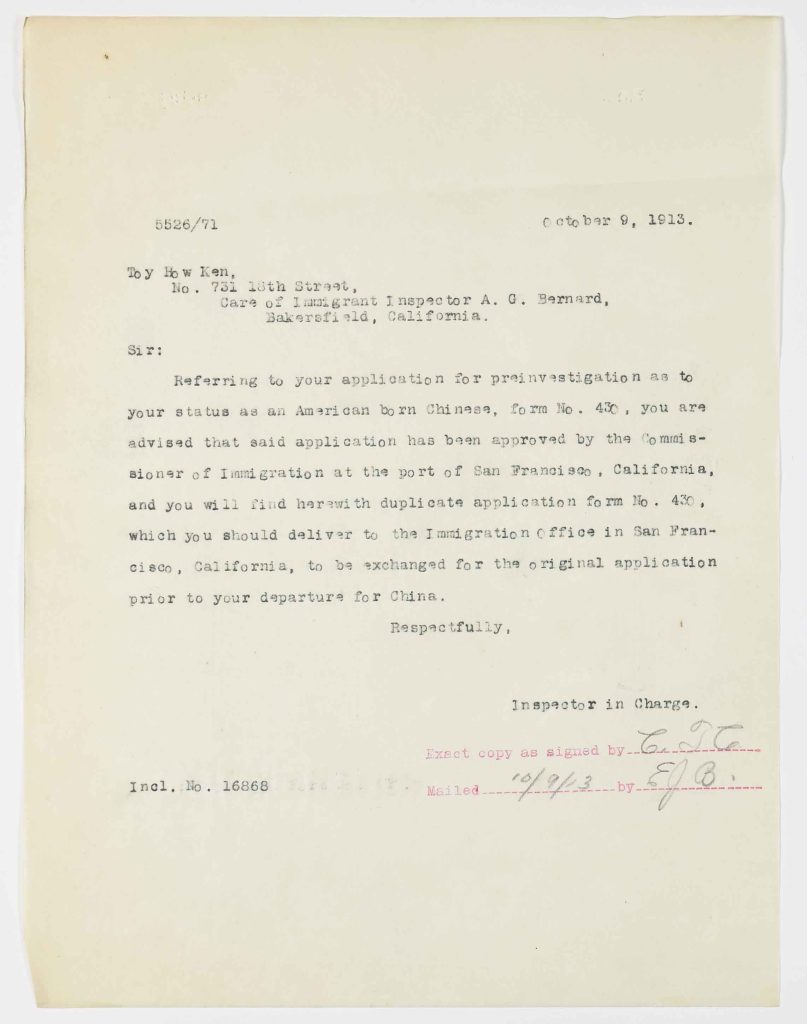
526/71October 9, 1913. Toy How Ken, No. 731 18th Street, Care of Immigrant Inspector A. G. Bernard, Bakersfield, California. Sir: Referring to your application for preinvestigation as to your status as an American born Chinese, form No. 430, you are advised that said application has been approved by the Commissioner of Immigration at the port of San Francisco, California, and you will find herewith duplicate application form No. 430, which you should deliver to the Immigration office in San Francisco, California, to be exchanged for the original application prior to your departure for China. Respectfully, Inspector in Charge. Exact copy as signed by ______ Mailed 10/9/13 by S.O. Incl. No. 16868 Physical Details Typed single-page official letter on cream paper; upper left reference number “5526/71.” Dated October 9, 1913. Signed in manuscript by the Inspector in Charge (signature partially illegible). Red stamped notation reading “Exact copy as signed by” and “Mailed 10/9/13 by S.O.” Minor creasing consistent with archival storage.
Record Group 85
Records of the Immigration and Naturalization Service
1787 – 2004, Chinese Exclusion Act Case Files
ca. 1893 – ca. 1945 https://catalog.archives.gov/id/574412566?objectPage=8

Minority Housing Districts in Bakersfield in the 19th and 20th Centuries from China Towns

Old China Town where Japanese Americans in Bakersfield

The New China Cafe, New China Town- 18th & Q St