
Public Housing

 Before 1938    –  Buying on Contract     Covenants  –   Covenant Database   –  East Bakersfield     

    Education    –   Eminent Domain     –     Moving into a Neighborhood   –    Neighborhoods     

 Public Housing   –  Resources    –   Rumford Fair Housing Act     Suburban Expansion   –   Zoning 

Public Housing

Public Housing in Bakersfield shares a similar fate to other California communities. Older minority neighborhoods often received less urban investment, of which destruction or purchasing under eminent domain was more likely. Adelante Vista, a public housing community in East Bakersfield, still stands and functions today as a public housing community. Adelante Vista was built over an older community and purchased through eminent domain.
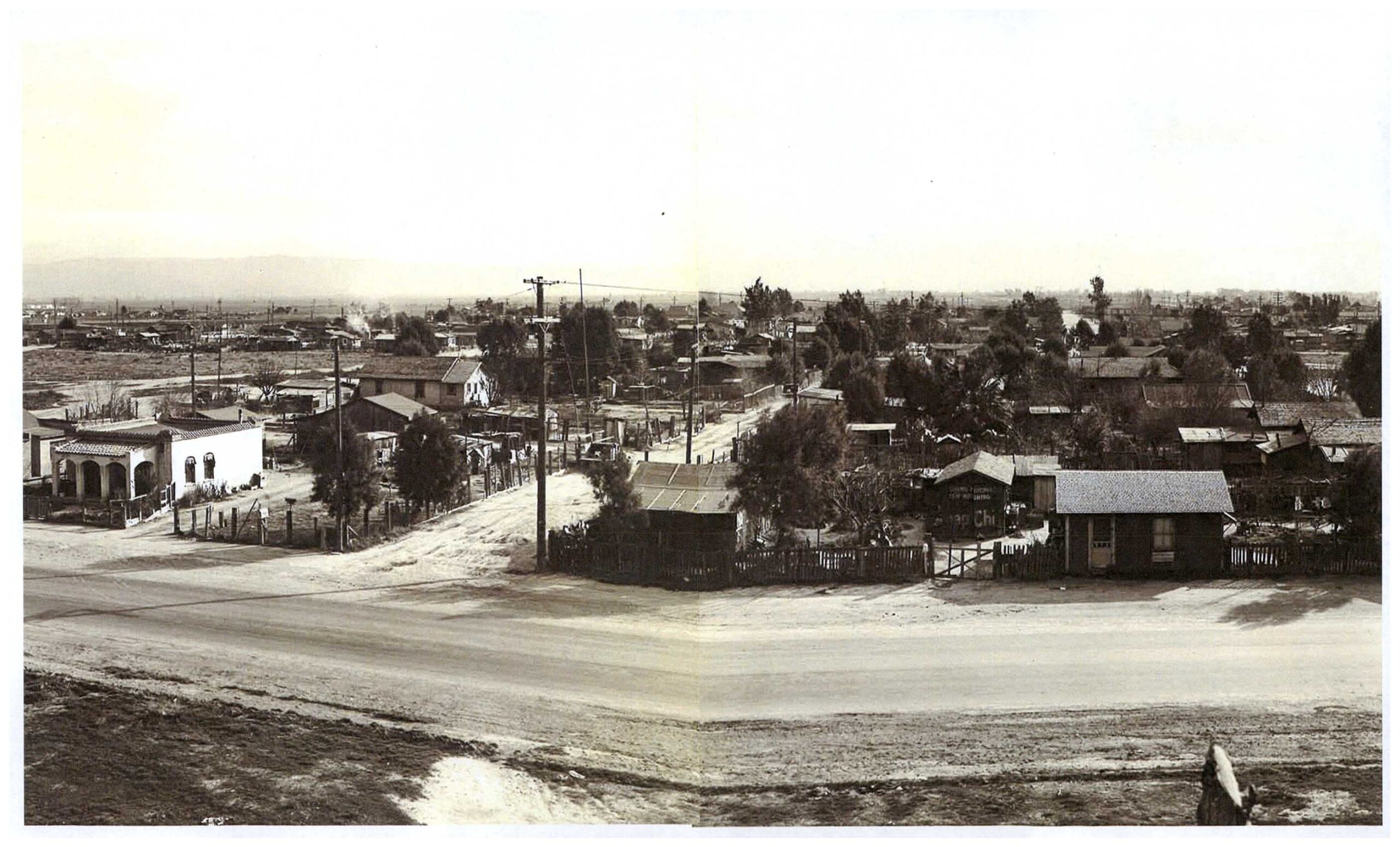
 

This wide-format black-and-white photograph captures a broad view of a Bakersfield neighborhood from an elevated vantage point. In the foreground, a curved dirt roadway runs horizontally across the image. A small wooden structure with a pitched roof and fenced yard sits near the bend in the road. Adjacent to it are additional modest houses constructed primarily of wood, several with porches, simple rectangular forms, and corrugated or shingled roofs.To the left, a larger stucco or masonry building with arched porch openings stands prominently at a street corner, suggesting either a residence with architectural embellishment or a small commercial or community structure. Wooden fences enclose many of the lots, and narrow unpaved side streets extend deeper into the neighborhood.

Utility poles and overhead lines run through the center of the scene, indicating electrification. The streets appear unpaved, and the lots are irregularly landscaped, with patches of bare earth. Trees of varying sizes are scattered throughout the area, though much of the terrain appears dry and sparsely vegetated.

Beyond the clustered homes, the background opens to flatter terrain with additional low structures and what appears to be agricultural or undeveloped land stretching toward distant hills or mountains faintly visible along the horizon.

The overall impression is of a working-class residential district during a period of early urban expansion, characterized by modest housing, limited infrastructure, and proximity to open land.
Neighborhood before Adelante Vista (Cal 8-2); California (8- Symbolized the County) (2- symbolized the order in which these communities were established) “Slum Area- Before the Construction of Adelante Vista.” “Slum Area- Before the Construction of Adelante Vista.” Housing Authority of the County of Kern, Date 1940-1941

The first African American assisted housing was in the Sunset Tract, a low-density tract compared to Mayflower, which helped low-income families in defense-related industries. No public housing would ever be built in Mayflower, but instead in Sunset. Residents of Mayflower were housed in the public housing units built in the Sunset Tract. The first duplex unit was Adelante Vista in 1942. Families qualified if their yearly income was less than $1,200. Each year the Housing Authority produced reports on surveys conducted, money used, and new developments. By 1943, most families were in defense-related labor or aiding in agriculture. All the units and communities were built under the Housing Authority of Kern County’s vision of suburban modernity and desirability. Suburban renewal displaced many of those who lived and worked on farmland. Hispanics experience displacement at the Hick’s Camp in El Monte, Los Angeles County. Many workers were Latina/o/x renters who worked in the Hick farms. As they lacked real property ownership, even if the camps had little modern features, they were removed because they were substandard. Most minorities were victims of urbanization’s mission to eradicate substandard housing, which was simply called “urban renewal.” This effort took the positive characteristics of modernity and urban development since modern changes were not a universal experience; this came at the cost of minority renters and homeowners.

Affordability did not always translate into equal housing, sanitary, or modern amenities. Modern infrastructure came at the cost of many minority populations. This instance in El Monte was similar to what happened in Chavez Ravine. The neighborhood of Chavez Ravine had been acquired through eminent domain to build public housing. As Hispanic families were evicted, subsequently, the City of Los Angeles decided that the vacant properties would become the home of Dodger Stadium. The City used eminent domain to acquire properties, and as they became owners, they invested in urban development for tourism and industry. They had no real interest in building minority housing.

This black-and-white reproduction shows a detailed subdivision map oriented vertically, with handwritten annotations identifying parcel boundaries, dimensions, street names, and property owners. The tract name “Sunset Tract” appears along the right margin, indicating the development area represented in the map.The document outlines rectangular and irregular lots arranged along intersecting streets and avenues. Street names and right-of-way measurements are noted along the edges, including references to California Avenue and other labeled roadways. Lot dimensions are recorded in feet, and many parcels contain handwritten names of owners, suggesting either tax assessment, planning, or title documentation purposes.

Numerous small circular symbols appear throughout the lots, likely representing trees or landscape features. Some parcels include structural outlines, suggesting building footprints. Notations referencing acreage (e.g., “1.14 A,” “1.5 A”) appear within certain parcels, indicating lot sizes.

The map includes boundary lines, corner markings, and measured distances along property edges. In addition to parcel divisions, the drawing includes annotations such as “Sunset Tract” and various personal names written in cursive, which appear to identify landholders or claimants.

The overall layout reflects early subdivision planning typical of expanding Bakersfield neighborhoods during the early to mid-20th century, documenting property ownership patterns and land division prior to or during residential development.
Homes that were purchased under eminent domain. Purchase Map, Housing Authority of the County of Kern, National Archives

In 1942, Adelante Vista was the only African American public housing structure. In 1945, the Negro Handbook, a collective resource for African American housing and statistical figures, cited Adelante Vista as a permanent public housing facility for the Black community. Segregation of state and federally subsidized public housing was no secret. The 1940s projects were Cal 8-1 Rio Vista (Roberts Lane), Cal 8-2 Adelante Vista (Sunset Tract), Cal 8-3 Valle Vista (Delano), and Cal 8-4 Monte Vista (Arvin).  In the 1943 Housing Authority report, all public housing other than Adelante Vista stated that their occupants were “mixed,” while Adelante Vista was labeled as “Colored.” The label “race occupancy” on formal reports said the clear difference between “mixed” and “colored” occupancy, which influenced race relations in public housing in the 1950s. Mixed most likely meant integrated, and colored, segregated. Oro Vista, the future public housing units built adjacent to Adelante Vista in 1954, remained African American. The sites had been selected by 1950 but were pending the Public Housing Administration’s approval of the proposed development programs in 1951. These projects for the 1950s followed Cal 8-5 Aero Vista (Oildale), Cal 8-6 Oro Vista (Sunset/Mayflower), and Cal 8-7 Terra Vista (Shafter). Oro Vista was the first large-scale public housing complex in the area and would house Mayflower and Sunset residents. 

 The public housing projects were given Spanish names, even when they were created to serve the African American community. The Sunset structures were named Oro Vista (Gold View) and Adelante Vista (Forward or Future View) to label these structures as a positive solution to the housing discrimination and shortage, but public housing was never meant to be permanent, nor had policies in place to protect equality. The Sunset-Mayflower public housing projects carried heavy negative connotations, especially in the fight that followed to stop the opening of Oro Vista from 1950-1954. “Public Housing” or “Projects” also carried a negative connotation in the national conversation. The Housing Authority built Oro Vista when reports told of the vast homes of Kern County in a dilapidated state, published in the 1950 Census of Housing report Special Tabulations for Local Housing Authorities. While these housing projects were built to alleviate the well-known housing situation, the orchestrated fight that followed in 1951 and 1952 did not help provide income or wealth access to residents of Mayflower. 
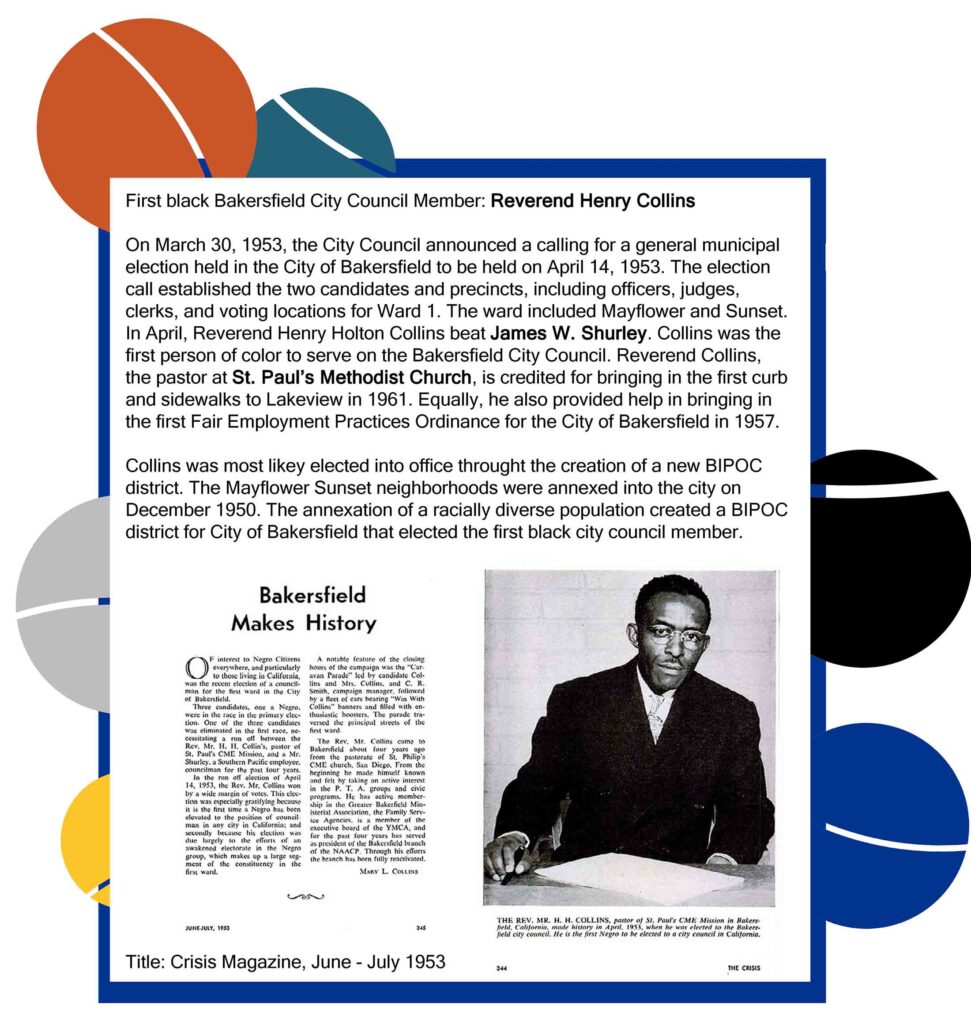
This exhibit-style panel features a white text box centered against a graphic background of overlapping circular shapes in orange, teal, black, gray, and blue. The headline reads:

“First black Bakersfield City Council Member: Reverend Henry Collins”

The panel text explains that on March 30, 1953, the Bakersfield City Council called for a general municipal election to be held on April 14, 1953. The election included Ward 1, which encompassed the Mayflower and Sunset neighborhoods. In April 1953, Reverend Henry Holton Collins defeated James W. Shurley. The panel identifies Collins as the first person of color to serve on the Bakersfield City Council.

Reverend Collins is described as pastor of St. Paul’s Methodist Church. The text credits him with helping bring curbs and sidewalks to the Lakeview area in 1961 and assisting in the passage of Bakersfield’s first Fair Employment Practices Ordinance in 1957.

The panel further explains that Collins’s election was likely made possible through the creation of a new BIPOC district. It notes that the Mayflower and Sunset neighborhoods were annexed into the City of Bakersfield in December 1950. The annexation of a racially diverse population created an electoral district that enabled the election of the first Black city council member.

Below the explanatory text is a reproduction of a 1953 Crisis Magazine spread titled:

“Bakersfield Makes History”

The spread includes a portrait of Reverend Collins seated at a desk, wearing glasses and a suit, and identified in the caption as pastor of St. Paul’s CME Mission in Bakersfield. The lower caption reads:

“Title: Crisis Magazine, June - July 1953”

The exhibit visually connects local political change in Bakersfield to broader civil rights documentation in national publications such as The Crisis.

Physical Details

Color digital exhibit panel. Graphic background with layered circular design elements. Includes reproduced black-and-white magazine images and portrait. Text set in modern sans-serif font within a white rectangular field bordered in blue.

Councilman Henry Collins, the first African American to hold an elected position in the City Council (Crisis Magazine June 1953), had reported to the Bakersfield Californian that Oro Vista had come to be a disappointment to the residents. The homes were to house 184 families, and with an estimated 800 applications, only a small fraction had moved. The newspaper reported that by mid-February 1954, only 17 families had moved into Oro Vista. Collins complained that the application process was too rigid and strict, limiting opportunities and access; he stated that people of irregular and lower income could not receive help. The narrow application window provided minimal access. There were also many restrictions beyond income. The application required families to have specific types of furniture, good credit, steady employment, and that the woman be a good housekeeper. Single individuals were barred from the application; only families could apply. Collins stated the obvious, “How can a woman prove she is a good housekeeper when she has no house to keep?” Regardless of Collins’s reflections, he supported the county’s plan to introduce substandard homes in Mayflower and Sunset. He stated, “I don’t like the looks of the housing deal. The city seems to be getting the run-around, and in the end, the people of Sunset-Mayflower will be left out.” Collins understood the politics of the city and perhaps saw little alternatives. He was right about the rigidity of segregation; long-term change and fair housing was far away from becoming a reality. Shortly after, the City Council crafted two urban renewal ordinances. The City Council was getting ready to legalize selling substandard homes to Mayflower and Sunset. 


“Things were decidedly different in 1953 when the Rev. Henry H. Collins, a newcomer to Bakersfield, took out papers to run for the council. One might think the Bakersfield of 1953 was a somewhat enlightened place to have elected an African American to the city council, one of the first California cities to do such a thing.”

https://www.kget.com/news/hidden-history/black-history-month/citys-first-black-council-member-went-right-to-work-on-bakersfields-housing-disparity-a-black-history-month-profile-of-h-h-collins/#/questions/5294859

By early June, the Bakersfield Californian reported that all the homes in Oro Vista were occupied, with occupants being 90 percent African American and 10 percent Mexican. The newspaper even reported that two white families applied but never returned to claim consideration. This perhaps hinted at the segregated nature of the housing in Oro Vista. Ninety percent of all Oro Vista’s residents were from within the Mayflower and Sunset Tract in June 1954. The newspaper did not report the origin of the other 10 percent of residents. Oro Vista was segregated from the beginning, resembling the demographic of Adelante Vista, which was segregated and adjacent.  

Black-and-white printed page titled “Adelante Vista.” At upper right is a small headshot labeled “Patti Wheeler – Management Aide.” Below the title appears a section labeled PROJECT DATA, listing:Size of Project: 50 duplex units.

Location: East California Avenue, Bakersfield.

Type of Tenancy: Colored.

The text explains that the project is a slum clearance development originally planned for families with annual incomes under $1,200. It notes that the project is now semi-defense housing, with some residents employed in defense work and others working in agriculture in Kern County.

Under TENANT ACTIVITY, the document states that Don Blackwell is President of the Tenants Council of Adelante Vista. Families may join the council at a charge of ten cents per week per family. Meetings are held semi-monthly and discussions focus on tenant problems. The report notes that several Kern County figures spoke to the council, including Judge Warren Stockton on juvenile delinquency; Mrs. Horace Tilley on Inter-Cultural Art; Mr. Hugh Lowery, Assistant Director of the colored USO, on juvenile recreation; and Mrs. Pearl Winters on current musical events.

Under RECREATION, the page describes a small community hall where meetings are held. Younger children have weekly game night and dance night. Punch and sandwiches are sold, with proceeds going to the Tenants Council Fund.

At the bottom of the page is a photograph of the housing structure—single-story duplex buildings with low-pitched roofs—captioned “Press of The Bakersfield Californian.”

The document explicitly identifies the housing project as designated for “Colored” tenancy, reflecting segregated public housing practices in Bakersfield during the early 1940s.
“Third Annual report,” Housing Authority of County of Kern, 1943


All the units and communities were built under the Housing Authority of Kern County’s vision of suburban modernity and desirability.
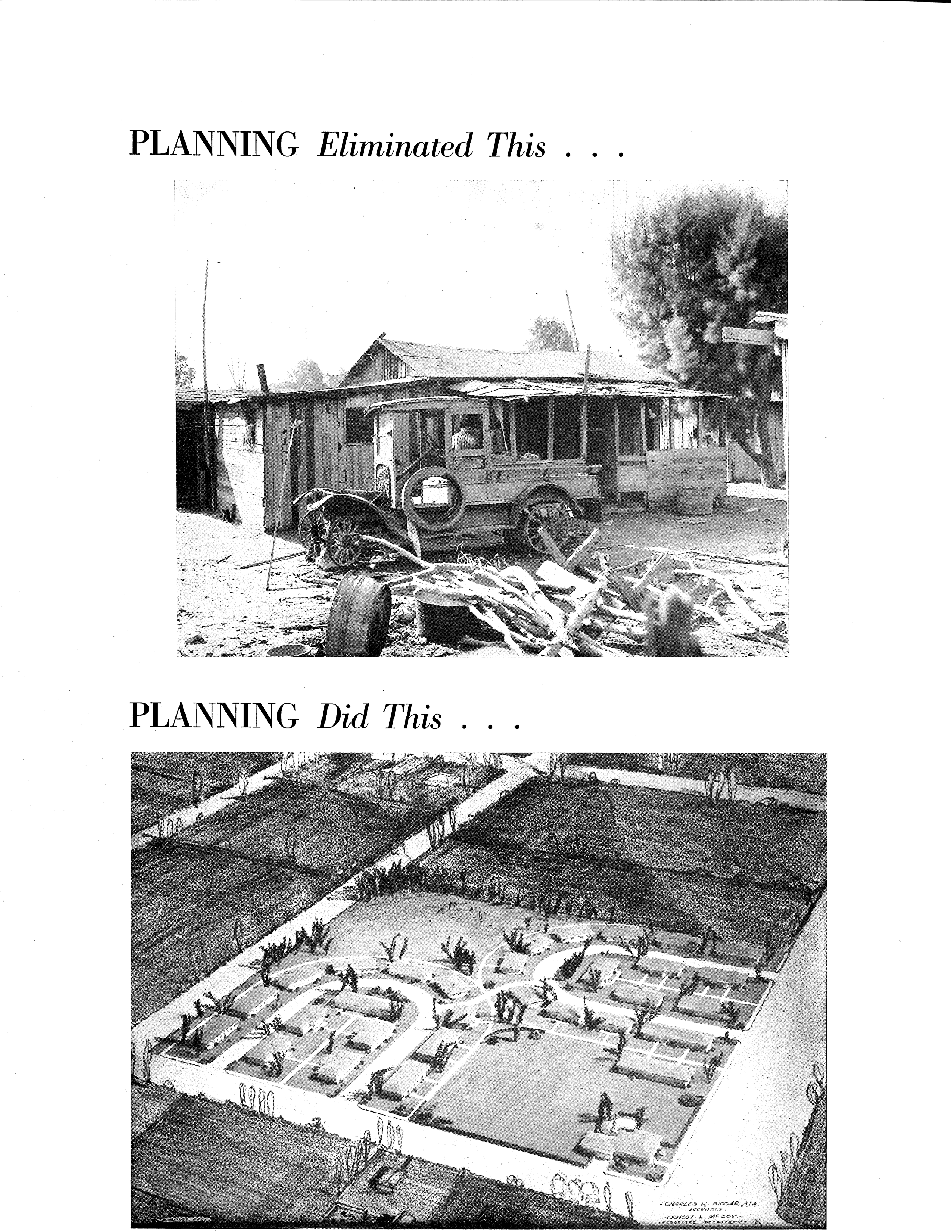
Black-and-white report page featuring two contrasting images presented as a before-and-after comparison of urban planning outcomes.At the top, the heading reads: “PLANNING Eliminated This . . .” Beneath it is a photograph of a deteriorated wooden shack. The structure appears weathered and unstable, with uneven boards, a sagging roofline, and rough construction. In front of the shack sits an old automobile with exposed wheels and visible wear. Scattered debris, scrap wood, and discarded materials lie across the dirt yard. The scene conveys poverty, neglect, and substandard housing conditions.

Below, a second heading reads: “PLANNING Did This . . .” Under this heading is an aerial rendering or model view of a planned housing development. The development consists of small, uniform housing units arranged in curved and organized rows around landscaped interior paths or streets. Trees are planted throughout the layout, and the buildings appear evenly spaced and systematically designed. The surrounding fields contrast with the orderly subdivision plan.

The page visually presents urban planning as transforming blighted or substandard housing conditions into organized residential developments, using direct visual comparison between informal settlement structures and planned community housing.
“Annual report,” Housing Authority of County of Kern, 1943


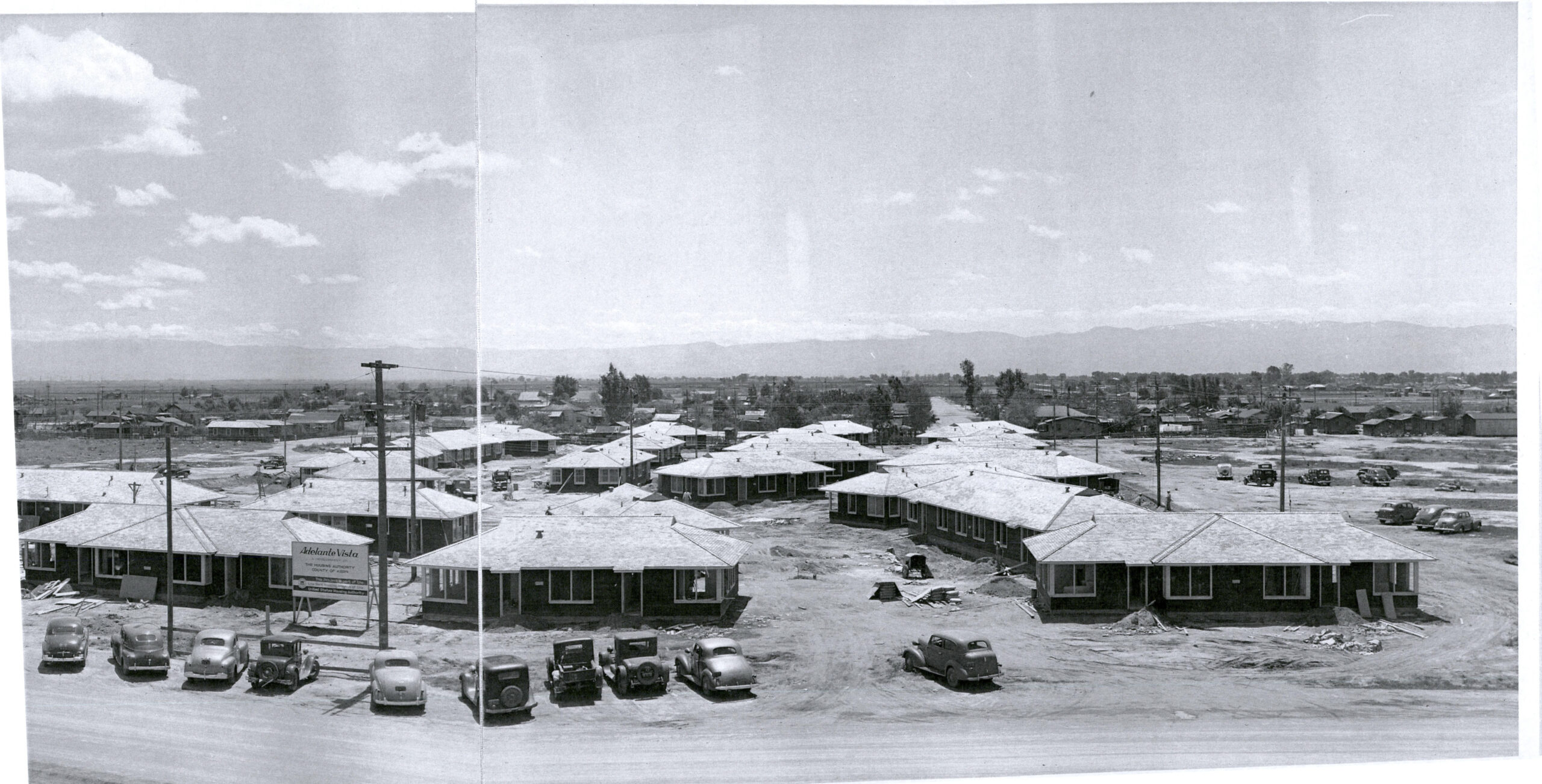
Wide black-and-white panoramic photograph depicting a newly built residential housing development composed of multiple single-story duplex-style buildings arranged in a clustered layout.In the foreground, a paved street runs horizontally across the image. Several mid-20th-century automobiles—rounded sedans and small trucks—are parked along the curb. A freestanding sign near the front of the development reads “Adelante Vista,” identifying the housing project.

Beyond the street, identical duplex units with low-pitched roofs and simple rectangular forms are arranged in orderly rows and slight curves. Each building has multiple windows facing outward and small entry areas. The ground between the buildings appears unfinished, with exposed dirt, construction debris, and sparse landscaping, suggesting the development is newly completed or still under construction.

Utility poles and overhead lines run through the development, and additional structures extend into the background. The surrounding landscape appears relatively flat and open, with scattered buildings and undeveloped lots visible beyond the project. Distant mountains form a faint horizon line under a lightly clouded sky.

The photograph emphasizes uniformity, planned layout, and modern residential construction within a semi-rural or expanding urban edge setting.
Adelante Vista (Cal 8-2), during construction on April 16, 1942. Adelante Vista (Cal 8-2), Housing Authority of the County of Kern, April 16, 1942.