Eminent Domain

 Before 1938    –  Buying on Contract     Covenants  –   Covenant Database   –  East Bakersfield     

    Education    –   Eminent Domain     –     Moving into a Neighborhood   –    Neighborhoods     

 Public Housing   –  Resources    –   Rumford Fair Housing Act     Suburban Expansion   –   Zoning 

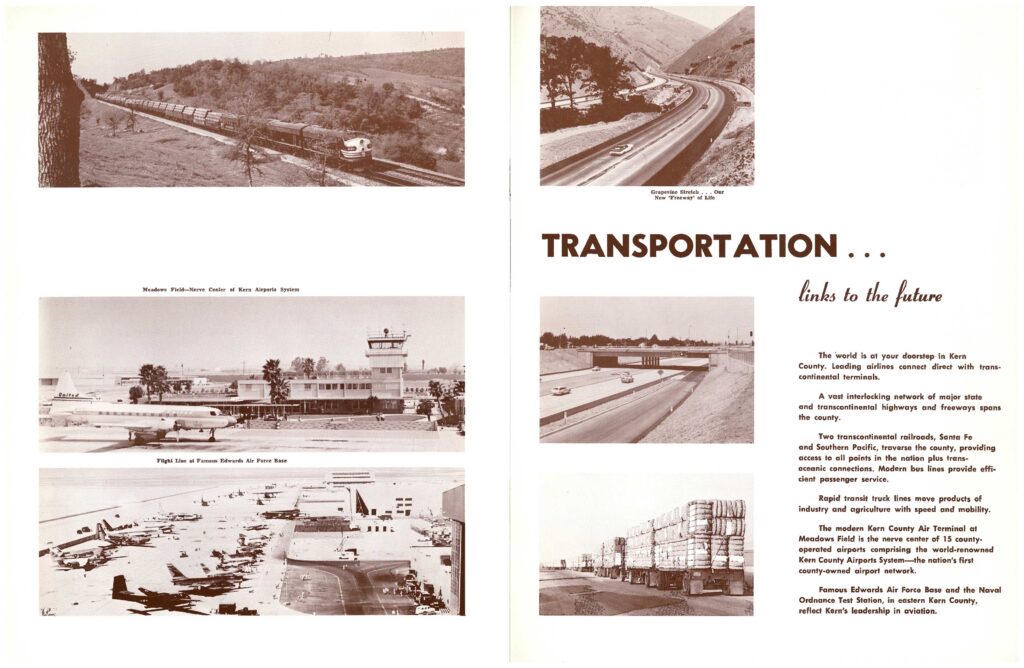
TRANSPORTATION…links to the future Caption under top right image: Grapevine Highway, One New Freeway of the West Main text on right page: “The world is at your doorstep in Kern County. Leading airlines connect direct with transcontinental terminals. A vast interlocking network of major state and transcontinental highways and freeways spans the county. Two transcontinental railroads, Santa Fe and Southern Pacific, traverse the county, providing access to all points in the nation plus trans-ocean connections. Modern bus lines provide efficient passenger service. Rapid transit truck lines move products of industry and agriculture with speed and mobility. The modern Kern County Air Terminal at Meadows Field is the nerve center of 15 county-operated airports comprising the world-renowned Kern County Airports System—the nation’s first county-owned airport network. Famous Edwards Air Force Base and the Naval Ordnance Test Station, in eastern Kern County, reflect Kern’s leadership in aviation.” Left-hand page captions: Top image: (train moving through hills; no visible caption text) Middle image caption: Modern Field–Meadow Field of Kern Airport System Lower image caption: Flight Line at Famous Edwards Air Force Base The spread includes photographs of: A freight train traveling through hilly terrain A modern freeway cutting through mountain landscape Meadow Field airport terminal with airplanes A flight line at Edwards Air Force Base with multiple aircraft A freeway interchange Flatbed trucks hauling bundled goods
“Transportation… Links to the Future,” California’s Golden Empire Magazine, 1950s

Older minority neighborhoods often received less urban investment than suburban and new housing. Destruction or purchasing under eminent domain, was a common way for cities to build in area they saw their least investment. Chavez Ravine, the well known case of Dodger Stadium, was initially purchased under eminent domain to build public housing but never became housing. Instead, the Los Angeles City Council used the acquired space to build Dodger Stadium (LAPL Photographs).

Minority communities in cities lacked equal investment, and rather than supporting the reconstruction of dilapidated neighborhoods, or urban investment,  homes were purchased under eminent domain for public projects, and highway initiatives, in order to condemn of dilapidated and aging homes. Like the case of many cities and counties, eminent domain reclassifications allowed city governments and federally funded programs to acquire homes, destroy, and at times for the promise to build public housing, without adequate or equal replacement.  The City used eminent domain to acquire properties but instead invested in urban development for tourism and industry.
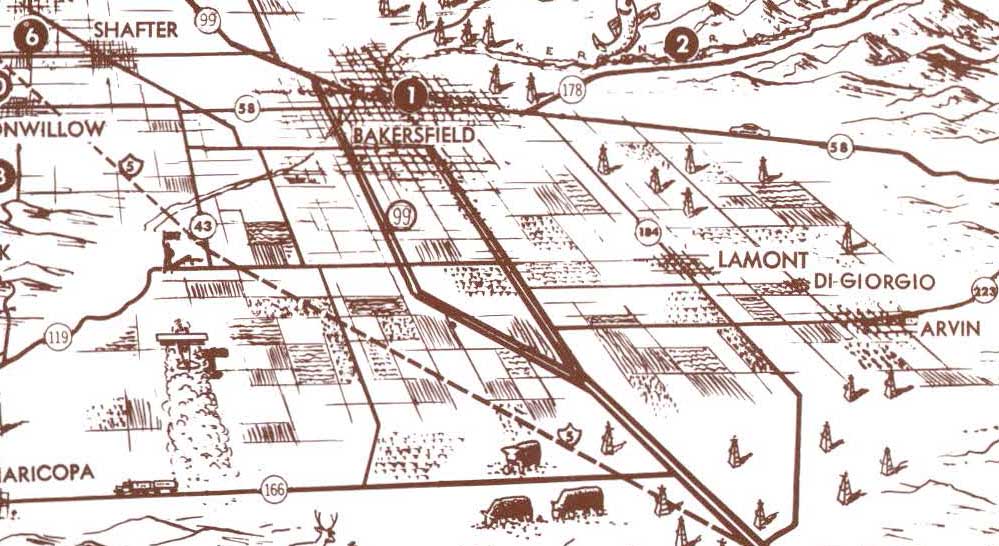
The image is a stylized illustrated map of central Kern County with the city of BAKERSFIELD prominently labeled at center.Visible place names: SHAFTER BAKERSFIELD LAMONT DI GIORGIO ARVIN MARICOPA Highway markers visible: 99 58 178 184 166 119 43 Additional visible features include: “KERN RIVER” (partially visible at top right) Agricultural fields illustrated as rectangular plots Oil derricks scattered across fields Cattle and grazing land illustrated at bottom A plume of smoke rising from an industrial facility (likely oil-related) Mountain ranges illustrated to the east The map uses a brown monochrome style typical of mid-20th-century promotional or informational brochures. It emphasizes oil production (with derricks), agriculture (fields and livestock), and transportation corridors converging at Bakersfield.
Highway before the modern Highway 99, California’s Golden Empire Magazine, 1950s

Excerpt from an oral history with Christina McClanahan detailing how the building of the State Route 58 affected her.

“The reason I thought about that is when we were looking at this house. When we lived up on Madison Street and the state bought our house for the freeway and we thought we’d just go out. It was 1960 by then, we thought we’d just go out and by a house. I went out and there just wasn’t a house for me… I think my husband must have mentioned something at the time we could sue. So his boss called him in and told him that he could not sue, if he did he wouldn’t have a job.”


Christina McClanahan, 1981 California Odyssey Project, Full Interview

McClanahan, Christina Veola Williams (133)

Audio

Transcript

McClanahan was born in Boley, Okfuskee County, Oklahoma in 1929. This interview provides an African American perspective to the Dust Bowl. She and her family came to Rosedale, California in 1936. McClanahan considers discrimination toward African Americans, the home remedies her family used for illness, her father’s involvement in WPA and SRA, discrepancies with a social worker and obtaining welfare, how labor contractors cheated anyone they could, and why African Americans saw Roosevelt as a great president.
20 June 1981
Judith Gannon


Other Dustbowl Interviews https://hrc.csub.edu/odyssey/dbinterviews/

African American Voices https://hrc.csub.edu/african-american-voices/oral-history/

In 1950, lawsuits tested the “Freeway Law” of 1939, which allowed the state to buy land and create ” …’expressway,’ such as divided roadway, separated crosstraffic, no left turns, direct interchange facility, ample right of way, no pedestrians, simple and adequate signs, are a definite requirement, but the important fundamental quality that creates the high, lasting character is the ‘freeway principle.'” Fred J. Grumm, “Freeways: Progress Toward the Ultimate in Highway Transportation,” California Highway and Public Works, March-April 1950, Vol 3-4, p55
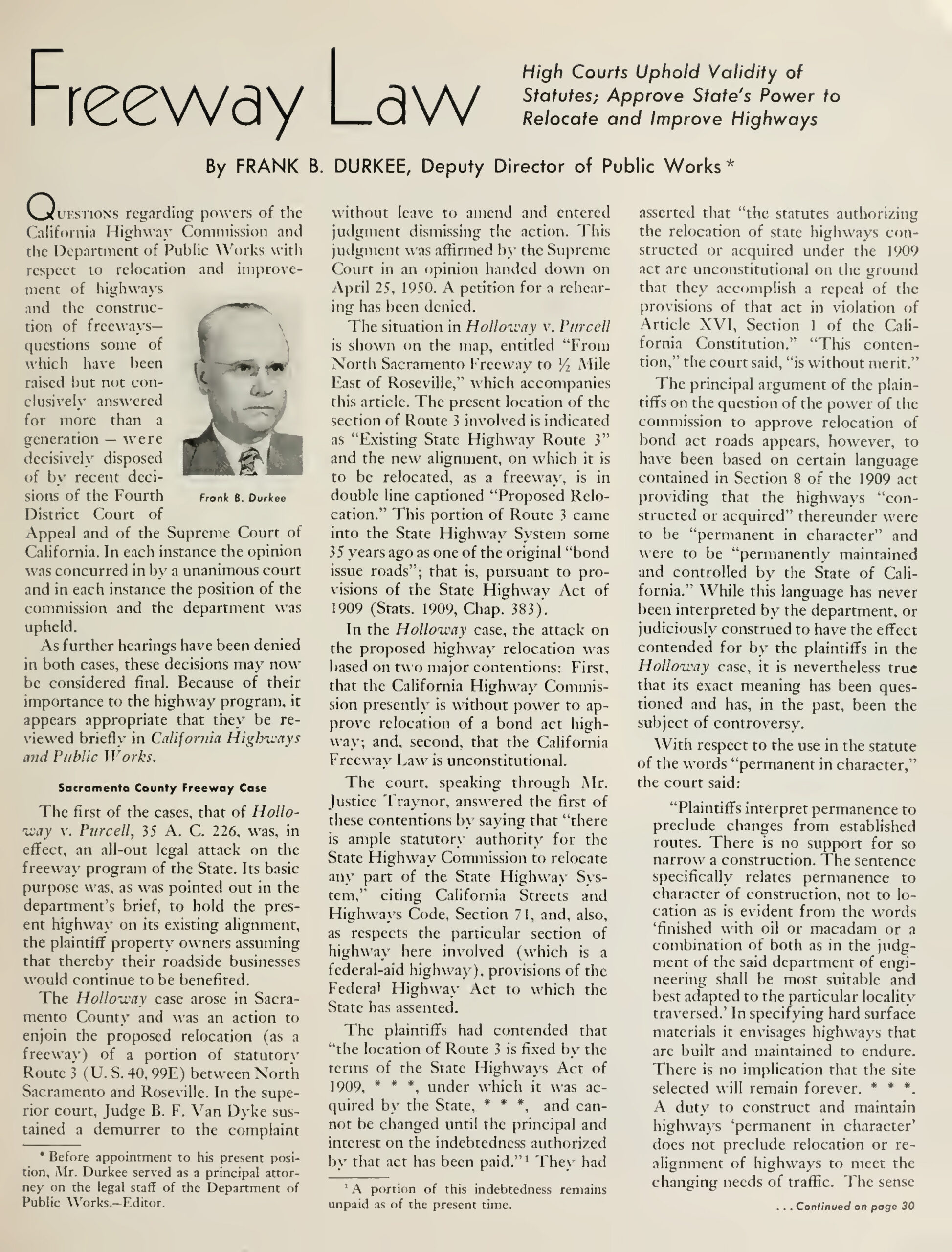
 

Freeway Law High Courts Uphold Validity of Statutes; Approve State’s Power to Relocate and Improve Highways By FRANK B. DURKEE, Deputy Director of Public Works* Opening text (visible portion): “Questions regarding powers of the California Highway Commission and the Department of Public Works with respect to relocation and improvement of highways and the construction of freeways—questions some of which have been raised but not conclusively answered for more than a generation—were decisively disposed of by recent decisions of the Fourth District Court of Appeal and of the Supreme Court of California. In each instance the opinion was concurred in by a unanimous court and in each instance the position of the commission and the department was upheld. As further hearings have been denied in both cases, the decisions may now be considered final. Because of their importance to the highway program, it appears appropriate that they be reviewed briefly in California Highways and Public Works.” Subheading: Sacramento County Freeway Case “The first of the cases, that of Holloway v. Purcell, 35 A.C. 226, was, in effect, an all-out legal attack on the freeway program of the State. Its basic purpose was, as was pointed out in the department’s brief, to hold the present highway on its existing alignment, the plaintiff property owners assuming that thereby roadside businesses would continue to be benefited. The Holloway case arose in Sacramento County and was an action to enjoin the proposed relocation (as a freeway) of a portion of statutory Route 3 (U.S. 40, 99E) between North Sacramento and Roseville. In the superior court, Judge B. F. Van Dyke sustained a demurrer to the complaint without leave to amend and entered judgment dismissing the action. This judgment was affirmed by the Supreme Court in an opinion handed down on April 25, 1950. A petition for a rehearing has been denied. The situation in Holloway v. Purcell is shown on the map, entitled “From North Sacramento Freeway to ½ Mile East of Roseville,” which accompanies this article. The present location of the section of Route 3 involved is indicated as “Existing State Highway Route 3” and the new alignment, on which it is to be relocated, as a freeway, is in double line captioned “Proposed Relocation.” This portion of Route 3 came into the State Highway System some 35 years ago as one of the original “bond issue roads”; that is, pursuant to provisions of the State Highway Act of 1909 (Stats. 1909, Chap. 383). In the Holloway case, the attack on the proposed highway relocation was based on two major contentions: First, that the California Highway Commission is presently without power to approve relocation of a bond act highway; and second, that the California Freeway Law is unconstitutional. The court, speaking through Mr. Justice Traynor, answered the first of these contentions by saying that “there is ample statutory authority for the State Highway Commission to relocate any part of the State Highway System,” citing California Streets and Highways Code, Section 71, and also, as respects the particular section of highway here involved (which is a federal-aid highway), provisions of the Federal Highway Act to which the State has assented. The plaintiffs had contended that the location of Route 3 is fixed by the terms of the State Highways Act of 1909, “* * *, under which it was acquired by the State, * * *, and cannot be changed until the principal and interest on the indebtedness authorized by that act has been paid.” They had asserted that “the statutes authorizing the relocation of state highways constructed or acquired under the 1909 act are unconstitutional on the ground that they accomplish a repeal of the provisions of that act in violation of Article XVI, Section 1 of the California Constitution.” “This contention,” the court said, “is without merit.” The principal argument of the plaintiffs on the question of the power of the commission to approve relocation of bond act roads appears, however, to have been based on certain language contained in Section 8 of the 1909 act providing that the highways “constructed or acquired” thereunder were to be “permanent in character” and were to be “permanently maintained and controlled by the State of California.” While this language has never been interpreted by the department, or contended for by the plaintiffs in the Holloway case, it is nevertheless true that its exact meaning has been questioned and has, in the past, been the subject of controversy. With respect to the use in the statute of the words “permanent in character,” the court said: “Plaintiffs interpret permanence to preclude changes from established routes. There is no support for so narrow a construction. The sentence specifically relates permanence to character of construction, not to location as is evident from the words ‘finished with oil or macadam or a combination of both as in the judgment of the said department of engineering shall be most suitable and best adapted to the particular locality traversed.’ In specifying hard surface materials it envisages highways that are built and maintained to endure. There is no implication that the site selected will remain forever. A duty to construct and maintain highways ‘permanent in character’ does not preclude relocation or realignment of highways to meet the changing needs of traffic. The sense … Continued on page 30” Photo caption under portrait: Frank B. Durkee Footnote at bottom: “* Before appointment to his present position, Mr. Durkee served as a principal attorney on the legal staff of the Department of Public Works.—Editor.” Publication footer: California Highways and Public Works

The high courts upheld and denied the challenges to the 1939 Freeway Law. The challenges originated from Sacramento and Bakersfield.
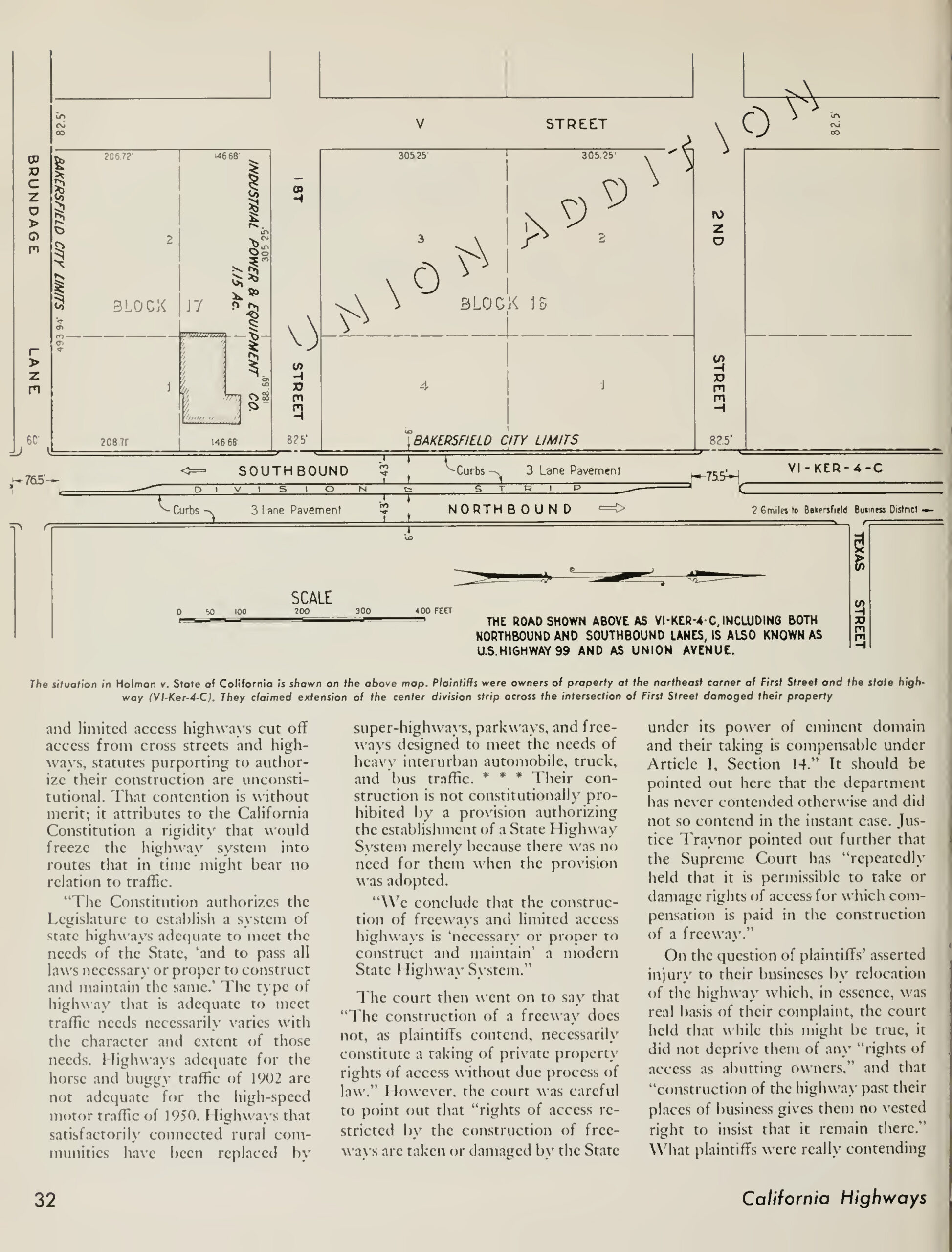
Street labels visible: BRUNDAGE LANE V STREET 1ST STREET 2ND STREET TEXAS STREET Blocks and parcels labeled: BLOCK 17 BLOCK 16 Industrial property label: INDUSTRIAL POWER & EQUIPMENT 1.15 Ac. City limits markings: BAKERSFIELD CITY LIMITS (shown along Division Street and along lower property line) Highway markings: SOUTHBOUND NORTHBOUND DIVISION STREET Road description: Curbs 3 Lane Pavement Highway designation box: VI-KER-4-C Text to right of highway box: 2.6 miles to Bakersfield Business District → Scale marking: SCALE 0 50 100 200 300 400 FEET Explanatory caption beneath scale: THE ROAD SHOWN ABOVE AS VI-KER-4-C, INCLUDING BOTH NORTHBOUND AND SOUTHBOUND LANES, IS ALSO KNOWN AS U.S. HIGHWAY 99 AND AS UNION AVENUE. Explanatory case text beneath map: “The situation in Holman v. State of California is shown on the above map. Plaintiffs were owners of property at the northeast corner of First Street and the state highway (VI-Ker-4-C). They claimed extension of the center division strip across the intersection of First Street damaged their property…” (Visible body text continues:) “…and limited access highways cut off access from cross streets and highways, statutes purporting to authorize their construction are unconstitutional. That contention is without merit; it attributes to the California Constitution a rigidity that would freeze the highway system into routes that in time might bear no relation to traffic. ‘The Constitution authorizes the Legislature to establish a system of state highways adequate to meet the needs of the State, and to pass all laws necessary or proper to construct and maintain the same.’ The type of highway that is adequate to meet traffic needs necessarily varies with the character and extent of those needs. Highways adequate for the horse and buggy traffic of 1902 are not adequate for the high-speed motor traffic of 1950. Highways that satisfactorily connected rural communities have been replaced by super-highways, parkways, and freeways designed to meet the needs of heavy interurban automobile, truck, and bus traffic. * * * Their construction is not constitutionally prohibited by a provision authorizing the establishment of a State Highway System merely because there was no need for them when the provision was adopted. ‘We conclude that the construction of freeways and limited access highways is “necessary or proper to construct and maintain” a modern State Highway System.’ The court then went on to say that ‘The construction of a freeway does not, as plaintiffs contend, necessarily constitute a taking of private property rights of access without due process of law.’ However, the court was careful to point out that ‘rights of access restricted by the construction of freeways are taken or damaged by the State under its power of eminent domain and their taking is compensable under Article 1, Section 14.’ It should be pointed out here that the department has never contended otherwise and did not so contend in the instant case. Justice Traynor pointed out further that the Supreme Court has ‘repeatedly held that it is permissible to take or damage rights of access for which compensation is paid in the construction of a freeway.’ On the question of plaintiffs’ asserted injury to their businesses by relocation of the highway which, in essence, was the real basis of their complaint, the court held that while this might be true, it did not deprive them of any ‘rights of access as abutting owners,’ and that ‘construction of the highway past their places of business gives them no vested right to insist that it remain there.’ What plaintiffs were really contending…” Page number: 32 Footer: California Highways

Frank B. Durkee, “Freeway Law, Illustrated,” California Highway and Public Works, July-August 1950, Vol 5-6, p1, 32


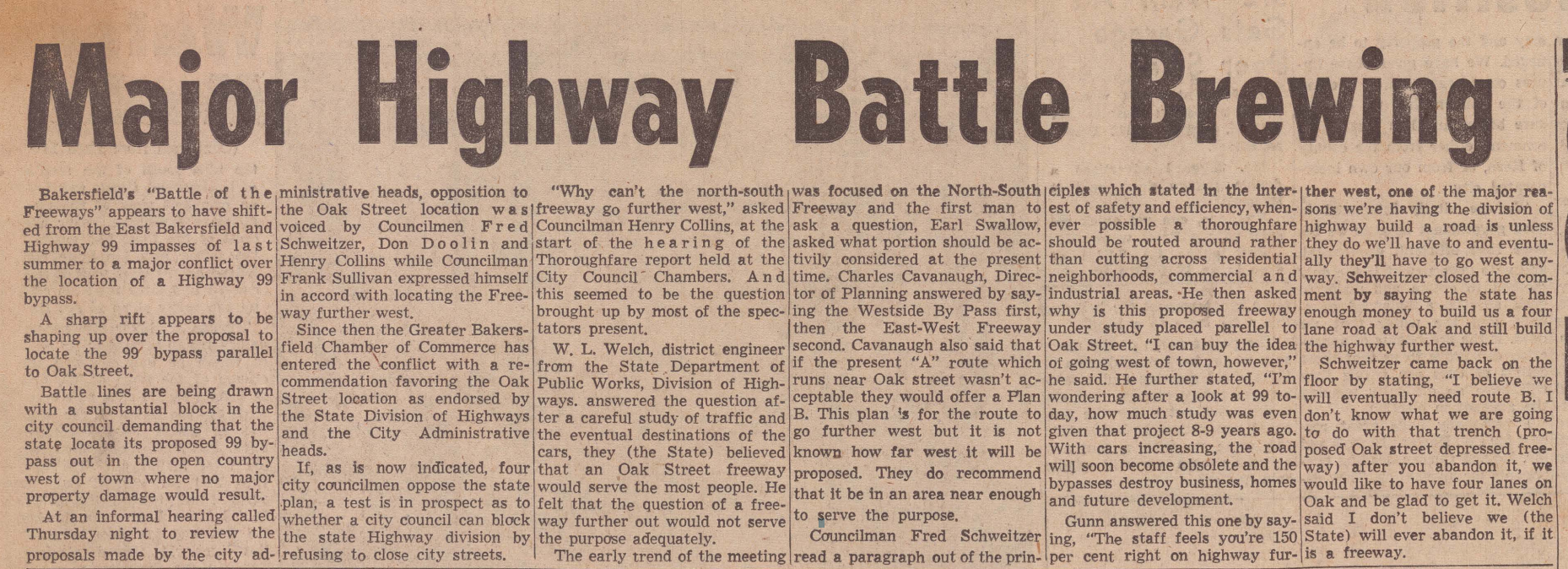
Article text (full visible portion):“Bakersfield’s ‘Battle of the Freeways’ appears to have shifted from the East Bakersfield Highway 99 impasses of last summer to a major conflict over the location of a Highway 99 bypass. A sharp rift appears to be shaping up over the proposal to locate the 99 bypass parallel to Oak Street. Battle lines are being drawn with a substantial block in the city council demanding that the state locate its proposed 99 bypass out in the open country west of town where no major property damage would result. At an informal hearing called Thursday night to review the proposals made by the city administrative heads, opposition to the Oak Street location was voiced by Councilmen Fred Schweitzer, Don Doolin and Henry Collins while Councilman Frank Sullivan expressed himself in accord with locating the Freeway further west. Since then the Greater Bakersfield Chamber of Commerce has entered the conflict with a recommendation favoring the Oak Street location as endorsed by the State Division of Highways and the City Administrative heads. If, as is now indicated, four city councilmen oppose the state plan, a test is in prospect as to whether a city council can block the state Highway division by refusing to close city streets. ‘Why can’t the north-south freeway go further west,’ asked Councilman Henry Collins, at the start of the hearing of the Thoroughfare report held at the City Council Chambers. And this seemed to be the question brought up by most of the spectators present. W. L. Welch, district engineer from the State Department of Public Works, Division of Highways, answered the question after a careful study of traffic and the eventual destinations of the cars, they (the State) believed that an Oak Street freeway would serve the most people. He felt that the question of a freeway further out would not serve the purpose adequately. The early trend of the meeting north-south was focused on the North-South Freeway and the first man to ask a question, Earl Swallow, asked what portion should be actively considered at the present time. Charles Cavanaugh, Director of Planning answered by saying the Westside By Pass first, then the East-West Freeway second. Cavanaugh also said that if the present ‘A’ route which runs near Oak street wasn’t acceptable they would offer a Plan B. This plan is for the route to go further west but it is not known how far west it will be proposed. They do recommend that it be in an area near enough to serve the purpose. Councilman Fred Schweitzer read a paragraph out of the principles which stated in the interest of safety and efficiency, whenever possible a thoroughfare should be routed around rather than cutting across residential neighborhoods, commercial and industrial areas. He then asked why is this proposed freeway under study placed parallel to Oak Street. ‘I can buy the idea of going west of town, however,’ he said. He further stated, ‘I’m wondering after a look at 99 today, how much study was even given that project 8-9 years ago. With cars increasing, the road will soon become obsolete and the bypasses destroy business, homes and future development.’ Gunn answered this one by saying, ‘The staff feels you’re 150 per cent right on highway further west, one of the major reasons we’re having the division of highway build a road is unless they do we’ll have to and eventually they’ll have to go west anyway.’ Schweitzer closed the comment by saying the state has enough money to build us a four lane road at Oak and still build the highway further west. Schweitzer came back on the floor by stating, ‘I believe we will eventually need route B. I don’t know what we are going to do with that trench (proposed Oak street depressed freeway) after you abandon it, we would like to have four lanes on Oak and be glad to get it.’ Welch said ‘I don’t believe we (the State) will ever abandon it, if it is a freeway.’”
The Press Volume III, No. 11, 05 February 1956. Kern County Newspaper Collection, 2020-002. California State University, Bakersfield, Walter W. Stiern Library-Historical Research Center. https://archives.csub.edu/repositories/3/archival_objects/6875 Accessed April 26, 2023.
 

The building of the freeway was not free or without resistance in Bakersfield. Residents protested the highway that was going to be placed parallel to Oak St, they wanted to avoid property destruction. Councilman Henry Collins suggested moving the 99 further west. Some of the Oak Street and Highway 99 will be the future site of the Centennial Corridor 57 years later.

The Press Volume III, No. 11, 05 February 1956. Kern County Newspaper Collection, 2020-002. California State University, Bakersfield, Walter W. Stiern Library-Historical Research Center. https://archives.csub.edu/repositories/3/archival_objects/6875 Accessed April 26, 2023.


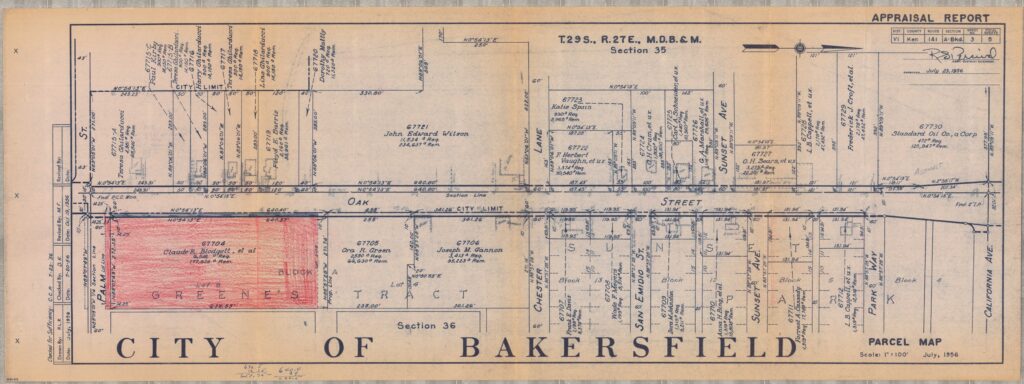
T.29S., R.27E., M.D.B.&M. Section 35 Large central label across bottom: CITY OF BAKERSFIELD Street names visible: OAK STREET CHESTER SUNSET AVE PALM AVE CALIFORNIA AVE Subdivision/tract label: GREENE’S TRACT Parcel reference numbers visible within shaded block: 67004 (Claude A. … et al — partial text visible) Additional parcel numbers visible (partial): 67005 67006 67732 67733 City boundary marking: CITY LIMIT Right-hand side box: PARCEL MAP Scale 1" = 100' July, 1956 Other visible notations: Block letters (e.g., “Block K”) Section 36 Lot boundary dimensions (numerical measurements along property lines) The map shows a long rectangular strip of property along Oak Street, shaded in red, identified as part of Greene’s Tract. The layout includes parcel boundaries, ownership notations, and adjacent residential lots to the north of Oak Street. The lower portion indicates Division Street alignment and city limit lines.

Section of Oak St. 10 years before the highway, July 1956.

“Oak Street, before Highway 99,” Claude Blodget Collection, 1956
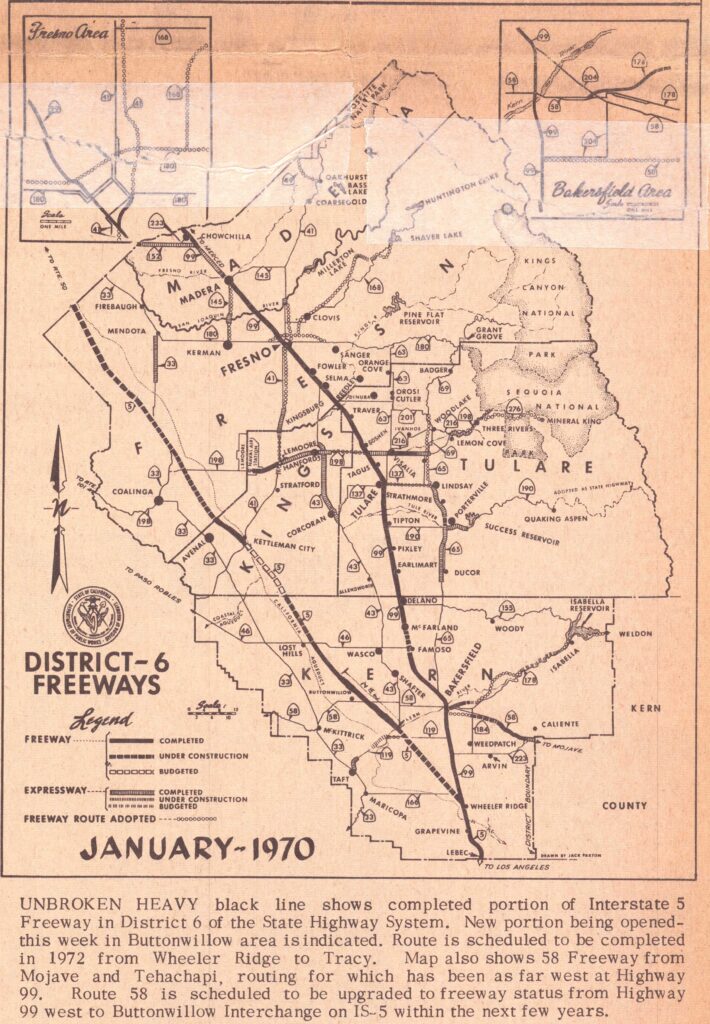
January 1970 California District 6 Freeways map depicting freeway routes across Fresno, Tulare, Kings, and Kern Counties, including Interstate 5 and Highway 99. Extended Description (Full Extracted Text from Visible Image) Top inset (left): Fresno Area Scale: One Mile Top inset (right): Bakersfield Area Scale: One Mile Main map title (lower left): DISTRICT–6 FREEWAYS Legend: FREEWAY — Completed — Under Construction — Budgeted EXPRESSWAY — Completed — Under Construction — Budgeted Date at bottom: JANUARY–1970 Main counties labeled on map: FRESNO MADERA TULARE KINGS KERN COUNTY Major city names visible: Fresno Clovis Selma Sanger Kerman Mendota Firebaugh Coalinga Hanford Lemoore Corcoran Tulare Visalia Porterville Delano Wasco Shafter Bakersfield Arvin Tehachapi Mojave Lebec Buttonwillow Major route numbers visible (circled markers): 5 33 41 43 46 58 65 99 119 168 178 198 204 223 Bottom explanatory text (visible portion): “UNBROKEN HEAVY black line shows completed portion of Interstate 5 Freeway in District 6 of the State Highway System. New portion being opened this week in Buttonwillow area is indicated. Route is scheduled to be completed in 1972 from Wheeler Ridge to Tracy. Map also shows 58 Freeway from Mojave and Tehachapi, routing for which has been as far west at Highway 99. Route 58 is scheduled to be upgraded to freeway status from Highway …” (The final sentence is cut off in the visible image.) Additional visible geographic labels: Isabella Reservoir Sequoia National Park Kings Canyon National Park Shaver Lake Pine Flat Reservoir Grant Grove The map uses heavy black lines to indicate completed freeway segments, lighter/dashed lines for under construction and budgeted segments, and shows the expanding Interstate and state freeway network through the Central Valley and into Kern County.

“Construction of the Interstate 5 in Kern County started in May, 1965. Approximately 75 miles of Interstate 5 will be build in Kern County from Wheeler Ridge to the Kings County Line. the Kern portion of the Interstate 5 is expected to be completed by 1972.” “BW Caravan Will Initiate Freeway,” Buttonwillow Times, February 5, 1970, p1
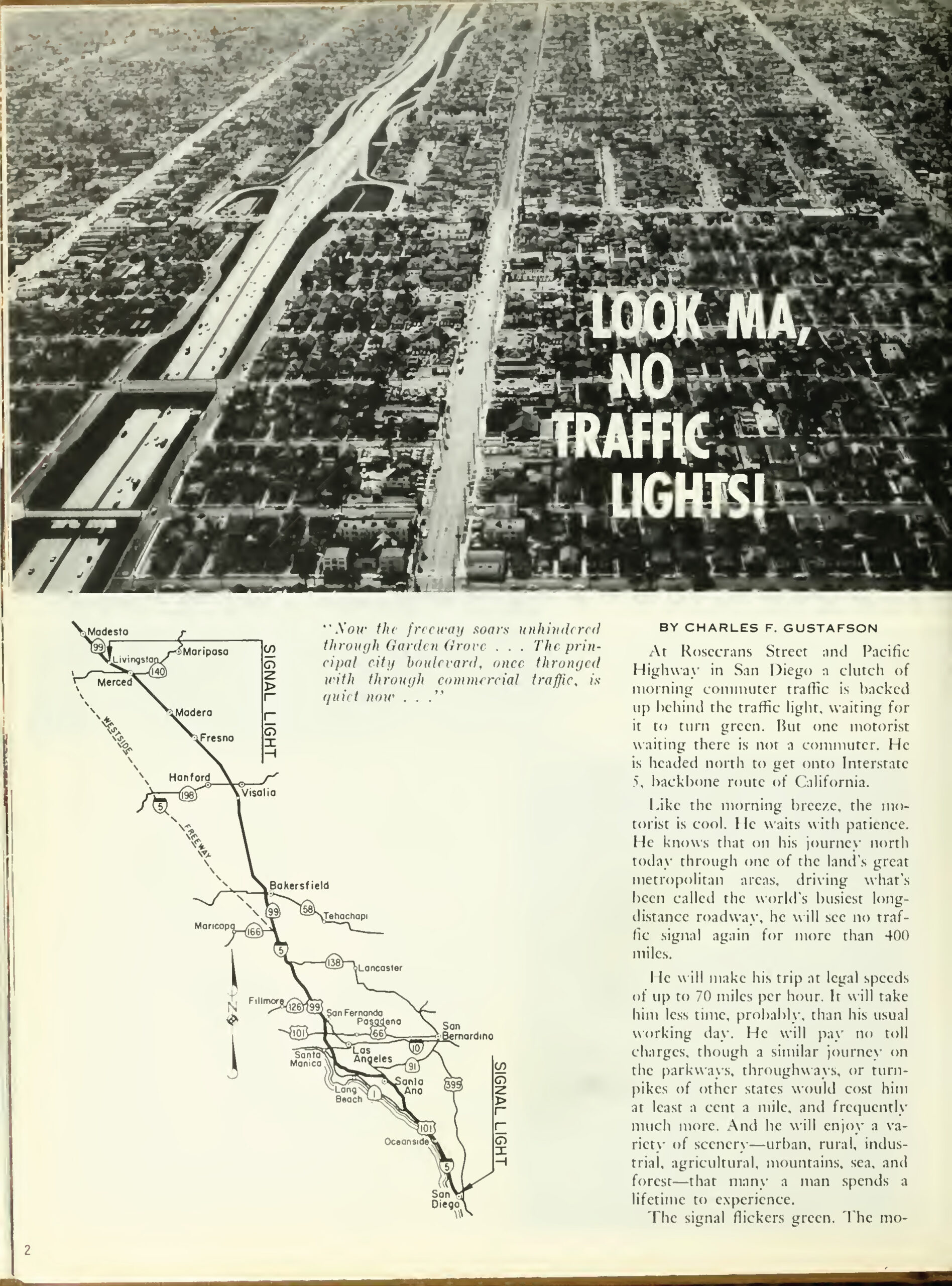
 

Large headline over aerial photograph: LOOK MA, NO TRAFFIC LIGHTS! Caption beneath aerial photograph: “Now the freeway soars unhindered through Garden Grove. The principal city boulevard, once thronged with through commercial traffic, is quiet now . . .” Byline: BY CHARLES F. GUSTAFSON Opening article text: “At Rosecrans Street and Pacific Highway in San Diego a clutch of morning commuter traffic is backed up behind the traffic light, waiting for it to turn green. Just one motorist waiting there is not a commuter. He is heading north to get onto Interstate 5, backbone route of California. Like the morning breeze, the motorist is cool. He waits with patience. He knows that on his journey north today through one of the land’s great metropolitan areas, driving what’s been called the world’s busiest long-distance roadway, he will see no traffic signal again for more than 400 miles. He will make his trip at legal speeds of up to 70 miles per hour. It will take him less time, probably, than his usual working day. He will pay no toll charges, though a similar journey on the parkways, thruways, or turnpikes of other states would cost him at least a cent a mile, and frequently much more. And he will enjoy a variety of scenery—urban, rural, industrial, agricultural, mountains, sea, and forest—that many a man spends a lifetime to experience. The signal flickers green. The mo-” (The final word is cut off in the visible image.) Inset map on lower left: A California route map labeled with cities and highways including: Modesto Livingston Merced Mariposa Madera Fresno Hanford Visalia Bakersfield Tehachapi Maricopa Lancaster San Fernando Pasadena Los Angeles Santa Monica Long Beach San Bernardino San Diego Oceanside Highway numbers visible include: 99 5 58 166 101 66 395 1 Vertical labels alongside the map: SIGNAL LIGHT (appears at both top and bottom ends of the route diagram) The aerial image shows a wide multi-lane freeway cutting diagonally through a dense residential grid with overpasses and on/off ramps, illustrating grade separation and uninterrupted traffic flow.

In 1966, the California Highway and Public Works magazine lauded the completion of the Interstate 5 and Highway 99 with no stop signs or lights. Previously, the old highway systems intersected city streets. In Bakersfield, Highway 99 ran through Union Avenue. After the completion, the highway was moved to run stop free parallel to Oak/Wible street. State Route 58 was completed to end at the Brundage and Oak Intersection. Previously State Route 466 was completed through Tehachapi, ending near Bakersfield, and later a freeway was constructed to run parallel to Brundage Lane. The 466 would run to the 99, making it State Signal Route 58. By 1966, the highway system would be complete, lauding, “Look Ma, No Lights!”

Charles F. Gustafson, “Look Ma, No Traffic Lights!,” California Highway and Public Works, May-June 1966, Volume 45, Issue 5-6, P

After the 1952 earthquake, the County of Kern invested millions in centering Kern County as a destination for commerce, investment, and tourism. Lake Isabella (Kern River Valley), Lake Ming (Bakersfield) and Lake Woollomes (Delano) were created as recreational and boating lakes in the late 1950s, following post-earthquake investment. By the 1960s, Kern cities and townships had re-envisioned themselves as new areas of commerce, housing, and recreation. The 1960s California highway era brought continued investment and centering cities around highway access and easy stops on the way to large cities like Los Angeles and San Francisco.
The highway became a center of economic commerce. This 1960s advertisement centers Delano on top of a map with a clear intersection of highway “99” with northern access to San Francisco and Los Angeles. The highway becomes a modern predictor of financial investment.
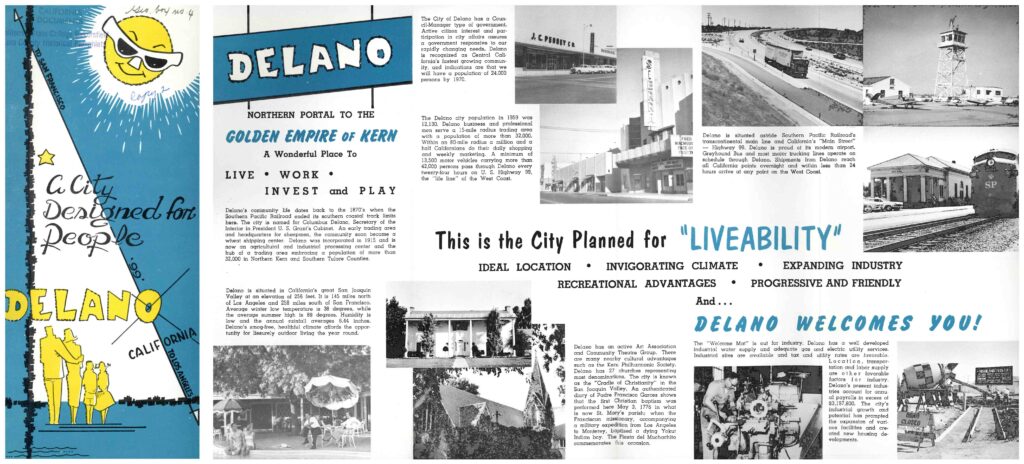
A City Designed for People DELANO CALIFORNIA Top banner (center panel): DELANO NORTHERN PORTAL TO THE GOLDEN EMPIRE OF KERN A Wonderful Place To LIVE • WORK • PLAY • INVEST Main center headline: This is the City Planned for “LIVEABILITY” Subheading: IDEAL LOCATION • INVIGORATING CLIMATE • EXPANDING INDUSTRY RECREATIONAL ADVANTAGES • PROGRESSIVE AND FRIENDLY Right panel headline: And … DELANO WELCOMES YOU! Additional visible promotional text (partial due to resolution): “The City of Delano has a Council-Manager type of government…” “Delano is situated in California’s great San Joaquin Valley…” “Delano has an active Air Association and Community Theater Group…” “Industrial sites are available…” Photo captions and visible business signage: A.C. Furniture Co. Southern Pacific (rail depot building) The brochure includes photographs of: Commercial storefronts A Southern Pacific railroad depot Industrial operations and machinery Agricultural processing A civic building Community recreational settings The design uses bold mid-century typography, a bright illustrated sun graphic on the cover, and promotional civic imagery. The tone emphasizes economic opportunity, modern infrastructure, rail access, agriculture, industry, and family-oriented living.

Most recently, starting in 2014-Present, the City of Bakersfield and the County of Kern moved forward with the Centennial Corridor Project, and displacing an estimated 300 homes, and over 900 residents. U.S. EPA DETAILED COMMENTS ON THE DRAFT ENVIRONMENTAL IMPACT STATEMENT FOR THE CENTENNIAL CORRIDOR PROJECT, KERN COUNTY, CALIFORNIA, JULY 8, 2014
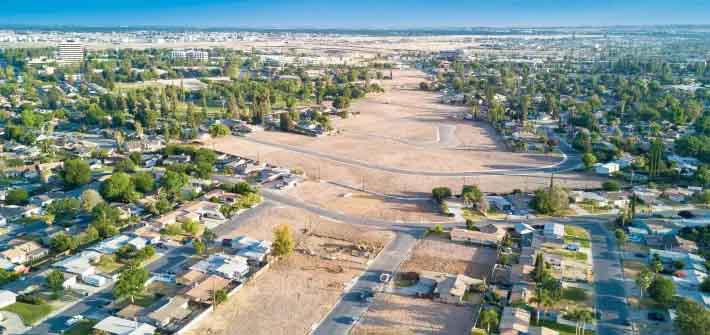
This is a color aerial photograph of a residential area in Bakersfield. In the foreground and along both sides of the image are single-story homes arranged on a grid of streets, with small yards, driveways, and scattered trees. The houses appear modest in size and closely spaced, typical of mid-20th-century residential development. Running diagonally through the center of the image is a broad strip of cleared, sandy earth where buildings have been removed. The cleared area is significantly wider than a single street and extends into the distance, forming a continuous corridor through the neighborhood. Portions of curbing and graded roadbed are visible, suggesting preparation for roadway construction or expansion. To either side of the cleared corridor, intact houses remain, some with mature trees and green lawns. In the background, the city extends toward a denser commercial or industrial district, with larger buildings and more concentrated development visible along the horizon. The image conveys a sharp contrast between established residential blocks and the wide, barren construction corridor cutting through them.

Bakersfield Opens New Centennial Corridor Freeway

The two-mile freeway demolished a swath of the Westpark neighborhood: 271 homes, 15 multi-family buildings and 36 commercial structures
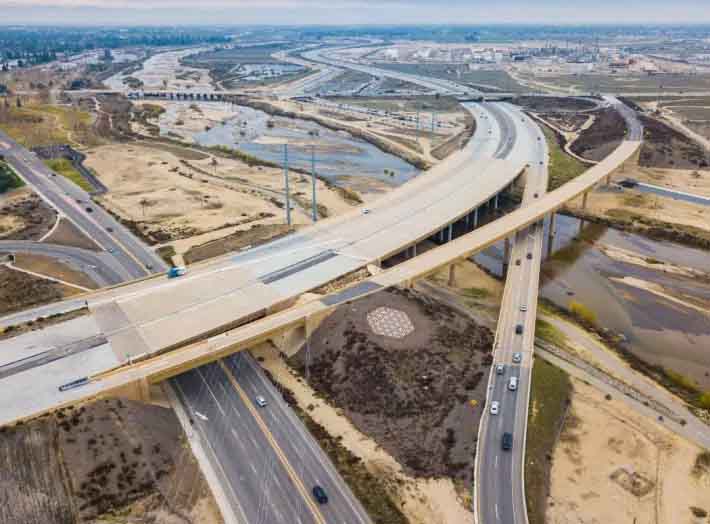
This is a color aerial photograph of a large, modern freeway interchange in Bakersfield. Multiple elevated concrete ramps curve and intersect at different heights, forming a layered network of overpasses. The main elevated roadway sweeps diagonally across the center of the image, supported by tall concrete columns. Below the overpasses are surface streets and additional lanes of traffic. Several vehicles—cars and trucks—are visible traveling in both directions on the freeway and connecting roads. The interchange spans a broad, mostly dry river channel or flood control basin, with sandy banks and patches of shallow water visible beneath and beside the bridges. The surrounding landscape appears semi-arid, with areas of bare earth, graded construction zones, and sparse vegetation. In the distance, additional highways, industrial buildings, and urban development stretch toward the horizon. The image emphasizes the scale and engineering complexity of the freeway system, highlighting sweeping curves, layered roadways, and expansive infrastructure built across the river corridor.