Before 1938 – Braceros – Buying on Contract – Covenant Database
California Nativism – Citizenship – Covenants – East Bakersfield – Education – Eminent Domain
English Only – Japanese Internment – Moving into a Neighborhood – Neighborhoods – Public Housing
Resources – Rumford Fair Housing Act – Suburban Expansion – Zoning
California Nativism had long excluded the idea of Japanese Americans as full citizens before WWII
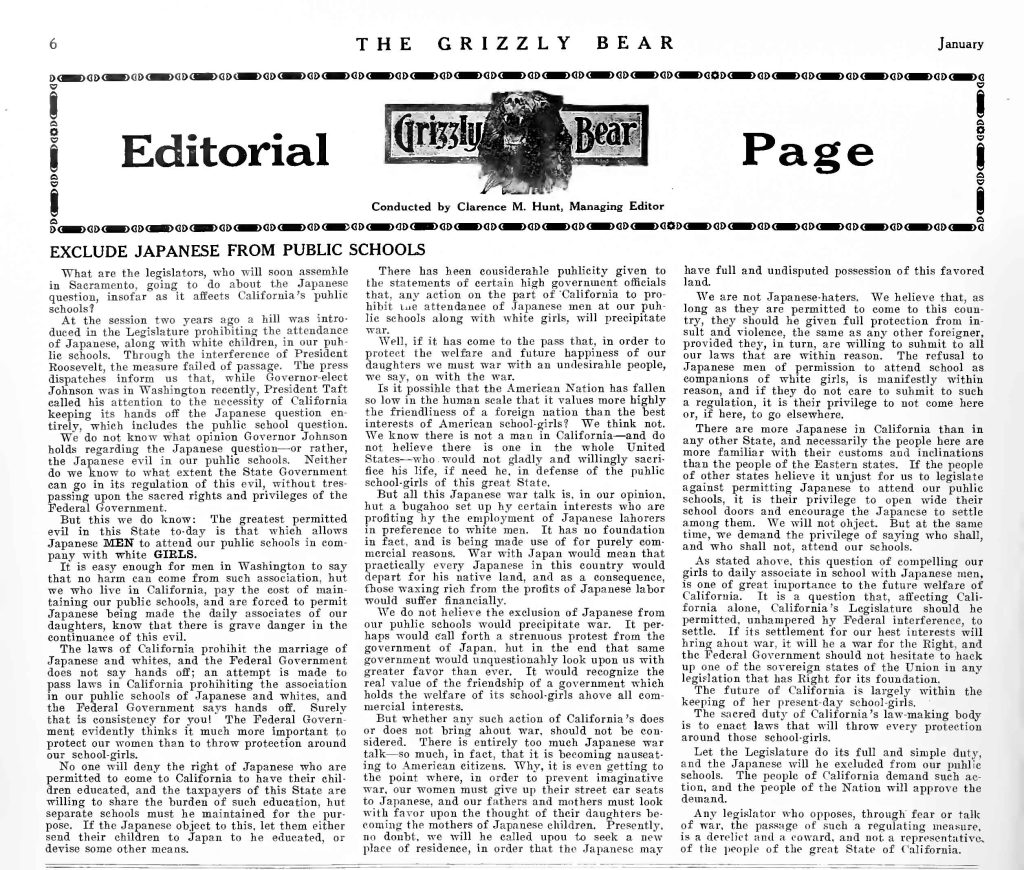
As early as January 1911, the GrizzlyBear encouraged “EXCLUDE JAPANESE FROM PUBLIC SCHOOLS.” The coverage of the failed national legislation to exclude Japanese set the tone that “There are more Japanese in California than in any other state… If the people of other states believe it unjust for us to legislate against permitting Japanese to attend our public schools, it is their privilege… but at the same time, we demand the privilege of saying who shall, and who shall not, attend our schools.” The GoldenBear was for racial segregation. In February 1911, the GrizzlyBear penned an open letter regarding public education, stating, “I knew someone there was standing up for the WHITE RACE.” The article wrote about the survival of the white race, keeping the bonds strong within the white race. In the next pages, articles, “SCHOOL SEGREGATION AND ALIEN LAND BILLS SHOULD PASS,” ran with statements like, “Make Japanese understand that we will not tolerate their being placed upon an equality with the white race,” and “The great State of California cannot afford to longer put off the passage of such laws as will correct these evils. This should be, from the very nature of things, a white man’s paradise.” In May 1912, the GrizzlyBear published “they must keep the rules,” advocating that members keep in line and meet the expectations of the Golden Sons and Daughters. “Are we cowards these days, I wonder, or are we simply dumb from lack of initiative? Don’t we know any better, or is it true that we, the white race, are we slowly taking on the lower standards, of the negro and the Japanese?”
California, Alien Land Law 1913- prohibited undocumented individuals from owning land. Four principles of immigration policy were the primary arguments: economic (best land), social (racial), nationalistic (racial), and foreign relations (International policy).
![Title:ALIEN LAND LAW. Initiative act. Date: Not visible. Creator / Publisher: Not listed. Document Type: Proposed law / ballot initiative text Location: State of California Brief Description: This document contains the text of a proposed California “Alien Land Law” presented as an initiative act for submission to voters at a general election. The measure outlines rights and restrictions concerning acquisition, possession, and transfer of real property by aliens, including those ineligible to citizenship, and prescribes reporting requirements and penalties. The text reflects early twentieth-century California efforts to regulate land ownership by immigrants through statutory and treaty-based limitations. Full Extracted Text: ALIEN LAND LAW. Initiative act. Permits acquisition and transfer of real property by aliens eligible to citizenship, to same extent as citizens except as otherwise provided by law; permits other aliens, and companies, associations and corporations in which they hold majority interest, to acquire and transfer real property only as prescribed by treaty, but prohibiting appointment thereof as guardians of estates of minors consisting wholly or partially of real property or shares in such corporations; provides for escheats in certain cases; requires reports of property holdings to facilitate enforcement of act; prescribes penalties and repeals conflicting acts. YES NO Sufficient qualified electors of the State of California present to the secretary of state this petition and request that a proposed measure, as hereinafter set forth, be submitted to the people of the State of California for their approval or rejection, at the next ensuing general election. The proposed measure is as follows: PROPOSED LAW. (Proposed changes from provisions of present laws are printed in black-faced type.) An act relating to the rights, powers and disabilities of aliens and of certain companies, associations and corporations with respect to property in this state, providing for escheats in certain cases, prescribing the procedure therein, requiring reports of certain property holdings to facilitate the enforcement of this act, prescribing penalties for violation of the provisions hereof, and repealing all acts or parts of acts inconsistent or in conflict herewith. The people of the State of California do enact as follows: Section 1. All aliens eligible to citizenship under the laws of the United States may acquire, possess, enjoy, transmit and inherit real property, or any interest therein, in this state, in the same manner and to the same extent as citizens of the United States, except as otherwise provided by the laws of this state. Sec. 2. All aliens other than those mentioned in section one of this act may acquire, possess, enjoy and transfer real property, or any interest therein, in this state, in the manner and to the extent and for the purposes prescribed by any treaty now existing between the government of the United States and the nation or country of which such alien is a citizen or subject, and not otherwise. Sec. 3. Any company, association or corporation organized under the laws of this or any other state or nation, of which a majority of the members are aliens other than those specified in section one of this act, or in which a majority of the issued capital stock is owned by such aliens, may acquire, possess, enjoy, and convey real property, or any interest therein, in this state, in the manner and to the extent and for the purposes prescribed by any treaty now existing between the government of the United States and the nation or country of which such alien is a citizen or subject, and not otherwise. Hereafter all aliens other than those specified in section one hereof may become members of or acquire shares of stock in any company, association or corporation that is or may be authorized to acquire, possess, enjoy or convey agricultural land, in the manner and to the extent and for the purposes prescribed by any treaty now existing between the government of the United States and the nation or country of which such alien is a citizen or subject, and not otherwise. Sec. 4. Hereafter no alien mentioned in section two hereof and no company, association or corporation mentioned in section three hereof, may be appointed guardian of that portion of the estate of a minor which consists of property which such alien or such company, association or corporation is inhibited from acquiring, possessing, enjoying or transferring by reason of the provisions of this act. The public administrator of the proper county, or any other competent person or corporation, may be appointed guardian of the estate of a minor citizen whose parents are ineligible to appointment under the provisions of this section. On such notice to the guardian as the court may require, the superior court may remove the guardian of such an estate whenever it appears to the satisfaction of the court: (a) That the guardian has failed to file the report required by the provisions of section five hereof; or (b) That the property of the ward has not been or is not being administered with due regard to the primary interests of the ward; or (c) That facts exist which would make the guardian ineligible to appointment in the first instance; or (d) That facts establishing any other legal ground for removal exist. Sec. 5. (a) The term “trustee” as used in this section means any person, company, association or corporation that as guardian, trustee, attorney-in-fact or agent, or in any other capacity has the title, custody or control of property, or some interest therein, belonging to an alien mentioned in section two hereof, or to the minor child of such an alien, if the property is of such a character that such alien is inhibited from acquiring, possessing, enjoying or transferring it. (b) Annually on or before the thirty-first day of January every such trustee must file in the office of the secretary of state of California and in the office of the county clerk of each county in which any of the property is situated, a verified written report showing: (1) The property, real or personal, held by him for or on behalf of such an alien or minor; (2) A statement showing the date when each item of such property came into his possession or control; (3) An itemized account of all expenditures, investments, rents, issues and profits in respect to the administration and control of such property with particular reference to holdings of corporate stock and leases, cropping contracts and other agreements in respect to land and the handling or sale of products therefrom. (c) Any person, company, association or corporation that violates any provision of this section is guilty of a misdemeanor and shall be punished by a fine not exceeding one thousand dollars or by imprisonment in the county jail not exceeding one year, or by both such fine and imprisonment. (d) The provisions of this section are cumulative and are not intended to change the jurisdiction or the rules of practice of courts of justice. Sec. 6. Whenever it appears to the court in any probate proceeding that by reason of the provisions of this act any heir or devisee cannot take real property in this state or membership or shares of stock in a company, association or corporation which, but for said provisions, said heir or devisee would take as such, the court, instead of ordering a distribution of such property to such heir or devisee, [End] Detailed Description / Context: This proposed initiative reflects California’s early twentieth-century Alien Land Law framework, which targeted “aliens ineligible to citizenship,” a category that effectively applied to Asian immigrants under federal naturalization law. At the time, U.S. citizenship eligibility was limited primarily to “free white persons” and persons of African nativity or descent, rendering most Japanese immigrants legally ineligible for naturalization. By tying land ownership rights to citizenship eligibility and to treaty provisions, the act restricted the ability of Japanese and other Asian immigrants to acquire agricultural land, control property through corporate structures, or serve as guardians of estates involving real property. The inclusion of reporting requirements, escheat provisions, and criminal penalties demonstrates the administrative mechanisms designed to enforce racialized property restrictions. These measures emerged amid broader anti-Asian agitation in California, labor competition debates, and diplomatic tensions with Japan. The Alien Land Laws of 1913 and 1920 were central to California’s system of racialized property regulation, influencing patterns of land tenure, agricultural development, and community formation among immigrant populations. The initiative format also illustrates the use of direct democracy mechanisms to enact exclusionary land policies.](https://hrc.csub.edu/wp-content/uploads/2026/02/ALIEN-LAND-LAW_Page_2-663x1024.jpg)
https://repository.uclawsf.edu/ca_ballot_props/130
Citizenship and Gender
Land title books from the Bakersfield Abstract Company in 1929 and 1936, both encourage race restrictions and inform sellers on citizenship clauses, like the Alien Lands Act (1913), and the Chinese Exclusion Acts. Section 34 of the Land Titles: Titles and Guarantee and Trust Company, stated that, “Japanese, Chinese, Hindus, Malays, and possibly all Asiatics,” were not able to acquire, posses, transfer real property, because of citizenship and land exclusion laws. Furthermore, Section 35-42 goes into specific details about passing titles, who is capable of, and even expressing doubt of racial ownership, because of Alien Land Laws.
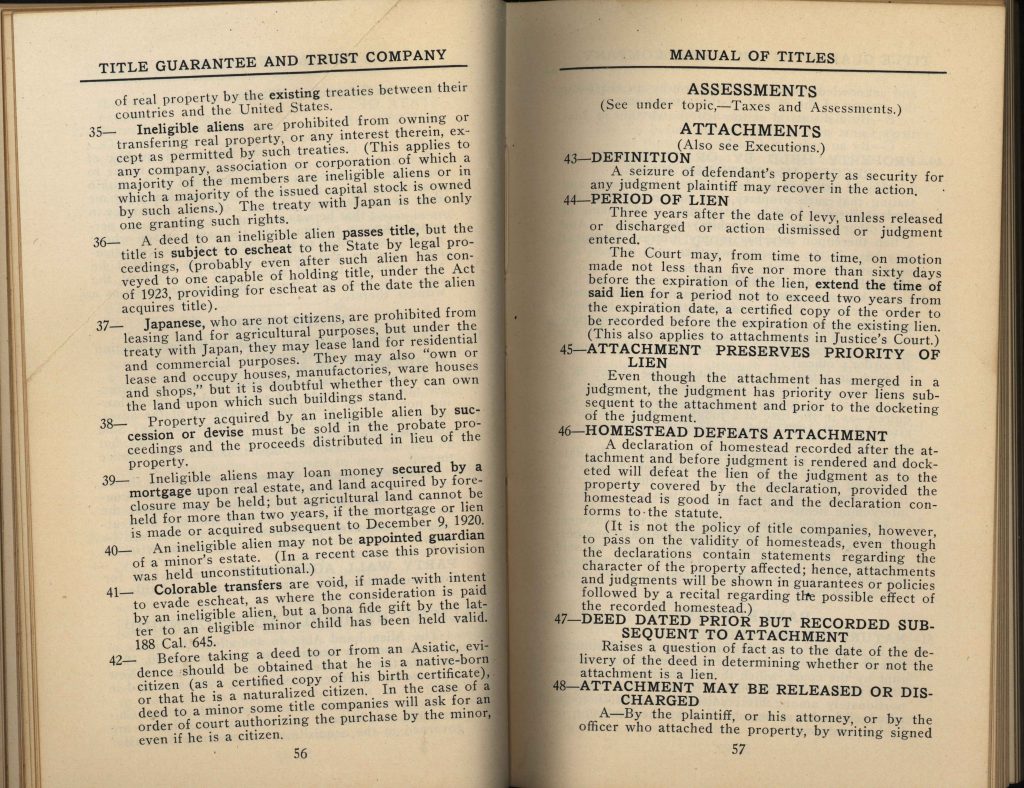
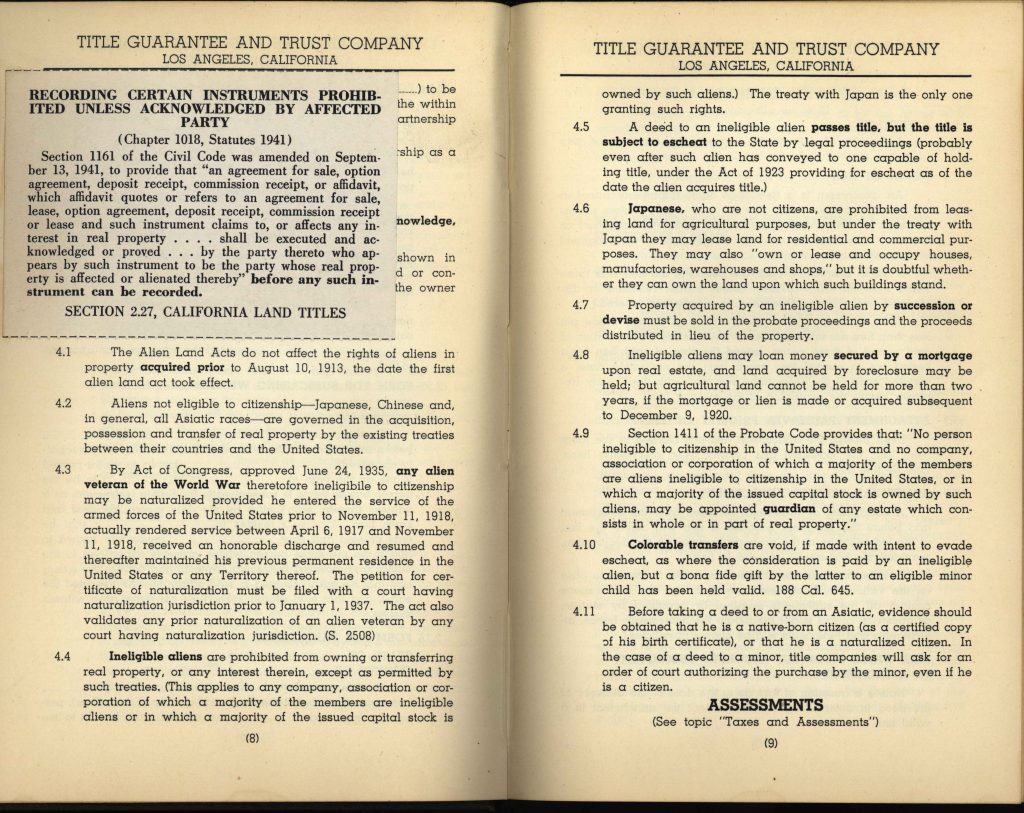
Statements that Asian residents could not use their children to hold property, unless property was given to them as a gift, and ends with, “before taking property from an Asiatic, evidence should be obtained that he is a native-born citizen or that this is a naturalized citizen.” The books were “to E. G. O’Boyle, Compliments of Bakersfield Abstract Company,” which cleared titles for real estate agents in Bakersfield.
The War and Japanese Internment
President Franklin Delano Roosevelt signed Executive Order 9066 on February 19, 1942, two months after the attack on Pearl Harbor. The executive order authorized the War Department to designate military area. The order was neutral in language; however, it targeted more than 110,000 Japanese, relocating all persons of Japanese ancestry, both citizens and aliens, inland, outside of the Pacific military zone. Within weeks all persons of Japanese ancestry, whether citizens or enemy aliens, young or old, rich or poor, were ordered to assembly centers near their homes. Soon they were sent to permanent relocation centers outside the restricted military zones. Japanese were subjected to white hostility and laws were enacted to pull them from full participation in economic and civic life. Japanese immigrants, known as Issei, could not own land, eat in white restaurants, or become naturalized citizens. But the American-born descendants of Japanese immigrants, called Nisei, were citizens by birthright, and many had become successful in business and farming. Pearl Harbor gave whites a chance to renew their hostility toward their Japanese neighbors. The attack on Pearl Harbor also launched a rash of fear about national security, especially on the West Coast Civil liberties advocates brought lawsuits to try to challenge the constitutionality of Japanese relocation – but a timid Supreme Court refused to overturn the internment orders. By mid-1944, the government began to release some internees that they certified to be loyal Americans, but the majority remained locked up. The internees were ultimately released in January 1945, and many returned to their homes and tried to rebuild their lives. Some found that their homes had become occupied by strangers and needed to evict them in order to move back in. For many others, the years behind barbed wire had resulted in financial calamity, and they faced the daunting task of starting over with nothing. In 1948, the Federal government distributed a mere $37 million in reparations. During the Reagan-Bush years Congress moved toward the passage of Public Law 100-383 in 1988 which acknowledged the injustice of the internment. This was after 40 years of political agitation, Japanese Americans persuaded Congress to approve legislation providing an official apology and a payment of 20,000 to each surviving internee.
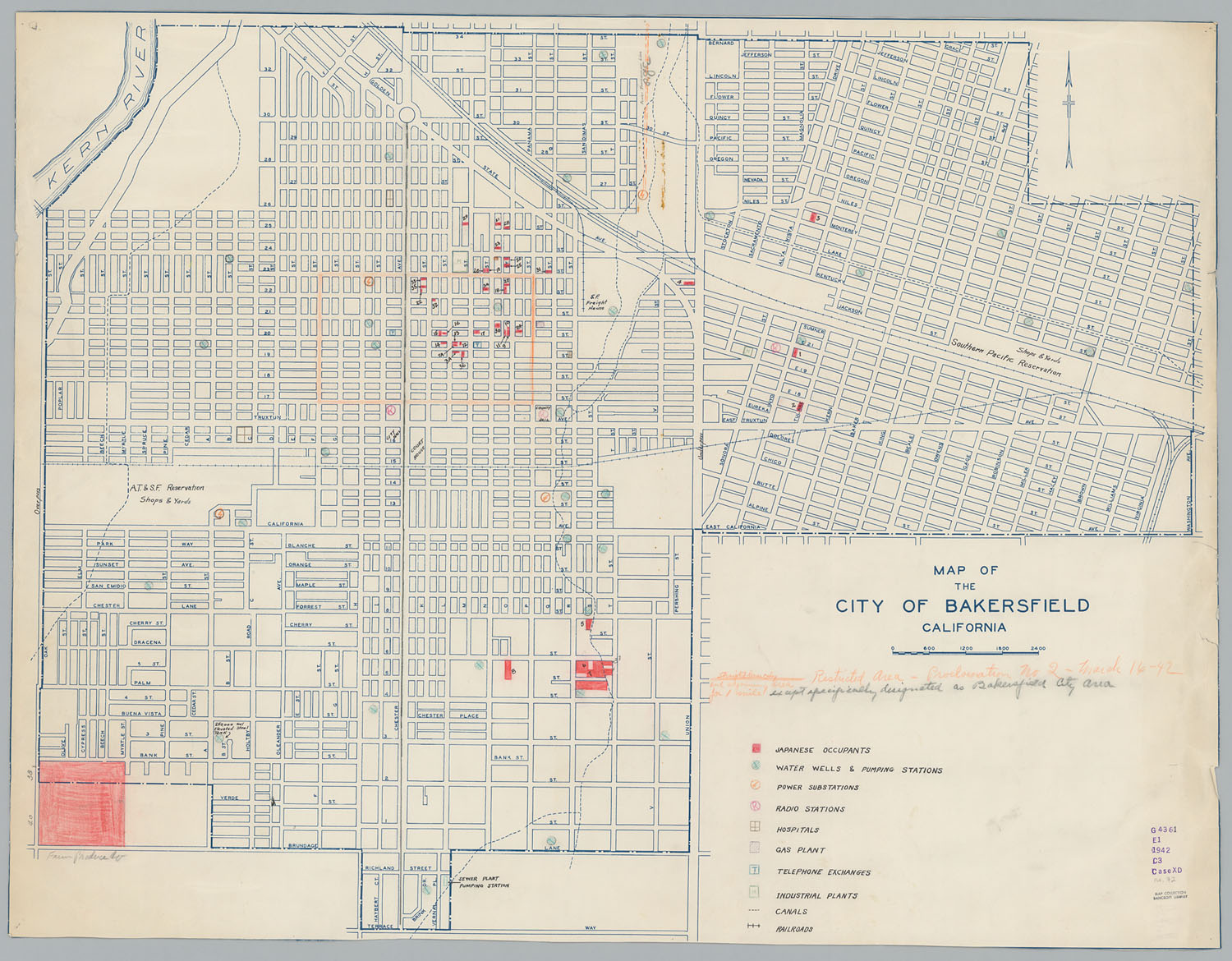
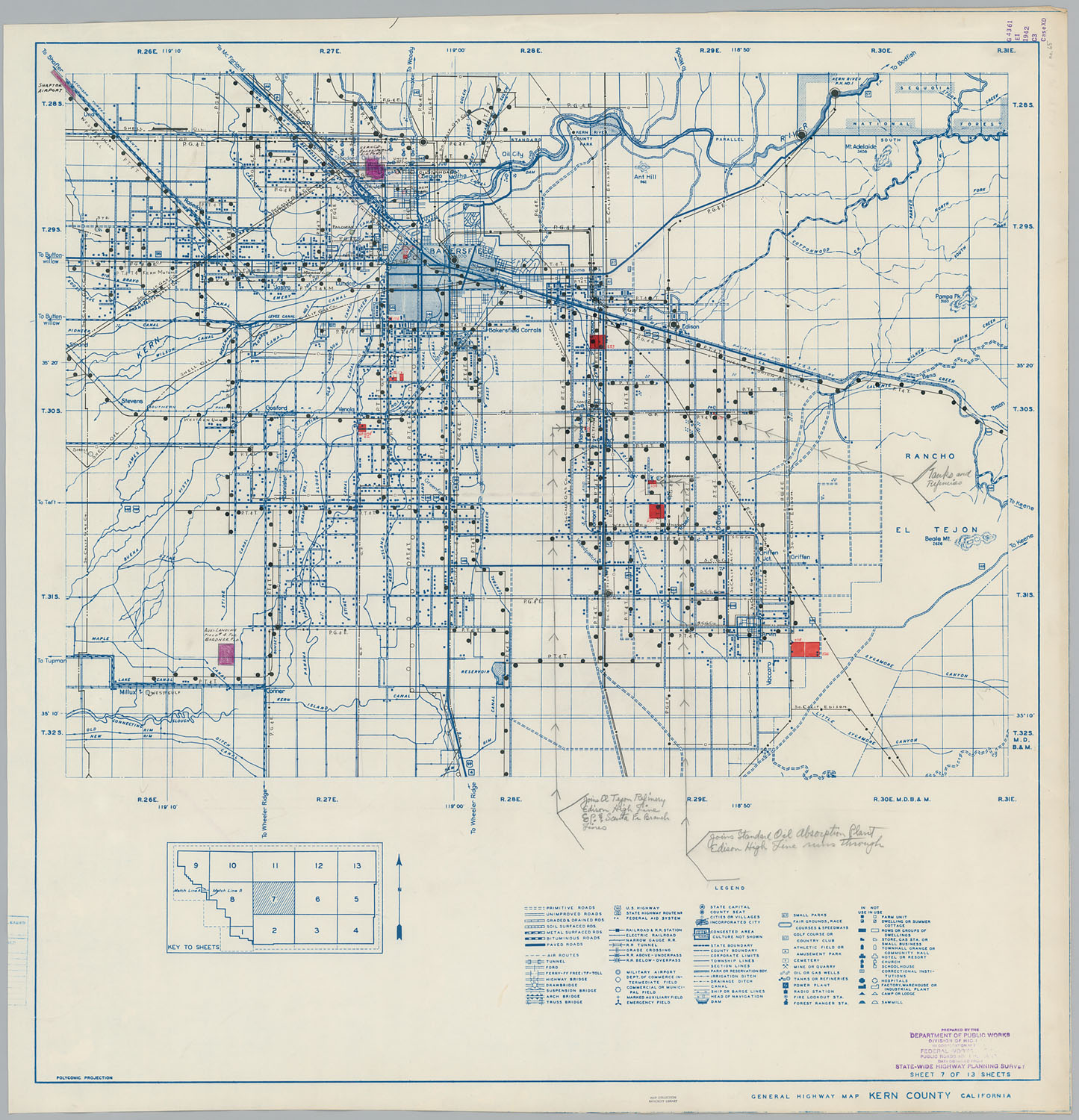
In April 1942, Frank Kawasaki, the president of the Kern County Japanese Association, was arrested by the FBI. Kawasaki was in charge of 150 Japanese workers on the DiGorgio Farms in Arvin. He was accused of sending money to Japan. Other legal cases included a California lawsuit to take land rights away from Japanese citizens. The case sought to take shares and financial interest from a Kern County farm and produce company that had Japanese American stockholders. 25% belonged to Tsunezo Kinoshita, J. Kubotsu Tanigaki, K. Tanaka, Irene Tanigaki, K. Kubostu, and Reymond Tatsuno.
In May 1942, Japanese residents were ordered to sell their items under direction of the Federal Reserve Bank of San Francisco’s Fiscal Agent. The Kern County’s District Attorney also sued Japanese American citizens for owning property in the County.
![Federal Reserve Bank of San FranciscoFiscal Agent of the United States May 17, 1943 Name: Y. Ishihara (Surname) (Print) (Given) Address: 1525 West Front Street Selma, California Telephone: Interview: X Adult: X Minor: Male: Female: X Citizenship: JAPAN Date of last entry into United States: ______ Operating under Treasury License now: ______ Type of Business: Partnership: X Proprietorship: Corporation: Individual: Person Interviewed: DAUGHTER Address: Same Telephone Number: None (Copy sent to Glen L. Johnson) Principal property involved and scope of problem: Property in Kern County. Have advised daughter that District Attorney of Kern County is suing the two above parents, Mr. & Mrs. Ishihara in escheat for account of State of California. She has replied that they began down payment on property before alien land law went into effect. They were advised to pay balance before law went into effect. They paid balance but without knowledge that law was already in force. Their lawyer, Harold M. Child, (business address Fresno, home address Selma) advised them to let case go to default as they had lost receipts showing part payment prior to alien land law and their chance of getting anything out of this property was negligible. They are quite willing to sign a quit claim. Payments including taxes amount to about $400.00. This was phoned to Mr. Armstrong in San Francisco and he advised the writer that there was still a possibility of obtaining some equity in land. Have now advised daughter to see lawyer who at present is away from town and have him correspond direct with the Deputy D.A., Mr. Child of Kern County at Bakersfield. Daughter has promised to do so on his return. The Ishihara family are from Santa Barbara and went to the unrestricted side of Selma under voluntary evacuation before March 31, 1942. Handled by [signature] Directed to file: ______ *Attach additional pages where necessary Persons Interviewed (1) Concerned (3) Selma Detailed Description / Context: This 1943 interview record documents the legal and economic consequences faced by Japanese immigrants under California’s Alien Land Laws, which prohibited “aliens ineligible for citizenship” from owning land. The case involves the Ishihara family, whose property in Kern County became subject to escheat proceedings by the state. The document also reflects the broader context of World War II policies affecting Japanese Americans, including forced relocation and “voluntary evacuation” prior to formal internment. The reference to moving to the “unrestricted side” of Selma indicates the geographic restrictions placed on individuals of Japanese ancestry during the early phase of wartime exclusion. The involvement of the Federal Reserve Bank as a fiscal agent suggests federal oversight of financial and property matters involving restricted individuals. The record highlights how legal frameworks, wartime policies, and racial discrimination intersected to dispossess Japanese American families of property and economic stability.](https://hrc.csub.edu/wp-content/uploads/2026/03/Reel-03_033_Page_017-805x1024.jpg)
![Federal Reserve Bank of San FranciscoFiscal Agent of the United States March 8th, 1943 Name: Kobayashi, Hiro K. Address: 213 K Street Bakersfield, Calif. Telephone: Interview: Adult: Minor: Male: Female: Citizenship: Date of last entry into United States: ______ Operating under Treasury License now: ______ Type of Business: Partnership: Proprietorship: Corporation: Individual: Person Interviewed: Mrs. Kobayashi Address: Same Telephone Number: 2424 Principal property involved and scope of problem: [Handwritten:] 1932 Chestnut Street Sold 12/25/42 Ran Fresno Owner There are no other problems Action taken: [Handwritten:] Make contact 3/8/43 Handled by: [signature] Directed to file: ______ *Attach additional pages where necessary (S-5055) Detailed Description / Context: This 1943 interview record is part of a broader system of wartime documentation concerning individuals of Japanese origin in the United States. Maintained by the Federal Reserve Bank acting as a fiscal agent, such records tracked property, financial status, and legal matters during a period when Japanese Americans faced extensive government surveillance and restrictions. The document reflects the impact of World War II policies, including forced relocation and internment, which often led to the sale or loss of property. The recorded sale of property in late 1942 aligns with patterns of dispossession experienced by Japanese American families under pressure to liquidate assets before or during evacuation. Although brief and administrative in nature, the record provides evidence of how federal agencies documented and managed the economic affairs of Japanese Americans, contributing to broader systems of control and oversight during the wartime period.](https://hrc.csub.edu/wp-content/uploads/2026/03/Reel-03_033_Page_236-794x1024.jpg)
![Federal Reserve Bank of San FranciscoFiscal Agent of the United States March 26, 1942 Mr. Glen L. Johnson, Field Representative, Evacuee Property Department, Federal Reserve Bank of San Francisco, c/o United States Employment Service, 1300 - 17th Street, Bakersfield, California. Dear Sir: Reference is made to your recent undated letter wherein you enclosed a copy of your interview memorandum with the Rev. Masatane Mitani. In reply to question No. 1 in your letter: "Can an alien withdraw funds from an impounded account in addition to his monthly allowance to move chattels during evacuation? If so what procedure would be followed?" We assume that you have reference to an account blocked because of the individual not having been in the United States on and at all times since June 17, 1940. The answer would be that any withdrawals in excess of those permitted by General License No. 11, which is $500.00 a month for living, travelling and similar personal expenses, could be made only after a specific license had been issued by the Federal Reserve Bank of San Francisco for such withdrawals. Applications for such licenses should be filed on Form TFE-1 (Revised) in triplicate. A small supply of these forms is enclosed for your information and convenience. The same answer would apply to question No. 2, wherein you ask "Could an alien secure funds from an impounded account to aid a Japanese who is a citizen to buy property?" You realize, of course, that if the individual could qualify as a generally licensed national under General License No. 63A, no specific license would be necessary. Yours very truly, [signature] Assistant Cashier Enclosures FOR DEFENSE BUY UNITED STATES SAVINGS BONDS AND STAMPS Detailed Description / Context: This 1942 letter reflects financial restrictions imposed under wartime emergency regulations, particularly following Executive Order 9066 and related policies affecting individuals of Japanese ancestry. The Federal Reserve Bank, acting as a fiscal agent, administered controls over “blocked” accounts, limiting access to funds for those subject to evacuation or classified as enemy aliens. The document outlines licensing procedures required to access funds beyond a fixed monthly allowance, illustrating how financial autonomy was restricted during evacuation. The reference to assisting a Japanese citizen in purchasing property further highlights concerns about asset transfers and property ownership under wartime controls. These financial regulations were part of a broader system of surveillance, restriction, and dispossession that affected Japanese Americans and Japanese nationals during World War II. The letter provides insight into the bureaucratic mechanisms used to regulate economic activity and enforce wartime policies.](https://hrc.csub.edu/wp-content/uploads/2026/03/Reel-03_033_Page_218-813x1024.jpg)
List of Address, Names and properties were cataloged by Federal Reserve Bank of San Francisco’s Fiscal Agent See National Archives San Francisco Branch Evacuee Property Files March 18, 1942 – June 30, 1946 files for records
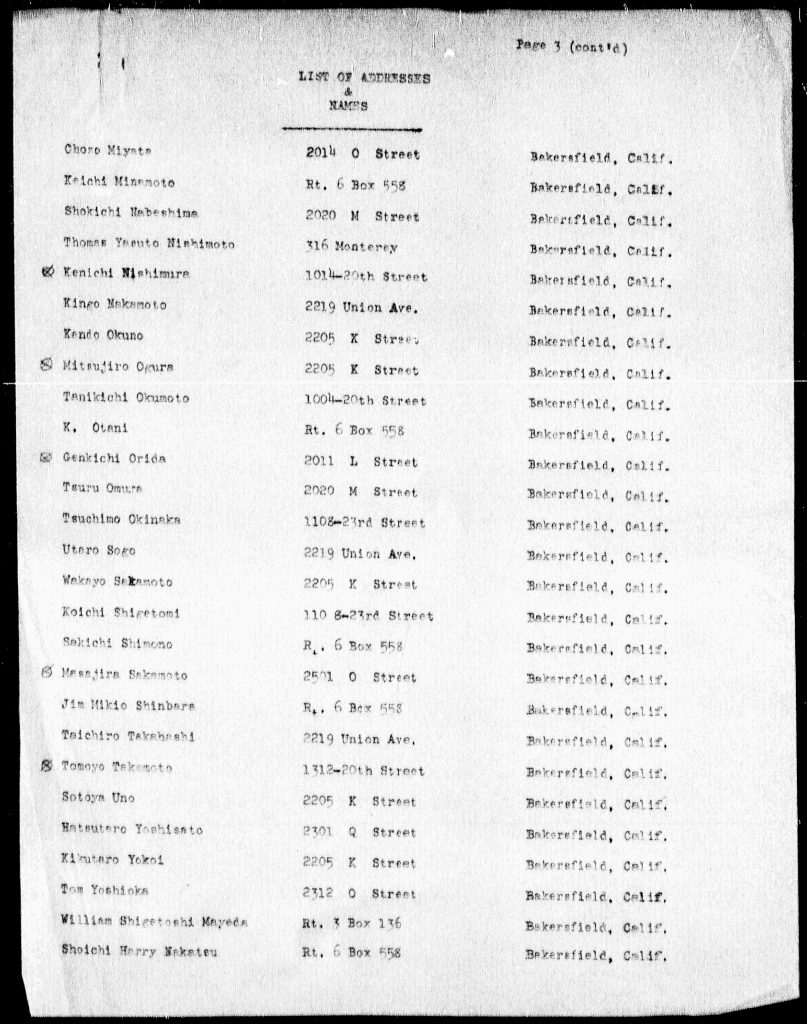
Poston reports state that there were 134 individuals from Bakersfield in October of 1942. Daily activities were logged with extreme detail, only described as under constant surveillance. Two internees were watched under specific order, just for expressing leadership in their camps.
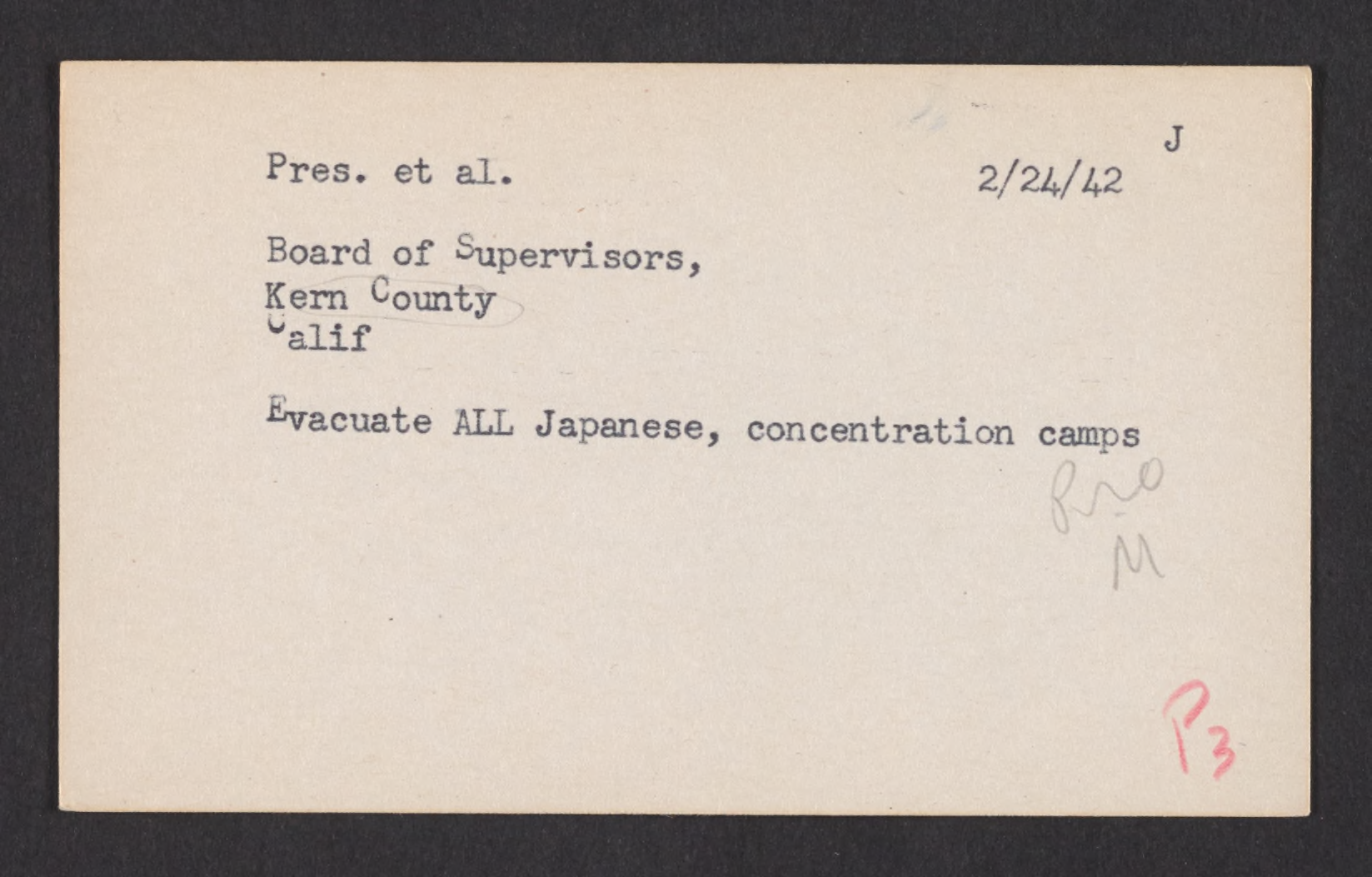
A local resident stated, “Then there will be bloodshed. Call it racial prejudice if you wish, but there is a growing sentiment against ever letting them return.” (1944)
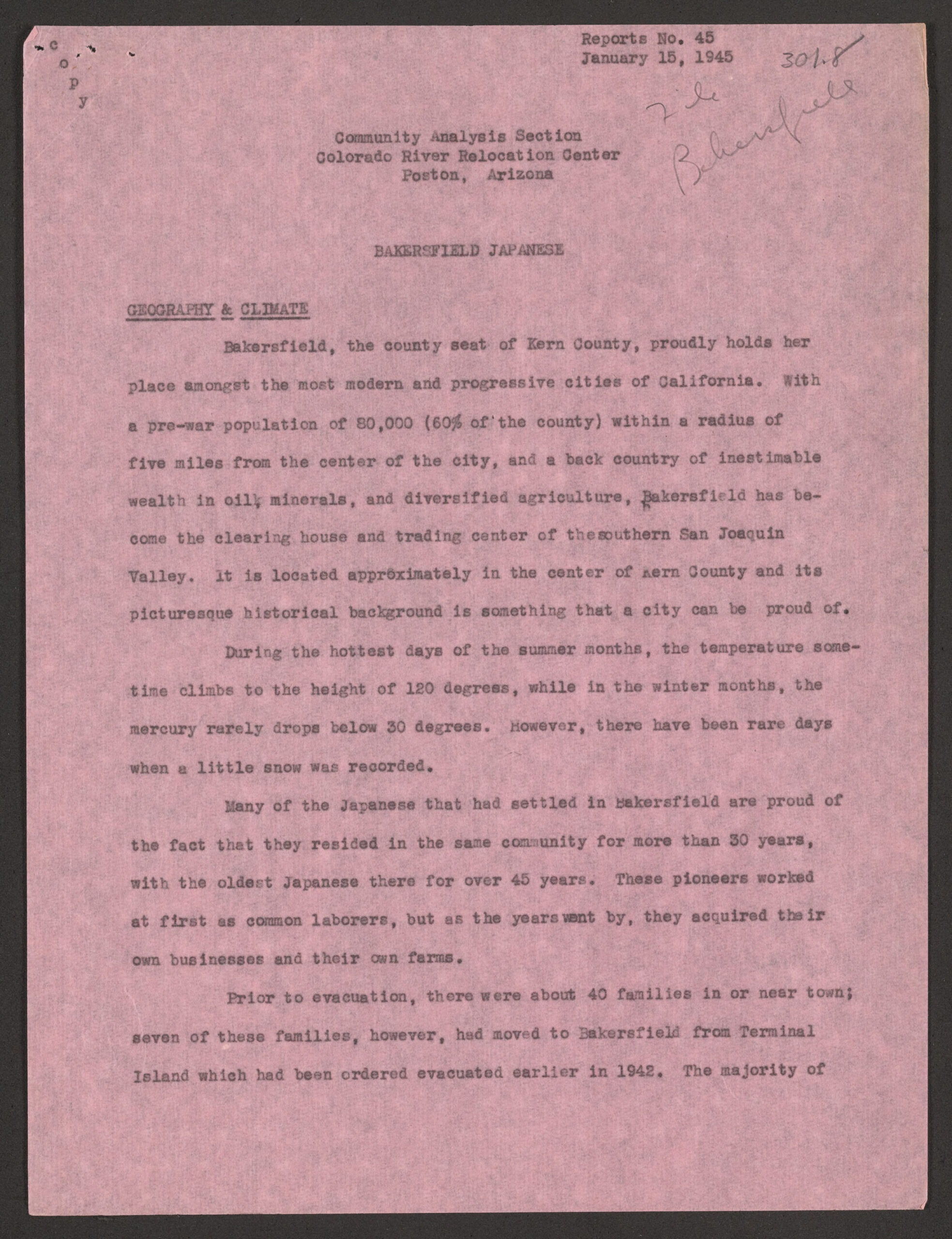
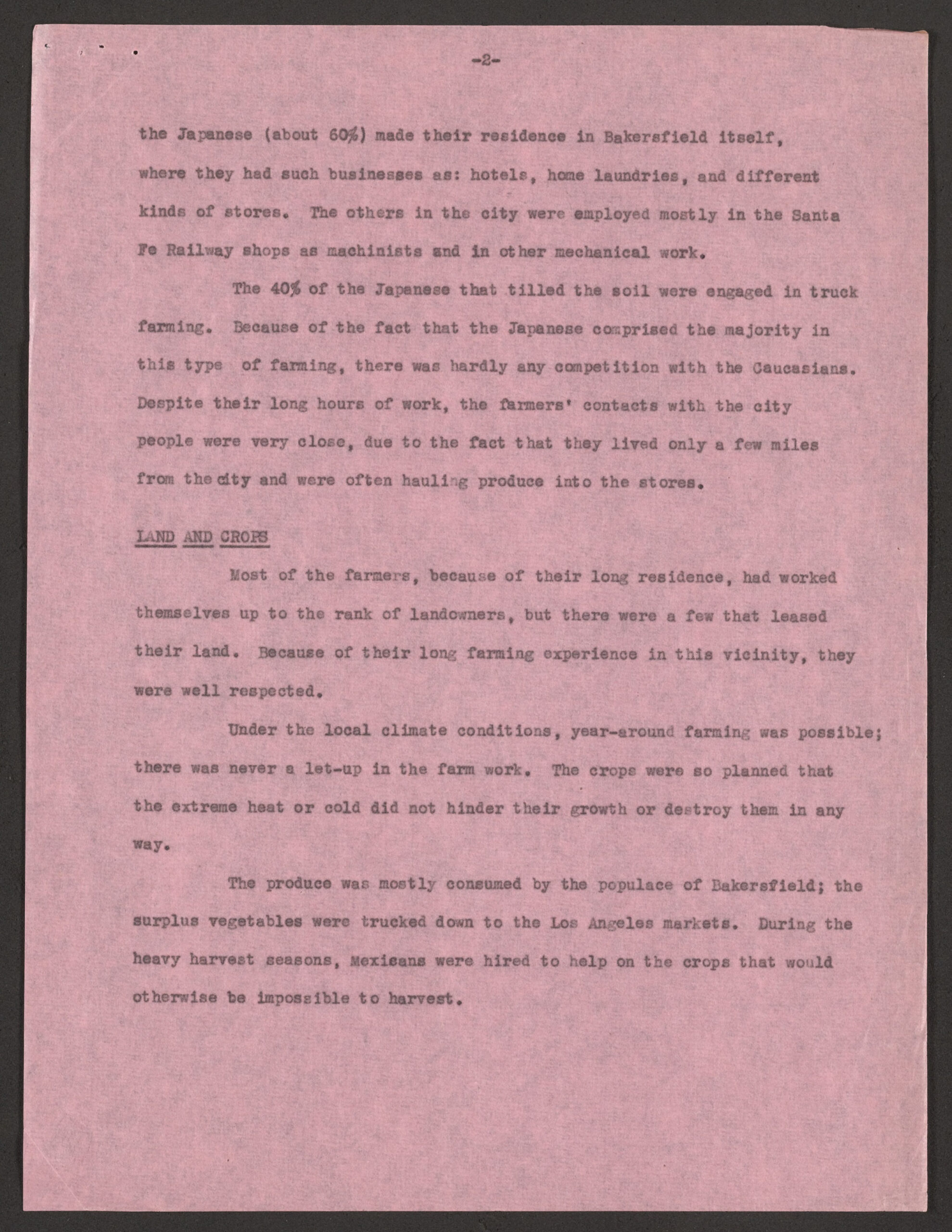
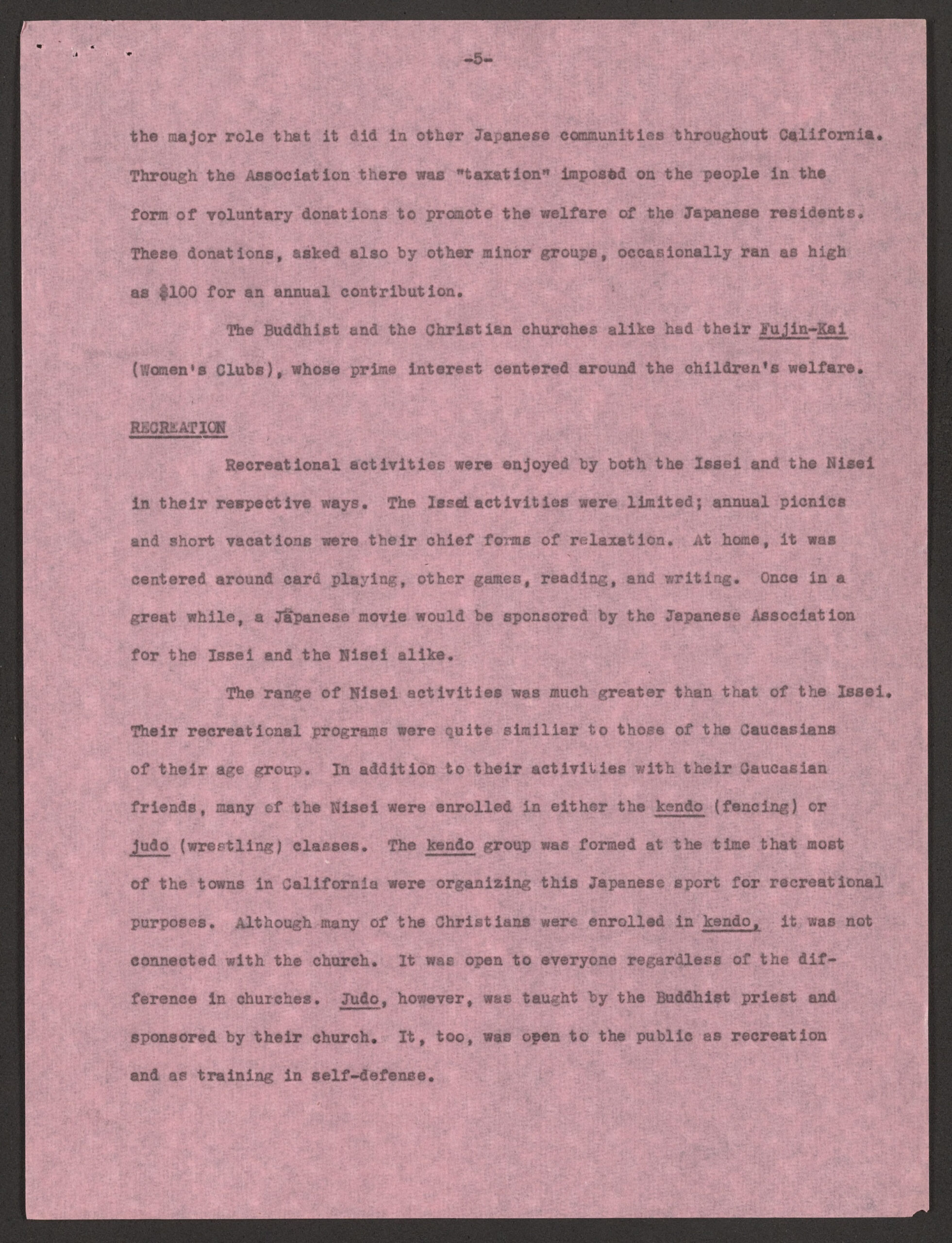
In 1945, a Bakersfield biography was created describing the Japanese community. They took immense pride coming from Bakersfield; most had resided in the city for over 30 years, and the oldest being in the city for 45 years. They worked hard and were able to move up from laborers to owning businesses and owning farms. There were about 40 families before the internment. They had hotels, home laundries, and stores. Sixty percent found employment at the Santa Fe shops as machinists and mechanics. Forty percent found work as truckers for farming and found little competition. Most of the farm workers became owners and were well respected. They sold most of their merchandise locally and sold surplus vegetables in Los Angeles. They hired migrant Mexican labor.
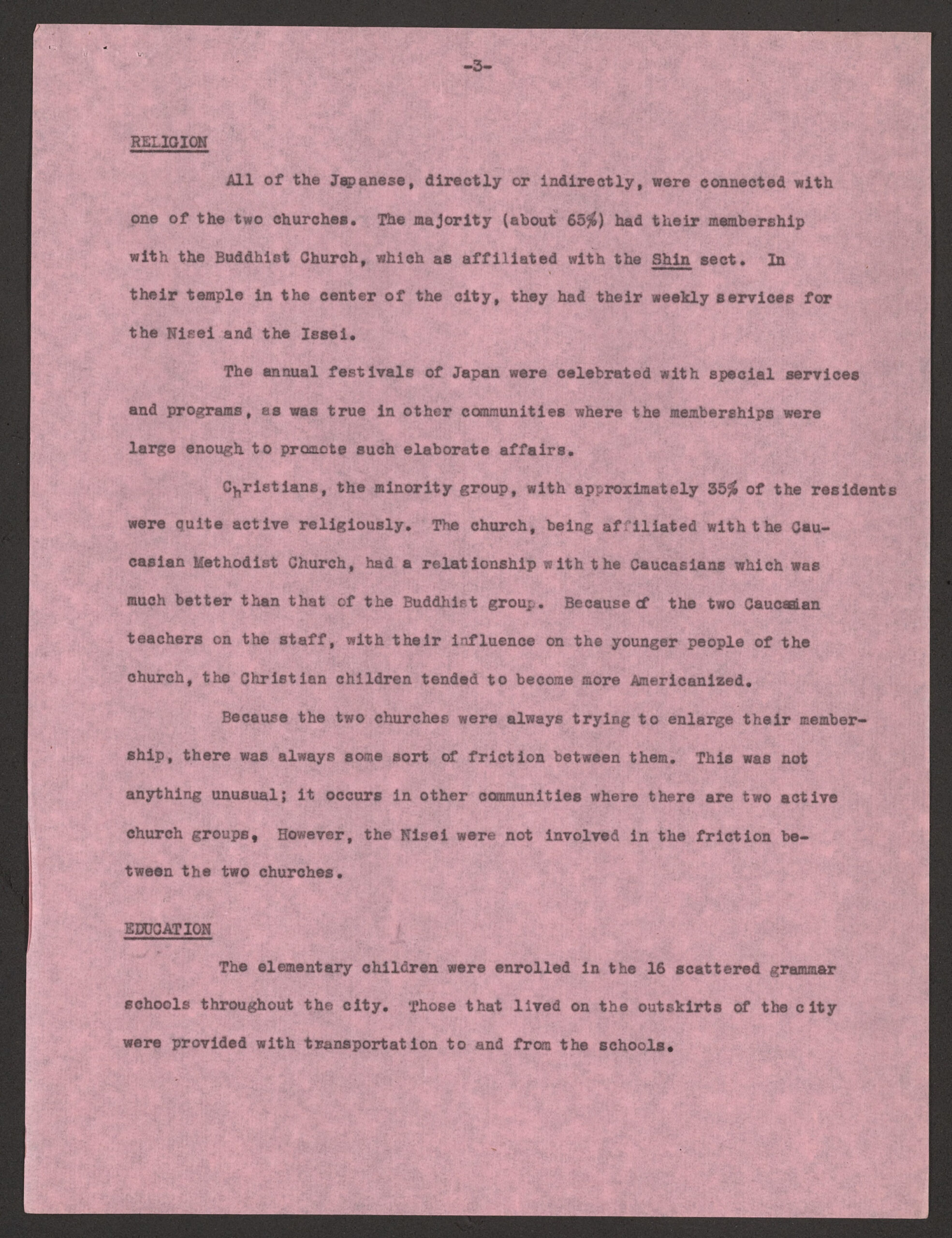
They were sixty-five percent Buddhist, Shin sect. They held festivals celebrating special services and programs, and large participation created festival-size affairs. Thirty-five percent were Christians and was more popular amongst Americanized individuals. Friction existed due to recruiting.
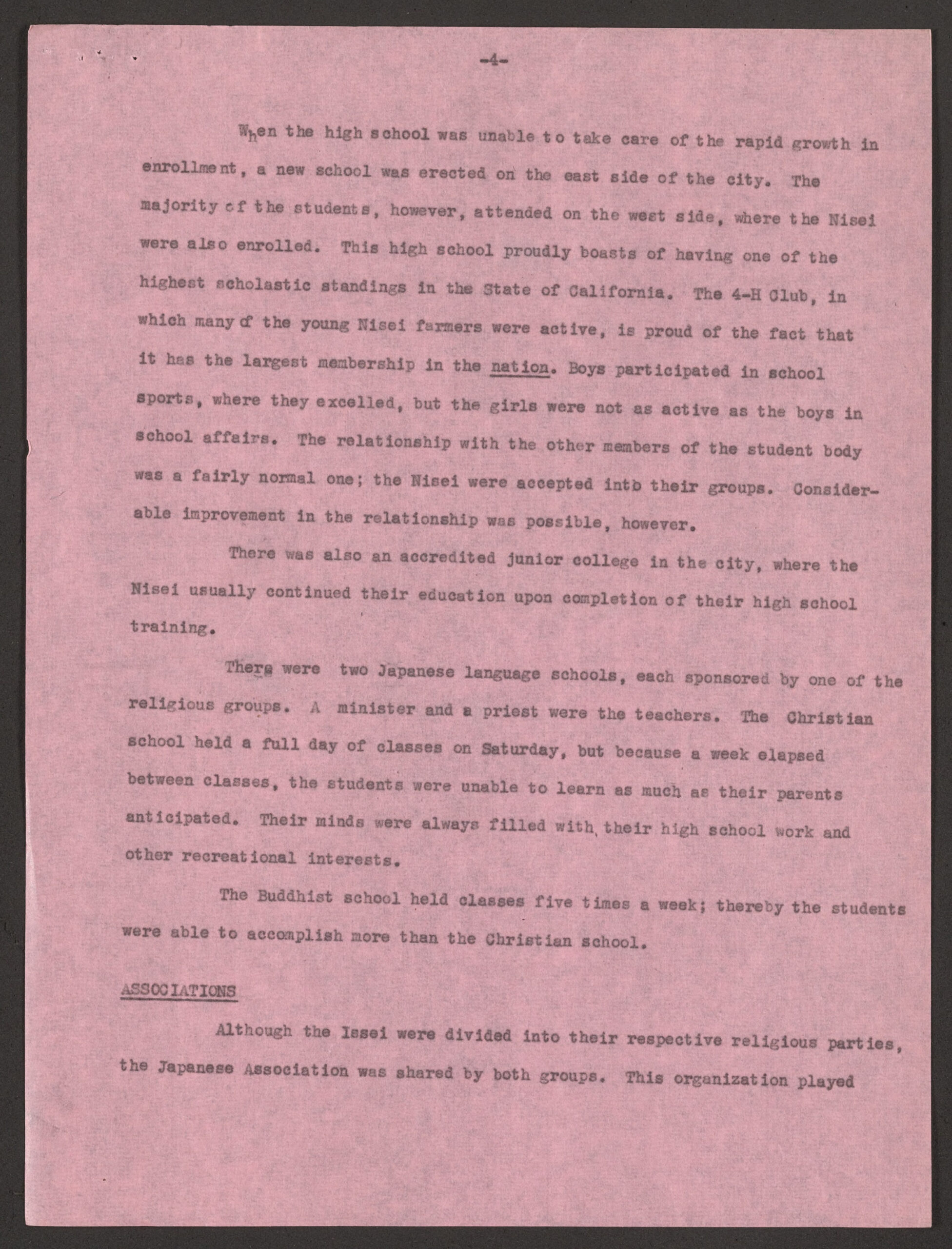
Education was scattered through 16 schools in the city. Most students attended Kern Union High School, even after the construction of East High. They held high scholastic standings and were in 4-H farming programs. Most attended Bakersfield College. There were two Japanese Language schools. The Christian School taught one day, and the Buddhist school taught all weekdays.
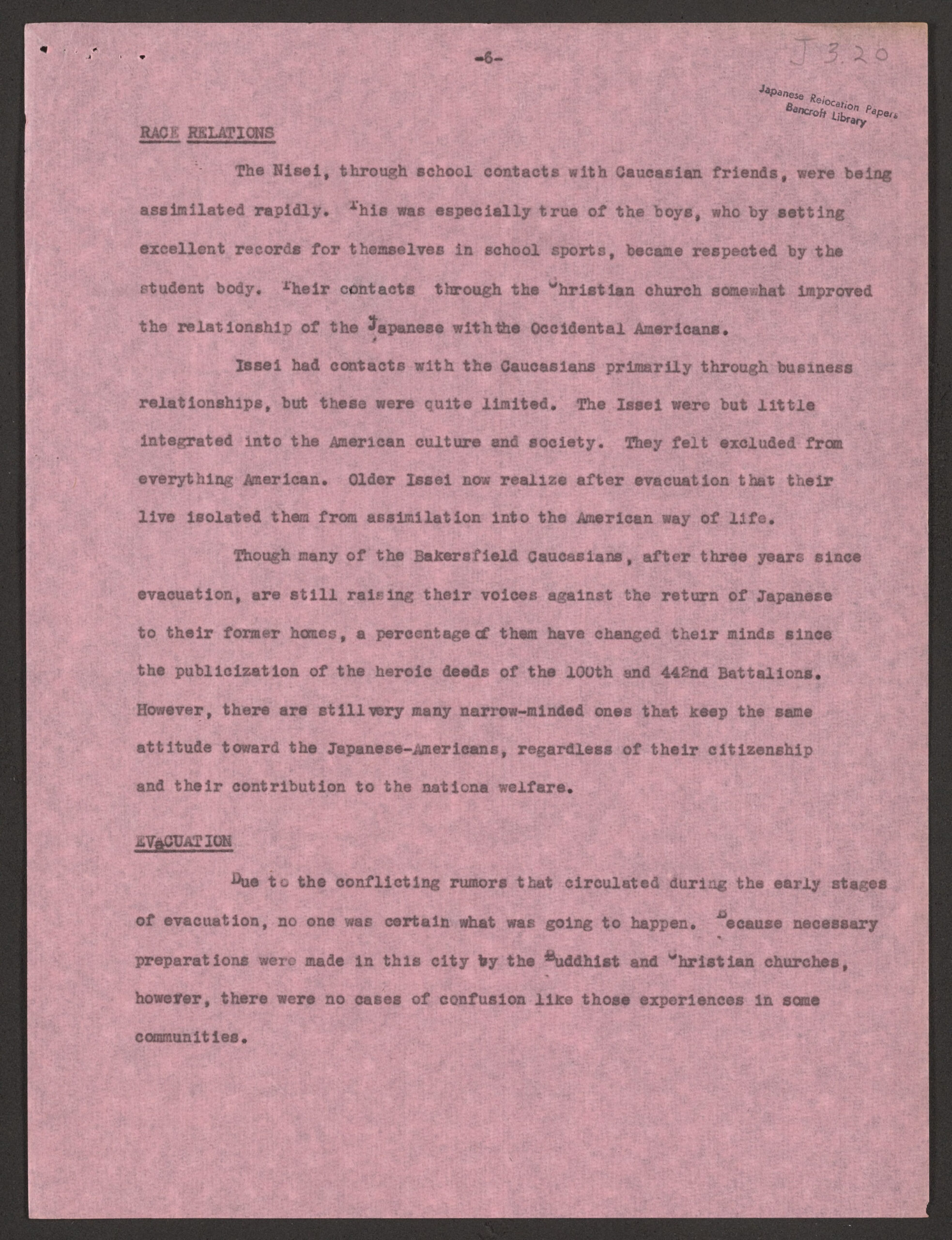
The community had a mutual aid society, which contributed up to $100 dollars per contribution. They helped welfare for the Japanese, but also other minority groups. They also had a women’s group. They had recreation groups for Judo and Kendo (fencing). The community had different relationships with white friends, ranging from business school sports, but did feel excluded from integration. Bakersfield residents continued to voice against the returning of residents, but some had changed their minds due to Japanese American heroism in the war.
The impact of relocation:
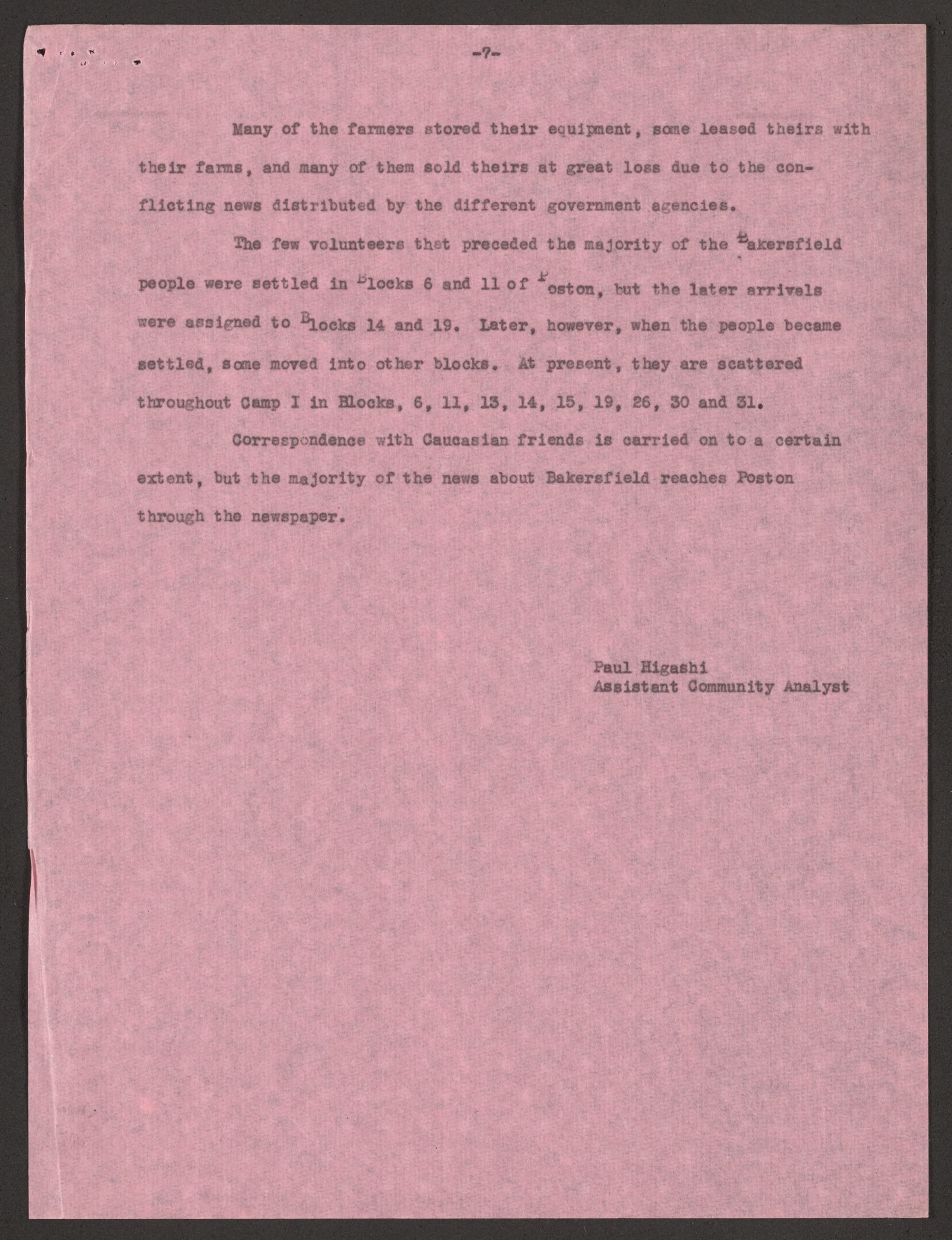
Many farmers stored their equipment, some leased theirs with their farms, and many of them sold theirs at great loss due to the conflicting news distributed by different government agencies. The new volunteers were settled in blocks 6 and 11 at Poston [Arizona], but later arrivals were assigned to Blocks 14 and 19. Later, however, when the people became settled, some moved into other blocks. At present, they were scattered through Camp 1 Blocks 6, 11, 13, 14, 15, 19, 26, 30, 30, and 31. Correspondence with Caucasian friends is carried on to a certain extent, but the majority of the news about Bakersfield reaches Poston Through the Newspaper. Paul Higashi, Assistant Community Analyst
Reports, Nos. 23-28, 30-56 [Community Analysis Section], Japanese American Evacuation and Resettlement records, BANC MSS 67/14 c, folder J3.21:2, The Bancroft Library, University of California, Berkeley. https://digicoll.lib.berkeley.edu/record/173574?ln=en&v=pdf