Moving into a Neighborhood

A Black Family Moves into a White Neighborhood, Bakersfield, California

 Before 1938    –  Buying on Contract     Covenants  –   Covenant Database   –  East Bakersfield     

    Education    –   Eminent Domain     –     Moving into a Neighborhood   –    Neighborhoods     

 Public Housing   –  Resources    –   Rumford Fair Housing Act     Suburban Expansion   –   Zoning 

On August 9, 1960, a Black family moved into the Hill Crest neighborhood. Days after moving in, the new homeowners received numerous phone calls, garbage service was denied, and they were harassed. A “Community” conversation was held to debate open, unrestricted housing.

California Crossroads Issues https://archives.csub.edu/repositories/3/archival_objects/5070

Hillcrest was a racially restricted (white only) neighborhood. The covenant reads, section 5, “No part of said realty shall ever at any time be used or occupied or be permitted to be used by any persons not of the white or Caucasian race, excepting such as are employed as servants upon said realty by the owners or tenants of said realty actually residing thereon.” Explore restricted neighborhoods https://hrc.csub.edu/neighborhood-mapping/

October 1960
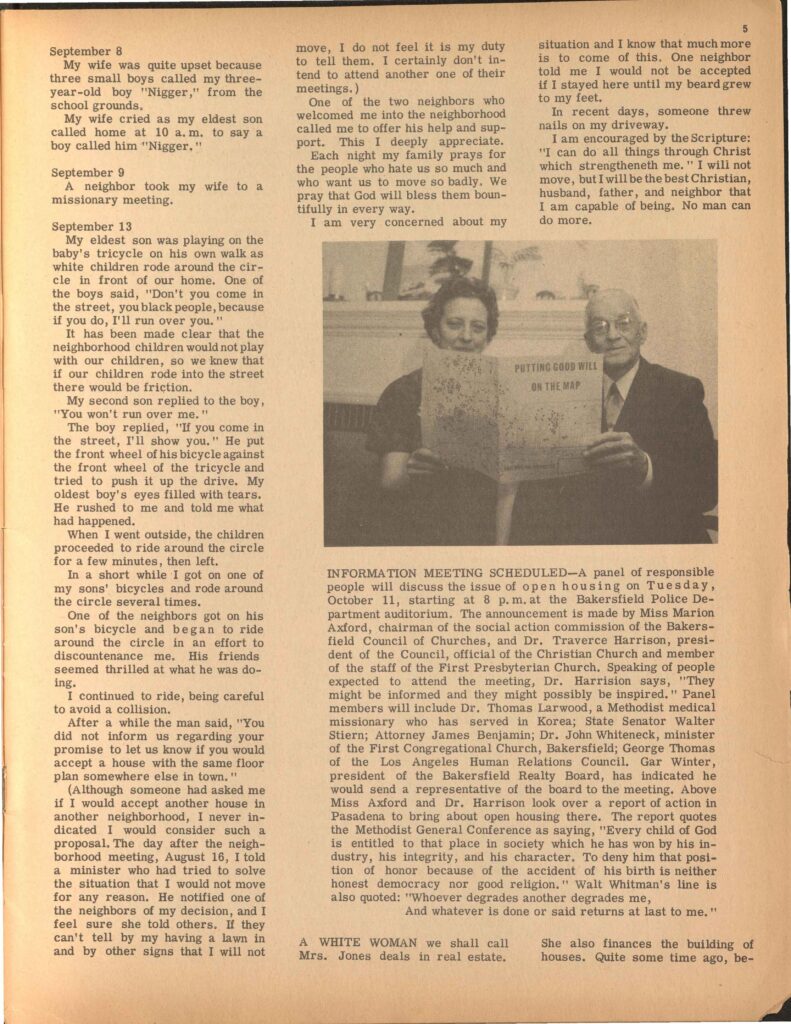
WHAT HAPPENS when a Negro family moves into a well-to-do white neighborhood? Here’s the diary-type report of someone who has first-hand knowledge, the head of a Negro family now living in Hillcrest. His name and profession are withheld for obvious reasons. Main title: A Negro Moves Into a White Neighborhood August 9, 1960 Moved into our new home in the Hillcrest area. Neighbors seemed puzzled. They gathered across the street, coming and going in shifts, and looked at men moving our furniture. My wife became so nervous, finally, that her speech was affected. August 10 Neighbors had a meeting next door. The meeting lasted from two and one half to three hours. After the meeting our phone rang every five minutes. When we answered, the callers would hang up. It was necessary to take the phone off the hook to get any rest at all. August 11 to 14 Annoying calls continued. August 15 Garbage man didn’t give us service. He said that if he did, others would stop patronizing him. My wife told him very sincerely that we wouldn’t want him to lose customers on our account. A neighbor’s son called me “Nigger.” Our baby son went next door; children there were kind to him. A boy on a bike said, “Mother said, ‘Those people are black.’” A white friend called at our house offering consolation and courage for the days to come. We had dinner with friends in La Cresta. Upon our return home, a person or persons intent on annoying us began ringing our phone and then hanging up. August 16 This morning a man called by phone and said, “Go away, Nigger.” At 4:35 p.m., I was called by a friend who advised me that there would be a meeting tonight. Discussion would center around how to get us out of the neighborhood. Two ministers went to each house on the block to speak of the Christian approach and to discuss ways of implementing it. A neighbor called to make an appointment so she and her husband could talk with us. Unknown to us, she called neighbors who wanted to get us out of the neighborhood to meet at our house. When the time for the meeting came, we had about fifteen or more white friends in our home. Neighbors who had gathered, upon seeing so many friends at our home, called to say they didn’t know we were expecting guests that evening and stated that rather than come visit as previously planned, they would come another evening. But, after some confusion, it turned out that the group of neighbors decided to meet next door and they invited us to come over there to discuss with them the problems and fears our moving in had caused them. Some of the questions asked during the meeting were: Why did you choose this neighborhood? Why didn’t you come to ask the neighbors how they felt? One man said, “I would have squared you.” Don’t you think you could do more among your own people? Someone said, “We would like you if you moved.” A friend of ours said that her beautician felt that our moving here was “out of place.” We tried to keep all this from our children at first, but now we discuss the happenings with them. One of our boys lies down in the car when he passes our neighbors’ houses. We have not enjoyed one single moment in the beautiful house we bought. It is the pleasure to leave work tired at the end of the day and be called names and be looked down on by people who judge themselves to be better than you because you belong to a different ethnic group. I mentioned to a friend that neighbors had not given us a chance to defend ourselves. I mentioned that we don’t know what we can do, what we are like. The only thing they can see is the color of our skin. This is a dangerous thing. A friend came by tonight to help brighten the day. August 17 A dairy company sold me milk in spite of losing three customers. (He never regained the customers on this street.) The garbage collector agreed to take garbage after being called by friends of ours. August 18 No calls lately. People probably thought I had given up and planned to move away, so they didn’t want to pester me. Later in the day, our telephone number is changed to an unlisted number. Still later: Not being able to reach me at home, callers began calling at the office. Apparently they did not realize that the calls did not reach me, but fall on the office girl who is paid to answer. Agitation by neighbors’ older children. Boys made noises like a dog so as to walk our dog from back of the house to the front. When we drove to a swimming event, did one kid yell something like, “…wreck your car?” August 19 Quiet night last night. Calls continue to come into the office. Included were a couple of encouraging calls. August 24 Boy said, “Nigger, Nigger, sure tastes good.” August 25 Boy called my eldest son, “Blackboy.” September 4 Children ran and hid behind bushes, calling “Nigger.” September 7 Two visitors called, expressing their good will.September 8 My wife was quite upset because three small boys called my three-year-old boy “Nigger,” from the school grounds. My wife cried as my eldest son called home at 10 a.m. to say a boy called him “Nigger.” September 9 A neighbor took my wife to a missionary meeting. September 13 My eldest son was playing on the baby’s tricycle on his own walk as white children rode around the circle in front of our home. One of the boys said, “Don’t you come in the street, you black people, because if you do, I’ll run over you.” It has been made clear that the neighborhood children would not play with our children, so we knew that our children rode into the street if there would be friction. My second son replied to the boy, “You won’t run over me.” The boy replied, “If you come in the street, I’ll show you.” He put the front wheel of his bicycle against the front wheel of the tricycle and tried to push it up the drive. My oldest boy’s eyes filled with tears. He rushed to me and told me what had happened. When I went outside, the children proceeded to ride around the circle for a few minutes, then left. In a short while I got on one of my sons’ bicycles and rode around the circle several times. One of the neighbors got on his son’s bicycle and began to ride around the circle in an effort to discontinue me. His friends seemed thrilled at what he was doing. I continued to ride, being careful to avoid a collision. After a while the man said, “You did not inform us regarding your promise to let us know if you would accept a house with the same floor plan somewhere else in town.” (Although someone had asked me if I would accept another house in another neighborhood, I never indicated I would consider such a proposal. The day after the neighborhood meeting, August 16, I told a minister who had tried to solve the situation that I would not move for any reason. He notified one of the neighbors of my decision, and I feel sure she told others. If they can’t tell by my having a law in and by other signs that I will not move, I do not feel it is my duty to tell them. I certainly don’t intend to attend another one of their meetings.) One of the two neighbors who welcomed me into the neighborhood called me to offer his help and support. This I deeply appreciate. Each night my family prays for the people who hate us so much and who want us to move so badly. We pray that God will bless them bountifully in every way. I am very concerned about my situation and I know that much more is to come of this. One neighbor told me I would not be accepted if I stayed here until my beard grew to my feet. In recent days, someone threw nails on my driveway. I am encouraged by the Scripture: “I can do all things through Christ which strengtheneth me.” I will not move, but I will be the best Christian, husband, father, and neighbor that I am capable of being. No man can do more. Photo caption text on the page: INFORMATION MEETING SCHEDULED— A panel of responsible people will discuss the issue of open housing on Tuesday, October 11, starting at 8 p.m. at the Bakersfield Police Department auditorium. The announcement is made by Miss Marion Axford, chairman of the social action commission of the Bakersfield Council of Churches, and Dr. Traver C. Harrison, president of the Council, official of the Christian Church and member of the staff of the First Presbyterian Church. Speaking of people expected to attend the meeting, Dr. Harrison says, “They might be informed and they might possibly be inspired.” Panel members will include Dr. Thomas Larwood, a Methodist medical missionary who has served in Korea; State Senator Walter Stiern; Attorney James Benjamin; Dr. Don Whitener, minister of the First Congregational Church, Bakersfield; George Thomas of the Los Angeles Human Relations Council. Gar Winter, president of the Bakersfield Realty Board, has indicated he would send a representative of the board to the meeting. Above Miss Axford and Dr. Harrison look over a report of action in Pasadena to bring about open housing there. The report quotes the Methodist General Conference as saying, “Every child of God is entitled to that place in society which he has won by his industry, his integrity, and his character. To deny him that position of honor because of the accident of his birth is neither honest democracy nor good religion.” Walt Whitman’s line is also quoted: “Whoever degrades another degrades me, And whatever is done or said returns at last to me.”

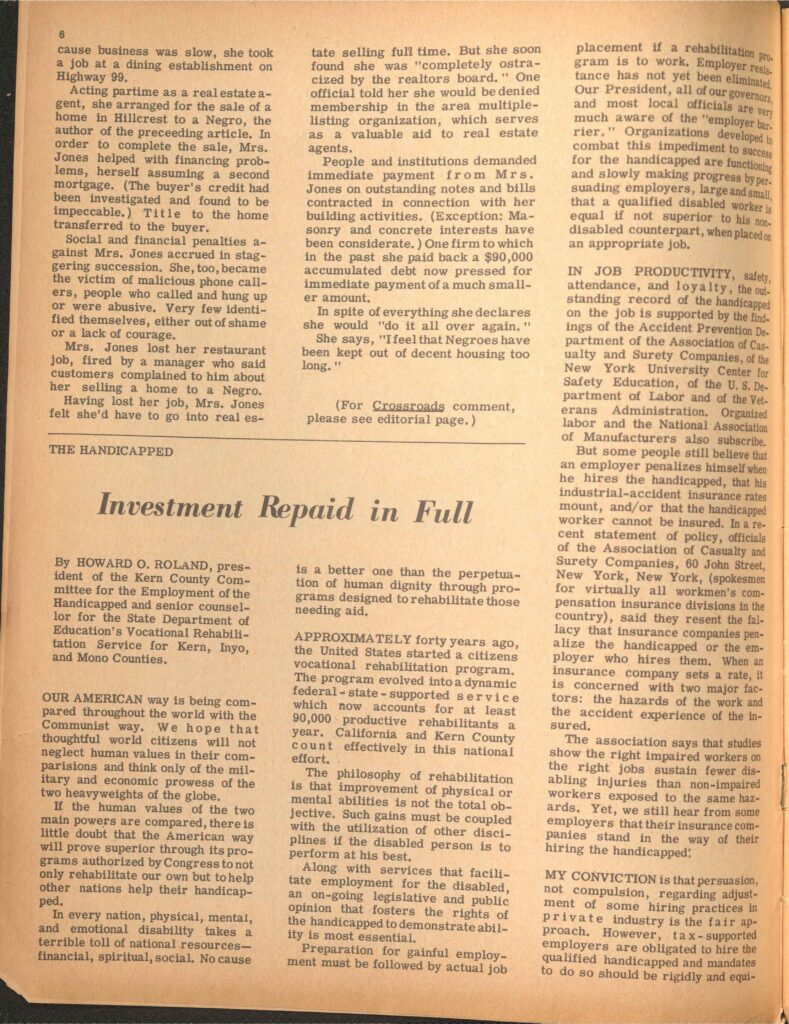
…cause business was slow, she took a job at a dining establishment on Highway 99. Acting parttime as a real estate agent, she arranged for the sale of a home in Hillcrest to a Negro, the author of the preceding article. In order to complete the sale, Mrs. Jones helped with financing problems, herself assuming a second mortgage. (The buyer’s credit had been investigated and found to be impeccable.) Title was transferred to the buyer. Social and financial penalties against Mrs. Jones accrued in staggering succession. She, too, became the victim of malicious phone callers, people who called and hung up or were abusive. Very few identified themselves, either out of shame or a lack of courage. Mrs. Jones lost her restaurant job, fired by a manager who said customers complained to him about her selling a home to a Negro. Having lost her job, Mrs. Jones felt she’d have to go into real estate selling full time. But she soon found she was “completely ostracized by the realtors’ board.” One official told her she would be denied membership in the area multiple-listing organization, which serves as a valuable aid to real estate agents. People and institutions demanded immediate payment from Mrs. Jones on outstanding notes and bills contracted in connection with her building activities. (Exceptions: Masonry and concrete interests have been considerate.) One firm to which she owes a past due balance of $90,000 accumulated debt now pressed for immediate payment of a much smaller amount. In spite of everything she declares she would “do it all over again.” She says, “I feel that Negroes have been kept out of decent housing too long.” (For Crossroads comment, please see editorial page.) THE HANDICAPPED Investment Repaid in Full By HOWARD O. ROLAND, president of the Kern County Committee for the Employment of the Handicapped and senior counselor for the State Department of Education’s Vocational Rehabilitation Service for Kern, Inyo, and Mono Counties. OUR AMERICAN way is being compared throughout the world with the Communist way. We hope that thoughtful world citizens will not neglect human values in their comparison and think only of the military and economic prowess of the two heavyweights of the globe. If the human values of the two main powers are compared, there is little doubt that the American way will prove superior through its programs authorized by Congress to not only rehabilitate our own but to help other nations help their handicapped. In every nation, physical, mental, and emotional disability takes a terrible toll of national resources—financial, spiritual, social. No cause is a better one than the perpetuation of human dignity through programs designed to rehabilitate those needing aid. APPROXIMATELY forty years ago, the United States started a citizens vocational rehabilitation program. The program evolved into a dynamic federal-state-supported service which now accounts for at least 90,000 productive rehabilitants a year. California and Kern County count effectively in this national effort. The philosophy of rehabilitation is that improvement of physical or mental abilities is not the total objective. Such gains must be coupled with the utilization of other disciplines if the disabled person is to return at his best. Along with services that facilitate employment for the disabled, an on-going legislative and public opinion that fosters the rights of the handicapped to demonstrate ability is most essential. Preparation for gainful employment must be followed by actual job placement if a rehabilitation program is to work. Employer resistance has not yet been eliminated. Our President, all officials of government and most local officials are very much aware of the “employer barrier.” Organizations developed to combat this impediment to successful employment are functioning and slowly making progress by persuading employers, large and small, that a qualified disabled worker is equal if not superior to his non-disabled counterpart, when placed on an appropriate job. IN JOB PRODUCTIVITY, safety, attendance, and loyalty, the outstanding record of the handicapped on the job is supported by the findings of the Accident Prevention Department of the Associated Casualty and Surety Companies of New York University Center for Safety Education, of the U.S. Department of Labor and the Veterans Administration. Organized labor manufacturers also subscribe. But some people still believe that an employer penalizes himself when he hires the handicapped, that his industrial-accident insurance rates mount, and/or that the handicapped worker cannot be insured. In a recent statement of policy, officials of the Association of Casualty and Surety Companies, 60 John Street, New York, (spokesmen for virtually all workmen’s compensation insurance divisions in the country), said they resent the fallacy that insurance companies penalize the handicapped or the employer who hires them. When an insurance company sets a rate, it is concerned with two major factors: the hazards of the work and the accident experience of the insured. The association says that studies show the right jobs suited workers on the job sustain fewer disabling injuries than non-impaired workers exposed to the same hazards. Yet, we still hear from some employers that their insurance companies stand in the way of their hiring the handicapped: MY CONVICTION is that persuasion, not compulsion, regarding adjustment of some hiring practices in private industry is the fair approach. However, tax-supported employers are obligated to hire the qualified handicapped and mandates to do so should be rigidly and equitably enforced.

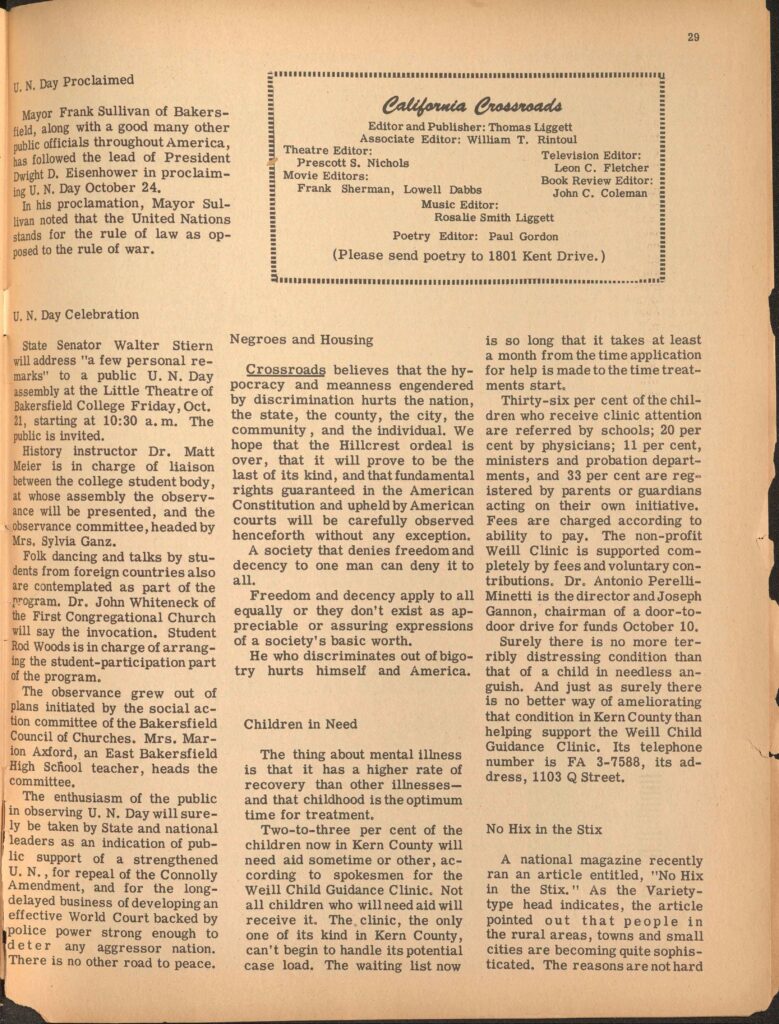
U. N. Day Proclaimed Mayor Frank Sullivan of Bakersfield, along with a good many other public officials throughout America, has followed the lead of President Dwight D. Eisenhower in proclaiming U. N. Day October 24. In his proclamation, Mayor Sullivan noted that the United Nations stands for the rule of law as opposed to the rule of war. U. N. Day Celebration State Senator Walter Stiern will address “a few personal remarks” to a public U. N. Day assembly at the Little Theatre of Bakersfield College Friday, Oct. 21, starting at 10:30 a.m. The public invited. History instructor Dr. Matt Meier is in charge of liaison between the college student body, at whose assembly the observance will be presented, and the observance committee, headed by Mrs. Sylvia Ganz. Folk dancing and talks by students from foreign countries also are contemplated as part of the program. Dr. John Whiteneck of the First Congregational Church will say the invocation. Student Rod Woods is in charge of arranging the student-participant part of the program. The observance grew out of plans initiated by the social action committee of the Bakersfield Council of Churches. Mrs. Marion Axford, an East Bakersfield High School teacher, heads the committee. The enthusiasm of the public in observing U. N. Day will surely be taken by State and national leaders as an indication of public support of a strengthened U. N., for repeal of the Connolly Amendment, and for the long-delayed business of developing an effective World Court backed by police power strong enough to deter any aggressor nation. There is no other road to peace. California Crossroads Editor and Publisher: Thomas Liggett Associate Editor: William T. Rintoul Theatre Editor: William T. Rintoul Television Editor: Leon C. Fletcher Movie Editors: Frank Sherman, Lowell Dabbs Book Review Editor: John Y. Coleman Music Editor: Rosalie Smith Liggett Poetry Editor: Paul Gordon (Please send poetry to 1801 Kent Drive.) Negroes and Housing Crossroads believes that the hypocrisy and meanness engendered by discrimination hurts the nation, the state, the county, the city, the community, and the individual. We hope that the Hillcrest ordeal is over, that it will prove to be the last of its kind, and that fundamental rights guaranteed in the American Constitution and upheld by American courts will be carefully observed henceforth without any exception. A society that denies freedom and decency to one man can deny it to all. Freedom and decency apply to all equally or they don’t exist as appreciable or assuring expressions of a society’s basic worth. He who discriminates out of bigotry hurts himself and America. Children in Need The thing about mental illness is that it has a higher rate of recovery than other illnesses—and that childhood is the optimum time for treatment. Two-to-three per cent of the children now in Kern County will need aid sometime or other, according to spokesmen for the Weil Child Guidance Clinic. Not all children who will need aid will receive it. The clinic, the only one of its kind in Kern County, can’t begin to handle its potential case load. The waiting list now is so long that it takes at least a month from the time application for help is made to the time treatment starts. Thirty-six per cent of the children who receive clinic attention are referred by schools; 20 per cent by physicians; 11 per cent, ministers and probation departments, and 33 per cent are registered by parents or guardians acting on their own initiative. Fees are charged according to ability to pay. The non-profit Weil Clinic is supported completely by fees and voluntary contributions. Dr. Antonio Perelli-Minetti is the director and Joseph Gannon, chairman of a door-to-door drive for funds October 1. Surely there is no more terribly distressing condition than that of a child in needless anguish. And just as surely there is no better way of ameliorating that condition in Kern County than helping support the Weil Child Guidance Clinic. Its telephone number is FA 3-7588, its address, 1103 Q Street. No Hix in the Stix A national magazine recently ran an article entitled, “No Hix in the Stix.” As the Variety-type head indicates, the article pointed out that people in the rural areas, towns and small cities are becoming quite sophisticated. The reasons are not hard (text cuts off at bottom of page)

November 1960

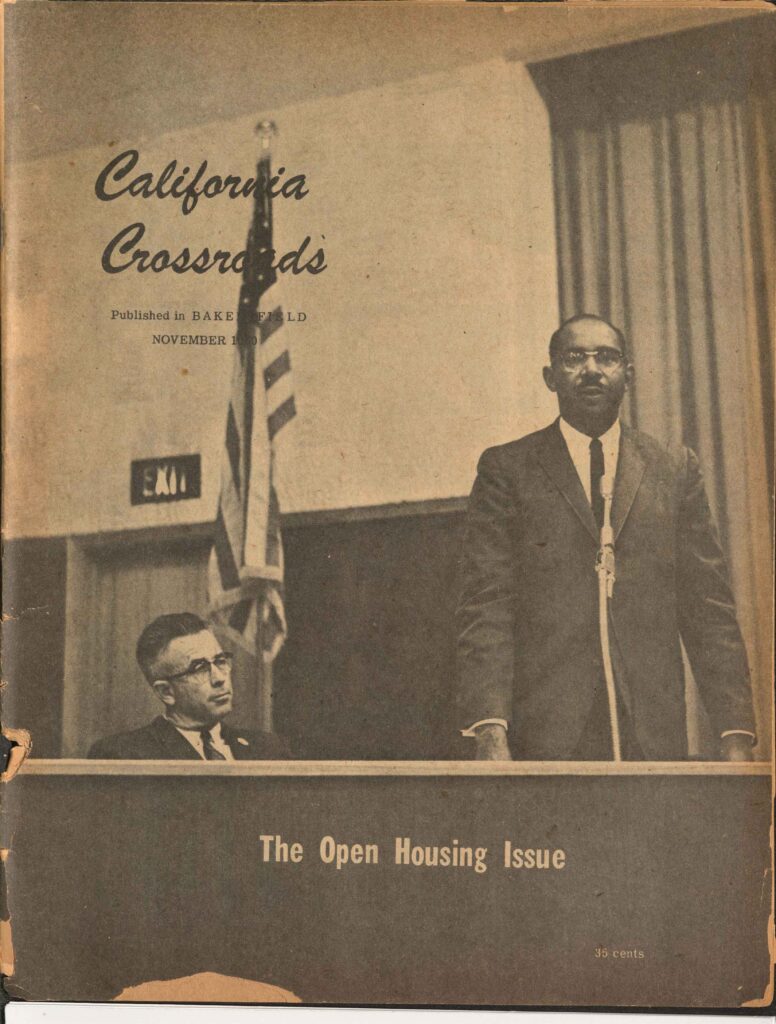
California Crossroads Published in BAKERSFIELD NOVEMBER 1960 The Open Housing Issue 35 cents Visual Description (for accessibility context) The cover features a black-and-white photograph of a formal public setting. A Black man stands at a microphone or podium, wearing a dark suit, white shirt, and tie. He appears to be speaking. To his left (viewer’s right), a white man in glasses sits behind a desk or bench, also wearing a suit and tie. An American flag stands behind them. A curtain hangs in the background. An “EXIT” sign is visible on the wall behind the seated man. The magazine shows visible wear along the edges and corners.

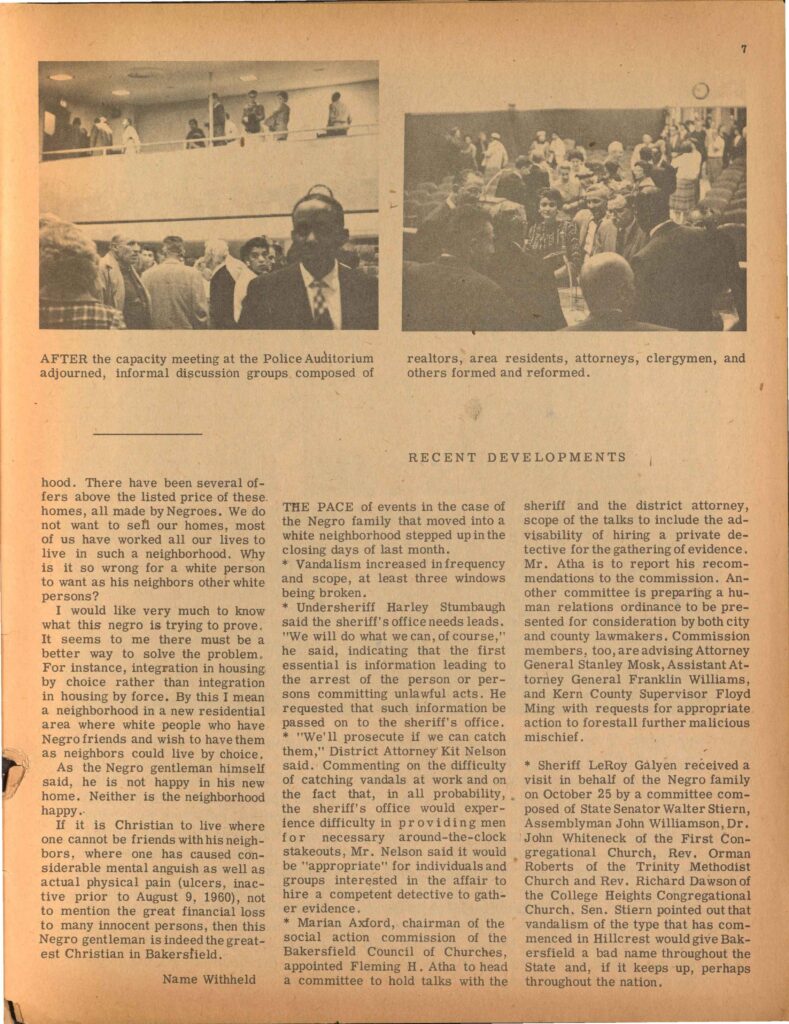
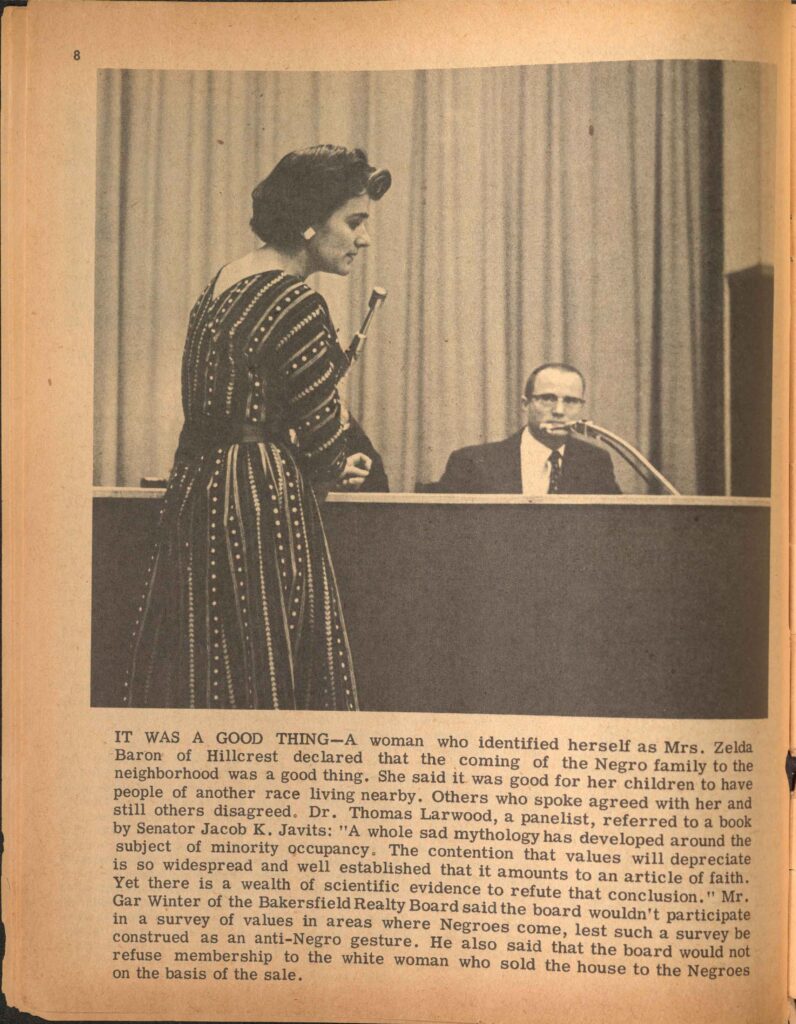
THE FOLLOWING letter came to the Crossroads office accompanied by this note: "I sincerely hope you will publish the enclosed letter as everyone must realize there are two sides to every story. I realize you are on one side of the fence and I am on the other to a certain extent. I am for integration in everything except housing and marriage. I do not, cannot, believe that our Lord made the black man black and the white man white for no reason at all. I imagine this is a question that will only be answered in Heaven. I respect every person's right to his own opinion. I cannot blame you for thinking your way is right. Try to consider my opinion in the same light. . . . I hope you will extend to me the same consideration you extended to (the Negro who moved into Hillcrest) in regard to using my name . . . I live in the vicinity of the house occupied by the Negro family." (For comment on the many stands taken in the note and in the article, stands with which Crossroads is in almost total disagreement, please see the editorial and letters-to-the-editor pages.) White Man, Black Man After reading the diary of the Negro gentleman who moved into Hillcrest (last month's Crossroads), I feel that the other side of the story should be presented. As a white neighbor in the immediate area, I am directly affected. Therefore, I consider it my civic duty to write this letter. Of course, the opinions expressed are entirely my own. However, I believe they are generally the same as a large majority of the neighbors living in the immediate vicinity. First let me state the answers to the questions as the Negro gentleman stated them. These are his own answers: Why did you choose this neighborhood? He said he liked the house, was very interested in education and considered the Harding School presented more opportunity for his children. (It was pointed out to him that the Harding School is much more crowded than the school his children formerly attended.) Why didn't you come to ask the neighbors how they felt? He said he expected some unfriendliness and didn't expect to be completely accepted into a white neighborhood until he had a chance to prove his good intentions of taking good care of the yard, landscaping and etc. Don't you think you could do more among your own people? He said, "I have never considered myself colored." I would like to correct the statement concerning the dairy. The dairy concerned had only one customer on the street prior to the Negro family moving in. They still have that same customer in addition to the Negro family. This Negro gentleman was asked at the neighborhood meeting he mentioned if he would accept a house of the same floor plan as the one he now occupies, in another neighborhood. He said he would think about it and let us know. We were never informed of his decision, by him or anyone else. At this same meeting, the Negro told us he was completely amazed at our statements concerning the loss of property value. He had never, he said, considered the possibility that a Negro living in the neighborhood could cause the value of the houses in the immediate area to drop. This does concern the whole neighborhood. Since this man moved in, we have contacted several reliable real estate men concerning this problem, and it is an accepted fact that the nearer the house is to the Negro, the greater the drop in value. We were told that houses next door to the Negro drop 50% in value the day after he moved in. It seems to me that any person, regardless of his skin coloring, who deliberately causes financial loss to a large number of innocent persons for any reason, should certainly understand an attitude of unfriendliness toward him. We would feel the same if it were a freeway being constructed in our immediate vicinity, if it would also lower the property value. Actually, we in the neighborhood now feel that the Negro is out of place here, realize fully that he is within the law and there is absolutely nothing we can do about it. If he was a white Negro student said in Life magazine, quote, "We all have a Supreme Court. When are you white folks going to get one?" I am not afraid to say that I do not want to live in a Negro neighborhood. This is not because of prejudice, but because of my own personal experience, which is too personal to relate here. Since the Negro moved in, we have been literally a guinea-pig neighborhood with car after car of Negroes driving by to see the conquest, I presume. The only prospective buyers of property in this area now are Negroes, although the people who are integrating Bakersfield all tell us that most Negroes cannot afford the type of homes for sale in this area. It would seem that we are left with two alternatives, should we decide to move elsewhere. We can sell our homes (possibly to a white buyer at a considerable loss, or sell to Negroes and completely disregard our friends and neighbors who established our beautiful neighborhood). (Continuation of letter text from previous page) hood. There have been several offers above the listed price of these homes, all made by Negroes. We do not want to sell our homes, most of us have worked all our lives to live in such a neighborhood. Why is it so wrong for a white person to want as his neighbors other white persons? I would like very much to know what this negro is trying to prove. It seems to me there must be a better way to solve the problem. For instance, integration in housing by choice rather than integration in housing by force. By this I mean a neighborhood in a new residential area where white people who have Negro friends and wish to have them as neighbors could live by choice. As the Negro gentleman himself said, he is not happy in his new home. Neither is the neighborhood happy. If it is Christian to live where one cannot be friends with his neighbors, where one has caused considerable mental anguish as well as actual physical pain (ulcers, inactive prior to August 9, 1960), not to mention the great financial loss to many innocent persons, then this Negro gentleman is indeed the greatest Christian in Bakersfield. Name Withheld RECENT DEVELOPMENTS THE PACE of events in the case of the Negro family that moved into a white neighborhood stepped up in the closing days of last month. Vandalism increased in frequency and scope, at least three windows being broken. Undersheriff Harley Stumbaugh said the sheriff’s office needs leads. “We will do what we can, of course,” he said, indicating that the first essential is information leading to the arrest of the person or persons committing unlawful acts. He requested that such information be passed on to the sheriff’s office. “We’ll prosecute if we can catch them,” District Attorney Kit Nelson said. Commenting on the difficulty of catching vandals at work and on the fact that, in all probability, the sheriff’s office would experience difficulty in providing men for necessary around-the-clock stakeouts, Mr. Nelson said it would be appropriate for individuals and groups interested in the affair to hire a competent detective to gather evidence. Marian Axford, chairman of the social action commission of the Bakersfield Council of Churches, appointed Fleming H. Atha to head a committee to hold talks with the sheriff and the district attorney, scope of the talks to include the advisability of hiring a private detective for the gathering of evidence. Mr. Atha is to report his recommendations to the commission. Another committee is preparing a human relations ordinance to be presented for consideration by both city and county lawmakers. Commission members, too, are advising Attorney General Stanley Mosk, Assistant Attorney General Franklin Williams, and Kern County Supervisor Floyd Ming with requests for appropriate action to forestall further malicious mischief. Sheriff Leroy Galyean received a visit in behalf of the Negro family on October 25 by a committee composed of State Senator Walter Stiern, Assemblyman John Williamson, Dr. John Whiteneck of the First Congregational Church, Rev. Orman Roberts of the Trinity Methodist Church and Rev. Richard Dawson of the College Heights Congregational Church. Sen. Stiern pointed out that vandalism of the type that has commenced in Hillcrest would give Bakersfield a bad name throughout the state and, if it keeps up, perhaps throughout the nation. Page number: 8 Black-and-white photograph at top of page: A woman stands at a podium speaking into a microphone in what appears to be an auditorium or council chamber. She wears a patterned dress and faces slightly left in profile. Behind her, a man in a suit sits at a desk with a microphone, looking toward her. Curtains hang in the background. Text beneath the photograph: IT WAS A GOOD THING— A woman who identified herself as Mrs. Zelda Baron of Hillcrest declared that the coming of the Negro family to the neighborhood was a good thing. She said it was good for her children to have people of another race living nearby. Others who spoke agreed with her and still others disagreed. Dr. Thomas Larwood, a panelist, referred to a book by Senator Jacob K. Javits: “A whole sad mythology has developed around the subject of minority occupancy. The contention that values will depreciate is so widespread and well established that it amounts to an article of faith. Yet there is a wealth of scientific evidence to refute that conclusion.” Mr. Gar Winter of the Bakersfield Realty Board said the board wouldn’t participate in a survey of values in areas where Negroes come, lest such a survey be construed as an anti-Negro gesture. He also said that the board would not refuse membership to the white woman who sold the house to the Negroes on the basis of the sale.