
Before 1938 – Buying on Contract – Covenants – Covenant Database – East Bakersfield
Education – Eminent Domain – Moving into a Neighborhood – Neighborhoods
Public Housing – Resources – Rumford Fair Housing Act – Suburban Expansion – Zoning
Black migrants encountered White, Mexican, Asian, indigenous, and European immigrant settlers and farmers when coming west. The West had limited diversity when it came to black settlers. The West had been largely defined by the area’s powerful white growers. Black migrants left the Jim Crow South only to find similar instances of racism and discrimination that had already limited other racial minorities in the American West.
Migrants who came to Buttonwillow found the “Jim Crow North,” as Robert Williams, a local resident said. Williams thought he had left discrimination in the south, only to find a “No Colored Trade” sign posted on a Buttonwillow café. Black migrants resisted and fought for change. Williams told historian Peter La Chappelle, who interviewed him in 1997, that he confronted the owner (a friend of Williams) and told him that he would not come in out of protest, even if the owner did not mean the sign to include Williams. This was not unique to the 1930s, as the Ku Klux Klan had already been active in the early 1920s in Taft, a known “sundown town.” In 1922, the New York Times reported on the case against the Kern KKK: “In its first report since it began inquiring into the recent activities of the masked night riders in the Central Valley oil fields, the Kern County Grand Jury delivered a presentment against the Ku Klux Klan today.” Other forms of disenfranchisement and discrimination included anti-miscegenation laws, the Chinese Exclusion Act, and housing discrimination.
Peter La Chappelle, “‘Shadows of the Dust’ The Expectation and Ordeal of California’s African-American Dust Bowl Migrants Southern San Joaquin Valley, 1929-1941,” (MA Thesis, CSU Bakersfield 1997) https://scholarworks.calstate.edu/concern/theses/r494vr48j
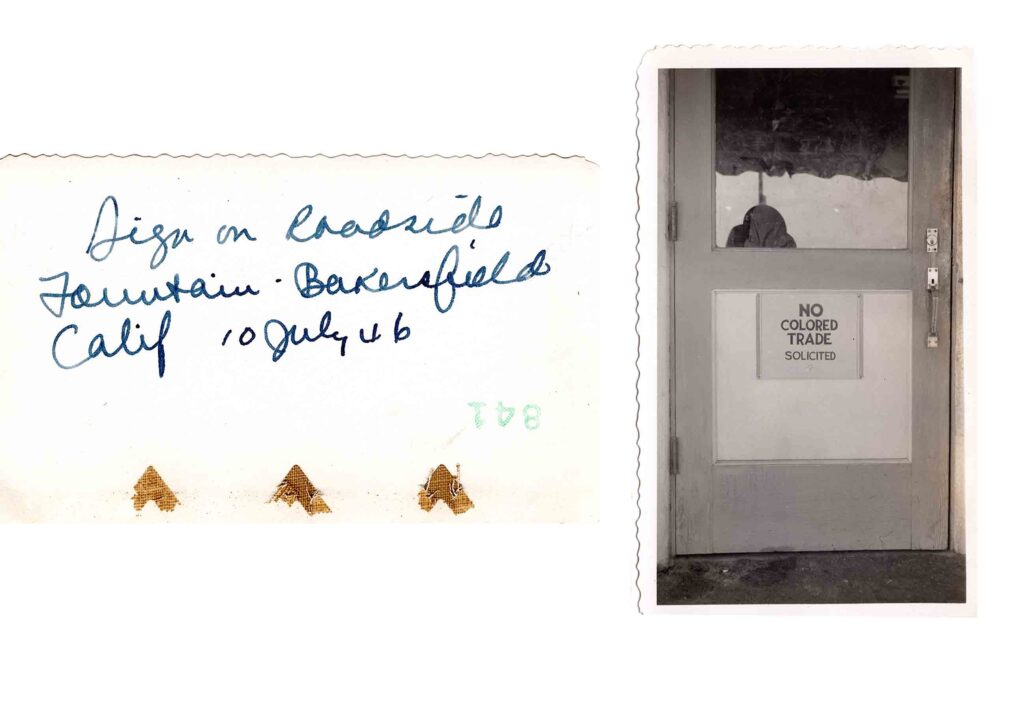
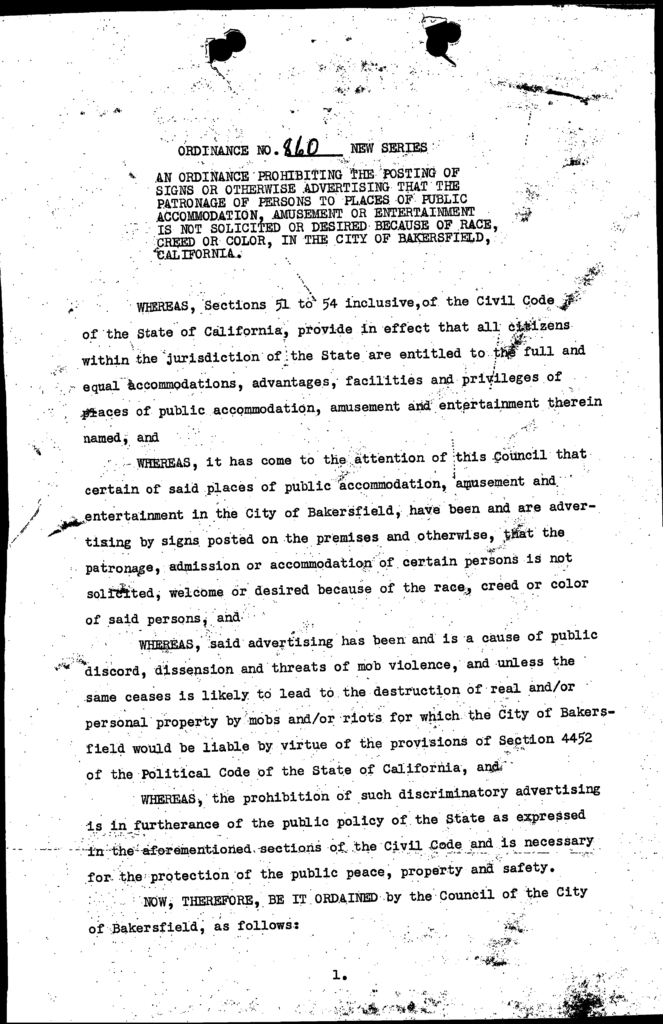
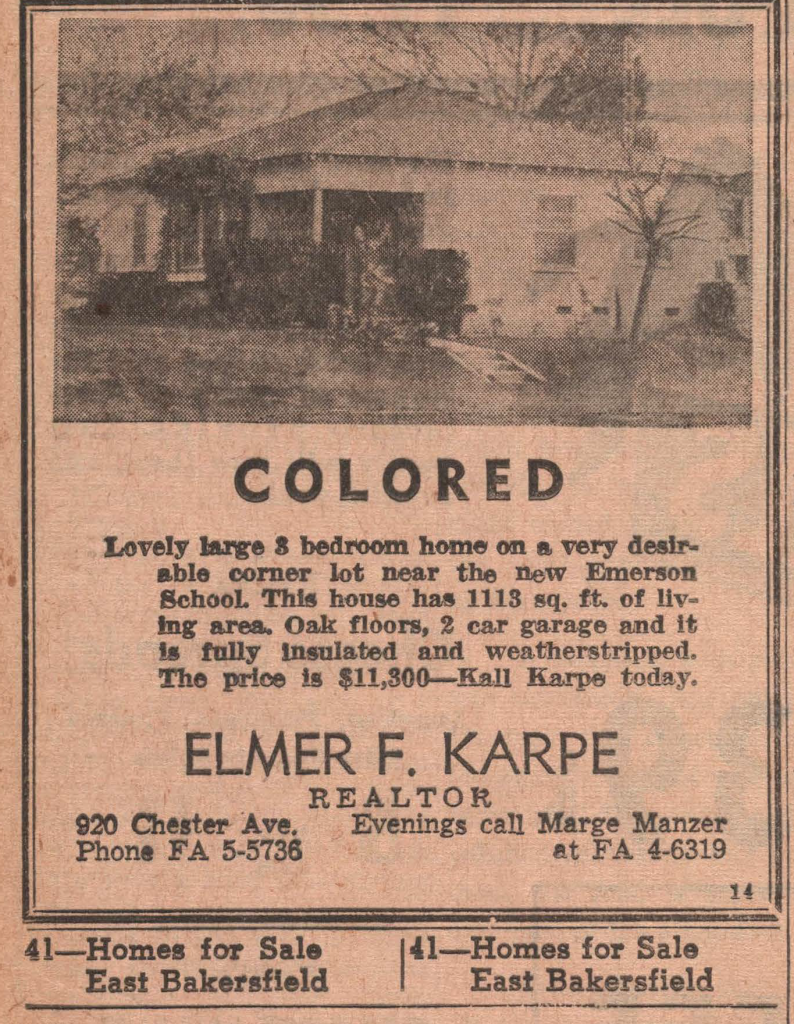
Housing discrimination included responses to deny housing. Johnie Mae Parker, an activist and historian, recounted, in her book How Long? Not Long!, that “In approaching a number of houses which had ‘For Sale or Rent’ signs posted, the response was, ‘Sorry, we don’t sell or rent to Colored.’ Two of such houses happened to be located on Kincaid Street in the Mayflower community. One of the houses was for sale by owner, the other one was for sale by realtor.”
With FHA (Federal Housing Administration) and HOLC (Homeowners Loan Corporation) loans out of reach, “buying on contract” was the process of “renting to own.” Minority home buyers were baited with the dream of homeownership, with the loans offered by real estate agents. The reality instead resulted in attempting to purchase homes under the agreement and conditions of a real estate broker. The broker owned and loaned the property to prospective buyers who did not have access to bank loans. The process of buying from the broker and owner created loans access with no protections or liability. Since FHA and HOLC loans did not operate in neighborhoods with poverty and areas where inadequate municipal services, “buying on contract” became the purchase method for many minorities well after the postwar period.
![Sample Contract: Agreement for the Sale of Real Estate This Agreement, executed in duplicate, February 25th, 19 43, Between ______________________, hereinafter designated as the Seller, And ______________________, hereinafter designated as the Buyer, Witnesseth That the said Seller, in consideration of the covenants and agreements hereinafter contained made by and on the part of the said Buyer, agrees to sell and convey unto the said Buyer that real property in the Mayflower Addition, County of Kern, State of California, described as follows, to-wit: Lots ______ in Block ______ of the Mayflower Addition, Bakersfield, Kern County, California; EXCEPTING THEREFROM all of the oil, gas and other hydrocarbon substances and other minerals of whatsoever kind in and under, or that may be produced from said land as per map recorded in Book ____ Page ____ of Maps, Official Records of said County, for the sum of SEVEN HUNDRED FIFTY AND 00/100 ($750.00) DOLLARS, in lawful money of the United States, and the Buyer, in consideration of the premises, agrees to buy said real property and pay therefor the said sum above mentioned in the following manner, to-wit: TWENTY-FIVE AND 00/100 ($25.00) DOLLARS, upon the execution and delivery of this agreement, receipt of which is hereby acknowledged, the balance to be paid as follows: Ten (10.00) Dollars on the 1st Day of April, 1943, and the same amount on the 1st Day of each and every month thereafter until the above purchase price together with interest on all deferred payments at the rate of seven per cent per annum, payable monthly, shall have been fully paid. The said Buyer is hereby given possession of the premises aforesaid and in consideration thereof hereby agrees to pay before delinquency all taxes and assessments which may hereafter become a lien on the premises above described, or any part thereof, and upon failure of the Buyer so to do the said Seller shall have the right to pay the same whatever costs and legal percentages there may be added, and the amount so paid, with interest at seven (7) per cent per annum, from date of payment until repaid, shall be included in this contract, and be repaid by the Buyer aforesaid on demand; said Buyer further agrees to keep the buildings now or hereafter erected on said premises insured during the life of this agreement for at least ______ Dollars ($_______), the policy to contain the clause that loss, if any, shall be payable to the Seller as his interest may appear. The seller may inspect said policy at any time. It is further agreed that the payment and performance of the obligations hereof are of the essence of this contract, and in the event of a failure of the Buyer to comply with all the terms hereof, the said Seller shall be released from all obligation in law or equity to convey said property, and the Buyer shall forfeit all right thereto and to all moneys theretofore paid under this contract. The Seller on receiving full payments at the times and in the manner above stipulated, agrees to execute and deliver to the Buyer or assigns, a good and sufficient deed conveying said property to Buyer, free of encumbrance, except second installment of taxes for 1942–1943. Conditions, Restrictions, Reservations and Rights of Way, if any, contained in any instrument of Record. All the stipulations and covenants aforesaid shall bind the successors of the respective parties hereto. In Witness Whereof, the parties hereto have affixed their hands and seals the day and year first above written. Signed, sealed and delivered in the presence of: ____________________ [Seal] ____________________ [Seal] ____________________ [Seal]](https://hrc.csub.edu/wp-content/uploads/2023/04/Page_01-copy-2-scaled.jpg)