America’s Newest Cities: Redlining and Housing Discrimination in Kern County

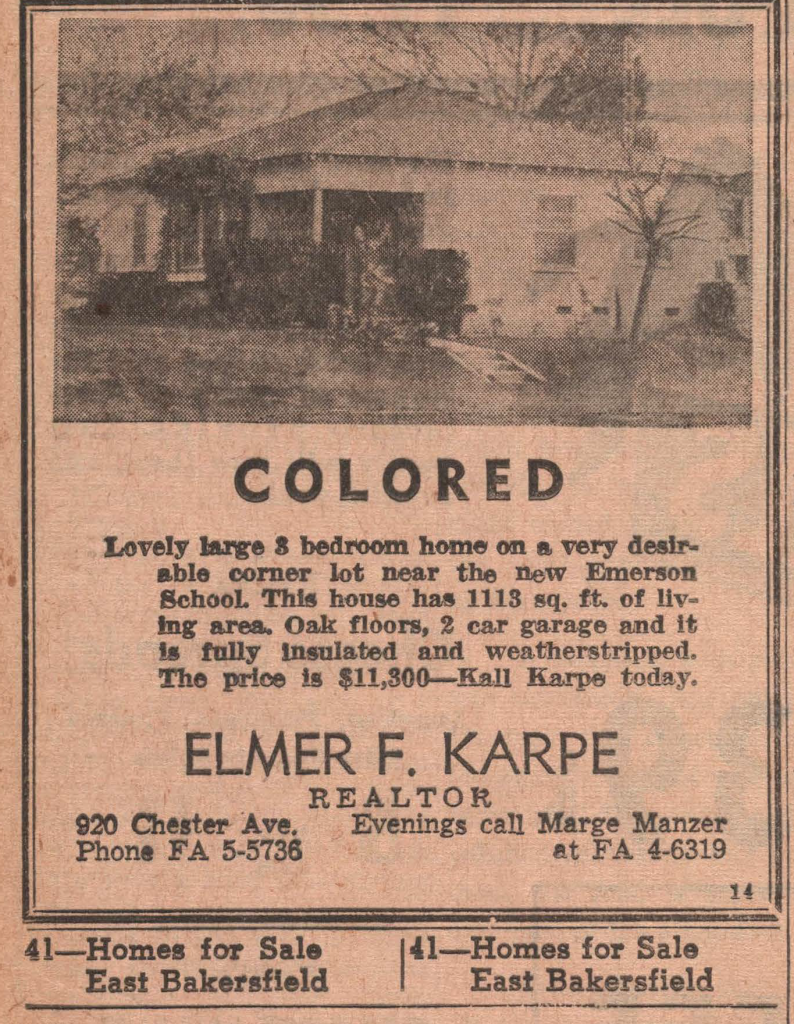
Housing Advertisement: The image shows a vintage newspaper real estate advertisement featuring a black-and-white photograph of a single-story house with a front porch and small yard.The headline reads in large capital letters: COLORED Below, the text reads: “Lovely large 3 bedroom home on a very desirable corner lot near the new Emerson School. This house has 1113 sq. ft. of living area. Oak floors, 2 car garage and it is fully insulated and weatherstripped. The price is $11,300—Kall Karpe today.” Below the description appears: ELMER F. KARPE REALTOR 920 Chester Ave. Phone FA 5-5736 Evenings call Marge Manzer at FA 4-6319 At the bottom margin, the classification reads: 41—Homes for Sale East Bakersfield The page number “14” appears in the lower right corner. The advertisement uses racially segregated labeling (“COLORED”) to designate the intended buyers, reflecting discriminatory housing practices of the period.
This newspaper ad is an example of racial segregation in Bakersfield housing during the 1950s. It is important to note that the advertisement still used “Colored” in 1956, eight years after Shelley v. Kaemer outlawed the use of racially restrictive covenants. The Press Volume III, No.14, 16 February 1956, 1956-02-16bp. Kern County Newspaper Collection, 2020-002. p11. California State University, Bakersfield, Walter W. Stiern Library-Historical Research Center. https://archives.csub.edu/repositories/3/archival_objects/5157

 Before 1938    –    Buying on Contract    –    Covenants   –   Covenant Database  

 East Bakersfield          –          Education           –           Eminent Domain 

   Moving into a Neighborhood   –    Neighborhoods     –   Public Housing    

Resources    –   Rumford Fair Housing Act     Suburban Expansion   –   Zoning 

The Federal Housing Administration (FHA) was established in 1934 as a New Deal Program. By 1938, the FHA Underwriting Manual recommended the use of racially restrictive covenants to developers and real estate agents to protect racial homogeneity within the realm of financial investment. To the left is a page from the Underwriting Manual, published in 1938. All covenants or legal agreements on the conditions of buying, owning, building, or selling homes were racially exclusive. These “agreements” were conditions of collective owning in neighborhoods. This style of contract was used all over the United States; examples are not limited to the American South and the Midwestern States and include the Urban North and the Western United States. There have been many historical analyses in states like Illinois and California. These case studies are used to show the type of racial segregation used in suburban and rapidly urbanizing rural communities outside of the “Jim Crow” American South. These restrictive covenants are sometimes classified under Agreement, Covenant, Covenant Agreement, Covenant Restrictions, Restrictions, Restrictions Amendments, Restrictions Declarations, and Restrictions Covenant Modifications.

Explore Racially Restrictive Covenant Database 

The conditions and restrictions created limited geographic access to renters and homebuyers. The limitations created uniform behaviors, which were made to encourage racial and economic homogeneity by having visual similarities, usage, square footage, yard setback, and financial value. Modern homes can also have these constraints, but in the past, covenants banned certain races. Covenants also had additional limitations, as the tract’s restrictive agreements had multiple sections and specific bans contained within them. Ideas of desirability influenced the first nine sections of the legal agreement. Besides race, the rest were all economic limitations. For example, restrictions included limits on home use, where no trade work or noxious buildings were allowed on the property lot. Additionally, only single-family homes were allowed with neighborhood committee approval and minimum property value and square foot size. The categories allowed future owners and sellers to sell to the race and the socioeconomic class they approved. These restrictions had a profound impact on neighborhood demographics by limiting purchases to white middle-class families.

White only neighborhood communities proliferated because new homes were legally segregated. Racially restrictive covenants, legal agreements between sellers and buyers, forbade the selling of new homes to minorities. Legal race controls, in part, helped create minority-dense neighborhoods. These legal agreements limited opportunities for minority residents to leave older neighborhoods and limited the geographic availability of older and dilapidated homes. The opening of older neighborhoods resulted in more racially homogeneous tracts in this geographic space. Minority residents were often only given the option to buy in already minority-populated neighborhoods, which for the most part, did not offer the same modern sanitary facilities or modern investments. “White Flight” created housing availability and opened homes for sale. These markets, however, allowed for predatory lending and selling of dilapidated homes. These conditions of segregation had similar outcomes to the segregation of Jim Crow.

The Federal Housing Administration was established in 1934 as a New Deal Program. By 1938, the FHA Underwriting Manual recommended the use of racially restrictive covenants to developers and real estate agents to protect racial homogeneity in the name of financial investment. Below is a page from the Underwriting Manual, published in 1938. Community members can now request to remove racially restrictive language from deeds under Assembly Bill 1466  for more information visit https://www.kerncounty.com/government/departments/assessor-recorder/records/restrictive-covenant-modification

This webpage and research are based on Cruz, Donato. “‘America’s Newest City’: 1950s Bakersfield and the Making of the Modern Suburban Segregated Landscape.” ProQuest Thesis Publishing, California State University, Bakersfield 2020.
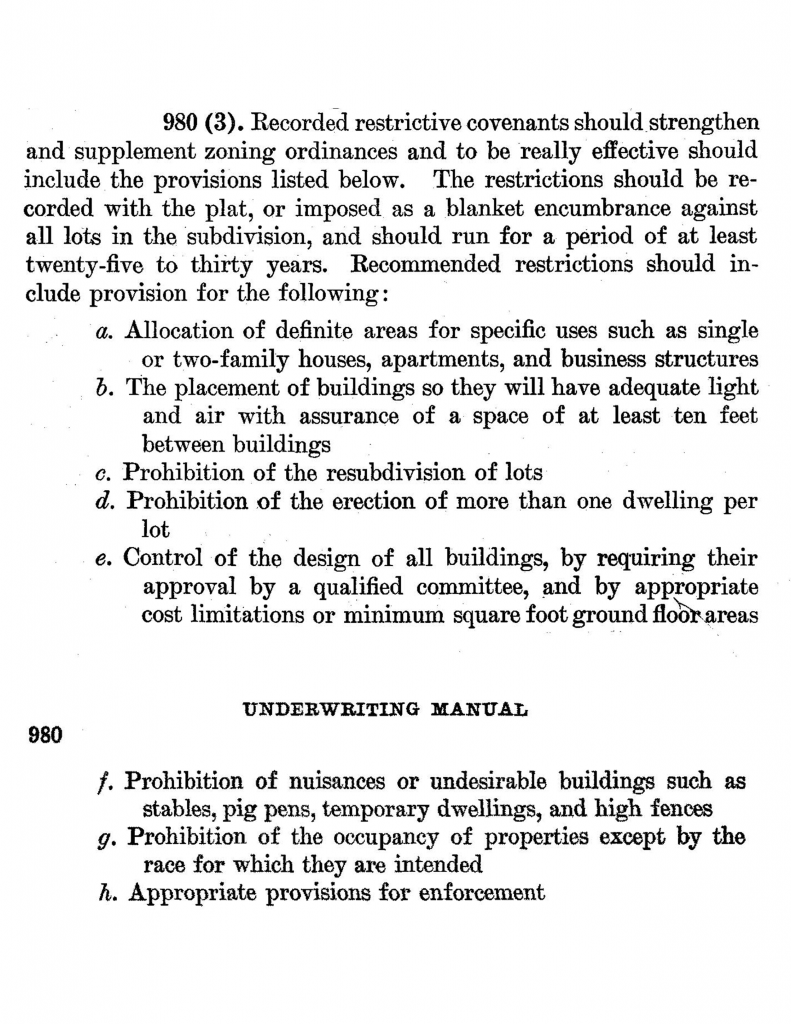
 

FHA underwriting manual 1938: he image shows a printed page labeled “980 (3)” from an Underwriting Manual. The text reads:“980 (3). Recorded restrictive covenants should strengthen and supplement zoning ordinances and to be really effective should include the provisions listed below. The restrictions should be recorded with the plat, or imposed as a blanket encumbrance against all lots in the subdivision, and should run for a period of at least twenty-five to thirty years. Recommended restrictions should include provision for the following: a. Allocation of definite areas for specific uses such as single or two-family houses, apartments, and business structures b. The placement of buildings so they will have adequate light and air with assurance of a space of at least ten feet between buildings c. Prohibition of the resubdivision of lots d. Prohibition of the erection of more than one dwelling per lot e. Control of the design of all buildings, by requiring their approval by a qualified committee, and by appropriate cost limitations or minimum square foot ground floor areas” Centered below is the heading: “UNDERWRITING MANUAL” The page continues: “f. Prohibition of nuisances or undesirable buildings such as stables, pig pens, temporary dwellings, and high fences g. Prohibition of the occupancy of properties except by the race for which they are intended h. Appropriate provisions for enforcement” The page number “980” appears at the bottom left.
FHA, Underwriting Manual: Underwriting and Valuation Procedure Under Title II of the National Housing Act, 1938, p978-980 https://www.huduser.gov/portal/sites/default/files/pdf/Federal-Housing-Administration-Underwriting-Manual.pdf


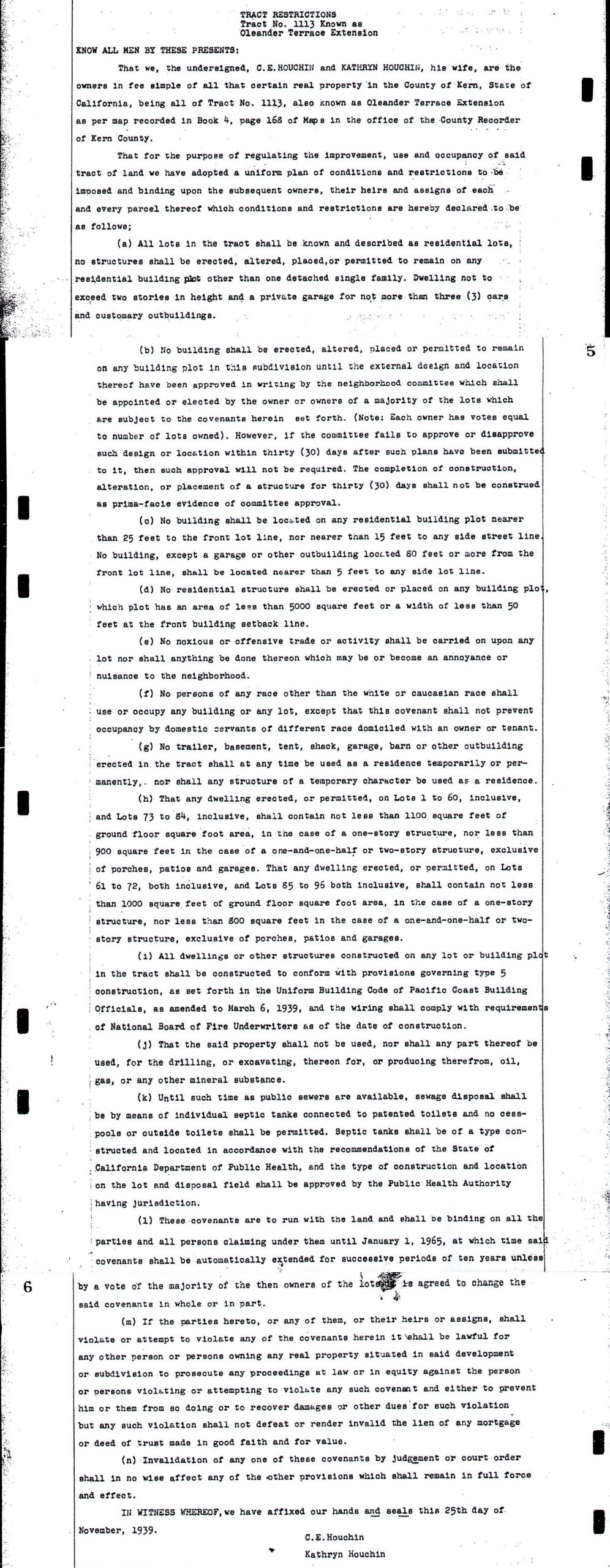
Oleander tract covenant: TRACT RESTRICTIONSTract No. 1113 Known as Oleander Terrace Extension KNOW ALL MEN BY THESE PRESENTS: That we, the undersigned, C.E. Houchin and Kathryn Houchin, his wife, are the owners in fee simple of all that certain real property in the County of Kern, State of California, being all of Tract No. 1113, also known as Oleander Terrace Extension as per map recorded in Book 4, page 168 of Maps in the office of the County Recorder of Kern County. That for the purpose of regulating the improvement, use and occupancy of said tract of land have adopted a uniform plan of conditions and restrictions to be imposed and binding upon the subsequent owners, their heirs and assigns of each and every parcel thereof which conditions and restrictions are hereby declared to be as follows: (a) All lots in the tract shall be known and described as residential lots, no structures shall be erected, altered, placed, or permitted to remain on any residential building plot other than one detached single family dwelling not to exceed two stories in height and a private garage for not more than three (3) cars and customary outbuildings. (b) No building shall be erected, altered, placed or permitted to remain on any building plot in this subdivision until the external design and location thereof have been approved in writing by the neighborhood committee which shall be appointed or elected by the owner or owners of a majority of the lots which are subject to the covenants herein set forth. (Note: Each owner has votes equal to number of lots owned.) However, if the committee fails to approve or disapprove such design or location within thirty (30) days after such plans have been submitted to it, then such approval will not be required. The completion of construction, alteration, or placement of a structure for thirty (30) days shall not be construed as prima-facie evidence of committee approval. (c) No building shall be located on any residential building plot nearer than 25 feet to the front lot line, nor nearer than 15 feet to any side street line. No building, except a garage or other outbuilding located 50 feet or more from the front lot line, shall be located nearer than 5 feet to any side lot line. (d) No residential structure shall be erected or placed on any building plot, which plot has an area of less than 5000 square feet or a width of less than 50 feet at the front building setback line. (e) No noxious or offensive trade or activity shall be carried on upon any lot nor shall anything be done thereon which may be or become an annoyance or nuisance to the neighborhood. (f) No persons of any race other than the white or caucasian race shall use or occupy any building or any lot, except that this covenant shall not prevent occupancy by domestic servants of different race domiciled with an owner
Oleander Terrace Extension, Tract 1113, Section F, “No person of any race other than white or caucasian [sic] race shall use or occupy any building or any lot, except that this covenant shall not prevent occupancy by domestic servants of different race domiciled with an owner or tenant.” page 1-3

tract 1113 Bakersfield: TRACT NO. 1113The heading states: “Being a subdivision of Lots 17 & 18 All in Sec. 30, R. 27E., M.D.B. & M. as shown on Kern County Sales Map No. 1 of Lands of J. B. Haggin filed May 3, 1889 in the Office of the County Recorder County of Kern.” The document is labeled: Kern County — California The map displays a grid of rectangular residential lots arranged in blocks and numbered sequentially. Streets are labeled, including Terrace Way, Grace Drive, Oleander Avenue, and Leslie Street, with multiple interior alleys running between rows of lots. Lot dimensions and boundary measurements are indicated in feet along property lines. At the lower right corner, an inset map references Tract 1010 and nearby streets including Birch Street. A legend identifies symbols for monuments, street widths, lot lines, and bearings. The lower portion of the document includes certification statements, surveyor acknowledgments, and notarized signatures. The filing information indicates the map was recorded in the Office of the County Recorder of Kern County. Handwritten signatures and official seals appear in several places, and the County Recorder’s certification is visible at the bottom. The document is presented in black ink on a light background, consistent with early 20th-century subdivision plats, and includes formal survey language and recording notations.
Tract Map, Oleander Terrace Extension, Tract 1113, Built by C.E. Houchin, November 29, 1939


In 1948, Shelley v. Kraemer, a U.S. Supreme Court case held that courts should no longer be enforce racially restrictive covenants in real property deeds, which prohibited the sale of property to non-Caucasians. Racially restrictive covenants violated the equal protection provision of the Fourteenth Amendment. While Shelley v. Kraemer overturned the “court enforcement” of racially restrictive covenants, contracts still included race restrictions until 1950 when the FHA announced that it would not finance homes that had racially exclusive agreements. The effect was minimal. This did not end housing segregation and it was not until 1968 when the Fair Housing Act was passed, the last Civil Rights Act of the 1960s. Housing inequalities continue to this day.

Between 1938 to 1950 there were an estimated 218 housing tracts built or had notarized racially restrictive covenants written in Bakersfield. While this research provides a glimpse to the vast racial segregation in Bakersfield, this research does not include individual housing racial restrictions that predate the FHA recommendation, nor does this research include other forms of racial segregation, or demographic research. The first racially restricted tract covenant was in 1938, Tract 1043, Rose Garden tract. Some tracts were older, but racially restricted covenants were not summited until after 1938, and some early tracts were re-subdivided during 1938-1950.

The Condition of Segregated Housing
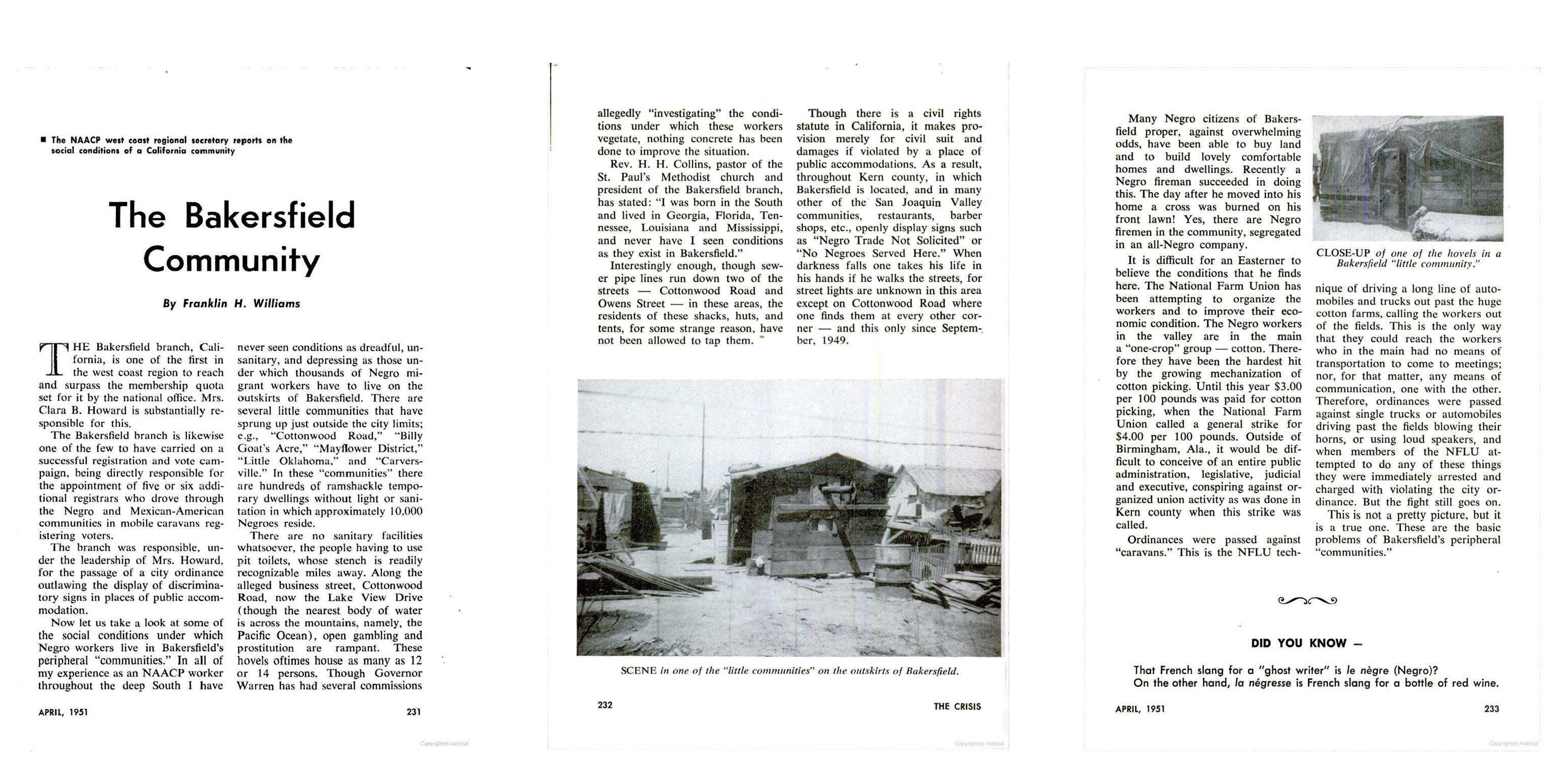
NAACP Article: The Bakersfield CommunityBy Franklin H. Williams Opening paragraph: “The Bakersfield branch, California, is one of the first in the west coast region to reach and surpass the membership quota set for it by the national office. Mrs. Clara B. Howard is substantially responsible for this. The Bakersfield branch is likewise one of the few to have carried on a successful registration and vote campaign, being directly responsible for the appointment of five or six additional registrars who drove through the Negro and Mexican-American communities in mobile caravans registering voters. The branch was responsible, under the leadership of Mrs. Howard, for the passage of a city ordinance outlawing the display of discriminatory signs in places of public accommodation. Now let us take a look at some of the social conditions under which Negro workers live in Bakersfield’s peripheral ‘communities.’ In all of my experience as an NAACP worker throughout the deep South I have never seen conditions as dreadful, unsanitary, and depressing as those under which thousands of Negro migrant workers have to live on the outskirts of Bakersfield. There are several little communities that have sprung up just outside the city limits; e.g., ‘Cottonwood Road,’ ‘Billy Goat’s Acre,’ ‘Mayflower District,’ and ‘Carversville.’ In these ‘communities’ there are hundreds of ramshackle temporary dwellings without light or sanitation in which approximately 10,000 Negroes reside. There are no sanitary facilities whatsoever, the people having to use pit toilets, whose stench is readily recognizable miles away. Along alleged business street, Cottonwood Road, now the Lake View Drive (though the nearest body of water is across the mountains, namely, the Pacific Ocean), open gambling and prostitution are rampant. These hovels oftimes house as many as 12 or 14 persons. Though Governor Warren has had several commissions allegedly ‘investigating’ the conditions under which these workers vegetate, nothing concrete has been done to improve the situation. St. Paul’s Methodist church and president of the Bakersfield branch, has stated: ‘I was born in the South and lived in Georgia, Florida, Tennessee, Louisiana and Mississippi, and never have I seen conditions as disgusting in Bakersfield.’ Interestingly enough, though sewer pipe lines run down two of the streets — Cottonwood Road and Owens Street — in these areas, the residents of these shacks, huts, and tents, for some strange reason, have not been allowed to tap them.” Continuation (center page): “Though there is a civil rights statute in California, it makes provision merely for civil suit and damages if violated by a place of public accommodations. As a result, throughout Kern county, in which Bakersfield is located, and in many other of the San Joaquin Valley communities, restaurants, barber shops, etc., openly display signs such as ‘Negro Trade Not Solicited’ or ‘No Negroes Served Here.’ When darkness falls one takes his life in his hands if he walks the streets, for street lights are unknown in this area except on Cottonwood Road where one finds them at every other corner — and this only since September, 1949.” Photo caption (center page): SCENE in one of the ‘little communities’ on the outskirts of Bakersfield. Right page text: “Many Negro citizens of Bakersfield proper, against overwhelming odds, have been able to buy land and to build lovely comfortable homes and dwellings.
“There are several little communities that have sprung up just outside of the city limits; e.g., ‘Cottonwood Road,’ ‘Billy Goat’s Acres,’ ‘Mayflower District,’ ‘Little Oklahoma,’ and ‘Carversville.’… In all of my experience as an NAACP worker throughout the deep South I have never seen as dreadful, unsanitary, and depressing as those under which thousand of Negro migrant workers have to live on the outskirts of Bakersfield… There are no sanitary facilities whatsoever, the people having to use pit toilets, whose stench is readily recognizable miles away. Along the alleged business district, Cottonwood Road, now the Lake View Drive [Mayflower- Sunset]… Many Negro citizens of Bakersfield proper, against overwhelming odds, have been able to buy land and to build lovely comfortable homes and dwellings. Recently a Negro fireman succeeded in doing this. The day after he moved into his home a cross was burned on his front lawn! Yes, there are Negro firemen in the community, segregated in an all-Negro company. Williams, Franklin. ” The Bakersfield Community,” The Crisis Magazine, April 1950, 231-233 https://books.google.com/books?id=81cEAAAAMBAJ&printsec=frontcover#v=onepage&q&f=false

Unequal Suburban Development

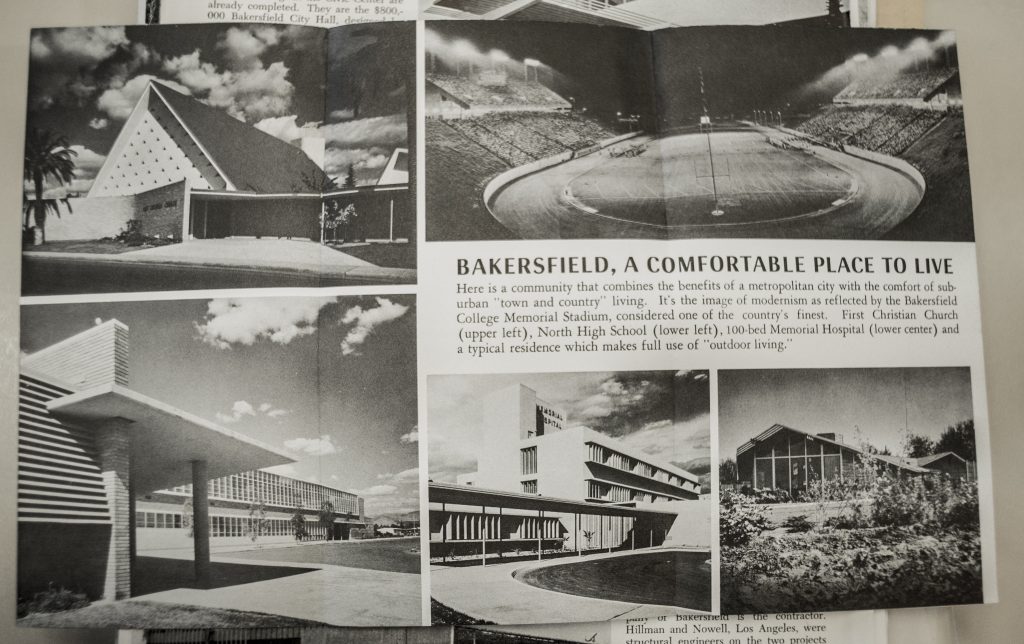
BAKERSFIELD, A COMFORTABLE PLACE TO LIVEThe paragraph below states: “Here is a community that combines the benefits of a metropolitan city with the comfort of suburban ‘town and country’ living. It’s the image of modernism as reflected by the Bakersfield College Memorial Stadium, considered one of the country’s finest. First Christian Church (upper left), North High School (lower left), 100-bed Memorial Hospital (lower center) and a typical residence which makes full use of ‘outdoor living.’” The page features five black-and-white photographs arranged in a grid: Upper left: A modern church building with a steep triangular roof and geometric façade (First Christian Church). Upper right: A large illuminated stadium at night filled with spectators (Bakersfield College Memorial Stadium). Lower left: A modern school building with flat roof and covered walkway (North High School). Lower center: A multi-story hospital building with modernist architecture (100-bed Memorial Hospital). Lower right: A single-story residence with large windows and landscaping, representing suburban “outdoor living.” The layout and architectural style reflect mid-20th-century modern design, emphasizing civic growth, education, healthcare, recreation, and residential development.
“America’s Newest City,” Bakersfield Kern County, Greater Bakersfield Chamber of Commerce 1959

List of all tracts organized by date of establishment, including developer names, covenant notarized date, and tract number or name. Explore the Interactive Map


Chris Livingston and Donato Cruz’s presentation, “Bakersfield Red Lining,” focuses on the HRC’s recent work documenting the history of racial segregation and housing policy in Bakersfield during the 1940s and 1950s. Based on the HRC’s current exhibit on the second floor of the Walter W. Stiern Library, this presentation will enlighten attendees regarding the history of segregation in Bakersfield, including innovative mapping being used to visualize race and space in Bakersfield. Includes the original song “Redlining Blues” by Gabriel Soria.

00:00:00 Introduction by Dr. Oliver A. Rosales 00:00:17 Introduction by Elizabeth Diaz, BC History Club President 00:03:34 Presentation by Chris Livingston, Historical Research Center 00:32:03 “Redlining Blues” by Gabriel Soria, a song about redlining in Kern County 00:35:37 Presentation by Donato Cruz, Redlining in Kern County 01:01:09 Questions and Answers

The story of Housing in California’s Central Valley has been one of exclusion, isolation, and destruction. This lecture will examine the history and development of “red-lining” and housing discrimination in Bakersfield and Kern County. It will also examine the primary sources that document this history and discuss the importance of critical examination of primary sources in historical research. Chris Livingston and Donato Cruz discuss redlining, research, and housing discrimination. Recorded October 11, 2023, Kern County Museum.


Kern County experts Donato Cruz, Jesus Garcia, Lori Pesante, Harveen Kaur, and Traco Matthews discuss the process and history of redistricting, their research and involvement in Kern County, as well as the effects redistricting, has had on BIPOC Communities. Panelists discussed the redistricting process and practice of redlining and how both affect BIPOC (Black, Indigenous, and People of Color) communities. Recorded October 20th, 2022, at the Kern County Library.


The Walter W. Stiern Library hosted an interdisciplinary panel discussion: “The Sound of Something Better,” A Legacy of Racial Injustice in Bakersfield. This panel addressed racial and religious inequalities in Bakersfield and surrounding communities. The presenters were Donato Cruz, Carolyn Lane, and Eileen Diaz. Topics included Bakersfield housing redlining. Recorded on October 26, 2022, at the Walter W. Stiern Library.