Before 1938

 Before 1938    –  Buying on Contract     Covenants  –   Covenant Database   –  East Bakersfield     

    Education    –   Eminent Domain     –     Moving into a Neighborhood   –    Neighborhoods     

 Public Housing   –  Resources    –   Rumford Fair Housing Act     Suburban Expansion   –   Zoning 

Establishing Kern 1866
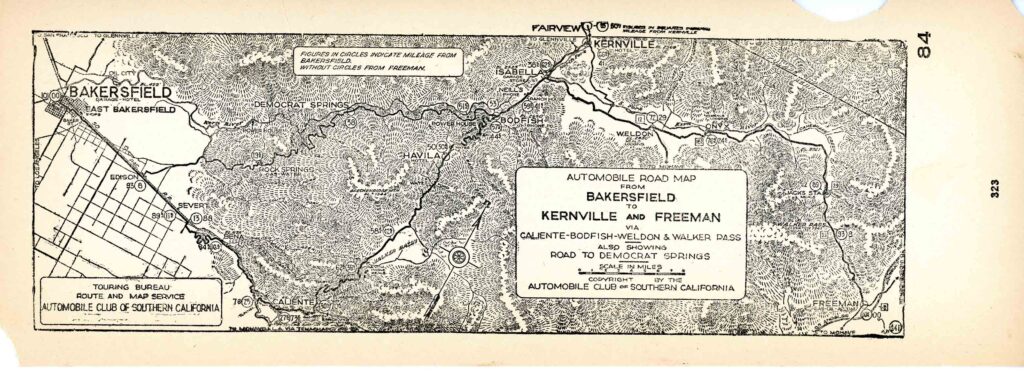
AUTOMOBILE ROAD MAPFROM BAKERSFIELD TO KERNVILLE AND FREEMAN VIA CALIENTE–BODFISH–WELDON & WALKER PASS Below that: ALSO SHOWING ROAD TO DEMOCRAT SPRINGS Scale 1 inch = 12 miles Copyright 19— by the Automobile Club of Southern California In the upper right corner appears the page number 84, and along the right margin the number 323. A boxed note near the top reads: FIGURES IN CIRCLES INDICATE MILEAGE FROM BAKERSFIELD WITHOUT CIRCLES FROM FREEMAN On the left side: BAKERSFIELD EAST BAKERSFIELD At the bottom left: TOURING BUREAU ROUTE AND MAP SERVICE AUTOMOBILE CLUB OF SOUTHERN CALIFORNIA Geographic locations labeled on the map include: Democrat Springs Havilah Caliente Bodfish Weldon Walker Pass Kernville Freeman The map shows winding mountain roads, elevation changes, and desert and foothill terrain between Bakersfield and the Kern River Valley region.
“Bakersfield to Kernville to Freeman” AAA Map 1920

At the establishment of Kern County, Havilah, CA was the county seat. It originally had about 800 inhabitants. Reports describe Havilah and surrounding areas as well wooded and watered and well adapted to agricultural purposes and also rich in mineral wealth. The area was isolated because “…distance and difficulty of a canyon being walled in by high mountains on three sides…prevented it from being thickly inhabited.” Euro-American settlers were attracted to Havilah because of the prominent river. John C. Fremont, an American-West explorer who was responsible for the killing of hundreds of California indigenous people and later a US senator from California, named the Kern River after Edward M. Kern, a topographer and US Army Captain who accompanied Fremont into the area. Edward M. Kern had also led various US sponsored violent anti-indigenous campaigns in the Sacramento valley in 1847. Mining and resources related to the use of natural resources drove colonization into the area during the 1850s. Thomas Baker, a state assembly member from Tulare, wrote a bill creating the County of Kern, in honor of Edward M. Kern, and Governor John Bigler approved the enactment in 1855. It was not until 1866, that the area had the requirements to form into a county. On August 1, 1866, a special meeting of the Board of Supervisors of Kern County was held at Havilah for the purpose of organizing the County. Representatives wrote the following in the minutes of the Board of Supervisors for Kern County: “Said meeting being held pursuant to an Act of the Legislature of the State of California, approved April 2nd A. D. 1866, entitled, ‘An Act to create the County of Kern, to define its boundaries and to provide for its organization.’ At which meeting the following proceedings were had.”
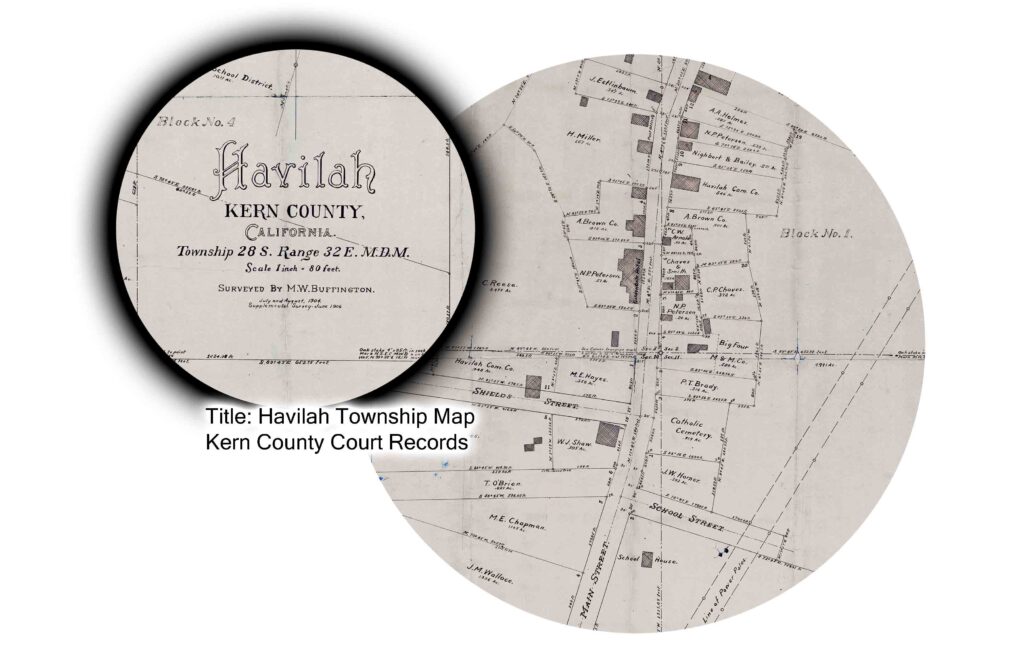

The image features two circular magnified sections of a historic map. The left circle displays the map title area, which reads: Havilah Kern County, California Township 28 S. Range 32 E. M.D.M. Scale 1 inch = 80 feet. Surveyed by M.W. Buffington. Below the circles appears the caption: Title: Havilah Township Map Kern County Court Records The right circle shows a detailed portion of the township map with labeled lots, property boundaries, and building footprints. Visible street names and labels include: Block No. 1 Shields Street School Street Catholic Cemetery Individual property owners’ names appear on the lots (partially legible), and small shaded rectangles indicate structures. The overall image highlights a historic township plat map of Havilah, emphasizing property divisions and early settlement layout in Kern County.

The first issue of the Havilah Weekly Courier ran on August 18, 1866. In their salutatory, C.W. Bush, editor, stated that the newspaper was committed to the interests of the county and surrounding areas. He goes on to note, “We believe, and shall so teach, that this is a government of white men, made by white men, for white men and their posterity forever; and shall ever oppose the radical abolition idea of the equality of races and blending of colors.” For 12 weeks, the Havilah Weekly Courier ran “States rights and state remedies– A government of white men or None” on their masthead under the newspaper name. The Havilah Courier changed its masthead on Dec. 29, 1866, to “An advocate of the interests of Kern County and the Principles of Democracy.” The newspaper’s masthead referenced articles published that stated reconstruction as radical, supporting the Southern grievance of the Civil War. The Havilah Weekly Courier was eventually moved to Bakersfield in 1869. The early Kern County articles and public statements were most likely tied to the resistance to the Reconstruction era.
HAVILAH WEEKLY COURIER.Below the title appears the slogan: STATE RIGHTS AND STATE REMEDIES—A GOVERNMENT OF WHITE MEN, OR NONE. Publication information: VOLUME I. HAVILAH, KERN COUNTY, CAL., SATURDAY, OCTOBER 6, 1866. NUMBER 8. The text is printed in bold, serif type typical of 19th-century newspapers. The slogan reflects the political ideology of the period and contains explicitly exclusionary racial language.
Havilah Weekly Courier, Kern County California, 10-6-1866, page 1
The Library of Congress defines Reconstruction “a period of political crisis and considerable violence. Many white Southerners envisioned a quick reunion in which white supremacy would remain intact in the South.” Reconstruction was planned, with the support of many, to secure thebasic rights of former slaves. The 14th Amendment was passed by the Senate on June 8, 1866, and ratified on July 9, 1868. The 14th Amendment, “Birth Right Citizenship,” extended liberties and rights granted by the Bill of Rights to formerly enslaved people. On February 3, 1870, the Voting Rights Amendment was ratified, having been passed by Congress on February 26, 1869. The Voting Rights Amendment resulted from the 13th Amendment, which set slaves free, and the 14th Amendment, giving citizenship to all US-born. The 15th Amendment is seen as a step in the struggle for equality.
African Americans exercised the right to vote and held office in many Southern states through the 1880s, but in the early 1890s, steps were taken to ensure subsequent “white supremacy.” Literacy tests for the vote, “grandfather clauses” excluding from the franchise all whose ancestors had not voted in the 1860s, and other devices to disenfranchise African Americans were written into the laws of former Confederate states.
The introduction of devices for disenfranchisement were also a main tactic in the Urban North and the American West. The methods for disenfranchisement are commonly referred to “Jim Crow” for Black Americans and “Jaime Crow,” for Hispanic Americans. The tactics and methods for disenfranchisement had widespread effects across racial minorities, including racial violence.
After the ending of reconstruction, the period from 1890 to 1940 is called the “Nadir,” meaning the low point. During the Nadir, segregation increased everywhere, not just in the South. This is not to say that racial minorities did not make progress in the face of resistance to equality.

Real Estate- Before 1938

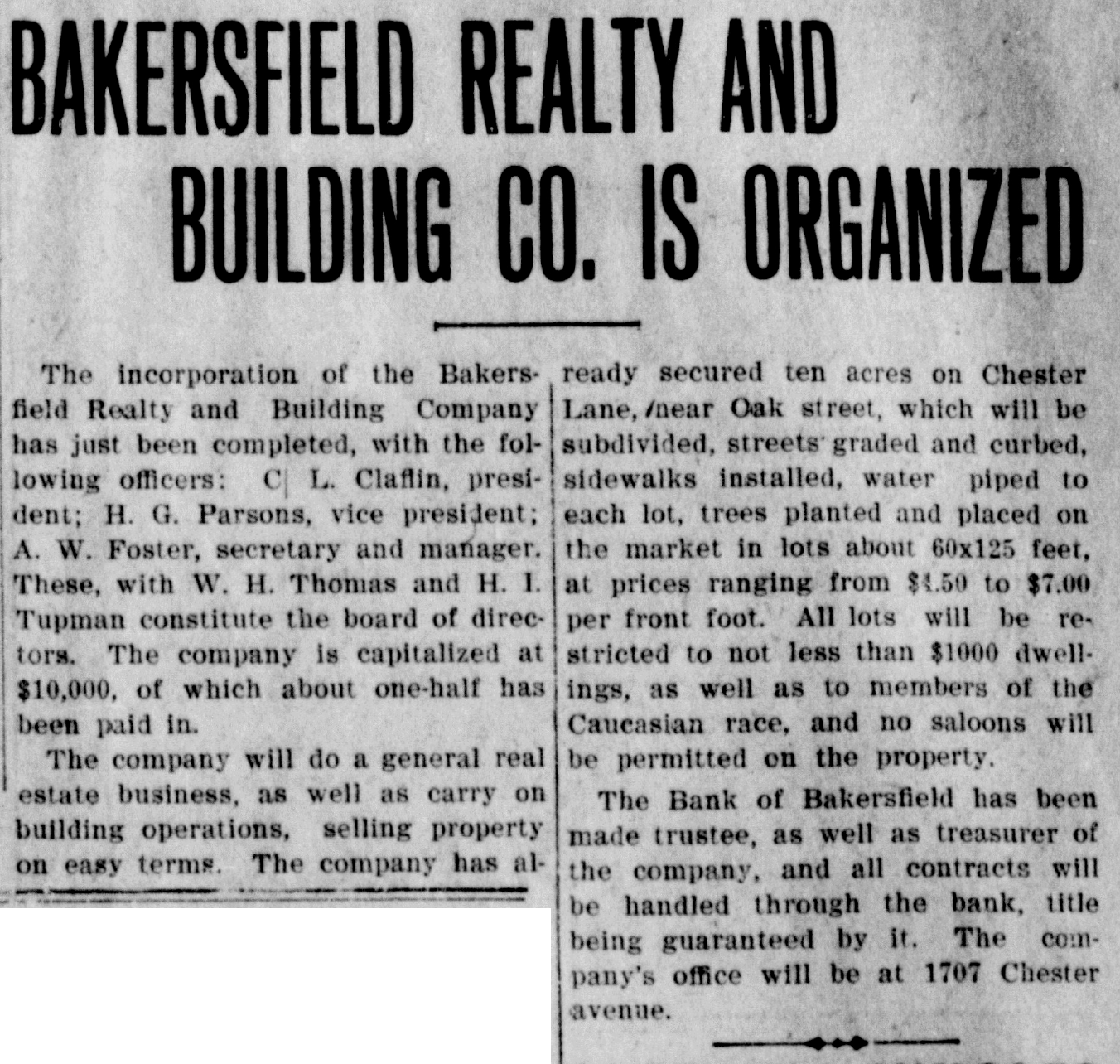
Headline:BAKERSFIELD REALTY AND BUILDING CO. IS ORGANIZED Body text: “The incorporation of the Bakersfield Realty and Building Company has just been completed, with the following officers: C. L. Claflin, president; H. G. Parsons, vice president; A. W. Foster, secretary and manager. These, with W. H. Thomas and H. I. Tupman constitute the board of directors. The company is capitalized at $10,000, of which about one-half has been paid in. The company will do a general real estate business, as well as carry on building operations, selling property on easy terms. The company has already secured ten acres on Chester Lane, near Oak street, which will be subdivided, streets graded and curbed, sidewalks installed, water piped to each lot, trees planted and placed on the market in lots about 60x125 feet, at prices ranging from $4.50 to $7.00 per front foot. All lots will be restricted to not less than $1000 dwellings, as well as to members of the Caucasian race, and no saloons will be permitted on the property. The Bank of Bakersfield has been made trustee, as well as treasurer of the company, and all contracts will be handled through the bank, title being guaranteed by it. The company’s office will be at 1707 Chester avenue.”
“Bakersfield Realty and Building Co. is Organized,” Bakersfield Californian, May 14, 1909 page 1

Bakersfield Realty organizations supported race restrictions in housing covenants. This 1909 article announced the organization of the Bakersfield Realty Building Company in 1909 stating, “All lots will be restricted to not less than $1000 dwellings, as well as to members of the Caucasian race, and no saloons will be permitted on the property.” Prior to 1938, home deeds featured racially exclusive language.


In a report conducted by the State of California in 1930 found that there were 24 out of 47 replies that cities had segregated Mexican Districts.
“In addition, other boards cited clauses inserted in deeds and sales contracts calculated to confine Orientals, Mexicans, and Negroes, to certain districts.”
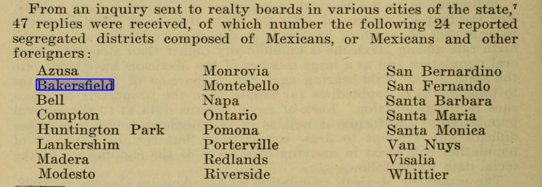
Segregated districts: The visible text reads: “From an inquiry sent to realty boards in various cities of the state, 47 replies were received, of which number the following 24 reported segregated districts composed of Mexicans, or Mexicans and other foreigners:” The cities listed are: Azusa Bakersfield Bell Compton Huntington Park Lankershim Madera Modesto Monrovia Montebello Napa Ontario Pomona Porterville Redlands Riverside San Bernardino San Fernando Santa Barbara Santa Maria Santa Monica Van Nuys Visalia Whittier The excerpt appears to document cities that reported racial or ethnic residential segregation practices.

Mexicans in California; report of Governor C. C. Young’s Mexican Fact Finding Committee, 1930


Here is an example of racially exclusive language used in 1924. This is not to say that housing discrimination did not exist, but that housing was segregated at the individual home level, led by sellers and real estate agents. It is not until after 1938, that racially restrictive covenants are used at large scale for entire tracts, neighborhoods, and blocks. The Bakersfield grant deed reads, “The lands herein conveyed shall never, at any time, be sold to or rented to or occupied by any person not of the white or Caucasian race.” This is an example of a racially exclusive covenant written in a deed.


Grant Deed We, F. A. Nighbert and Hattie M. Nighbert, husband and wife, in consideration of Ten Dollars ($10.00) and other good and valuable considerations, the receipt whereof is hereby acknowledged, DO HEREBY GRANT to CITY OF BAKERSFIELD, a municipal corporation, all that certain real property situate in the County of Kern, State of California, described as follows: North seventy feet of Lot 3, in Block “F” in VIRGINIA TRACT, according to the Map of said Tract filed in the office of the County Recorder of said Kern County on the 25th day of January, 1923. RESERVING THEREFROM, a right-of-way eight feet wide across the rear of each lot in Blocks “A”, “B”, “C” and “D”, also a like reservation across the rear and along the side of each lot in Blocks “E” and “F” where necessary, for water, gas, sewer and pole lines, also reserving a right-of-way throughout said Tract for existing canals, ditches and conduits, with the right of ingress and egress for the care and maintenance of same. Also reserving right to remove or reconstruct ditch known as “Brink” ditch now located on above described property. As a part of the consideration for the delivery of this deed, the Grantee hereby accepts the same and takes said property subject to all the RESERVATIONS, RESTRICTIONS, and COVENANTS contained herein. That no residence building shall be erected on the above described lot which shall cost less than $3,000.00, and no building shall be placed thereon less than twenty-five feet from the front property line, nor less than eight feet from the rear property line, and that only one residence building be built or constructed upon each lot of Fifty feet frontage. That no Laundry, Restaurant, Garage, Gasoline Service Station, or any Blacksmithing, or Manufacturing, Dairy or Livery Business shall be maintained or carried on upon said lot or any part thereof, prior to Ten Years from date of filing map of said Tract, and if during said time said Grantee, its heirs, assigns, successors in interest, or those holding or claiming hereunder shall violate any of the provisions herein contained directly or indirectly, the land or lot upon which such violation shall take place or occur shall thereupon revert to and be vested in the Grantors, their successors or assigns, and said Grantors shall be entitled to immediate possession thereof; provided, that the breach of any of the foregoing restrictions or any re-entry, by reason of such breach shall not defeat nor render invalid the lien of any Mortgage or Deed of Trust, made in good faith and for value as to said land and any improvements thereon or any part thereof. That said restrictions shall cease to be effective on January 25, 1933. That the lands herein conveyed shall never, at any time, be sold to or rented to or occupied by any person not of the white or Caucasian race. That the Grantors herein hereby agree to construct sidewalks and curbing along the herein described property at their own expense in accordance with the following, only: — none. — That all subsequent Deeds or Conveyances executed to convey or encumber said premises, shall contain the above mentioned restrictions and reservations. TO HAVE AND TO HOLD unto said Grantee and its assigns forever. WITNESS our hands this 2nd day of August, 1924. (Signatures) F. A. Nighbert Hattie M. NighbertGrant Deed We, F. A. Nighbert and Hattie M. Nighbert, husband and wife, in consideration of Ten Dollars ($10.00) and other good and valuable considerations, the receipt whereof is hereby acknowledged, DO HEREBY GRANT to CITY OF BAKERSFIELD, a municipal corporation, all that certain real property situate in the County of Kern, State of California, described as follows: North seventy feet of Lot 3, in Block “F” in VIRGINIA TRACT, according to the Map of said Tract filed in the office of the County Recorder of said Kern County on the 25th day of January, 1923. RESERVING THEREFROM, a right-of-way eight feet wide across the rear of each lot in Blocks “A”, “B”, “C” and “D”, also a like reservation across the rear and along the side of each lot in Blocks “E” and “F” where necessary, for water, gas, sewer and pole lines, also reserving a right-of-way throughout said Tract for existing canals, ditches and conduits, with the right of ingress and egress for the care and maintenance of same. Also reserving right to remove or reconstruct ditch known as “Brink” ditch now located on above described property. As a part of the consideration for the delivery of this deed, the Grantee hereby accepts the same and takes said property subject to all the RESERVATIONS, RESTRICTIONS, and COVENANTS contained herein. That no residence building shall be erected on the above described lot which shall cost less than $3,000.00, and no building shall be placed thereon less than twenty-five feet from the front property line, nor less than eight feet from the rear property line, and that only one residence building be built or constructed upon each lot of Fifty feet frontage. That no Laundry, Restaurant, Garage, Gasoline Service Station, or any Blacksmithing, or Manufacturing, Dairy or Livery Business shall be maintained or carried on upon said lot or any part thereof, prior to Ten Years from date of filing map of said Tract, and if during said time said Grantee, its heirs, assigns, successors in interest, or those holding or claiming hereunder shall violate any of the provisions herein contained directly or indirectly, the land or lot upon which such violation shall take place or occur shall thereupon revert to and be vested in the Grantors, their successors or assigns, and said Grantors shall be entitled to immediate possession thereof; provided, that the breach of any of the foregoing restrictions or any re-entry, by reason of such breach shall not defeat nor render invalid the lien of any Mortgage or Deed of Trust, made in good faith and for value as to said land and any improvements thereon or any part thereof. That said restrictions shall cease to be effective on January 25, 1933. That the lands herein conveyed shall never, at any time, be sold to or rented to or occupied by any person not of the white or Caucasian race. That the Grantors herein hereby agree to construct sidewalks and curbing along the herein described property at their own expense in accordance with the following, only: — none. — That all subsequent Deeds or Conveyances executed to convey or encumber said premises, shall contain the above mentioned restrictions and reservations. TO HAVE AND TO HOLD unto said Grantee and its assigns forever. WITNESS our hands this 2nd day of August, 1924. (Signatures) F. A. Nighbert Hattie M. Nighbert