Education

Education and Segregation

 Before 1938    –  Buying on Contract     Covenants  –   Covenant Database   –  East Bakersfield     

    Education    –   Eminent Domain     –     Moving into a Neighborhood   –    Neighborhoods     

 Public Housing   –  Resources    –   Rumford Fair Housing Act     Suburban Expansion   –   Zoning 

According to historian Colin Gordon, “Segregation reinforced inequalities in housing, education, government investment, trust, social capital, job opportunities, environmental hazards, crime, and job opportunities.” Housing Segregation had a deep impact on communities of color. The lack of resources and education quality ran parallel with housing discrimination. When real estate agents used the argument of “private rights” to deny citizens of color, their own rights, investments in the “redlined” neighborhoods often had unequal services and unequal demographics.

Gordon, Colin. Patchwork Apartheid: Private Restriction, Racial Segregation, and Urban Inequality. New York: Russell Sage Foundation, 2023. https://csu-bakersfield.primo.exlibrisgroup.com/permalink/01CALS_UBA/1efqqi0/cdi_globaltitleindex_catalog_421066406
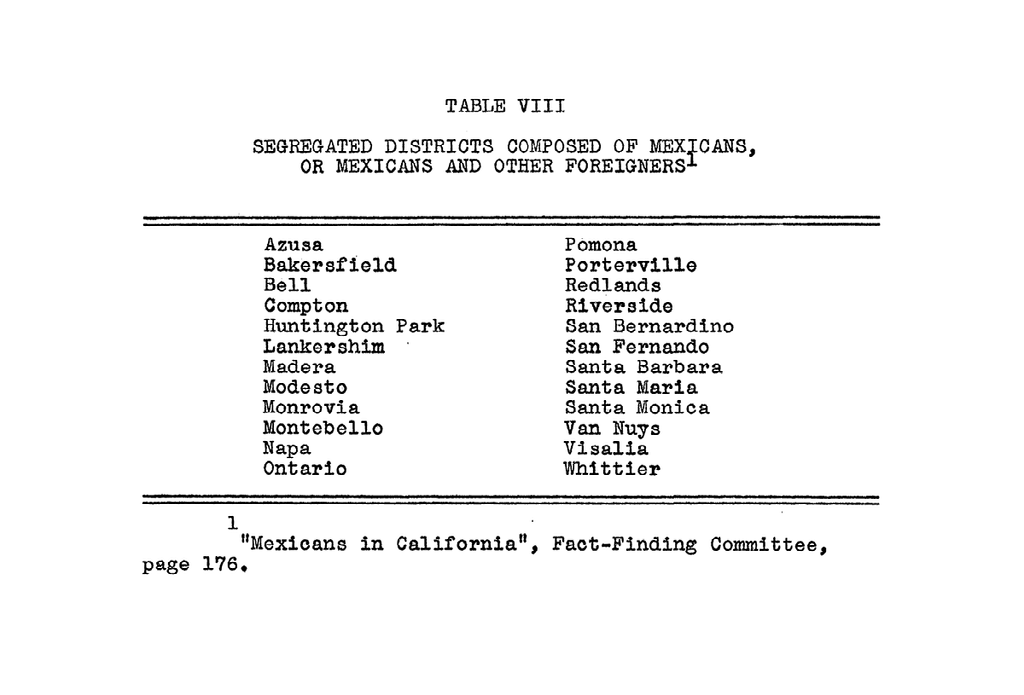
 

TABLE VIIISEGREGATED DISTRICTS COMPOSED OF MEXICANS, OR MEXICANS AND OTHER FOREIGNERS¹ Azusa Bakersfield Bell Compton Huntington Park Lankershim Madera Modesto Monrovia Montebello Napa Ontario Pomona Porterville Redlands Riverside San Bernardino San Fernando Santa Barbara Santa Maria Santa Monica Van Nuys Visalia Whittier Footnote: ¹ “Mexicans in California,” Fact-Finding Committee, page 176.
Carpenter, Charles. “A study of segregation versus non-segregation of Mexican Children.” Masters Thesis, USC, 1935 (p30)

In a report conducted by the State of California in 1930 found that there were 24 out of 47 replies that cities had segregated Mexican Districts. The report states,
“In addition, other boards cited clauses inserted in deeds and sales contracts calculated to confine Orientals, Mexicans, and Negroes, to certain districts.” Bakersfield was already reported with housing segregation.

Mexicans in California; report of Governor C. C. Young’s Mexican Fact Finding Committee, 1930


In the 1950s, George Perkins reported in his Master’s thesis, “Survey of Racial Attitudes in Three Communities Kern County California,” that Bakersfield had seen an increase in the Black population. Perkins reported percentages of 5.5 in 1940 and as high as 18.8 in 1948. Mexican residents remained in an average of 14, and as high as 19.9 from 1940 to 1951. Bakersfield of the 1950s remained a majority white city, demographic ranging from 67.1 percent to as high as 83.6 percent in the 10 year period, 1940 to 1951. The Lincoln School was the segregated, Black and Hispanic school.

George Perkins “Survey of Racial Attitudes in Three Communities Kern County California,” Master’s Thesis, University of Montana, 1952.

In 1946, John Randle King found that the Mexican population was treated as an “isolated and transient minority,” reporting that the white population believed that those of Mexican ancestry preferred to live in segregation. King researched bias and racial attitudes from Bakersfield’s white majority and did mention the effects of systemic housing segregation. King states, “One of the most common means by which a majority group can segregate an undesired minority is to restrict its areas of residence. These restrictions may be made by local ordinances, but more common are organized social pressures and restrictive covenants.”

John Randle King, “An inquiry into the status of Mexican Segregation in Metropolitan Bakersfield,” Master’s Thesis, Claremont Graduate School, 1946
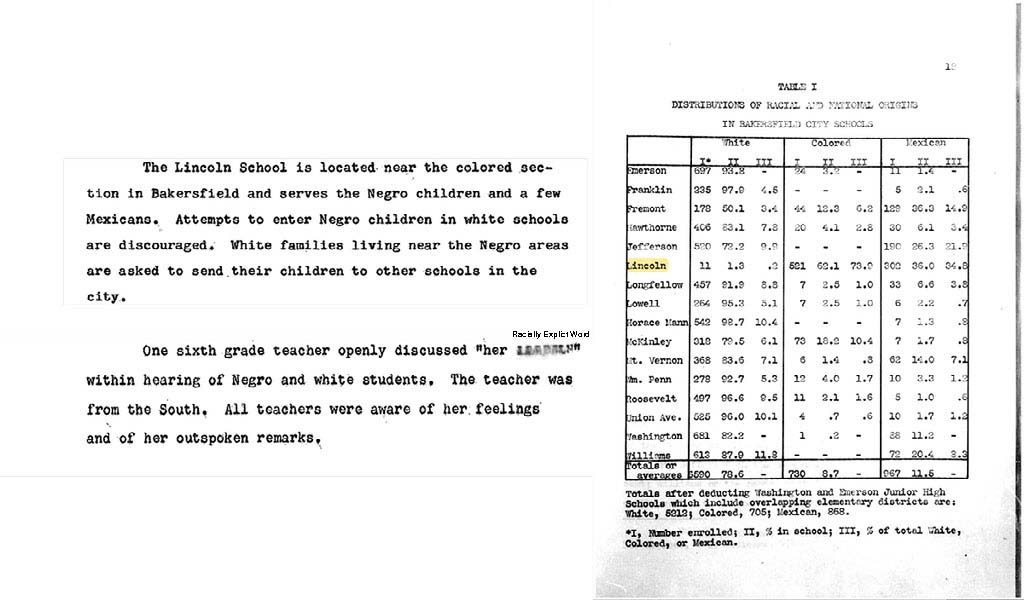
Left panel text:“The Lincoln School is located near the colored section in Bakersfield and serves the Negro children and a few Mexicans. Attempts to enter Negro children in white schools are discouraged. White families living near the Negro areas are asked to send their children to other schools in the city.” Below that: “One sixth grade teacher openly discussed her "Racially Explicit Word," within hearing of Negro and white students. The teacher was from the South. All teachers were aware of her feelings and of her outspoken remarks.” Right panel heading: TABLE I DISTRIBUTION OF RACIAL AND NATIONAL ORIGINS IN BAKERSFIELD CITY SCHOOLS Column headings: White Colored Mexican School names listed in the table include: Emerson Franklin Fremont Hawthorne Jefferson Lincoln Longfellow Lowell Horace Mann McKinley Mt. Vernon Thompson Roosevelt Union Ave. Washington Williams Totals row (visible): Totals — 8500 (White), 739 (Colored), 867 (Mexican) Average — 87.6 (White), 8.7 (Colored), 11.5 (Mexican) Footnote (visible portion): “*1. Number enrolled; II, % in school; III, % of total white, colored, or Mexican.” Additional note below table (visible portion): “Totals after deducting Washington and Emerson Junior High Schools which include overlapping elementary districts are: White, 8843; Colored, 705; Mexican, 868.”
George Perkins “Survey of Racial Attitudes in Three Communities Kern County California,” Master’s Thesis, University of Montana, 1952. John Randle King, “An inquiry into the status of Mexican Segregation in Metropolitan Bakersfield,” Master’s Thesis, Claremont Graduate School, 1946

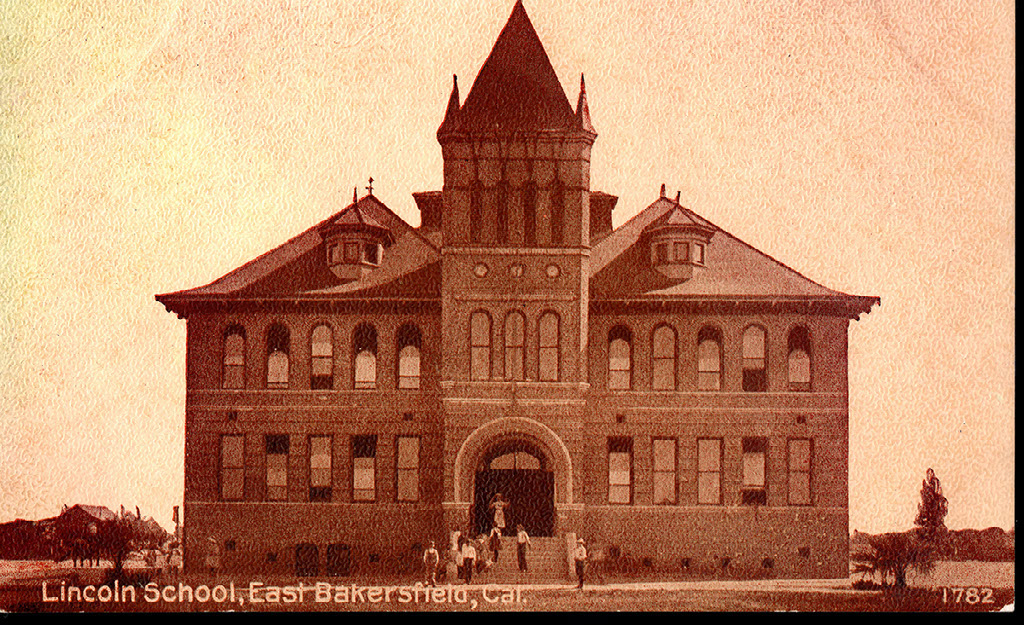
 

Number printed at lower right:1782 The photograph shows a large, symmetrical, two-story brick school building with a prominent central tower rising above the main entrance. The tower features a steep, pointed roof. The building façade includes arched windows on both levels and a large arched doorway at the center. Several children and possibly adults are visible standing on the steps and in front of the entrance. The grounds appear open and undeveloped, with minimal landscaping and distant trees in the background. The image is tinted in sepia tones, consistent with early 20th-century postcard or printed photograph reproduction.
1940s Lincoln School is in the Sunset Mayflower district.

Sunset-Mayflower District- Children of the Mayflower-Sunset tract attended the Lincoln School

The Sunset-Mayflower District was home to much of the city’s poor migrant populations who worked in nearby agricultural fields and labor camps. Due to the black population’s wariness of cohabitating with whites within labor camps, many chose to live with family members who had settled prior or settled in areas where the white population was minimal – like the Sunset-Mayflower District.  

While the district’s population was largely impoverished, the racial and ethnic background of the area was rather diverse, housing white, black, Hispanic, and Asian families.  Census data from the 1920s, 30s, and 40s show a significant increase in the black population, specifically residing in the Sunset-Mayflower District and a decrease in white residents in the area. This phenomenon is known as “White Flight,” in which white families choose to leave impoverished areas when black and brown families began moving into their communities. Those who migrated out of the Mayflower into newer subdivisions opened up opportunities for housing for blacks to become available. The Sunset Tract and Mayflower Addition were a few of the only tracts in the greater Bakersfield Area that allowed unrestricted buying power to blacks. 
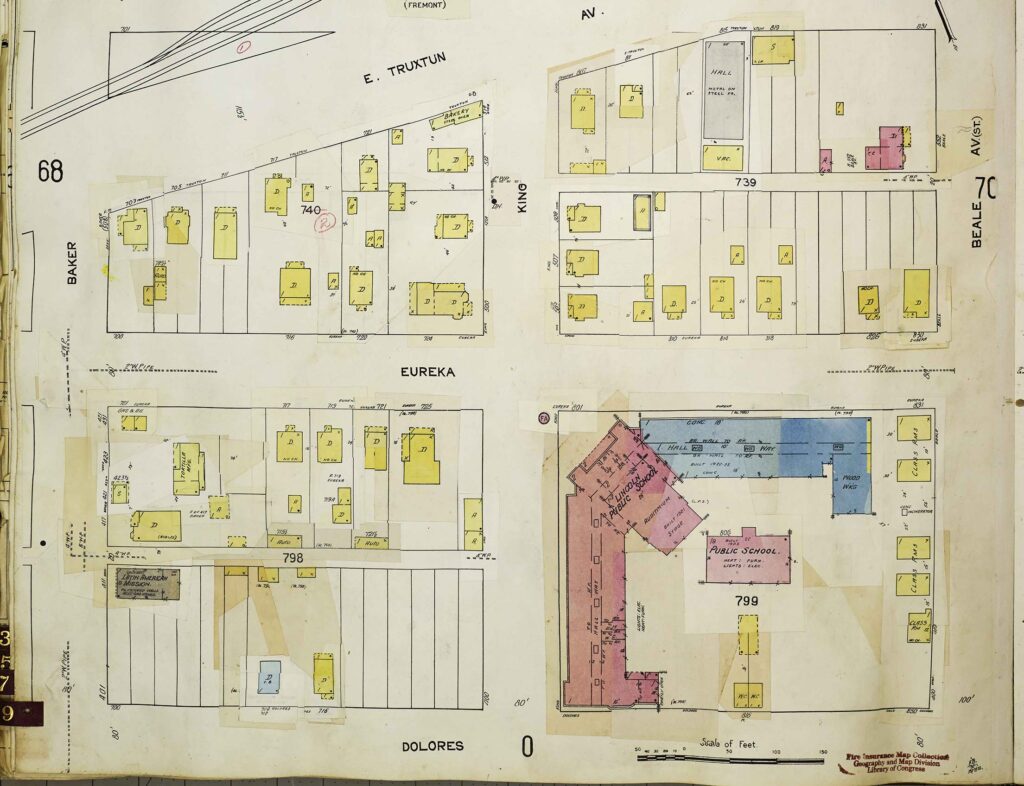
The map shows detailed block-level property information with building footprints shaded in yellow (likely wood-frame structures), pink (brick or masonry), and blue (special construction or fireproof). Lot numbers and block numbers are visible.Street names visible: E. TRUXTUN BAKER KING BEALE AVE (ST) EUREKA DOLORES Block numbers visible: 68 740 739 798 799 7C (appears at upper right margin) Public building labels visible: PUBLIC SCHOOL (within Block 799) LINCOLN SCHOOL (visible within the school compound area) Additional labels: Hall (partially visible) Scale of Feet (bottom center) Bottom right credit: Fire Insurance Map Collection Geography and Map Division Library of Congress The map illustrates parcel boundaries, individual buildings with dimensions, lot lines, alleyways, and structural materials typical of Sanborn Fire Insurance maps. The large compound labeled “Public School” (Block 799) includes multiple connected masonry buildings forming an irregular shape. Surrounding blocks show residential lots with small detached houses.
Lincoln School, Sanborn Maps, Library of Congress 1950


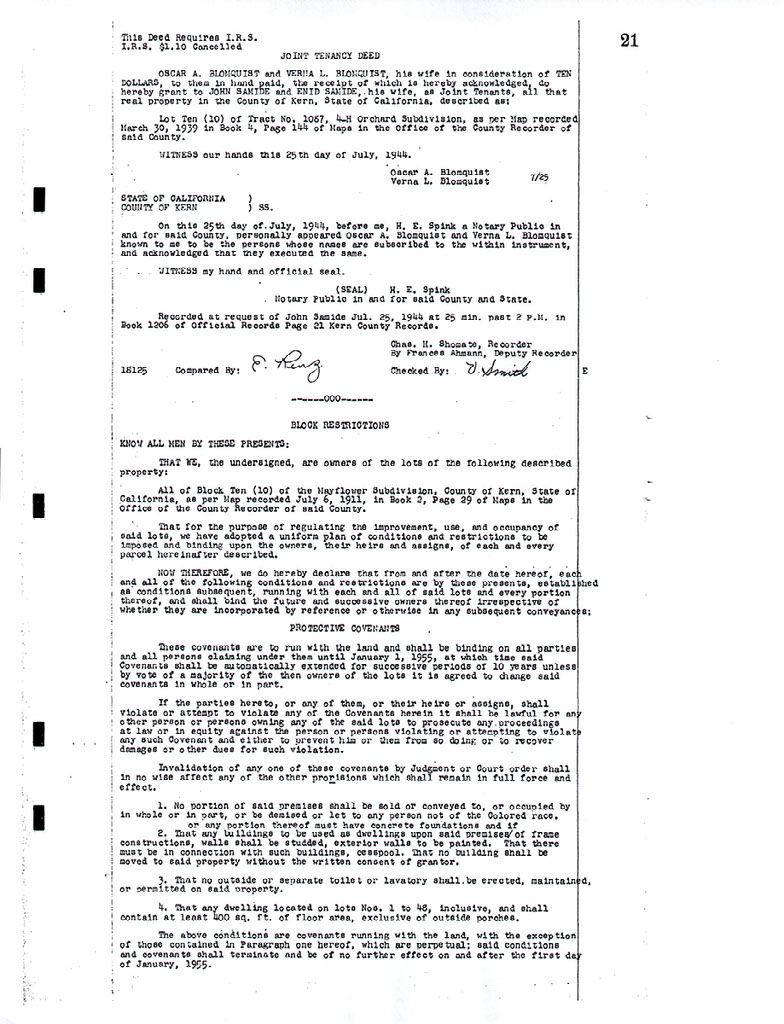
KNOW ALL MEN BY THESE PRESENTS:THAT WE, the undersigned, are owners of the lots of the following described property: All of Block Ten (10) of the Mayflower Subdivision, County of Kern, State of California, as per map recorded July 6, 1911, in Book 2, Page 29 of Maps in the Office of the County Recorder of said County. That for the purpose of regulating the improvement, use, and occupancy of said lots, we have adopted a uniform plan of conditions and restrictions to be imposed and binding upon the owners, their heirs and assigns, of each and every parcel herein described. NOW THEREFORE, we do hereby declare that from and after the date hereof, and all of the following conditions and restrictions are by these presents established as conditions subsequent, running with each and all of said lots and every portion thereof, and shall bind the future and successive owners thereof irrespective of whether they are incorporated by reference or otherwise in any subsequent conveyances: PROTECTIVE COVENANTS These covenants are to run with the land and shall be binding on all parties and all persons claiming under them until January 1, 1955, at which time said Covenants shall be automatically extended for successive periods of 10 years unless by vote of a majority of the then owners of the lots it is agreed to change said covenants in whole or in part. If the parties hereto, or any of them, or their heirs or assigns, shall violate or attempt to violate any of the covenants herein it shall be lawful for the other person or persons owning any of the said lots to prosecute any proceeding at law or in equity against the person or persons violating or attempting to violate any such covenant and either to prevent him or them from so doing or to recover damages or other dues for such violation. Invalidation of any one of these covenants by judgment or court order shall in no wise affect any of the other provisions which shall remain in full force and effect. No portion of said premises shall be sold or conveyed to, or occupied by in whole or in part, or be demised or let to any person not of the Colored race. In any portion thereof not having concrete foundation and if construction is permitted, walls shall be stucco, exterior walls to be painted. That there must be in connection with such dwelling, cesspool. That no building shall be moved to said property without the written consent of grantor. That no outside or separate toilet or lavatory shall be erected, maintained, or permitted on said property. That any dwelling located on lots No. 1 to 48, inclusive, shall contain at least 800 sq. ft. of floor area, exclusive of outside porches. The above conditions and covenants running with the land, with the exception of those contained in Paragraph one hereof, which are perpetual, said conditions and covenants shall terminate and be of no further effect on and after the first day of January, 1955.
Section 1. “No portion of said premises shall be sold or conveyed to, or occupied by in whole or in part, or be denied or let any person not of the Colored race.” Elmer Karpe, “Mayflower Block Restrictions,” Kern County Hall of Records, 1944


“Early in the decade of the 1940’s, the Elmer F. Karpe Agency was the first realtor to build new homes in the Sunset Mayflower community for sale to non-White buyers… The historic housing movement by the Karpe Agency generated an exodus by white residents of the area.” Parker, Johnie Mae, How Long, Not Long. (Bakersfield, California) 1987
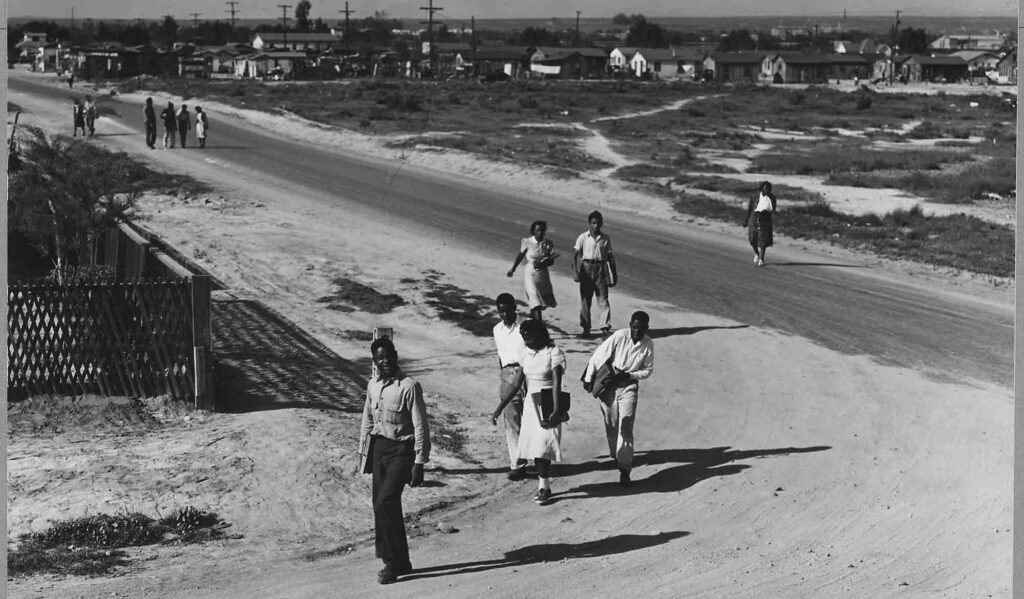


This black-and-white photograph shows several Black residents walking along a broad dirt road in what appears to be a modest residential area. In the foreground, a group of children and teenagers walk toward the camera, some carrying books or folders. Behind them, adults follow along the same road. Their clothing suggests a mid-20th-century time period.On both sides of the road are open, sandy lots with sparse vegetation. A wooden fence appears on the left side of the frame. In the distance, small single-story houses line the horizon, along with utility poles and telephone wires. The landscape appears flat and largely undeveloped, with wide spacing between homes. The image conveys a sense of daily life in a segregated or economically marginalized neighborhood, with residents traveling on foot along an unpaved roadway.
Dorothea Lange, “Sunset District, East Bakersfield, Kern County, California. High school students from the Negro shacktowns.” National Archives, 1940 https://catalog.archives.gov/id/521669?objectPage=3


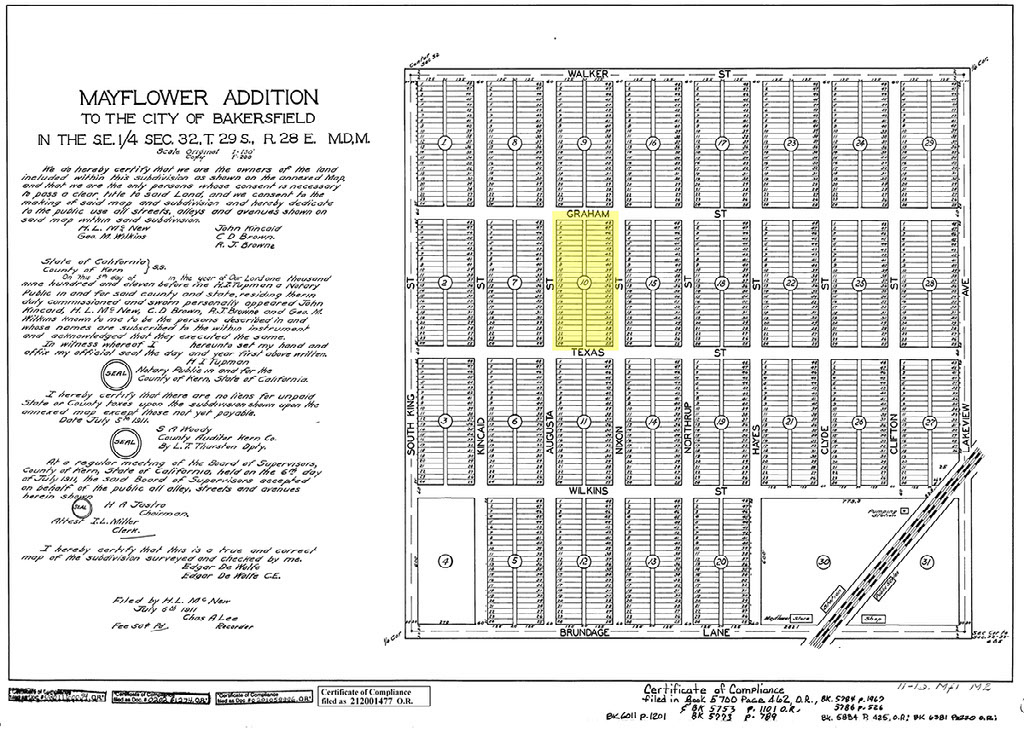
MAYFLOWER ADDITIONTO THE CITY OF BAKERSFIELD IN THE E. 1/4 SEC. 32, T. 29 S., R. 28 E. M.D.M. Scale 1 inch = 200 ft. Certification text (visible portion): “We the hereby certify that we are the owners of the land included in this subdivision as shown on the annexed map and that the same is correctly shown and that we hereby dedicate for public use all streets, alleys and avenues shown on said map.” Signatures visible: H. L. McNer G. H. Hinkins John Pincaid C. D. Brown R. S. Browne Notary acknowledgment (visible portion): “State of California County of Kern On this ____ day of ____ in the year of our Lord one thousand nine hundred and ____ before me ____ a Notary Public in and for said county and state, residing therein, duly commissioned and sworn, personally appeared…” Board of Supervisors approval text (visible portion): “At a regular meeting of the Board of Supervisors, County of Kern, State of California, held on the 6th day of July, 19__, this map was accepted and approved…” Map layout details: Street names visible: Walker St Graham St Texas St Wilkins St Brundage Lane South King Magnolia Augusta Knox Norton Hayes Clyde Lakeview Ave Lot blocks are numbered in circles across the map (examples visible include 1 through 31). Individual residential lots are shown as narrow rectangular parcels aligned in rows along each street. A highlighted rectangular block (colored yellow in the image) appears along Graham Street, likely marking a specific block of interest. Lower margin text: “Certificate of Compliance Filed as 210001477 O.R.” Additional recording references (visible): Bk. 1260 Pg. 446 O.R. Bk. 5753 Pg. 119 O.R. Bk. 4584 Pg. 435 O.R. Recorder notation (visible portion):
Mayflower Addition, Kern County Records, 7-6-1911


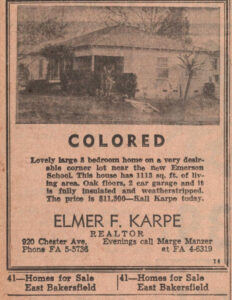
The advertisement includes a small black-and-white photograph of a single-story house with a front porch and shrubs. Below the image appears the headline: COLORED The body text reads: “Lovely large 3 bedroom home on a very desirable corner lot near the new Emerson School. This house has 1113 sq. ft. of living area. Oak floors, 2 car garage and it is fully insulated and weatherstripped. The price is $11,300—Kall Karpe today.” Below the description: ELMER F. KARPE REALTOR 920 Chester Ave. Phone FA 5-5736 Evenings call Marge Manzer at FA 4-6319 At the bottom of the page: 41—Homes for Sale East Bakersfield The advertisement uses racially segregated labeling (“COLORED”) to designate intended buyers, reflecting discriminatory real estate practices of the period.

This newspaper ad is an example of racial segregation in Bakersfield housing during the 1950s. It is important to note that the advertisement still used “Colored” in 1956, eight years after Shelley v. Kaemer outlawed the use of racially restrictive covenants. The Press Volume III, No.14, 16 February 1956, 1956-02-16bp. Kern County Newspaper Collection, 2020-002. p11. California State University, Bakersfield, Walter W. Stiern Library-Historical Research Center. http://archives.csub.edu/repositories/3/archival_objects/5157


1969- Jesse Alcala, Narrative of the Bakersfield’s School Segregation

In the case of the Bakersfield City School District (BCSD), the State of California and the Office of Civil Rights (Department of Health, Education, and Welfare) agreed and the federal government followed soon thereafter with a charge that the BCSD was in violation of Title VI of the Civil Rights Act of 1964 and demanded the district take immediate steps to integrate its white, black, and Mexican American students. The Office of Civil Rights focused on three areas where the BCSD was in violation: 1) “inferior educational services to the district’s minority children…that disadvantage, on the basis of race and ethnicity, [their] educational development”; 2) “creation and maintenance of racially identifiable special education classes” where minority students tended to be over-represented; and 3) maintenance of some schools as racially identifiable by means of zone changes, grade manipulations, and school site selection.” A supplement to the trial brief filed in the case, People of the State of California v Bakersfield City School District, noted that the city’s “schools are racially imbalanced, separate, and isolated” and “that demands have been made to eliminate and alleviate racial imbalance, separation, and isolation” but the “respondent [school board] has failed to exert that effort.”
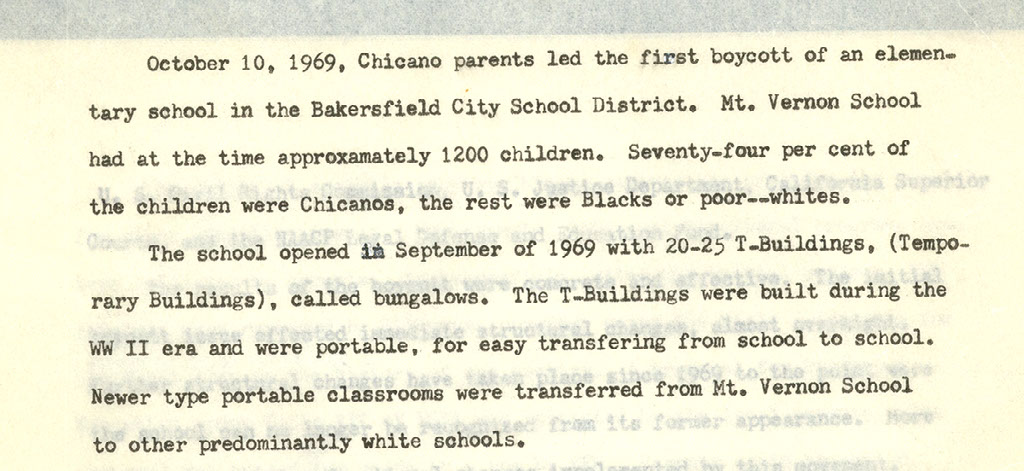
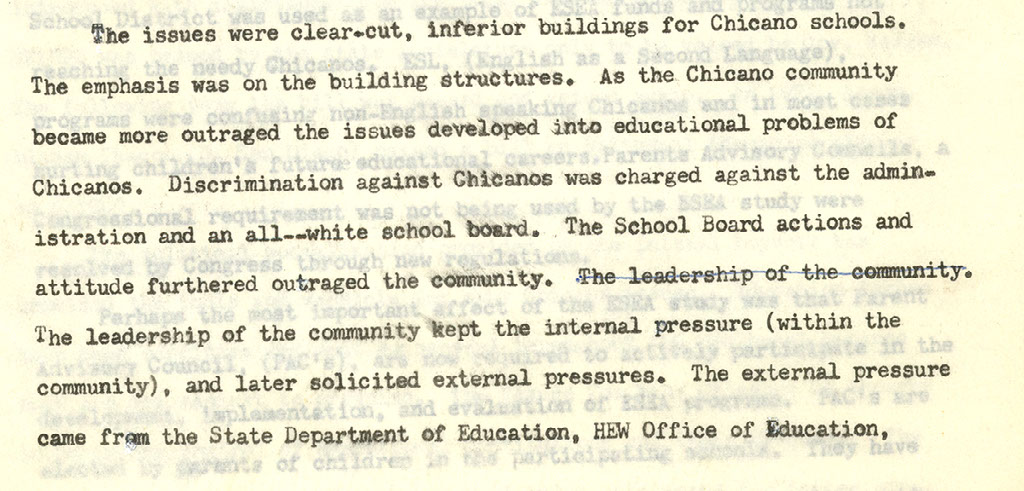
“October 10, 1969, Chicano parents led the first boycott of an elementary school in the Bakersfield City School District. Mt. Vernon School had at the time approximately 1200 children. Seventy-four per cent of the children were Chicanos, the rest were Blacks or poor-whites.The school opened in September of 1969 with 20–25 T-Buildings, (Temporary Buildings), called bungalows. The T-Buildings were built during the WW II era and were portable, for easy transferring from school to school. Newer type portable classrooms were transferred from Mt. Vernon School to other predominantly white schools.”
Jesse Alcala Digital Collection, 2020-01-23. California State University, Bakersfield, Walter W. Stiern Library-Historical Research Center. https://archives.csub.edu/repositories/3/resources/28 Accessed March 04, 2024.


“The issues were clear-cut, inferior buildings for Chicano schools. The emphasis was on the building structures. As the Chicano community became more outraged the issues developed into educational problems of Chicanos. Discrimination against Chicanos was charged against the administration and an all-white school board. The School Board actions and attitude further outraged the community. The leadership of the community kept the internal pressure (within the community), and later solicited external pressures. The external pressure came from the State Department of Education, HEW Office of Education,”
Jesse Alcala Digital Collection, 2020-01-23. California State University, Bakersfield, Walter W. Stiern Library-Historical Research Center. https://archives.csub.edu/repositories/3/resources/28 Accessed March 04, 2024.

Jesse Alcala, Oral History with Oliver Rosales. Jesse Alcala Digital Collection, 2020-01-23. California State University, Bakersfield, Walter W. Stiern Library-Historical Research Center. https://archives.csub.edu/repositories/3/archival_objects/8956 Accessed March 04, 2024.

1984- Desegregation, 30 years after Brown v. Board of Education

In 1975, the U.S. government said BCSD was purposely busing students to keep white and black schools separate, a violation of the Civil Rights Act. The ensuing legal battle lasted nearly a decade until in 1984, the U.S. Department of Justice stepped in and sued the district for having “racially imbalanced schools” and to reduce segregation.


The desegregation order was lifted in 2011.
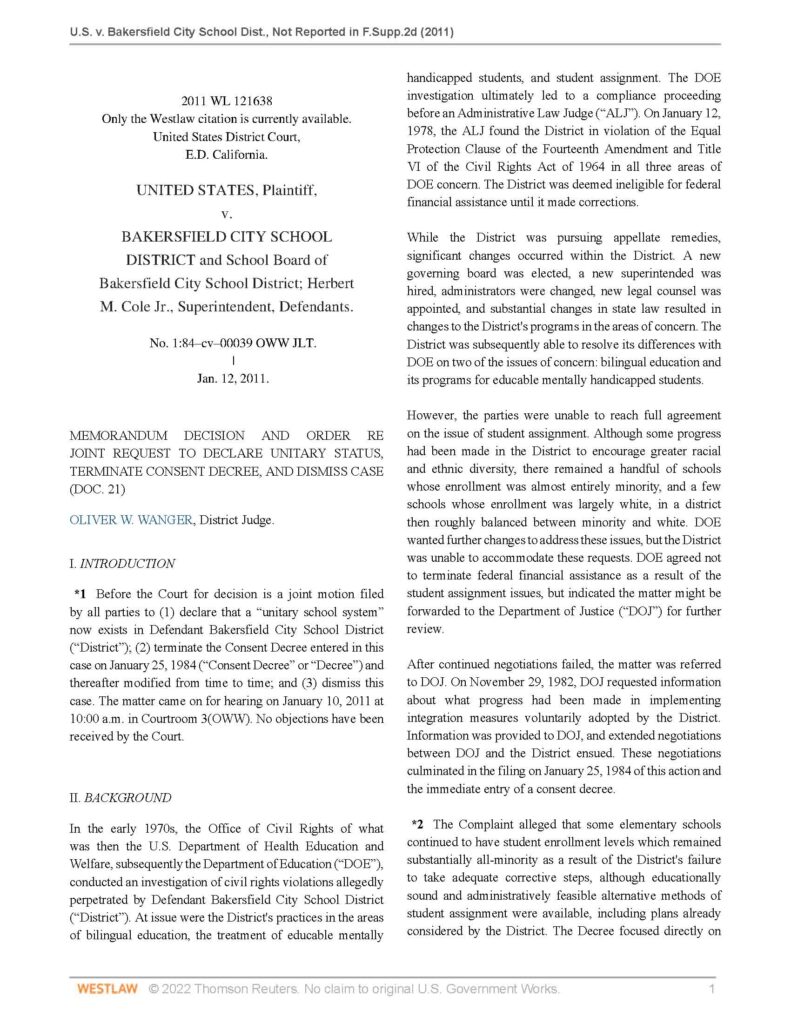
U.S. v. Bakersfield City School Dist., Not Reported in F.Supp.2d (2011)2011 WL 121638 Only the Westlaw citation is currently available. United States District Court, E.D. California. UNITED STATES, Plaintiff, v. BAKERSFIELD CITY SCHOOL DISTRICT and School Board of Bakersfield City School District; Herbert M. Cole Jr., Superintendent, Defendants. No. 1:84-cv-00039 OWW JLT. Jan. 12, 2011. MEMORANDUM DECISION AND ORDER RE JOINT REQUEST TO DECLARE UNITARY STATUS, TERMINATE CONSENT DECREE, AND DISMISS CASE (DOC. 21) OLIVER W. WANGER, District Judge. I. INTRODUCTION *1 Before the Court for decision is a joint motion filed by all parties to (1) declare that a “unitary school system” now exists in Defendant Bakersfield City School District (“District”); (2) terminate the Consent Decree entered in this case on January 25, 1984 (“Consent Decree” or “Decree”) and thereafter modified from time to time; and (3) dismiss this case. The matter came on for hearing on January 10, 2011 at 10:00 a.m. in Courtroom 3 (OWW). No objections have been received by the Court. II. BACKGROUND In the early 1970s, the Office of Civil Rights of what was then the U.S. Department of Health Education and Welfare, subsequently the Department of Education (“DOE”), conducted an investigation of civil rights violations allegedly perpetrated by Defendant Bakersfield City School District (“District”). At issue were the District’s practices in the areas of bilingual education, the treatment of educable mentally handicapped students, and student assignment. The DOE investigation ultimately led to a compliance proceeding before an Administrative Law Judge (“ALJ”). On January 12, 1978, the ALJ found the District in violation of the Equal Protection Clause of the Fourteenth Amendment and Title VI of the Civil Rights Act of 1964 in all three areas of DOE concern. The District was deemed ineligible for federal financial assistance until it made corrections. While the District was pursuing appellate remedies, significant changes occurred within the District. A new governing board was elected, a new superintendent was hired, administrators were changed, new legal counsel was appointed, and substantial changes in state law resulted in changes to the District’s programs in the areas of concern. The District was subsequently able to resolve its differences with DOE on two of the issues of concern: bilingual education and its programs for educable mentally handicapped students. However, the parties were unable to reach full agreement on the issue of student assignment. Although some progress had been made in the District to encourage greater racial and ethnic diversity, there remained a handful of schools whose enrollment was almost entirely minority, and a few schools whose enrollment was largely white, in a district then roughly balanced between minority and white. DOE wanted further changes to address these issues, but the District was unable to accommodate these requests. DOE agreed not to terminate federal financial assistance as a result of the student assignment issues, but indicated the matter might be forwarded to the Department of Justice (“DOJ”) for further review. After continued negotiations failed, the matter was referred to DOJ. On November 29, 1982, DOJ requested information about what progress had been made in implementing integration measures voluntarily adopted by the District. Information was provided to DOJ, and extended negotiations between DOJ and the District ensued. These negotiations culminated in the filing on January 25, 1984 of this action and the immediate entry of a consent decree. *2 The Complaint alleged that some elementary schools continued to have student enrollment levels which remained substantially all-minority as a result of the District’s failure to take adequate corrective steps, although educationally sound and administratively feasible alternative methods of student assignment were available, including plans already considered by the District. The Decree focused directly on
U.S. v. Bakersfield City School Dist., Not Reported in F.Supp.2d (2011)

Historic desegregation order against BCSD schools lifted

“A more than 30-year court fight to bring racial equality to Bakersfield City School District campuses is officially over. As a result of the federal case, BCSD schools are more diverse, have bilingual and magnet programs at what now are some of the county’s highest-achieving campuses and educate all students equally, officials said.”

https://www.bakersfield.com/historic-desegregation-order-against-bcsd-schools-lifted/article_e974da39-377c-53fe-b7bc-91abe868f2ed.html


Establishing CSU, Bakersfield

On August 22, 1952, an aftershock to an earlier earthquake (July 21) hit Bakersfield. The epicenter was in the eastern periphery of the city. The original earthquake and the previous two aftershocks struck Arvin and Tehachapi. It was 3:41pm on a Friday summer afternoon. As the dust settled, the damage was extensive. While many buildings survived, they faced structural damage.
Shortly after the City of Bakersfield began rebuilding and created a new urban and vibrant downtown. Many suburban areas benefited from urban renewal, however, some areas were excluded. By 1956, new buildings were already visible and the urban landscape was shifting to East Bakersfield and to the southwest of town. The Greater Bakersfield Chamber of Commerce rebranded the city as “America’s Newest City: Bakersfield, Kern County, California.” The program included a large advertising campaign, financing, agriculture and industry, and heavy manufacturing. Magazines advertised, “Homes: Built to take advantage of the climate,” while others announced, “Improved industrial property awaits you in Greater Bakersfield.”
Education was also vastly changed after the 1952 natural disaster. Bakersfield College was slated to move into its new location in 1951, but the 1952 earthquake accelerated the relocation from Kern Union High School downtown to its current location. Most schools in the Bakersfield City School District were rebuilt after sustaining major damage. Out of the ten schools, only one was reported with minor damage.
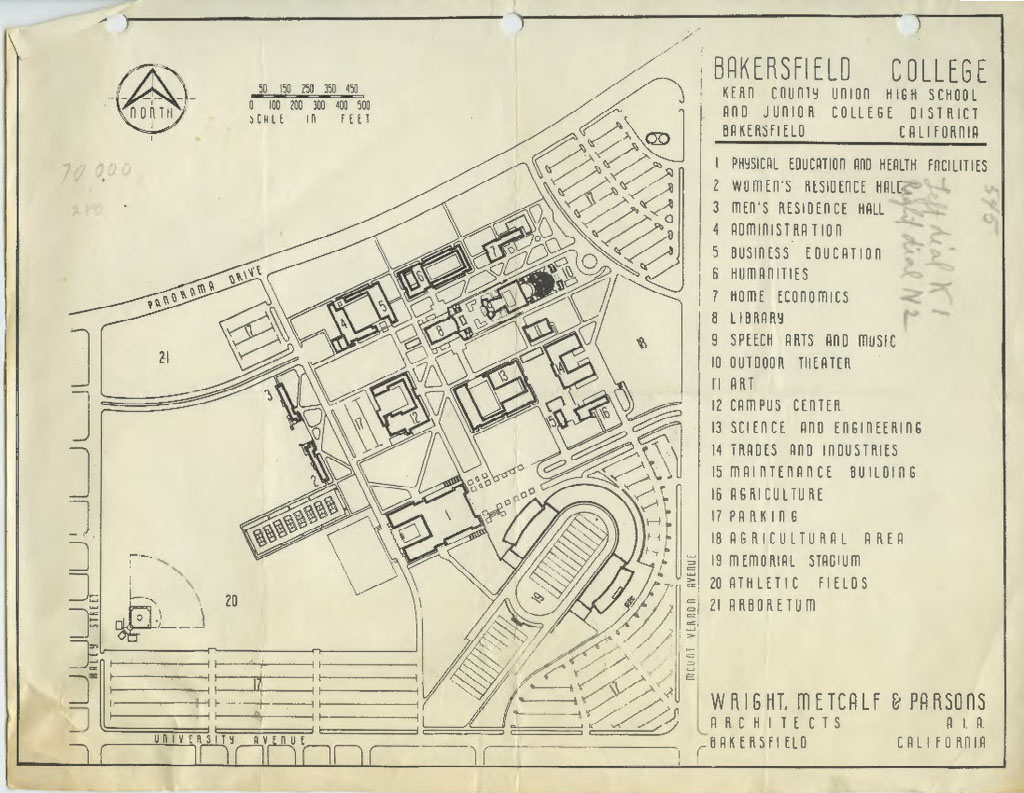
BAKERSFIELD COLLEGEKERN COUNTY UNION HIGH SCHOOL AND JUNIOR COLLEGE DISTRICT BAKERSFIELD, CALIFORNIA Legend listing campus facilities: Physical Education and Health Facilities Women’s Residence Hall Men’s Residence Hall Administration Business Education Humanities Home Economics Library Speech Arts and Music Outdoor Theater Art Campus Center Science and Engineering Trades and Industries Maintenance Building Agriculture Parking Agricultural Area Memorial Stadium Athletic Fields Arboretum Map features and labels: NORTH (compass symbol shown) Scale in feet (0–500) Panorama Drive (top left boundary) Mount Vernon Avenue (right boundary) University Avenue (bottom boundary) The plan shows a centralized academic core of rectangular building footprints connected by walkways. The large oval-shaped Memorial Stadium (19) appears prominently in the lower right quadrant, with adjacent Athletic Fields (20). Multiple parking areas (17) are distributed around the campus perimeter. Agricultural areas (18) and an Arboretum (21) are also indicated. Bottom right credit: WRIGHT, METCALF & PARSONS ARCHITECTS A.I.A. BAKERSFIELD, CALIFORNIA
Wright, Metcalf and Parsons, “Bakersfield College,” Clarence Cullimore Collection, Circa 1954
In 1960, the Kern County Superintendent of Schools stated that Bakersfield was the largest isolated metropolitan area in the United States to be without a senior college or university. In 1965, the California State Senate approved a proposal to build a higher education campus in Kern County. “Kern State College” was established, but a location for the college was not selected. The State College was to be the 19th campus in the California State College system and it was also the only campus within a 100-mile radius to offer a four-year degree.
Senate Bill 75 established the planning of the State College in Kern County. The bill cited a 1959 report recommending a 4-year higher learning institution in the County of Kern. Senator Walter Stiern argued to the California State Senate that, “A great number of students would benefit from the addition of a new State College in Kern County since there are no four-year collegiate institutions in this area. College-going students from this area will continue to be isolated until a new campus is opened.” Stiern knew that there was a need for higher education. As an advocate for equal education, the proposed college was also to meet future growth and enrollment rates. In 1963, for every 1,000 students, 535 high school graduates were enrolling in a higher education institution in California. This was close to the state average of 559 for every 1,000. There was an estimated 3,000 projected enrollment for the new State College. The bill established what would later become California State College, Bakersfield and subsequently California State University, Bakersfield. The bill was co-authored by assembly members Williamson and Casey.
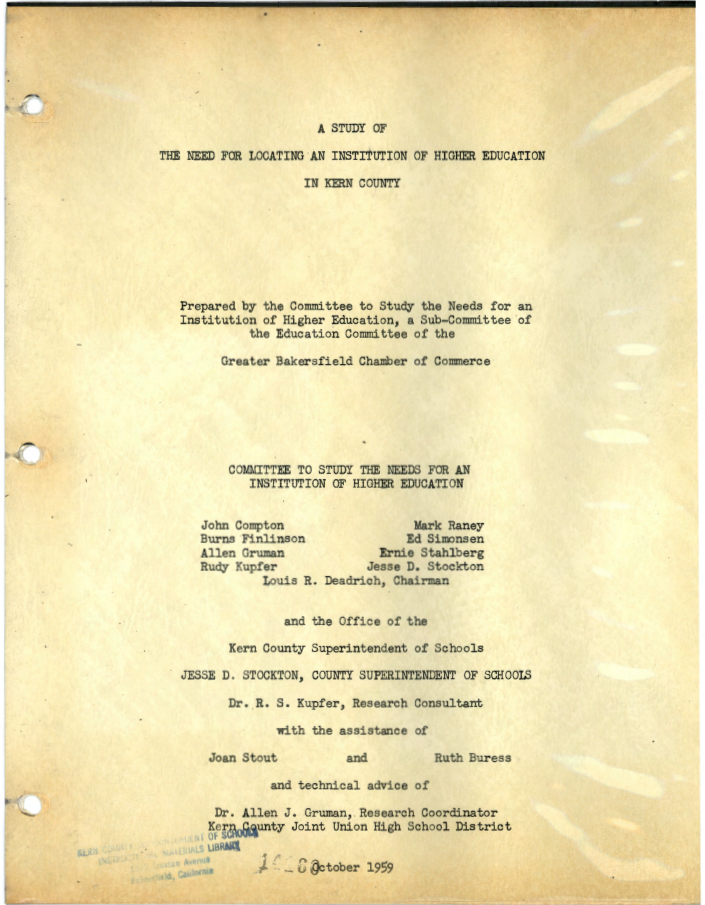
Title:A STUDY OF THE NEED FOR LOCATING AN INSTITUTION OF HIGHER EDUCATION IN KERN COUNTY Prepared by the Committee to Study the Needs for an Institution of Higher Education, a Sub-Committee of the Education Committee of the Greater Bakersfield Chamber of Commerce COMMITTEE TO STUDY THE NEEDS FOR AN INSTITUTION OF HIGHER EDUCATION John Compton Burns Finlinson Allen Gruman Rudy Kupfer Louis R. Deadrich, Chairman Mark Raney Ed Simonsen Ernie Stahlberg Jesse D. Stockton and the Office of the Kern County Superintendent of Schools JESSE D. STOCKTON, COUNTY SUPERINTENDENT OF SCHOOLS Dr. R. S. Kupfer, Research Consultant with the assistance of Joan Stout  and  Ruth Buress and technical advice of Dr. Allen J. Gruman, Research Coordinator Kern County Joint Union High School District Stamped at bottom (partially visible): Kern County Superintendent of Schools Instructional Materials Library Bakersfield, California Date at bottom: October 1959
Greater Bakersfield Chamber of Commerce, “A study of the need for locating an institution of higher education in Kern County,” Kern County 10-1959
Proposed Sites for California State College, Bakersfield 
Tejon Ranch was willing to donate 400 acres in the southeast area to build the new college. Situated near Arvin, California, “The White Wolf Grade: stretched between Bakersfield and Tehachapi and would have been a prime location because of the breathtaking view of the mountains and the easy access for commuters to Highway 58.” Another location, offered by George W. Nickel, Jr., was south of the Kern River by Highway 178 just east of Lake Ming Park.
The final location selected for the new college site was offered as a gift by Kern County Land Company. The land was donated to the state of California in 1962 with the express purpose of having a state college campus in Bakersfield. The campus was situated on a 370-acre site in southwest Bakersfield on Stockdale Highway, approximately five miles west of central Bakersfield, and far away from areas of poverty.
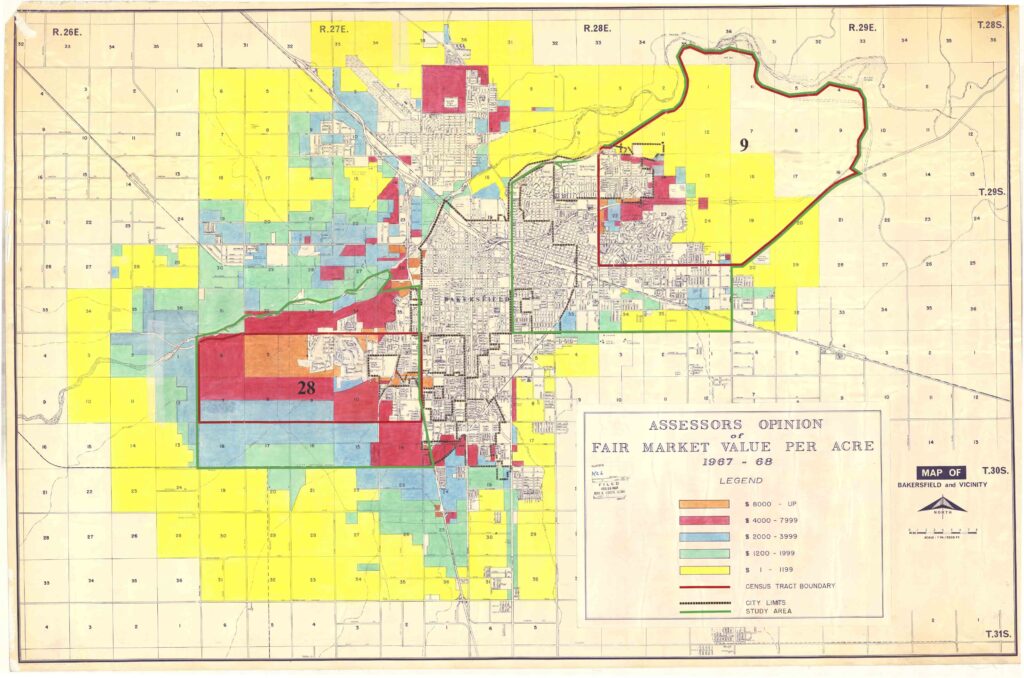
Main title box:ASSESSORS OPINION of FAIR MARKET VALUE PER ACRE 1967 – 68 Legend: $ 8000 – UP $ 4000 – 7999 $ 2000 – 3999 $ 1200 – 1999 $ 1 – 1199 Additional legend markings: CENSUS TRACT BOUNDARY CITY LIMITS STUDY AREA Map label at right: MAP OF BAKERSFIELD AND VICINITY Township and range references along top: R.26E. R.27E. R.28E. R.29E. Section references: T.29S. T.28S. T.30S. T.31S. The map shows central Bakersfield with census tract numbers (including “28” prominently in the southwest area) and colored overlays indicating assessed value ranges. Higher-value areas (orange/red) appear in portions of the southwest and northeast, while lower-value areas (yellow/light green) dominate the surrounding agricultural and peripheral lands. City limits and study area boundaries are marked with bold outlines.
Kern County Assessor’s Map 1967 CSUB’s future site is at the highest value (Orange) Kern County Court Collection

The Stockdale location was the only site to offer adjacent housing and development support. The maps presented to building the site had listed churches, industrial districts, a high school, and new housing by the Stockdale Development Corporation.  Kern County Assessor’s Map 1967 CSUB’s future site is at the highest value (Orange).

Zone of Influence and Suburban Ideal
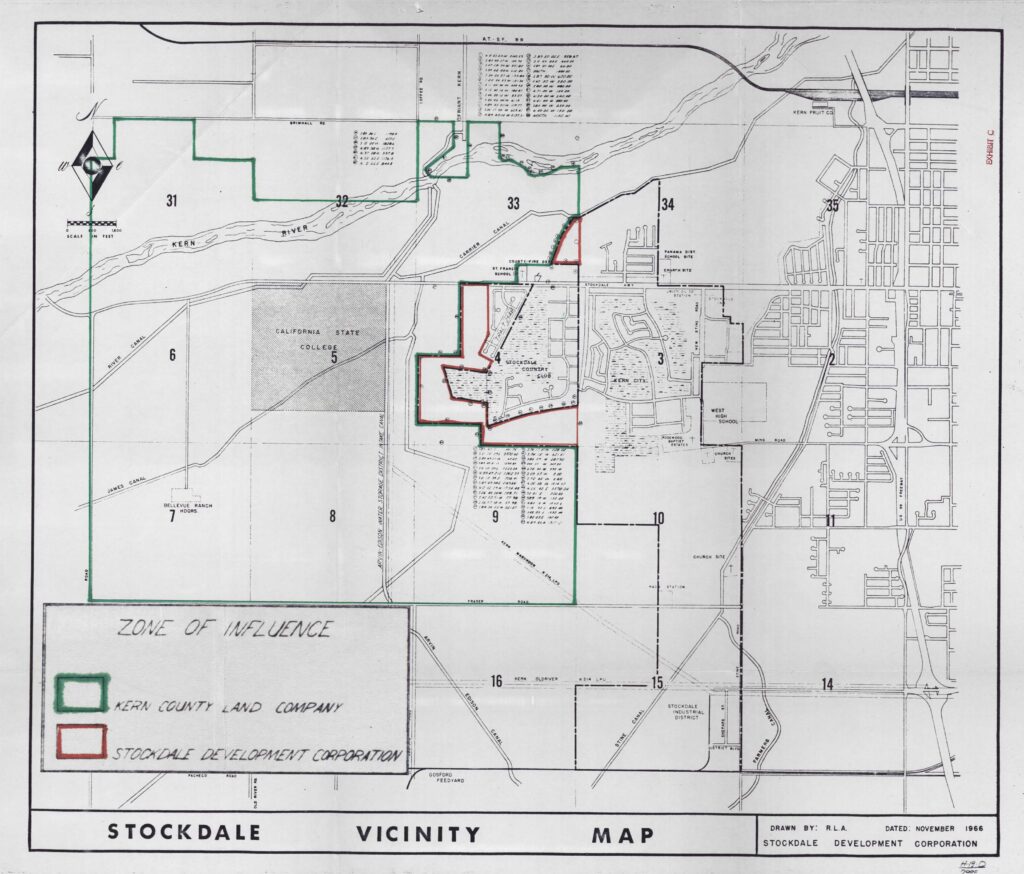
STOCKDALE VICINITY MAPLegend box: ZONE OF INFLUENCE Green outline: KERN COUNTY LAND COMPANY Red outline: STOCKDALE DEVELOPMENT CORPORATION Township and section references visible: 31 32 33 34 35 6 8 9 10 14 15 16 Geographic features labeled: KERN RIVER Institutional/land labels visible: CALIFORNIA STATE COLLEGE (shaded area marked “5”) STOCKDALE COUNTRY CLUB Roads and features visible (partial): Panorama Road Calloway (appears partially) Stine Road Gosford (appears partially) Rail lines labeled (A.T.&S.F. RR visible at top) Boundary marking: EXHIBIT C (right margin) Bottom right credits: DRAWN BY: R.L.A. DATED: NOVEMBER 1966 STOCKDALE DEVELOPMENT CORPORATION The map shows the southwest Bakersfield area with large agricultural sections and developing residential tracts. The green boundary encloses a broad zone extending west and north along the Kern River. The red boundary highlights the Stockdale Development Corporation holdings around the Stockdale Country Club and adjacent subdivisions.
Stockdale Development Corporation, “Stockdale Vicinity Map,” California State University, Bakersfield, circa 1967


Stockdale County Club served as the “Zone of Influence” for the establishment of California State College, Bakersfield. Along with the establishment plan to establish the college, housing had to support the vision of the then California State College, Bakersfield.
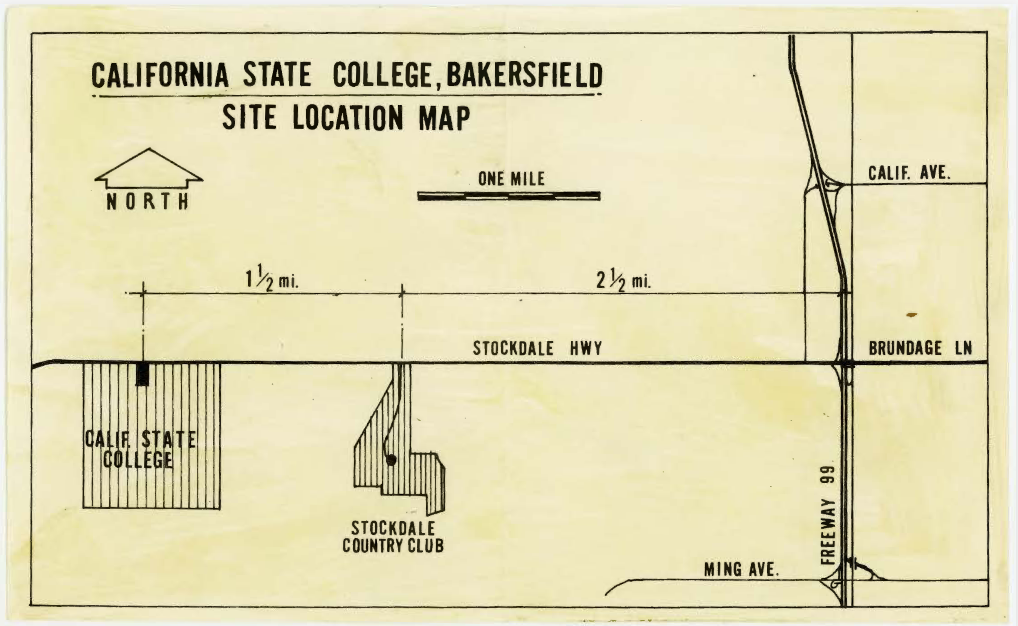
 

Title at top:CALIFORNIA STATE COLLEGE, BAKERSFIELD SITE LOCATION MAP Compass marking: NORTH Scale marking: ONE MILE Distance indicators: 1½ mi. 2½ mi. Roads and highways labeled: STOCKDALE HWY BRUNDAGE LN CALIF. AVE. FREEWAY 99 MING AVE. Landmarks labeled: CALIF STATE COLLEGE (shown as a shaded rectangular area) STOCKDALE COUNTRY CLUB The diagram shows a simplified layout of west Bakersfield. California State College is located west of Freeway 99 along Stockdale Highway. The Stockdale Country Club appears just east of the college site. Brundage Lane and California Avenue intersect near Freeway 99, and Ming Avenue runs parallel further south. The map is schematic rather than detailed, emphasizing major roads and distances from Freeway 99 and central Bakersfield.
Wright, Metcalf and Parsons, “Bakersfield College,” Clarence Cullimore Collection, Circa 1954

On the April 4, 1969, the day of the groundbreaking ceremony of California State College, Bakersfield, the Members of the Advisory Board held the reception at Stockdale Country Club, east of the university. The country club is in close proximity, and in recent times, Seven Oaks Country Club was established on the west side of the university.