
Rumford Fair Housing Act

 Before 1938    –  Buying on Contract     Covenants  –   Covenant Database   –  East Bakersfield     

    Education    –   Eminent Domain     –     Moving into a Neighborhood   –    Neighborhoods     

 Public Housing   –  Resources    –   Rumford Fair Housing Act     Suburban Expansion   –   Zoning 

Typed document page with the heading “What the Rumford Act Does” centered at the top. The text explains key provisions of the Rumford Fair Housing Act.The first paragraph states that the Act extends existing law to prohibit discrimination in all housing assisted by public financing. The second paragraph explains that the Act prohibits discrimination in approximately 70% of private housing. The phrase “discrimination in about 70% of private housing” is underlined. The document specifies that owners of single, duplex, triplex, and four-unit dwellings are excluded from its provisions. The third paragraph states that the Act increases the membership of the Fair Employment Practice Commission (FEPC) from five to seven members and assigns the commission responsibility for investigating and hearing complaints of housing discrimination. The final paragraph explains that under FEPC procedures, all complaints and hearings are confidential. It emphasizes that enforcement focuses on persuasion, education, and conciliation rather than punitive measures. The page appears to be part of a mid-1960s informational binder or advocacy packet related to fair housing legislation.
“Notes from Walter W. Stiern.” Walter W. Stiern Collection, 1964

William Byron Rumford (b. 1908 – d. 1986) was the first African American elected to state office in California. He served as a California State Assemblyman for the 17th District from 1949- 1967. Although Rumford is most known for his career in politics, he was a pharmacist by profession and owned his own business, Rumford’s Pharmacy, in Berkeley. His political career focused on legislation about California fair housing, a higher minimum wage, and reducing unemployment, especially for African American youth.
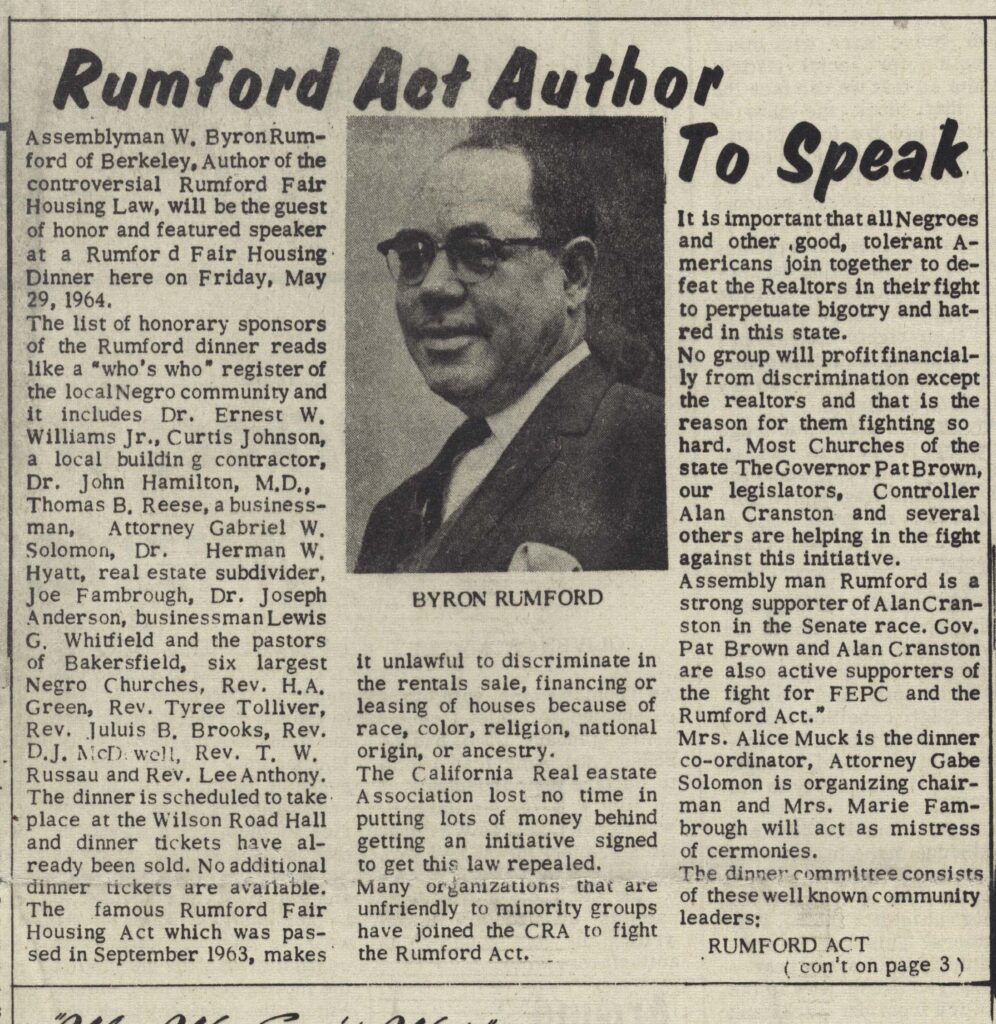
This image shows a black-and-white newspaper article with the headline “Rumford Act Author To Speak.” A portrait photograph of Assemblyman Byron Rumford appears at the center of the article. He is shown wearing glasses, a suit jacket, white shirt, and tie. The caption beneath the photograph reads “BYRON RUMFORD.”The article states that Assemblyman W. Byron Rumford of Berkeley, author of the controversial Rumford Fair Housing Law, will be the guest of honor and featured speaker at a Rumford Fair Housing Dinner to be held on Friday, May 29, 1964. It lists honorary sponsors from Bakersfield’s Black community, including Dr. Ernest W. Williams Jr., Curtis Johnson, Dr. John Hamilton, Thomas B. Reese, Attorney Gabriel W. Solomon, Dr. Herman W. Hyatt, Joe Fambrough, Dr. Joseph Anderson, businessman Lewis G. Whitfield, and pastors of six of Bakersfield’s largest Negro churches, including Rev. H.A. Green, Rev. Tyree Tolliver, Rev. Julius B. Brooks, Rev. D.J. McDowell, Rev. T.W. Russau, and Rev. Lee Anthony. The article explains that the dinner will take place at Wilson Road Hall and that tickets have already been sold. It describes the Rumford Fair Housing Act, passed in September 1963, as making it unlawful to discriminate in the rental, sale, financing, or leasing of housing based on race, color, religion, national origin, or ancestry. It notes that the California Real Estate Association began efforts to repeal the law and that various organizations joined the opposition. The right column emphasizes the importance of support from Negroes and “good, tolerant Americans” in defending the law against repeal efforts. It mentions Governor Pat Brown, Controller Alan Cranston, and other public officials as supporters of the Rumford Act and the Fair Employment Practices Commission (FEPC). The article identifies Mrs. Alice Muck as dinner coordinator, Attorney Gabe Solomon as organizing chairman, and Mrs. Marie Fambrough as mistress of ceremonies. The overall layout reflects mid-1960s local newspaper design, with dense column text and a centered portrait image.
“Rumford Act Author to Speak,” The Outlook, May 27, 1964

“The Famous Rumford Fair Housing Act, which was passed in September 1963, makes it unlawful to discriminate in the rentals, sale, financing, or leasing or housing because of race, color, religion, national origin, or ancestry. The California Real Estate Association lost no time in putting money behind getting the initiative signed to get this law repealed.”
This image shows a black-and-white newspaper article with the headline “Rumford Act Author To Speak.” A portrait photograph of Assemblyman Byron Rumford appears at the center of the article. He is shown wearing glasses, a suit jacket, white shirt, and tie. The caption beneath the photograph reads “BYRON RUMFORD.”The article states that Assemblyman W. Byron Rumford of Berkeley, author of the controversial Rumford Fair Housing Law, will be the guest of honor and featured speaker at a Rumford Fair Housing Dinner to be held on Friday, May 29, 1964. It lists honorary sponsors from Bakersfield’s Black community, including Dr. Ernest W. Williams Jr., Curtis Johnson, Dr. John Hamilton, Thomas B. Reese, Attorney Gabriel W. Solomon, Dr. Herman W. Hyatt, Joe Fambrough, Dr. Joseph Anderson, businessman Lewis G. Whitfield, and pastors of six of Bakersfield’s largest Negro churches, including Rev. H.A. Green, Rev. Tyree Tolliver, Rev. Julius B. Brooks, Rev. D.J. McDowell, Rev. T.W. Russau, and Rev. Lee Anthony. The article explains that the dinner will take place at Wilson Road Hall and that tickets have already been sold. It describes the Rumford Fair Housing Act, passed in September 1963, as making it unlawful to discriminate in the rental, sale, financing, or leasing of housing based on race, color, religion, national origin, or ancestry. It notes that the California Real Estate Association began efforts to repeal the law and that various organizations joined the opposition. The right column emphasizes the importance of support from Negroes and “good, tolerant Americans” in defending the law against repeal efforts. It mentions Governor Pat Brown, Controller Alan Cranston, and other public officials as supporters of the Rumford Act and the Fair Employment Practices Commission (FEPC). The article identifies Mrs. Alice Muck as dinner coordinator, Attorney Gabe Solomon as organizing chairman, and Mrs. Marie Fambrough as mistress of ceremonies. The overall layout reflects mid-1960s local newspaper design, with dense column text and a centered portrait image.
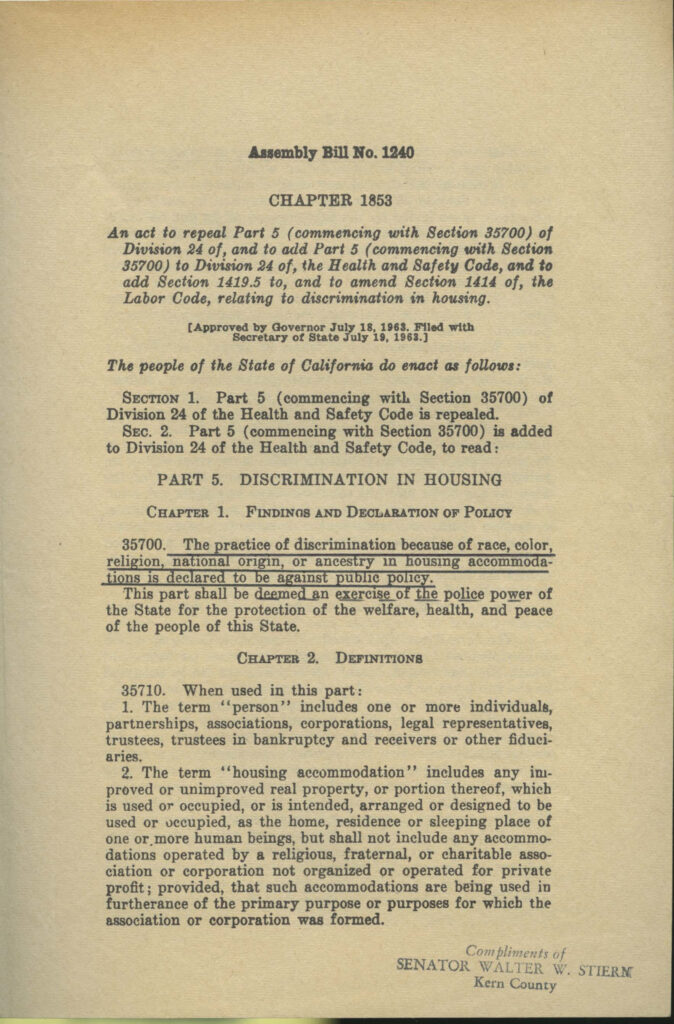
“Rumford Fair Housing Act” Assembly Bill No. 1240, 1963

Rumford successfully passed the Rumford Fair Housing Act in 1963, but it was repealed by Proposition 14 in 1964. The Rumford Act law prohibited discrimination in all housing assisted by public financing, and private housing, and increased the membership of the Fair Employment Practice Commission. The Commission was responsible to investigate and hear complaints of discrimination. The Rumford Act was supported by various senators, including Walter W. Stiern. “Finding aid to the William Byron Rumford papers, 1934-1982.” Online Archive of California, Accessed 30 January 2020.

In 1964, the California Real Estate Association (CREA) sponsored Proposition 14. They named it the “CREA Amendment,” supporting housing discrimination by overturning the Rumford Fair Housing Act.

This image shows a printed legislative document titled “Assembly Bill No. 1240” at the top of the page, followed by “CHAPTER 1853.” The document is printed on cream-colored paper in a formal serif typeface. The subtitle reads: “An act to repeal Part 5 (commencing with Section 35700) of Division 24 of, and to add a new Part 5 (commencing with Section 35700) to Division 24 of, the Health and Safety Code, and to add Section 1419.5 to, and to amend Section 1414 of, the Labor Code, relating to discrimination in housing.” Beneath this appears the approval notation: “Approved by Governor July 18, 1963. Filed with Secretary of State July 19, 1963.” The text begins: “The people of the State of California do enact as follows:” Section 1 states that Part 5 of Division 24 of the Health and Safety Code is repealed and replaced. Under “PART 5. DISCRIMINATION IN HOUSING” and “Chapter 1. Findings and Declaration of Policy,” Section 35700 declares: “The practice of discrimination because of race, color, religion, national origin, or ancestry in housing accommodations is declared to be against public policy.” The section further states that this part shall be deemed an exercise of the police power of the State for the protection of the welfare, health, and peace of the people of California. Chapter 2 provides definitions. Section 35710 defines the term “person” to include individuals, partnerships, associations, corporations, legal representatives, trustees, trustees in bankruptcy, receivers, or other fiduciaries. It defines “housing accommodation” as improved or unimproved real property or portions thereof used or intended for residential occupancy, excluding certain religious, fraternal, or charitable organizations not operated for private profit. At the bottom right corner of the page appears the printed note: “Compliments of Senator Walter W. Stiern, Kern County.” The page represents a formal printed copy of the legislation commonly known as the Rumford Fair Housing Act of 1963, which expanded legal protections against housing discrimination in California.

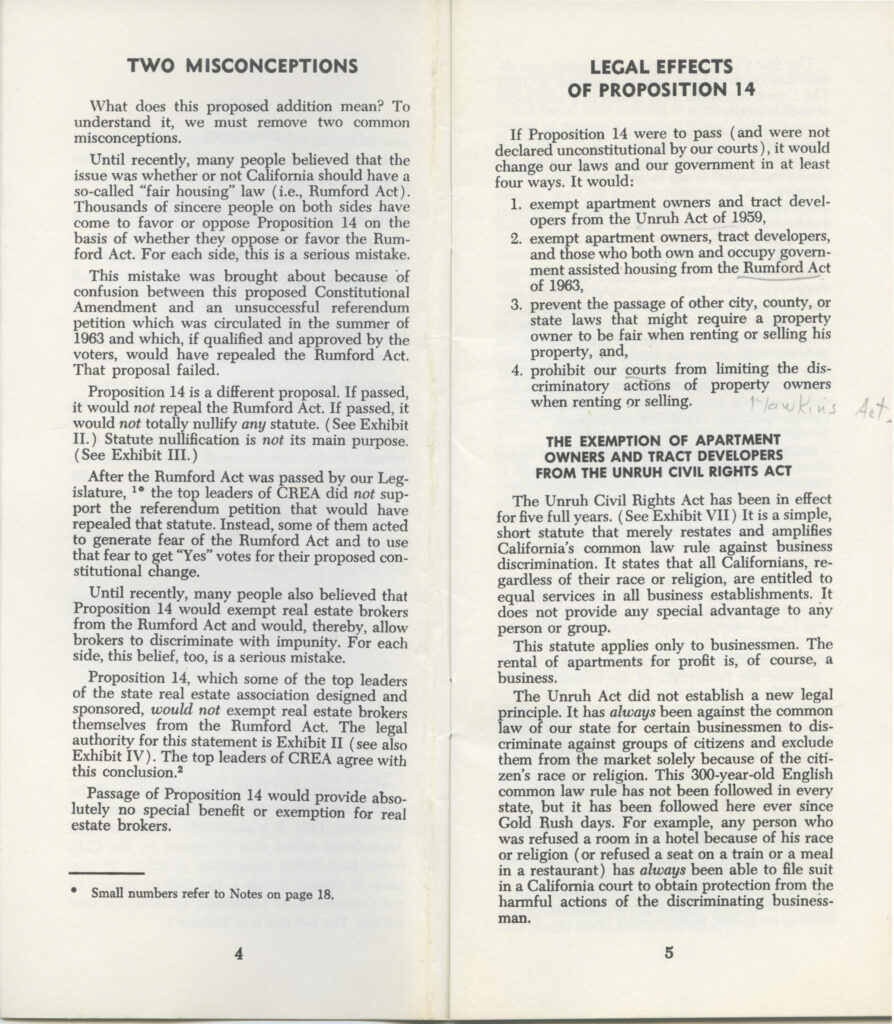
This image shows a printed page with the centered heading “INTRODUCTION” in bold capital letters at the top. The page is printed on off-white paper in a clear serif typeface. The text reads: “The so-called ‘CREA Amendment’ will be proposition number 14 on the California ballot in November, 1964. It is an Initiative Constitutional Amendment which was sponsored by the California Real Estate Association (CREA). It proposes to change Article I, the ‘Bill of Rights’ of the Constitution of California, by adding a new section. The full text is in Exhibit I.” The page explains that Proposition 14, known as the CREA Amendment, was an initiative constitutional amendment sponsored by the California Real Estate Association. It states that the measure would amend Article I (the Bill of Rights) of the California Constitution by adding a new section. This document introduces Proposition 14, the 1964 ballot measure that sought to overturn the Rumford Fair Housing Act by permitting property owners to refuse to sell or rent housing at their discretion.

“If Proposition 14 were to pass… it would change our laws that our government in at least four ways. It would… 4. prohibit our courts from limiting the discriminatory actions of property owners when renting or selling.”

Petitions were circulated to, “Neither the state nor any subdivision or agency thereof shall deny, limit or abridge, directly or indirectly, the right of any persons, who is willing or desires to sell, lease or rent any part of his real property, to decline or sell, lease or rent such properties, to such person or persons as he, in his absolute discretion, chooses.”
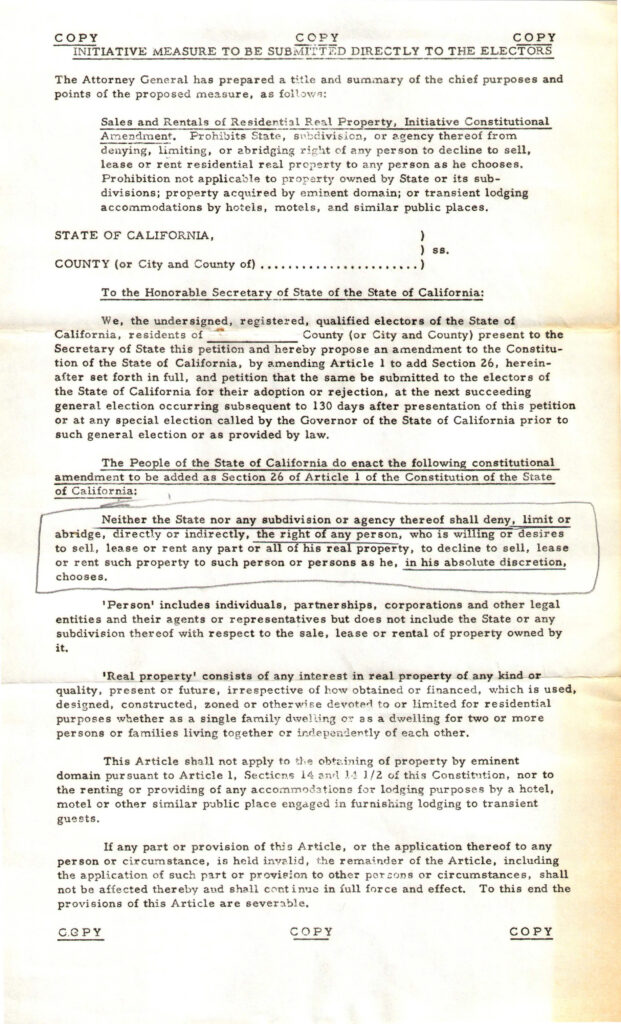
This image shows a single-page typed petition document on off-white paper. The word “COPY” appears at the top multiple times, along with the heading: “INITIATIVE MEASURE TO BE SUBMITTED DIRECTLY TO THE ELECTORS.” At the top of the page, a summary prepared by the Attorney General reads: “Sales and Rentals of Residential Real Property, Initiative Constitutional Amendment. Prohibits State, subdivision, or agency thereof from denying, limiting, or abridging right of any person to decline to sell, lease or rent residential real property to any person as he chooses. Prohibition not applicable to property owned by State or its subdivisions; property acquired by eminent domain; or transient lodging accommodations by hotels, motels, and similar public places.” Below the summary are blank lines for jurisdiction identification: “STATE OF CALIFORNIA, COUNTY (or City and County of) ……………………” The text then addresses: “To the Honorable Secretary of State of the State of California:” and begins the formal petition language. It states that registered, qualified electors of California petition to amend the Constitution of the State of California by adding Section 26 to Article I, and request that the amendment be submitted to voters at the next general election or special election as provided by law. A boxed section contains the proposed constitutional language: “Neither the State nor any subdivision or agency thereof shall deny, limit or abridge, directly or indirectly, the right of any person, who is willing or desires to sell, lease or rent any part or all of his real property, to decline to sell, lease or rent such property to such person or persons as he, in his absolute discretion, chooses.” The document then provides definitions: “Person” includes individuals, partnerships, corporations, and other legal entities and their agents or representatives, but does not include the State or its subdivisions with respect to property they own. “Real property” includes any interest in real property used or intended for residential purposes, including single-family dwellings or dwellings for multiple persons or families. The text specifies exemptions for property obtained by eminent domain and for transient lodging in hotels, motels, or similar public accommodations. The final paragraph states that if any part of the Article is held invalid, the remainder shall remain in force and effect, affirming severability. The word “COPY” appears again at the bottom of the page. This document presents the formal ballot language for Proposition 14, the 1964 initiative sponsored by the California Real Estate Association to amend the st


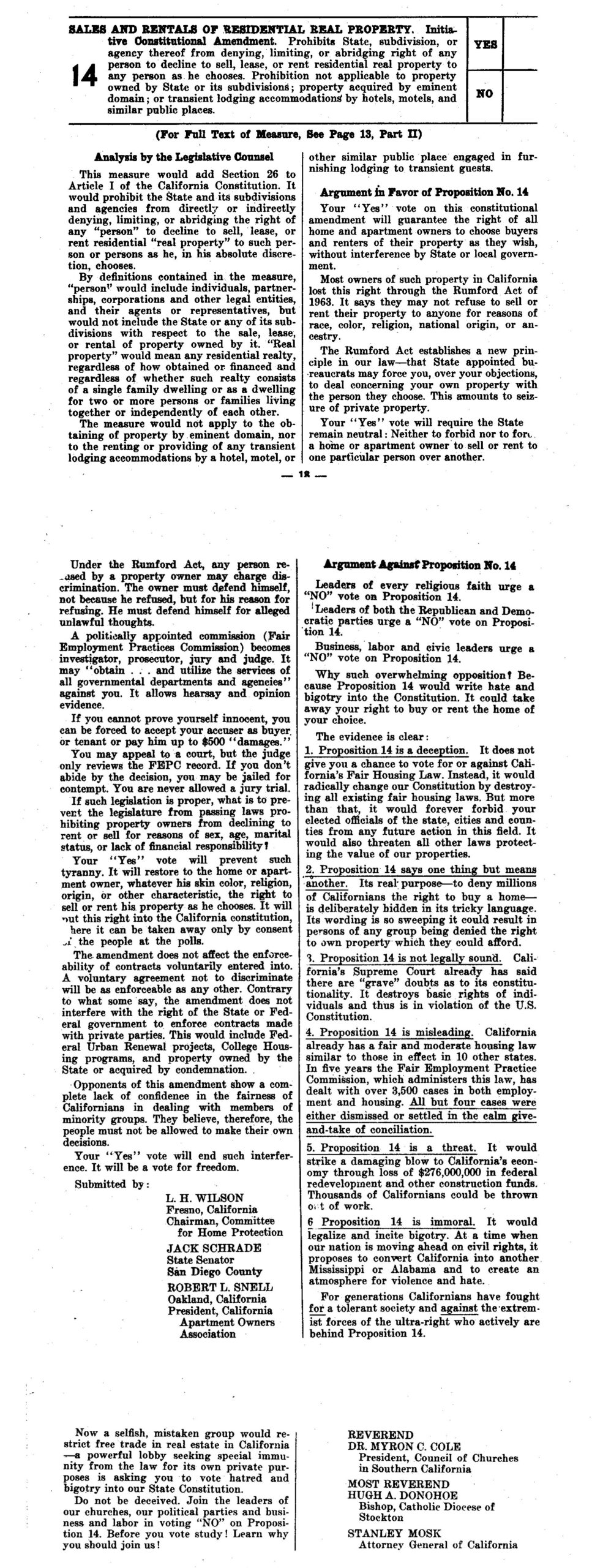
Proposition 14 of 1964 repealed the act. White voters had responded to keep segregation alive and supported the repeal of the act. Proposition 14, UC Hastings, 1964

“Your ‘yes’ vote on this constitutional amendment will guarantee the right of all home and apartment owners to choose buyers and renters of their property as they wish, without interference by State or local government. Most owners of such property in California lost this right through the Rumford Act of 1963. It says they may not refuse to sell or rent their property to anyone for the reasons of race, color, religion, national origin, or ancestry.” Proposition 14 was passed in 1964. It was not until 1968, with the Fair Housing Act, that fair housing was made legal. Lawsuits and advocacy continue to this day.
This image shows a single-page typed petition document on off-white paper. The word “COPY” appears at the top multiple times, along with the heading: “INITIATIVE MEASURE TO BE SUBMITTED DIRECTLY TO THE ELECTORS.” At the top of the page, a summary prepared by the Attorney General reads: “Sales and Rentals of Residential Real Property, Initiative Constitutional Amendment. Prohibits State, subdivision, or agency thereof from denying, limiting, or abridging right of any person to decline to sell, lease or rent residential real property to any person as he chooses. Prohibition not applicable to property owned by State or its subdivisions; property acquired by eminent domain; or transient lodging accommodations by hotels, motels, and similar public places.” Below the summary are blank lines for jurisdiction identification: “STATE OF CALIFORNIA, COUNTY (or City and County of) ……………………” The text then addresses: “To the Honorable Secretary of State of the State of California:” and begins the formal petition language. It states that registered, qualified electors of California petition to amend the Constitution of the State of California by adding Section 26 to Article I, and request that the amendment be submitted to voters at the next general election or special election as provided by law. A boxed section contains the proposed constitutional language: “Neither the State nor any subdivision or agency thereof shall deny, limit or abridge, directly or indirectly, the right of any person, who is willing or desires to sell, lease or rent any part or all of his real property, to decline to sell, lease or rent such property to such person or persons as he, in his absolute discretion, chooses.” The document then provides definitions: “Person” includes individuals, partnerships, corporations, and other legal entities and their agents or representatives, but does not include the State or its subdivisions with respect to property they own. “Real property” includes any interest in real property used or intended for residential purposes, including single-family dwellings or dwellings for multiple persons or families. The text specifies exemptions for property obtained by eminent domain and for transient lodging in hotels, motels, or similar public accommodations. The final paragraph states that if any part of the Article is held invalid, the remainder shall remain in force and effect, affirming severability. The word “COPY” appears again at the bottom of the page. This document presents the formal ballot language for Proposition 14, the 1964 initiative sponsored by the California Real Estate Association to amend the st