
East Bakersfield

 Before 1938    –  Buying on Contract     Covenants  –   Covenant Database   –  East Bakersfield     

    Education    –   Eminent Domain     –     Moving into a Neighborhood   –    Neighborhoods     

 Public Housing   –  Resources    –   Rumford Fair Housing Act     Suburban Expansion   –   Zoning 

East Bakersfield  

The development of East Bakersfield, north and east of Sumner, started with the redevelopment of older neighborhoods like the Drury Tract and subsequent additions (1893, 1896, and 1907), signifying the first East Bakersfield developments. By 1940, a new East Bakersfield had formed and was redeveloping. In 1939, and later, tracts like 1282 (1947), 1369 (1947), 1300 (1947), and 1095 (1939) were re-subdivided into the Drury Tract. All the new tracts had race restrictions.  
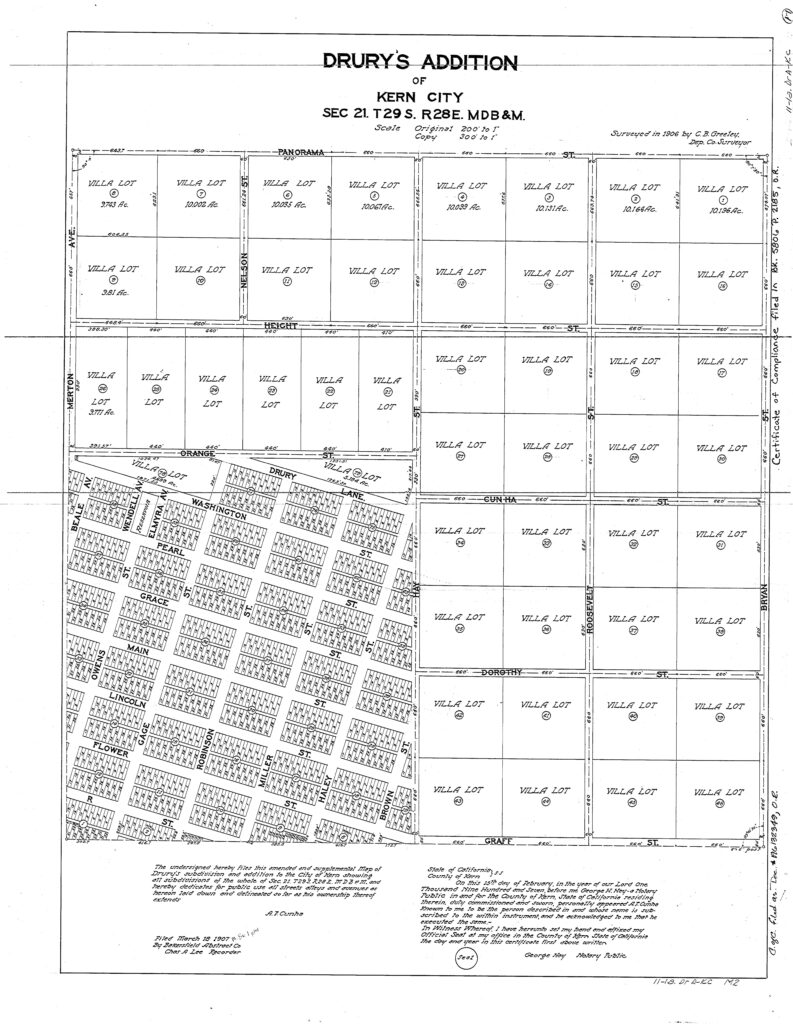
Drury Addition: Title block at top:DRURY’S ADDITION OF KERN CITY SEC 21. T29 S. R28E. MDB&M. Scale — Original 200 ft to 1" Copy 300 ft to 1" Surveyed in 1906 by C.B. Ormset Deputy C.B. Surveyor The plat shows large parcels labeled repeatedly as: VILLA LOT with acreage amounts such as: 10.03 Ac. 10.02 Ac. 10.15 Ac. 10.09 Ac. 10.11 Ac. 10.16 Ac. 9.81 Ac. 9.87 Ac. Street names visible on the map include: Panorama Height Orange Drury Lane Gun Ha (appears as Gun-ha or similar spelling) Dorothy Grace The lower left section shows a dense grid labeled: Washington Pearl Grace Main Lincoln Flower Additional street names visible include: Beale Washburn Robinson Miller Main Certification text (partially visible): “The undersigned hereby certifies that he caused said subdivision of Drury’s Addition in the City of Kern City to be surveyed and that the plat thereof is correct.” Filing information at bottom: “Filed March 18, 1907 at ____ o’clock M. In Book ___ of Maps At Page ___ County Recorder” County Clerk certification text (partially visible): “State of California County of Kern On this 31st day of February, in the year of our Lord one thousand nine hundred and seven…” Recorder notation at lower right margin: “Filed at request of ____ County Recorder of the County of Kern”
Drury’s Addition, Kern County Records, 1-6-1896

Older neighborhoods like Monte Vista (established in 1916, covenant added in 1939) and La Naranja (established in 1916, covenant added in 1941) had restrictions added to the tract after the initial subdivision in 1916. This signified the new and renewed housing development during the FHA and HOLC New Deal housing policies. This also was the start of the revitalization of older white neighborhoods.  

All these tract neighborhoods were in close proximity to East Bakersfield High School and Kern General Hospital. Along with education buildings and commercial centers, the “New” East Bakersfield’s growth started a new phase of housing development after the building of the Kern General Hospital in 1925, located on Flower Street. East High was a Works Progress Administration publicly funded project. It was completed in 1938. These two public buildings on the East Side started a proliferation of housing developments in the “new” East Bakersfield. These neighborhoods were attractive building sites due to the FHA recommendations of grading loan standards and restrictive policies introduced after 1938.  

East Bakersfield was once an area of development and peak investment.

Grading was a standard of home finance introduced during the New Deal. Grading included proximity to schools, areas of commerce, hospitals, parks, and other characteristics of “desirability.” The closer to these commerce, recreation, and education centers landed the property higher on the scale of home loan finance opportunities. Restrictive covenants were recommended to limit the use of the home outside of living, standardized characteristics (like committee approvals), and racial restrictions. Housing between 1938 and 1950 reserved the best homes and financing for white communities all over America. This pattern is visible in East Bakersfield. By 1950, East Bakersfield was one of the most desirable areas to live in.  

Major developments since 1925:

Kern General Hospital was relocated to East Bakersfield in 1925

East Bakersfield High was built in 1938

In April 1956, Bakersfield College was opened in East Bakersfield
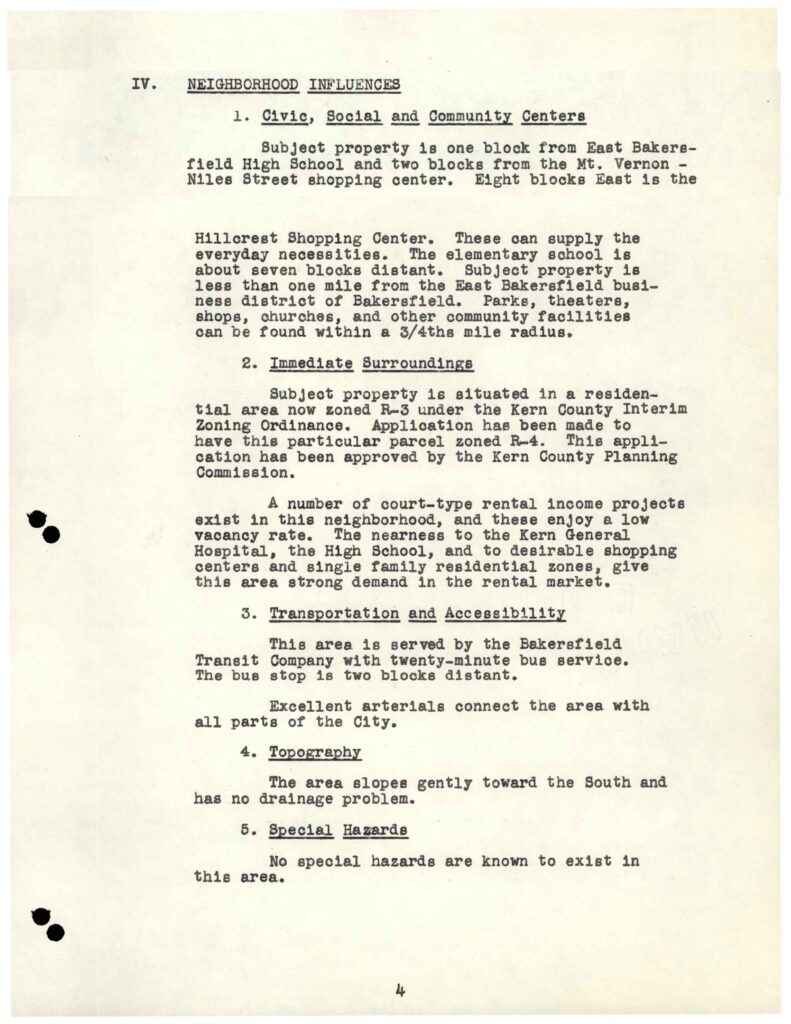
Fha Grading: IV. NEIGHBORHOOD INFLUENCES1. Civic, Social and Community Centers Subject property is one block from East Bakersfield High School and two blocks from the Mt. Vernon – Niles Street shopping center. Eight blocks East is the Hillcrest Shopping Center. These can supply the everyday necessities. The elementary school is about seven blocks distant. Subject property is less than one mile from the East Bakersfield business district of Bakersfield. Parks, theaters, shops, churches, and other community facilities can be found within a 3/4ths mile radius. 2. Immediate Surroundings Subject property is situated in a residential area now zoned R-3 under the Kern County Interim Zoning Ordinance. Application has been made to have this particular parcel zoned R-4. This application has been approved by the Kern County Planning Commission. A number of court-type rental income projects exist in this neighborhood, and these enjoy a low vacancy rate. The nearness to the Kern General Hospital, the High Schools, and to desirable shopping centers and single family residential zones, give this area strong demand in the rental market. 3. Transportation and Accessibility This area is served by the Bakersfield Transit Company with twenty-minute bus service. The bus stop is two blocks distant. Excellent arterials connect the area with all parts of the City. 4. Topography The area slopes gently toward the South and has no drainage problem. 5. Special Hazards No special hazards are known to exist in this area. Page number: 4
FHA Grading, Claude Blodget Collection, 1954

East Bakersfield also became the new home of Bakersfield College which was outgrown. College officials expressed interest in relocating the campus away from Kern Union High School. In April 1956, Bakersfield College opened the campus after spending 8 million dollars on the new facilities on the Panoramic Bluffs. As the college opened, it created a new string of developments surrounding the campus. The college sustained the influence of East Bakersfield in the following decades. East Bakersfield experienced constant growth until recent history.  
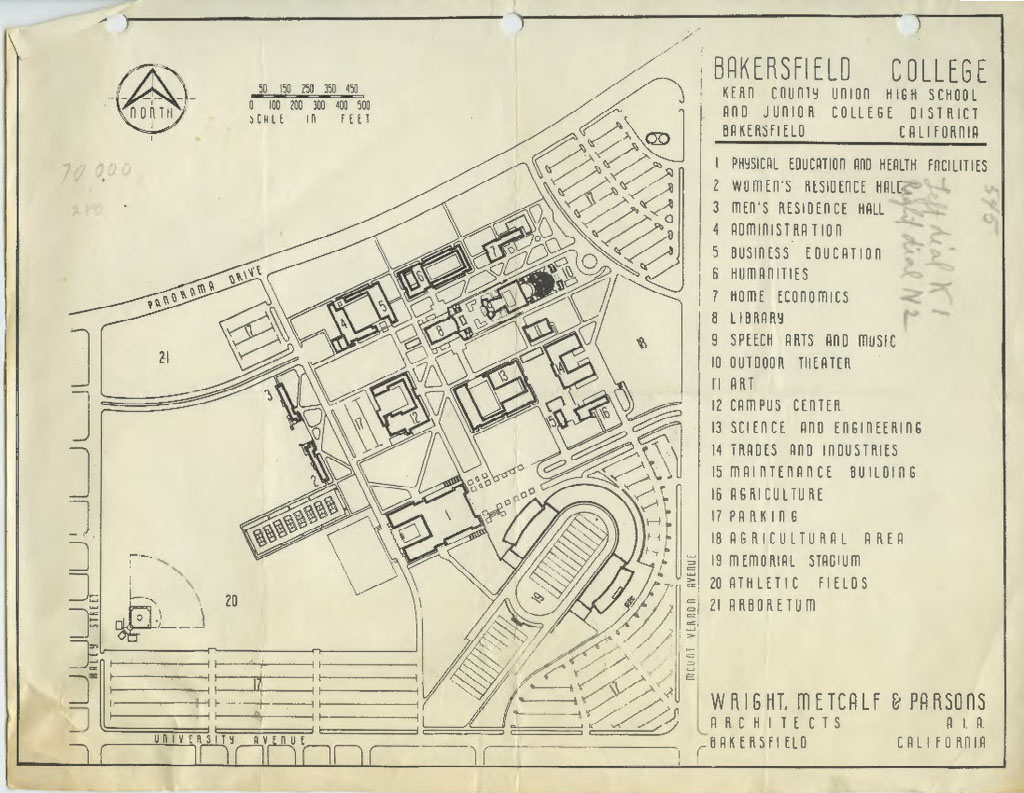
 

Bakersfield College: BAKERSFIELD COLLEGEKERN COUNTY UNION HIGH SCHOOL AND JUNIOR COLLEGE DISTRICT BAKERSFIELD, CALIFORNIA A legend lists campus facilities numbered 1 through 21: Physical Education and Health Facilities Women’s Residence Hall Men’s Residence Hall Administration Business Education Humanities Home Economics Library Speech Arts and Music Outdoor Theater Art Campus Center Science and Engineering Trades and Industries Maintenance Building Agriculture Parking Agricultural Area Memorial Stadium Athletic Fields Arboretum Map features include: North arrow with compass symbol labeled “NORTH” Scale in feet (marked 0–500) Panorama Drive (top left) Mount Vernon Avenue (right side) University Avenue (bottom) The site plan shows a central academic core with multiple rectangular building footprints connected by walkways. The large oval Memorial Stadium (19) appears prominently at lower right with adjacent athletic fields (20). Parking areas (17) surround portions of the campus. An agricultural area (18) and arboretum (21) are also indicated. Bottom right credit line: WRIGHT, METCALF & PARSONS ARCHITECTS A.I.A. BAKERSFIELD, CALIFORNIA
Wright, Metcalf and Parsons, “Bakersfield College,” Clarence Cullimore Collection, Circa 1954

East Bakersfield was once an area with a high concentration of “White Only” Neighborhoods


The image shows a contemporary street map of central and east Bakersfield, California, with neighborhood and landmark labels. Overlaid on the map are green outlined shapes indicating identified racially restricted subdivisions. One area near the lower left center is shaded red and labeled:LAKEVIEW Mayflower Addition (Bla… (text partially visible) Visible place and landmark labels include: Kern River Bakersfield College Lowe’s Home Improvement Highland High School Panorama Dr Fairfax Rd Manor St River Blvd La Cresta Drury Annex Heights Drury Tract Drury Add Bakersfield Country Club Oswell St Hillcrest Niles St Edison Hwy Potomac Park Oakridge E California Ave Washington St Union Ave Pyrenees Cafe Mercado Latino Walmart Neighborhood Market Kayandee Tyner Homes WoodSpring Bakersfi… (partially visible) Highway 178 Highway 204 Highway 58 The green outlines appear across multiple neighborhoods, including La Cresta, Drury Annex Heights, Hillcrest, Potomac Park, and areas east and southeast of central Bakersfield. The red-shaded Lakeview / Mayflower Addition area stands out distinctly from the green-outlined tracts. The map visually overlays historically documented racially restricted subdivisions onto the modern street grid of Bakersfield. If you would like, I can also prepare a research-focused version that explains how the overlay relates to recorded restrictive covenants in your database
Green Blocks (White Only) Red Block (Black Only) View Racially Restricted Interactive Map


STREET MAP OF BAKERSFIELD and vicinity J.R. Thornton, County Surveyor KERN COUNTY, CALIFORNIA. MAY 1939. The map displays the city grid of Bakersfield and surrounding areas as of 1939. Visible geographic and street labels include: Kern River Golden State Highway A.T.&S.F. Ry. Southern Pacific R.R. California Avenue Chester Avenue Truxtun Avenue Brundage Lane Panorama Drive Union Avenue Niles Street Baker Street Bernard Street Oak Street Beale Avenue East Bakersfield Kern County Hospital An alphabetical street index appears in the upper right portion of the map listing numerous streets, including (partial visible list): A Street Acacia Ave Adams Street Alta Vista Drive Arvin Road Baker Street Bank Street Beale Avenue Bernard Street Brundage Lane California Ave Chester Ave Elm Street F Street Golden State Ave Grace Street H Street Jefferson Street Kentucky Street Lincoln Street M Street Main Street Maple Avenue Niles Street Oak Street Panorama Drive Pearl Street Potomac Avenue Truxtun Avenue Union Avenue Virginia Avenue Washington Street The map shows block numbers, parcel divisions, rail lines, canals, cemeteries, schools, and public buildings. Fold lines and aging are visible, consistent with a printed 1939 planning map.

In 1939, development was only in East Bakersfield. There was no real Southwest, West, or North West (like today). There were some colonies in Rosedale, Panama, and Gosford, but not a large urban population. The city ended at Oak and Brundage. After the 1950s, the city started to move SouthWest, West, and NorthWest. Bakersfield was not very diverse.

RACIAL POPULATION (Kern County)Population      Percent White — 213,661   93.58 Negro — 12,530    5.49 Chinese — 685    .30 Indian — 316     .14 Japanese — 236    .10 Other Non-White — 881 .39 RACIAL CONCENTRATIONS (By Communities)        White  Negro  Other Non-White Arvin — 4,964  19  24 *Metropolitan Bakersfield — 92,814  8,020  862 Delano — 7,502  639  576 Mojave — 2,047  8 Shafter — 2,196  6  5 **Metropolitan Taft — 13,148  9  21 Tehachapi — 1,682  3 Wasco — 5,060  514  18 *Bakersfield, East Bakersfield, South Bakersfield, Oildale. **Taft, South Taft, Taft Heights, Ford City. SOURCE: U. S. Census, 1950. Page number: 36
Bakersfield had a small amount of diversity, Kern County was about 93% white. 1956 statistics boolet

We can see some expansions in the West during the Covenant era, but not really until the 1960s. More expansion comes West of Bakersfield after West High was finished in 1965. Kern City was developed between 1961 and 1977 (retirement community in front of West High). Highway 99 divides the city in 1966 (Parallel to Oak/Wible), pushing the traffic and business west, replacing Union Ave as the old 99. 
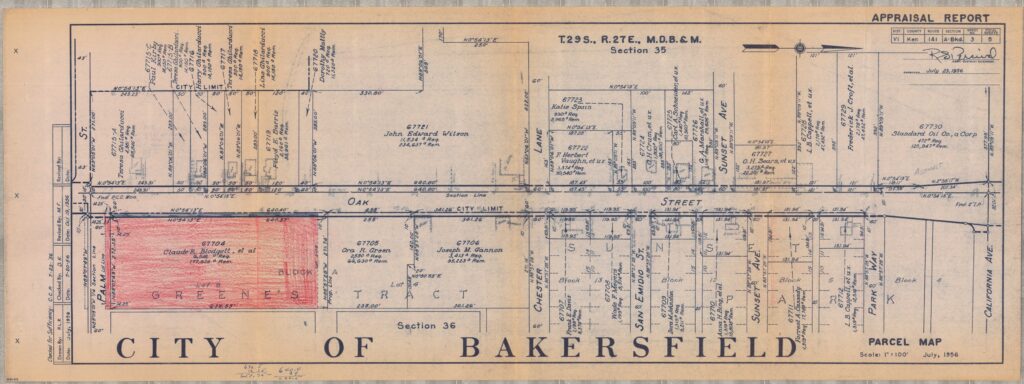
APPRAISAL REPORTTownship and section information: T.29 S., R.27 E., M.D.B.&M. Section 35 Map area label at bottom center: CITY OF BAKERSFIELD Highlighted area label: GREENE’S TRACT Street names visible: Oak Street Palm Avenue Chester Avenue Santa Fe Avenue Edison Highway Sunset Avenue Park Way California Avenue Lane (multiple references) Parcel labeling: PARCEL MAP Scale 1" = 100' July, 1956 City boundary references: City Limit Property and owner names visible (partial examples): Claude B. Rodgers et al. Dr. R. Green Joseph M. McGallon John Bernard Wilson Standard Oil Co., a Corp Lot and block references include: Block G Block H Block K The left portion of the map shows a red-shaded rectangular parcel within Greene’s Tract, bounded by Palm Avenue and Oak Street. The map includes lot dimensions, property lines, and ownership annotations.
Section of Oak St. 10 years before the highway, July 1956. “Oak Street, before Highway 99,” Claude Blodget Collection, 1956

In 1966, the California Highway and Public Works magazine lauded the completion of the Interstate 5 and Highway 99 with no stop signs or lights. Previously, the old highway systems intersected city streets. In Bakersfield, Highway 99 ran through Union Avenue. After the completion, the highway was moved to run stop free parallel to Oak/Wible street. State Route 58 was completed to end at the Brundage and Oak Intersection. Previously State Route 466 was completed through Tehachapi, ending near Bakersfield, and later a freeway was constructed to run parallel to Brundage Lane. The 466 would run to the 99, making it State Signal Route 58. By 1966, the highway system would be complete, lauding, “Look Ma, No Lights!”

The city moves West

The image shows a detailed street map of an area in Bakersfield including Kern City and surrounding neighborhoods.Visible labels include: KERN CITY KERN CITY GOLF COURSE Street names and roads visible: Thunderbolt St Oak Street Bernard St Nordic Dr Florida Drive Valley Drive Ming Avenue Horan Avenue Rickey Way Halsey Ct Hahn Ave Coney Way White Lane Road White Ln Niles Street Edison Hwy Fairfax Rd Union Ave Washington St McCray St Monterey Schools and facilities labeled: West High School Thompson Junior High School Elem School Site Kern County Hospital East Bakersfield High School Commercial areas: Passion Valley Shopping Center Other neighborhood names and landmarks: Lakeview Potomac Park Oakridge Kayandee Tyner Homes Highway markers: 204 58 The map shows parcel blocks, residential subdivisions, school sites, shopping centers, and major roads connecting west and east Bakersfield.
Valley Plaza can be seen in the center of an expanding West Bakersfield in 1970. Economic and Appraisal study of White Lane and Hughes, “Commercial and Multiple Property, Bakersfield.” Claude Blodget Collection 1970

CSUB opened West of Bakersfield, in 1970.

In 1960, the Kern County Superintendent of Schools stated that Bakersfield was the largest isolated metropolitan in the United States to be without a senior college or university. In 1965, the California State Senate approved a proposal to build a higher education campus in Kern County. Kern State College was established, but a location for the college was not selected. The State College was to be the 19th campus in the California State College system, and it was also the only campus within a 100-mile radius to offer a four-year degree.

Senate Bill 75 established the planning of a State College in Kern County. The bill cited a 1959 report recommending a 4-year higher learning institution in the County of Kern. Senator Stiern argued to the California State Senate, “A great number of students would benefit from the addition of a new State College in Kern County since there are no four-year collegiate institutions in this area. College-going students from this area will continue to be isolated until a new campus is opened.” Stiern knew that there was a need for higher education. As an advocate for equal education, the proposed college was also to meet future growth and enrollment rates. In 1963, for every 1,000 students 535 high school graduates were enrolling in a higher education institution in California. This was close to the state average of 559 for every 1,000. With an estimated 3,000 projected enrollment for the new State College. Planning and management were left of the immediate future. The bill established, what would later become California State College Bakersfield and subsequently California State University, Bakersfield. The bill was co-authored by assembly members Williamson and Casey.

Proposed Sites for California State College, Bakersfield

Tejon Ranch was willing to donate 400 acres in the southeast area to build the new college. Situated near Arvin, California, “The White Wolf Grade: stretched between Bakersfield and Tehachapi and would have been a prime location because of the breathtaking view of the mountains and the easy access for commuters to Highway 58.

Another location, offered by George W. Nickel, Jr., was south of the Kern River by Highway 178 just east of Lake Ming Park.

The final location selected for the new college site was offered as a gift by Kern County Land Company. The land was donated to the state of California in 1962 with the express purpose of having a state college campus in Bakersfield. The campus would be situated on a 370-acre site in southwest Bakersfield on Stockdale Highway, approximately five miles west of central Bakersfield.

The Stockdale location was the only site to offer adjacent housing and development support. The maps presented to building the site had listed churches, industrial districts, a high school, and new housing by the Stockdale Development Corporation.

The image is a historic planning map titled “Stockdale Vicinity Map,” dated November 1966 and drawn for the Stockdale Development Corporation. The map depicts a large area of southwest Bakersfield and surrounding land divisions.Major features include the Kern River running across the upper portion of the map and a large shaded area labeled “California State College” to the west of the developed city grid. The city street grid of Bakersfield appears on the right side, with labeled features including West High School, Kern City, and other neighborhood sites. Large numbered land sections (such as 6, 8, 9, 10, 14, 15, 16, 17, 18, 31–35) divide the map into parcels. A red-outlined irregular shape near the center highlights property associated with the Stockdale Development Corporation, while a green boundary line indicates land owned by the Kern County Land Company, as noted in the legend under “Zone of Influence.” Transportation features include rail lines (A.T. & S.F. R.R. and S.P.R.R.), canals, and major roads. A compass rose and scale in feet appear in the upper left corner. The map presents a mid-20th-century development overview of the Stockdale area and its relationship to the emerging California State College campus and surrounding subdivisions
1966 Map proposing University and housing West Bakersfield

The college becomes a reference for urban investment.

The image shows a cropped portion of a typed document with the heading:“STATE COLLEGE INFORMATION:” The text explains that the impact of the community’s residential growth is expected to increase with the opening of a new state college in the city of Bakersfield. It states that the campus is a 375-acre tract located five miles west of central Bakersfield. The document notes that operations are expected to begin in 1970 with an approximate enrollment of 1,300 units, and references previously predicted enrollment figures. The document appears to be a planning or development report discussing projected population and educational growth related to the establishment of the state college.
Economic and Appraisal study of White Lane and Hughes, “Commercial and Multiple Property, Bakersfield.” Claude Blodget Collection 1970


Coming into a Modern East Bakersfield

In 1988, the East Hills Mall opened; it subsequently was demolished in 2021. The East Hills Mall’s failure signifies the development pivot to the Northwest, West, and Southwest. This is also the period of rapid growth of Hispanic and Black communities in East Bakersfield, outside of Mayflower and Sunset. By 2020, East Bakersfield had Hispanic-dominant areas. Some are now predominantly Hispanic. East Bakersfield was the first site of a Hispanic grocery supermarket, Pro’s Ranch Market, opening in the 2000s at the intersection of Mt. Vernon and Niles Street. Now, there are Superior Grocery stores, Vallarta Grocery stores, and many smaller markets that have opened as they see Hispanic residents as stakeholders in cultural investment, including ethnic foods. Most recently, a Vallarta Grocery store opened on Rosedale Highway, a predominantly white area, and in the same parking lot where there was a confrontation between Alt-Right Supporters of former President Trump and anti-trump activists. The most recent investment in the Southwest has been Vallarta’s announcement of a new proposed grocery store at the intersections of Panama and Old River, where new homes are under development with prices advertised right below $500,000. This represents Hispanics at the pinnacle of investment, where chains and Hispanic serving stores see Latina/o/x as stakeholders in areas that are not at the poverty or affordable new construction income level.  

Prior to the rise of Hispanic supermarkets, Mercado Latino opened on April 10, 1994, at California and Chamberlain Avenues. Mercado Latino is a diverse shopping area where small business owners rent a storefront and sell inside and outdoors in the building area. Previously, the building had been an Aaron’s Home Center. The original Mercado Latino was a grocery store with sublet space for independent merchants. Merchandise included tools, music, balloons, decorations, shoes, clothes, jewelry, and Mexican food. April 2024 will be its 30th anniversary.  
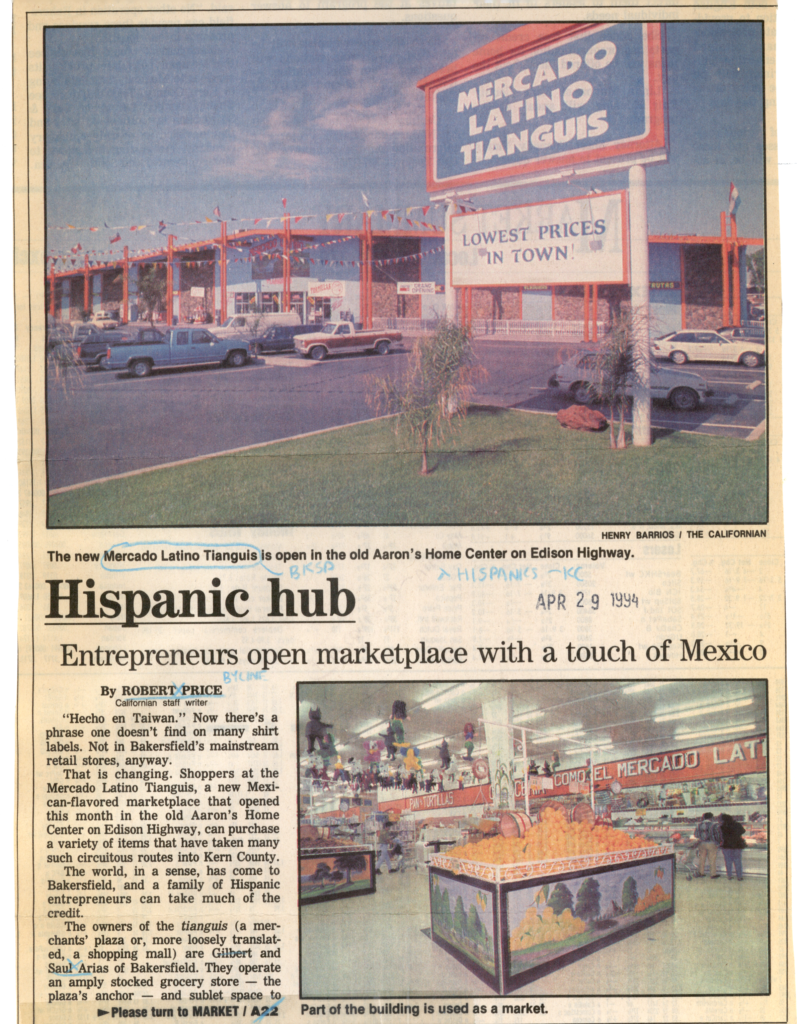
 

Mercado Latino: By ROBERT PRICECalifornian staff writer Article text (visible portion): “‘Hecho en Taiwan.’ Now there’s a phrase one doesn’t find on many shirt labels. Not in Bakersfield’s mainstream retail stores, anyway. That is changing. Shoppers at the Mercado Latino Tianguis, a new Mexican-flavored marketplace that opened this month in the old Aaron’s Home Center on Edison Highway, can purchase a variety of items that have taken many such circuitous routes into Kern County. The world, in a sense, has come to Bakersfield, and a family of Hispanic entrepreneurs can take much of the credit. The owners of the tianguis (a merchants’ plaza or, more loosely translated, a shopping mall) are Gilbert and Saul Arias of Bakersfield. They operate an amply stocked grocery store — the plaza’s anchor — and sublet space to” (Article continues beyond visible portion.) Lower photo caption: Part of the building is used as a market. Handwritten notation visible on page: APR 29 1994
Robert Price “Hispanic Hub,” Bakersfield Californian, 4-29-1994

 Current: Diverse East Bakersfield 

The image shows a regional map titled “AFFH – 2.0.” It depicts census tracts in and around Bakersfield shaded to represent racial segregation and integration patterns based on 2020 data.According to the legend: Light yellow indicates racially integrated tracts. Tan or light brown indicates low-to-medium segregation. Dark red indicates high segregation of people of color. Light green indicates high White segregation. Gray areas indicate no data applicable to 2021 census tract boundaries. The central city area shows a mix of low-to-medium segregation and high POC segregation, particularly in portions of south and east Bakersfield. Some northern and outlying areas are shaded light green, indicating high White segregation. Several tracts appear racially integrated in scattered areas near the city center and western neighborhoods. The map includes tract boundary lines, major roadways, a scale bar in miles and kilometers, and data attribution noting “Racial Segregation/Integration (OBI, 2020) – Tract,” with a timestamp of September 23, 2024. If this is for an AFFH report or housing equity analysis, I can also provide a more policy-focused description highlighting spatial patterns and disparities without interpretive language.
Affirmatively Furthering Fair Housing Data and Mapping Resources

 A place of less economic opportunity

The image shows a regional map titled “AFFH – 2.0.” It displays census tracts across the Bakersfield area and surrounding communities, outlined in black and shaded in varying colors to represent economic opportunity scores.According to the legend, red areas (0–0.2) indicate less positive economic outcomes. Orange areas (greater than 0.2–0.4) and light yellow areas (greater than 0.4–0.6) represent moderate scores. Light green (greater than 0.6–0.8) and dark green (greater than 0.8–1) indicate more positive economic outcomes. The map includes major roads and city boundaries. Central Bakersfield shows a mix of red, orange, and yellow tracts, while many western and some northern areas are shaded dark green. Some eastern and outlying areas appear red or orange. Text at the bottom identifies the source as “COG Geography TCAC/HCD Opportunity Map – Economic Score (HCD, 2023) – Tract,” with a timestamp of September 23, 2024. A scale bar in miles and kilometers appears in the lower right corner, along with attribution to mapping data sources.
Affirmatively Furthering Fair Housing Data and Mapping Resources

Residents of East Bakersfield want investment

The image shows a screenshot of an online news article from Eyewitness News. The headline reads: “East Bakersfield residents frustrated over lack of big-brand businesses.” The byline credits Leslie Valle, with publication and update times listed as June 21, 2023.Below the headline is a large video thumbnail image showing a storefront window with bold black lettering that reads “OPENING SOON” and “OPENING 8 DAYS” partially visible. A play button icon appears centered on the image, indicating embedded video content. To the right are smaller preview images labeled “View All Photos.” A caption beneath the image states that Chick-fil-A’s grand opening announcement for a second Bakersfield location is sparking controversy, with many questioning why there are not more big businesses in east Bakersfield. The station identifiers KBAK/KBFX are included.
East Bakersfield residents frustrated over lack of big-brand businesses